TSUBA COLLECTIVE & GAKKO
TSUBA COLLECTIVE & GAKKO
IRON TSUBA --> AKASAKA ~ BUSHU/CHOSHU ~ GOTO ~ HARUSADA ~ HAYASHI MATASHICHI ~ HAZAMA ~ HEIANJO ~ HIGO ~ HIRATA HIKOZO ~ HOAN ~ JAKUSHI-HIZEN ~ KAGA ~ KAGAMI-SHI ~ KAMAKURA-BORI ~ FUKANOBU KAMIYOSHI ~ KANAYAMA ~ KANEIYE ~ KINAI/AKAO ~ MINO ~ MITO ~ MYOCHIN ~ NAGOYA ~ KO-NARA & NARA ~ NISHIGAKI KANSHIRO ~ NOBUIYE ~ ONIN ~ OWARI to MIKAWA ~ SADAHIRO ~ SADAYUKI ~ SADO ISLAND ~ SANKEI ~ SAOTOME - TEMBO ~ SHIMIZU (Jingo) ~ SHOAMI ~ SHOKOKU ~ SOTEN ~ SUKASHI ~ SURUGA ~ TACHI KANAGUSHI ~ TANKO (KATCHUSHI & TOSHO) ~ UMETADA ~ YAMAKICHIBEI
SOFT METAL (KINKO) TSUBA --> HAMANO ~ HARUAKI ~ HIROAKI ~ JOEI ~ JOI ~ KANRI ~ KIYOSADA ~ KO-KINKO ~ MITSUNAGA ~ MOTOTADA ~ NAGATSUNE ~ NAOMITSU ~ SEKIBUN ~ SHIGENORI ~ SOCHI ~ TOMIHISA ~ YASUCHIKA
KODOGU-DO Told by Robert E. Haynes in five parts. |
|
ROBERT E. HAYNES & ELLIOTT D. LONG |
 |
Robert and I are merely the temporary caretakers of the pieces we collect. Whether this ownership lasts a minute or a lifetime, our responsibility is to care, respect, appreciate and enjoy these treasures everyday so that, in turn, future collectors are afforded that same opportunity. We have bought and sold many pieces in our life and consider ourselves very lucky and truly rich to have been guardians to so many wonderful treasures.
As students of fittings, and at our respective points in life, our goal is to enhance our collections as our knowledge and expertise continues to grow. Thus one purpose of the web-site is to sell pieces we have studied. Since establishing our relationship in 2005, we are proud to have assisted many collectors in their pursuit.
What about appraisal? We are always glad to share our knowledge and help anyone learn about the fittings, etc. that they own. Looking at koshirae and related items increases our knowledge and there is no substitute for research as a learning tool. Thus we gladly help people at no charge or obligation.
Please continue to enjoy this web-site. It is intended to be an all-encompassing text on Japanese Bijutsu and related items. Hopefully, it will present enough information to provide basics and lead to more in depth discussions on specific subjects or about specific fittings, etc. We look forward to hearing from anybody and everybody about this most interesting of subjects.
It is important to understand the concept of the Tsuba, as well as its development in form and function. The Tsuba is counterbalance to the Sword Blade in many levels of understanding. The Sword Blade is aggressive, destructive, offensive in purpose. It is used for attack and destruction. It is masculine and active in principle -- pure YANG.
The Tsuba, its counterpart, is defensive, protective, ornamental; its function is to guard and preserve and is feminine in concept and execution -- pure YIN.
Once you grasp this essential difference, you will find that the true beauty of fine Tsuba will have a new value and your appreciation will be greatly enhanced. Once you understand that the Yang and the Yin are essential parts of the whole, you cannot see a Sword Blade without visualizing the perfect Tsuba to compliment it -- nor can you appreciate a great Tsuba without mentally equating a fine Blade that would compliment the Tsuba.
The two become one, and that is ZEN.
It has been since 2004 being a student of tsuba that I now have a pre-eminent authority as my mentor, through the books and guidance of Robert E. Haynes. With the continuation of study, research, and re-appraisal, the student can now advance his knowledge to a higher level. It is now possible for a greater bond to be formed, giving all students equal exchange of ideas, theories, and information. The re-evaluation of old ideas, the new research; which has proved and disproved old theories, is now common knowledge.
The analytical research needed to fully understand this subject has been applied by only the last three generations. Mr. Akiyama Kyusaku adopted an organized research method toward the end of the 19th century. Carrying forward this study was his last student, Dr. Kazutare Torigoye. Dr. Torigoye refined and re-appraised the research of his teacher in light of a lifetime of study. Finally, in 1961, Robert E. Haynes had the great privilege of being Dr. Torigoye’s student at his home in Okayama, Japan. It is possible under the guiding hand of a great teacher to learn the basic principles, which would take years of unassisted self study. In the area of judgment alone the teacher and student relationship is vital to a comprehensive knowledge of the basic fundamental value of the tsuba. I can only hope that with my continued visits with Robert E. Haynes and the information he is passing on, my knowledge of the tsuba will prosper.
I will close with a most sincere welcome to all students of the tsuba, and I hope they may find some small benefit to their scholastic understanding of tsuba through this chapter of my website.
The art of the tsuba was developed as an independent branch of the sword art. Considering the great interest that tsuba has engendered through my collecting since 2004, it is of interest that the most reliable literature was produced in the 20th century. The following books have been my recent textbooks for scholastic and perceptive understanding along with the periodic studies with Robert E. Haynes.
TSUBA, An Aesthetic Study by Dr. Kazutaro Torigoye and Robert E. Haynes.
ROBERT HAYNES AUCTION CATALOG's
by Robert Haynes, LTD.
Hompo Soken Kinko Ryakushi (A Brief History of Japanese Sword Fittings Artisans) by Wada Tsunashiro.
The Index of Japanese Sword Fittings and Associated Artists by Robert E. Haynes.
Tsuba Kanshoki by Dr. Kazutaro Torigoye.
Japanese Sword-Mounts In the Collection of the Field Museum by Helen C. Gunsaulus.
Additional References Noted Below.
TSUBA IDENTIFICATION
SUKASHI TSUBA ARTICLE.
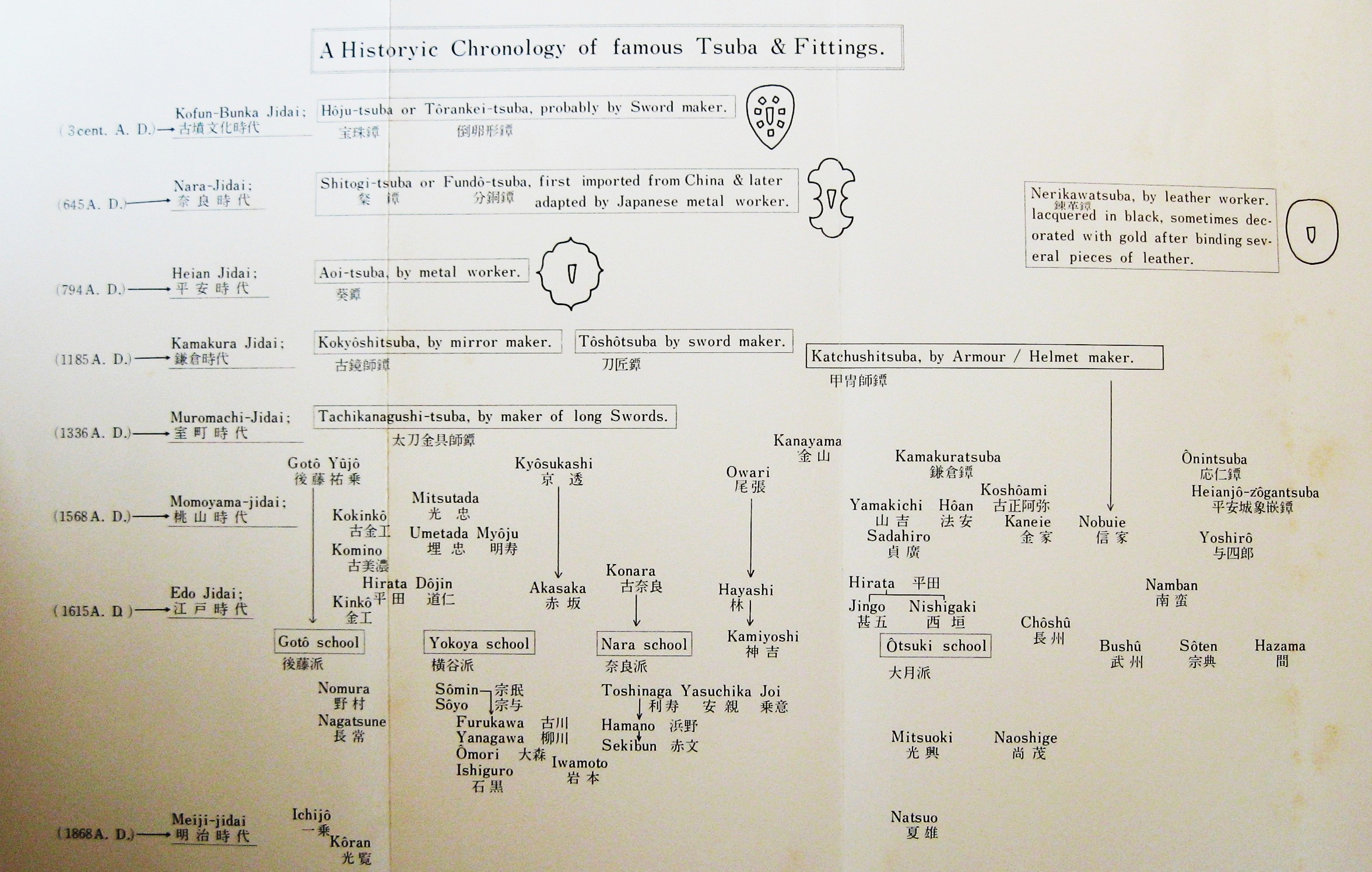
from TOSO SORAN by Dr. Torigoye
| If you would like to know more about any items on this website, or if you are considering a purchase, please send Elliott and Robert an E-MAIL ( elliott@shibuiswords.com ), asking us any questions you have or what pieces interest you. |
TANKO (KATCHUSHI & TOSHO)
TANKO
- Robert Haynes has proposed the term "Tanko" for these early iron tsuba. He sites Joly's manuscript translation of the 1913 publication 'Hompo Soken Kinko Ryakushi' by Wada Tsunashiro. Included there is a line "The tsuba makers are tanko". (Nelson's kanji 4895:1451) This compound basically means metalworker, and seems quite appropriate.
From the Meiji and Tensho eras
(1868-1926) into the beginning of the Showa era (1926-1935) Ko-Katchu-shi
tsuba were already properly evaluated by those who
appreciated them; however, there were few who had much interest in Ko-Tosho tsuba. Even among early tsuba, they had come to be seen as trifling. However,
recently, perhaps from an appreciation point of view, opinions have changed and
the fact that the true value of Ko-Tosho seems to
have been recognized is greatly heartening.
There are the Ko-Tosho,
Ko-Katchu-shi, Onin and
Kamakura type tsuba, and although from the viewpoint
of designation, there is no term for the Ko-Katchu-shi style ita-tsuba that have lively negative silhouette piercings (mon-sukashi), an
entire surface that has been worked with a punch in nanako
style and works that give an impression that is not particularly high, due to
the number of these shared features, I believe they are in the same group.
Excluding the exceptions, the standard Ko-Katchu-shi
works are large sized with a height of around three sun.
The construction is thin and the negative silhouette designs closely resemble
those of the other types. Because of the large size of these tsuba, we can deduce that they were put on uchigatana
with blade lengths of around three shaku. It is
probable that the thin construction and piercings were to keep the weight of
these tsuba down. In addition, when we
take the period into consideration, there were the warriors who
wore koshigatana or short uchigatana
fitted out as tachi. Thus, it is probable that Ko-Katchu-shi tsuba were used on
the uchigatana of those who were on foot, such as ashigaru, who were a social class that could not wear tachi. I think that when a warrior on foot challenged a
mounted warrior it would be necessary to have a sword of such a long length.
The period from which such individuals participated in warfare was after the
Mongol invasions of 1274 and 1281 during the later half of the
The
uchigatana of this class of individuals from the Heian period (794-1185) to the middle
Furthermore,
Ko-Tosho tsuba, which are
from about eight hundred and fifty years ago, and Ko-Katchu-shi,
which are from about four hundred and fifty years ago, occupy a period of
history which I believe arouses great interest. Beginning with the great
simplicity of the Ko-Tosho tsuba,
the KoKatchu-shi and then the
I believe that those tsuba that are called Ko-Tosho are not entirely all made by swordsmiths.
Moreover, I think we can say the same thing about Ko-Katchu-shi
tsuba. Nonetheless, the sensation one receives from
these works and the feelings invoked by the terms Ko-Tosho
and Ko-Katchu-shi are absolutely convincing, such is
their persuasive power. As for the use
of "old" (ko ),
I believe that there are a few Ko-Tosho and Ko-Katchu-shi tsuba that have original hitsu-ana (ubu-hitsu-ana).
This is linked to the kozuka and kogai that
existed during this
same period. However,
regarding this, I will just
conclude that I am
convinced such ubu-hitsu-ana exist. Even with ubu-hitsu-ana, there is the balance
of the negative silhouette piercings as well as cases where the filling in of
the space entirely enhances the piece. I believe this has to be tolerated
through an appreciative sense. There is
an opinion that Ko-Tosho
and Ko-Katchu-shi tsuba
were mounted on nagamaki. However, even if there are
exceptions, because of the arrangement of the negative silhouette piercings, they
are said to have been mounted on uchigatana.
(Above translated from
Sasano Asayuki's "Ko-Tosho • Ko-Katchu-shi Tsuba" in the Shoyu -kai's "Tosogu Yuhin Zufu" series)(NCJSC)
The Tosho and Katchushi tsuba are linked together in their history, though the Tosho tsuba was of slightly earlier development. The most important feature to distinguish the Tosho from the Katchushi tsuba is their different method of folding the plate. The Tosho smith turned and hammered his bar of iron several times to achieve his plate. The Katchushi maker followed the same procedure, but after forging the plate the Katchushi would give his plate one or two additional folds. In the single fold the plate was doubled and the weld hammered fast. In the double fold an S curve was formed, hammered flat and welded shut. In the Katchushi tsuba it is possible to see the edges where this final weld joins. It will usually be visible on the web of the plate either near the edge or toward the center of the plate. In the best work this weld is visible as a hair-line or not at all. It is also visible on the walls of any perforations in the Katchushi tsuba. They will appear as fine lines dividing the wall of the perforation into two or three sections, depending on the number of times the plate was folded.
In early Tosho tsuba the designs most commonly found are very simple, such as the sun, moon and stars, or tools. In early Katchushi tsuba the designs are more complex, the most common being animals, plants and flowers. Generally, the Katchushi tsuba is more skillful in most respects than the Tosho tsuba. Surprisingly the quality of the iron is superior in the Katchushi tsuba. Their work is not as naive nor as rough as that of the sword smith.
(from the "Tsuba Geijutso Ko" by Dr. Kazutaro Torigoye)
Read more about the Manufacture, Function and Material of Early Iron Tsuba. This article written by Boris Markhasin of Tosogo Ya.
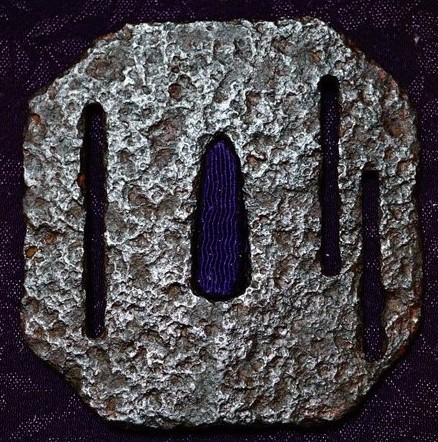 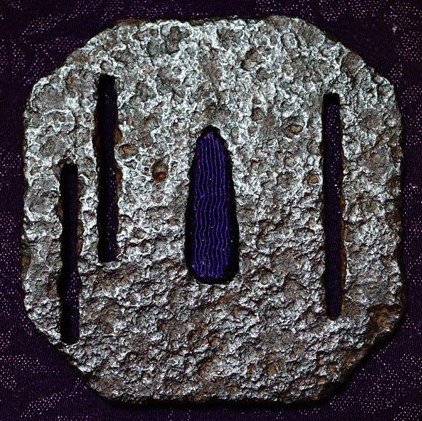 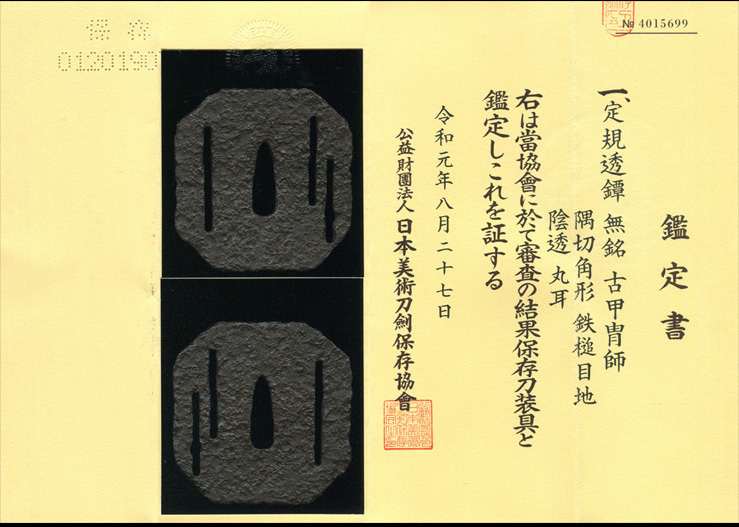 |
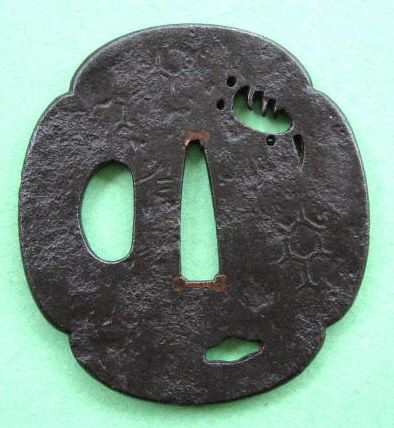
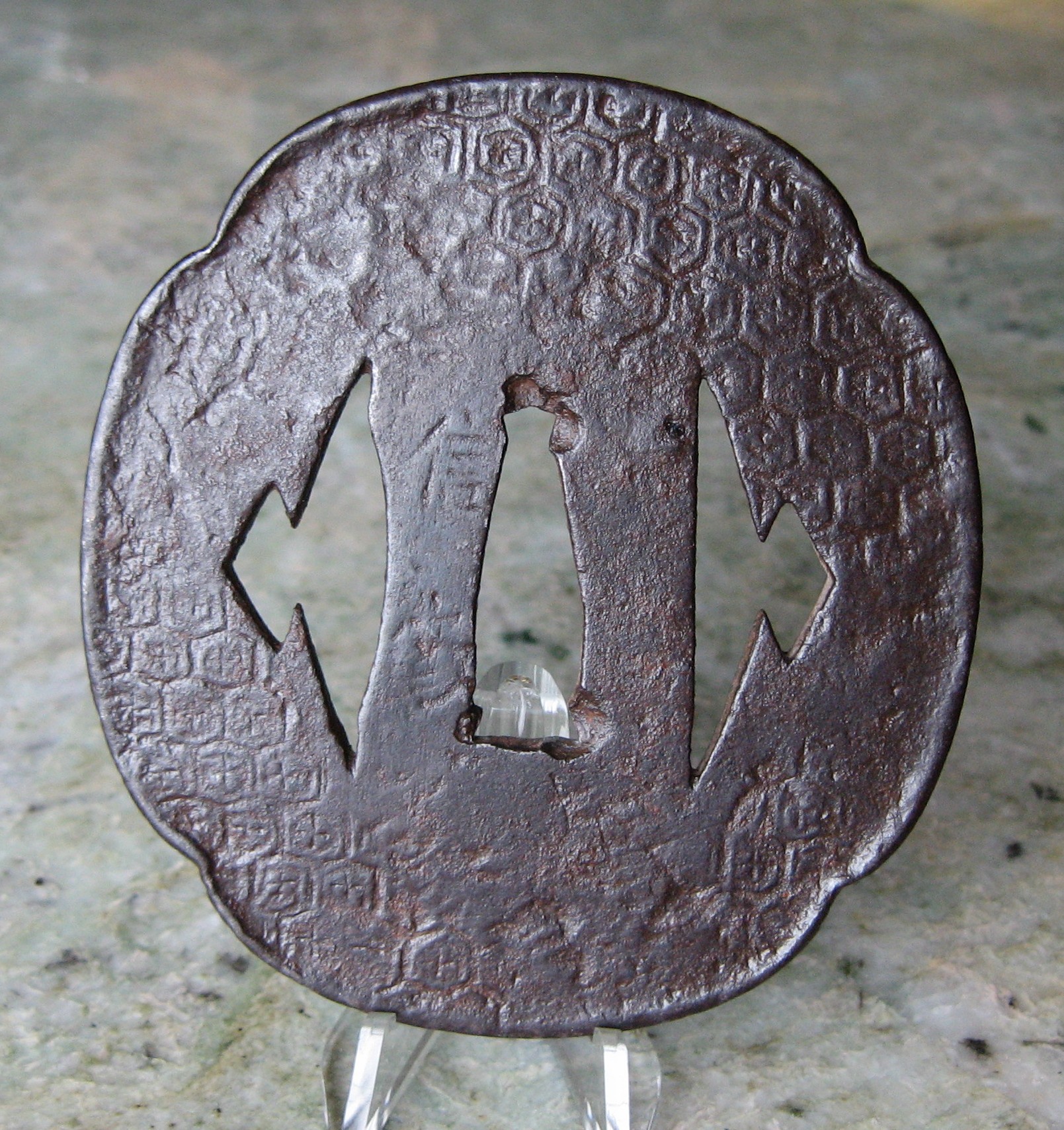
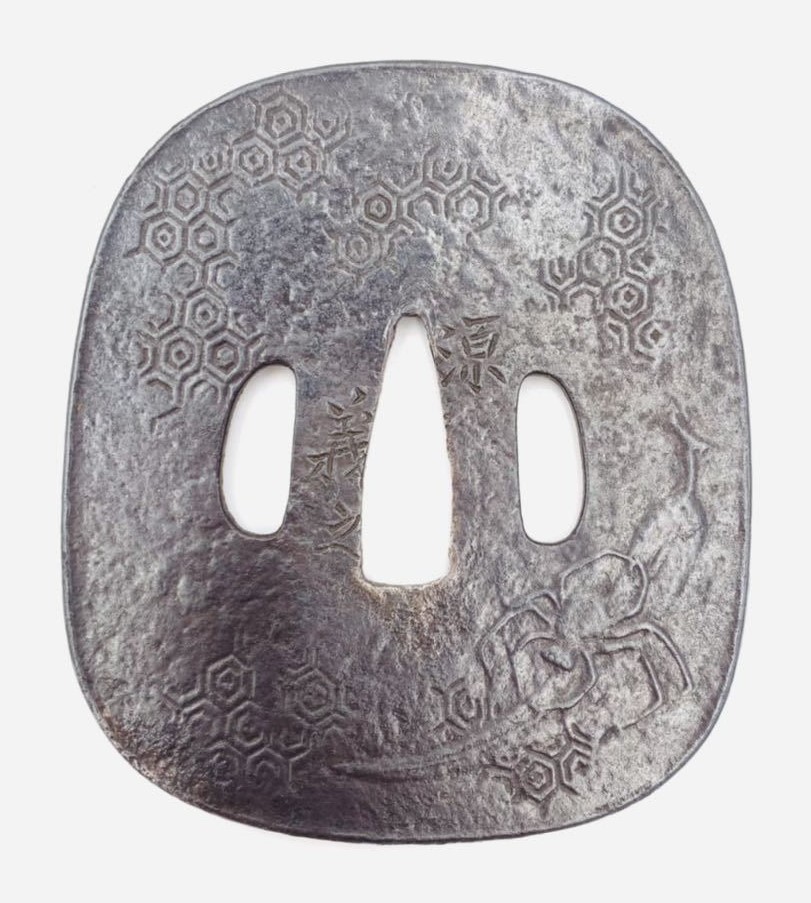
KO - KATCHUSHI $6000.00 "Large square iron plate nicely forged and hammered with excellent patina and color. Further study and description coming soon." (Haynes & Long) |
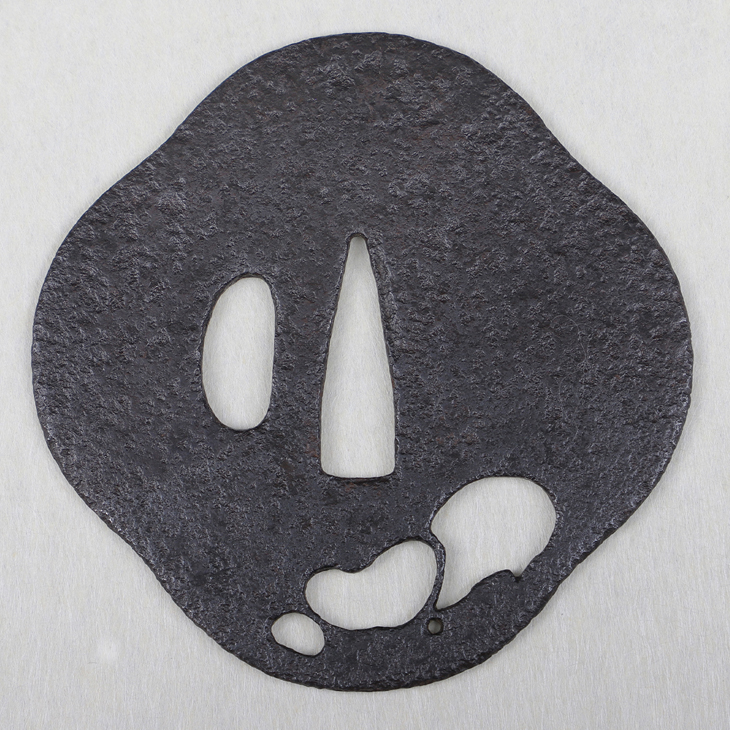 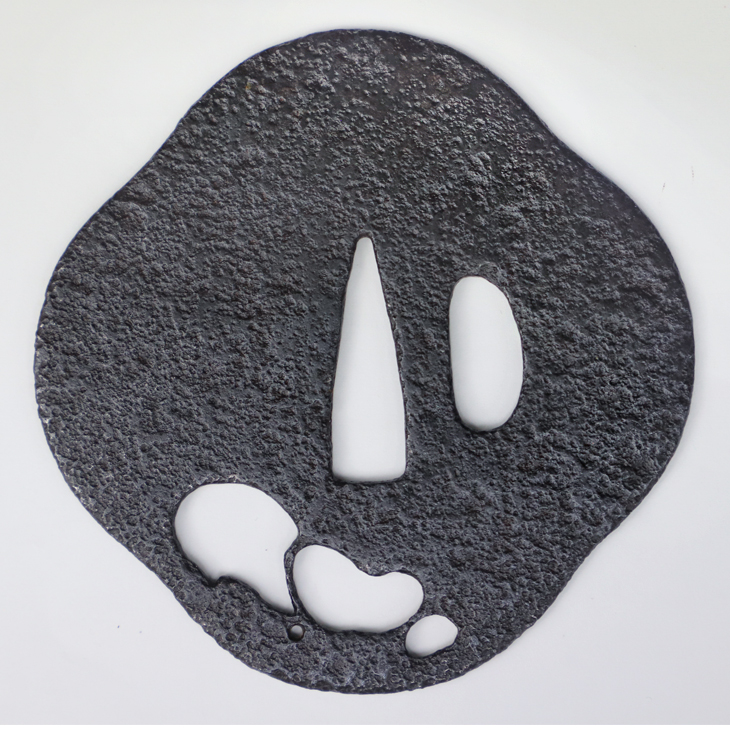 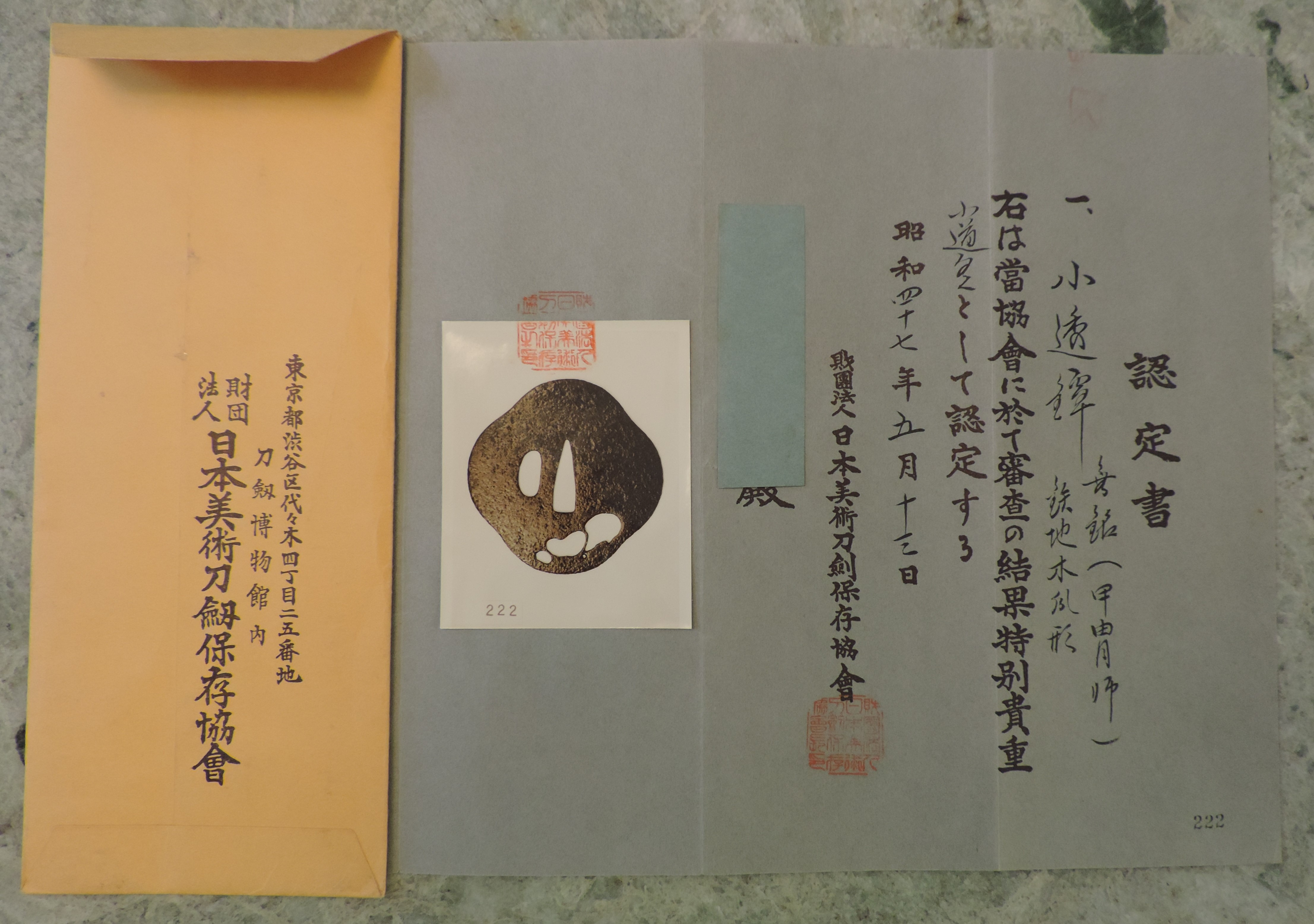 |
KATCHUSHI $1700.00 "Presented here is a well forged iron plate in a gourd shape with Kotoru rounded edge. Both surfaces are expertly hammered. Eggplant sukashi at the lower quarter. This workmanship creates an indescribable atmosphere. Further study and description coming soon Attributed by NBTHK Tokubetsu Kicho (Green) Origami. Dated May 13, 1972." (Haynes & Long) |
 |
KAMAKURA Period Please Contact Us For Price "Mokko gata shape with boars eyes at the corners. The design is powerful, and the iron is rich and strong. The openwork walls extending to the radiant field is chamfered and carefully built. All of this suggests that this guard dates from the Kamakura Period to the early Muromachi period." (Haynes) |
  |
KATCHUSHI Please Contact Us For Price "An iron plate in mokko style shape with noticable yasurime in symetrical order. There are five negative sukashi openings, each of a different representation, which are spaced within everyother yasurime. Only one hitsu is present. The angles and positions of the individual designs add movement to the entire tsuba and enhance the artistic impression sought by the smith. Accompanied by both a N.B.T.H.K 'GREEN' paper and a Hakogaki by Sato Kanzan." (Long) |
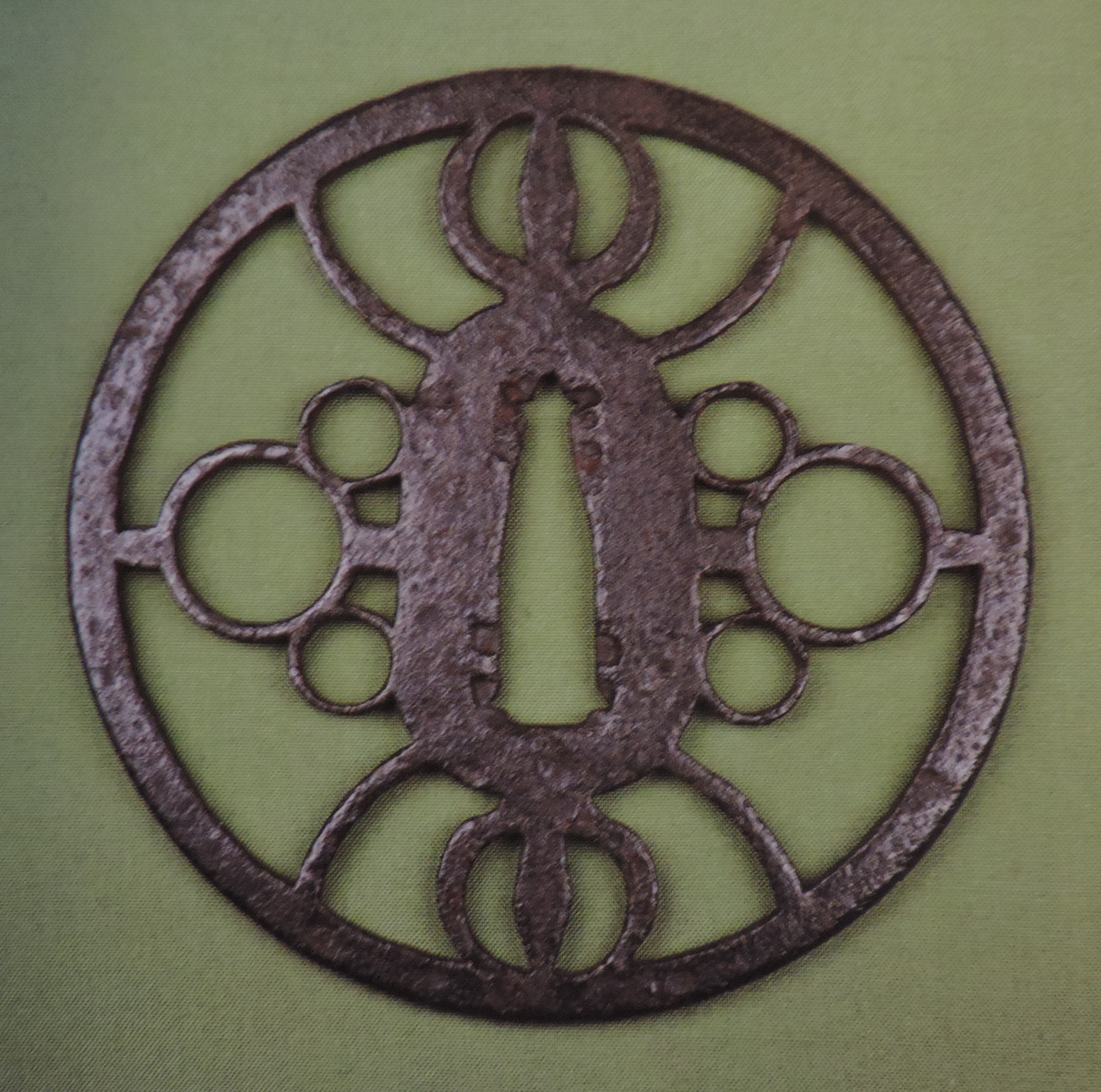 |
KO-KATCHUSHI Please Contact Us For Price "A Ko-Katchushi tsuba with Shakujo (Khakkhara) design. The top and bottom appear to be Mon. Dates to ca. 1300 or earlier." (Haynes) |
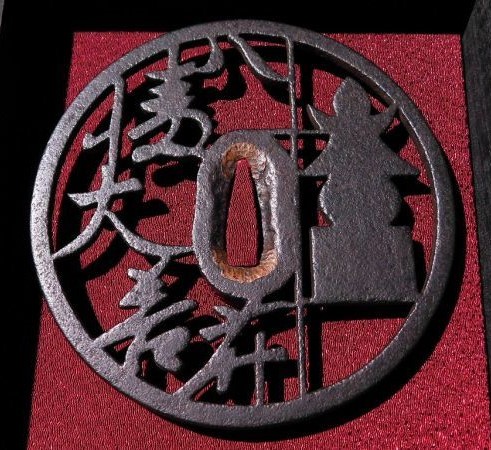 |
KO-KATCHUSHI Please Contact Us For Price "Hachiman Daibosatsu, 5-tiered pagoda motif sukashi tsuba. Maru-gata iron plate with positive sukashi and mimi-kaku. A very skillful, elaborate and extremely sophisticated work." (Haynes) |
  |
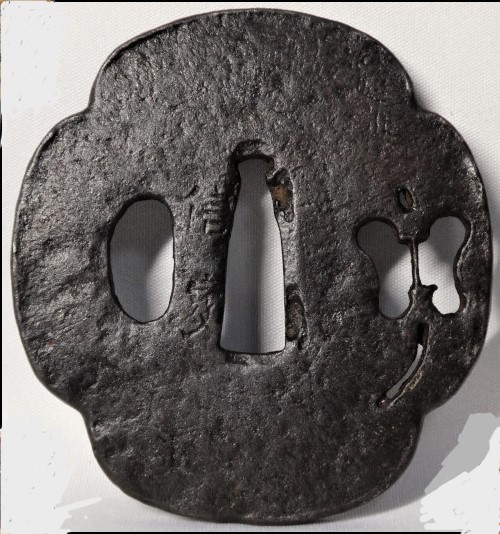
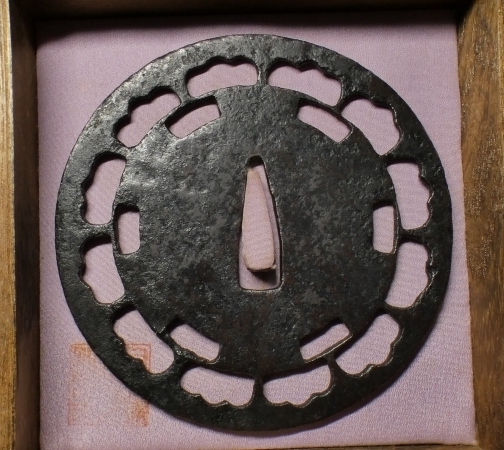
KO-KATCHUSHI Please Contact Us For Price "Sukashi design of partial cherry blossoms, and a gourd. The blossoms with petals missing suggests a change without misfortune. The delicate subject, careful finish and refined iron establishes this tsuba as a work of perfection. Dates to Mid Muromachi period, late 15th century." (Haynes) |
  |
KO-KATCHUSHI Please Contact Us For Price "A Ko Katchushi tsuba with Karigane-Umebachi-Yama design. Both hitsu are present. Muromachi period (15th-16th C.)" (Haynes) |
 |
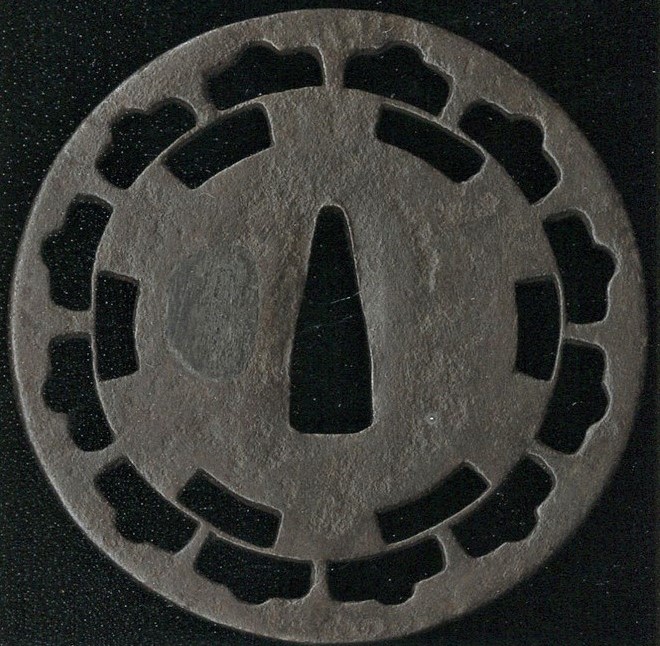
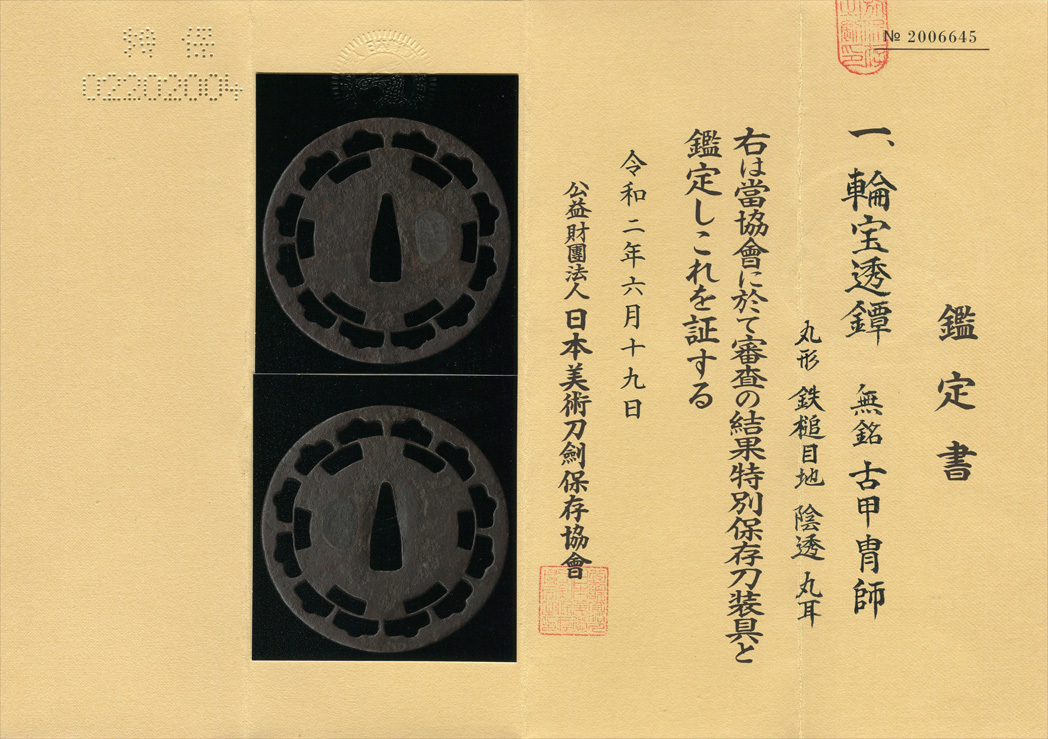
KO-KATCHUSHI $6000.00 Write up coming soon. Ubu iron plate in excellent condition. Dates to ca. 1300 or earlier. (Long) |
  |
KO-KATCHUSHI $5000.00 Write up coming soon. From the Kamakura period to early Muromachi period. |
  |
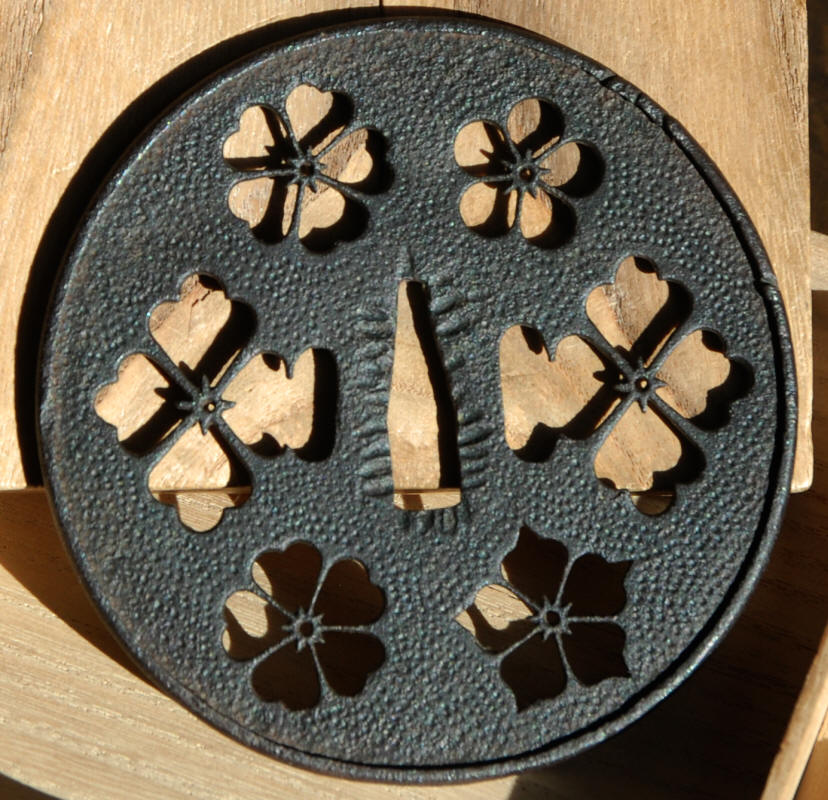
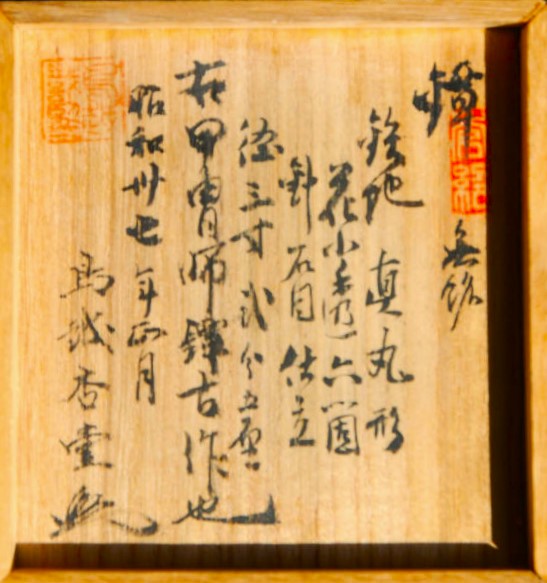
KO-KATCHUSHI Please Contact Us For Price "A very large well forged iron tsuba with designs of turnip and mushrooms. The plate is quite thin at about 0.18cm thick with a 'pipe' rim of 0.50cm that makes a hollow sound when tapped with a fingernail." (Haynes) |
  |
KO-KATCHUSHI Please Contact Us For Price "An early Ko Katchushi tsuba with multiple kirikomi on the rim. There is meaning to having one plum, two cherry and two karabana blossoms as the motif of this piece." (Haynes) |
  |
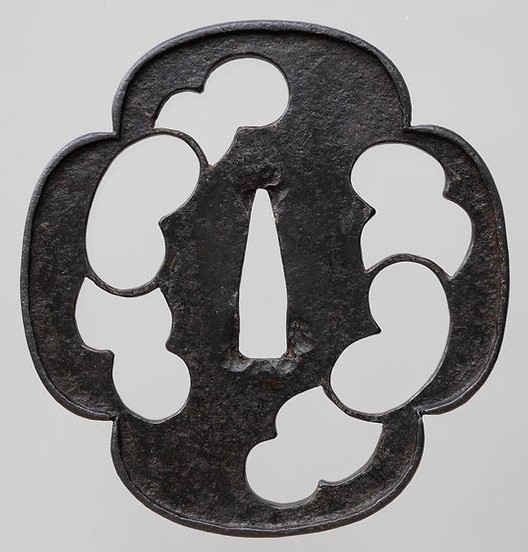
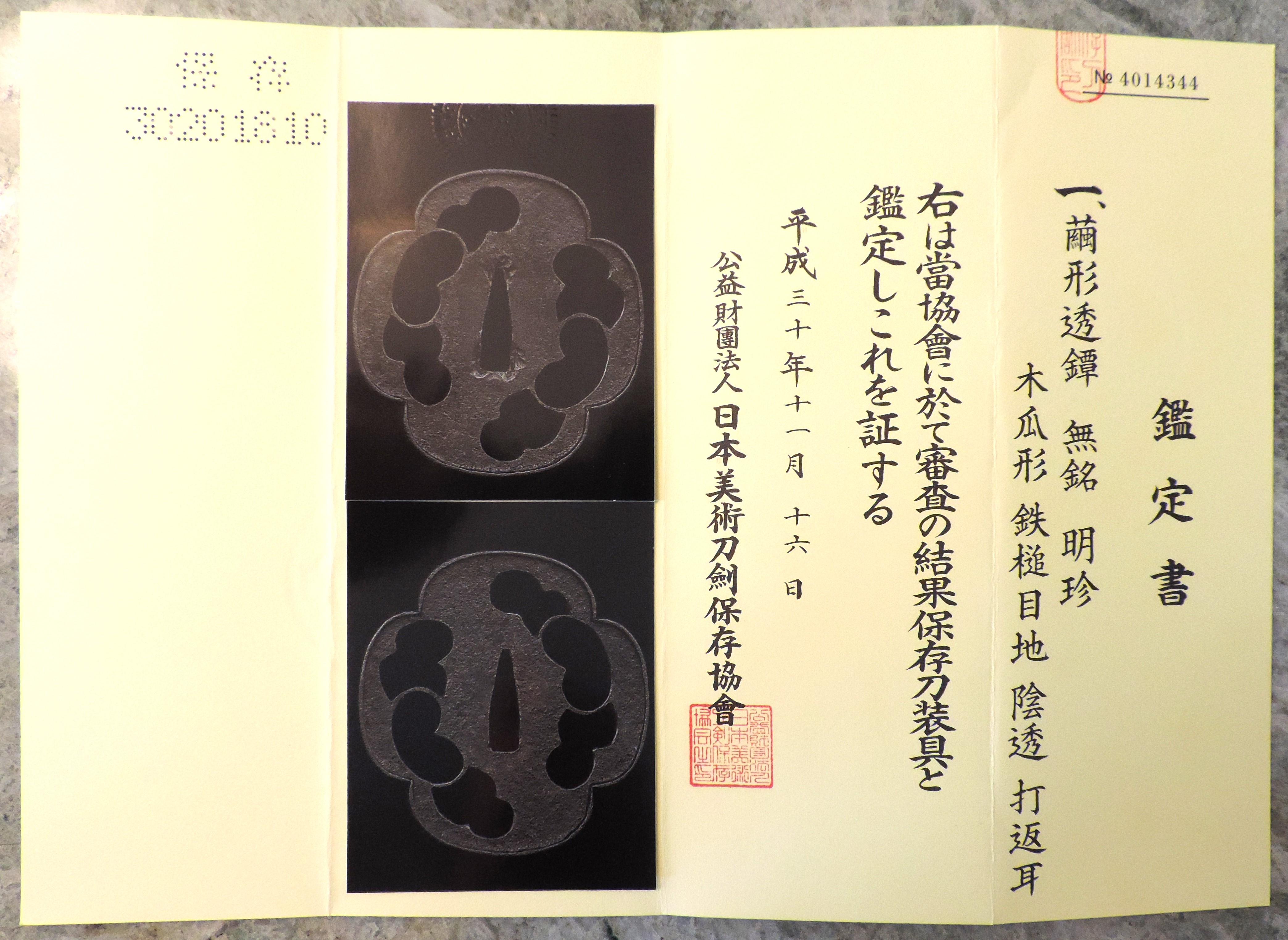
KO-KATCHUSHI Please Contact Us For Price "The strong, softly lustrous metal with small pitted marks on both faces, and the antique-looking chisel marks around the tang hole are all characteristic indications of very early Muromachi work. The original hitsu is the rectangular shaped one, the kogai hitsu added later during mid-Muromachi period. This is a valuable work from the research standpoint." |
  |
KO KATCHUSHI Please Contact Us For Price "The name ``Kacushi'' was given because it resembles the small watermarks applied to the gauntlets attached to armor. The name ``Kachu-shi'' can already be found in the Oshigata collection of Akiyama Hisaku, a master of tsuba appraisal in the Meiji period. In addition, Mr. Daiyuki Sasano named the earlier tsuba, 'kokushi', to distinguish it from the tsuba made by armor makers from the Edo period onwards, who worked on the rims. This tsuba is quite thin and has a mokkogata shape. It is thought to be from around the Bunroku and Keicho eras, and is considered to be the last period in which it was used by old armor makers. Three cocoons are visible on the left and right sides of the precisely tailored flat ground." (Long) |
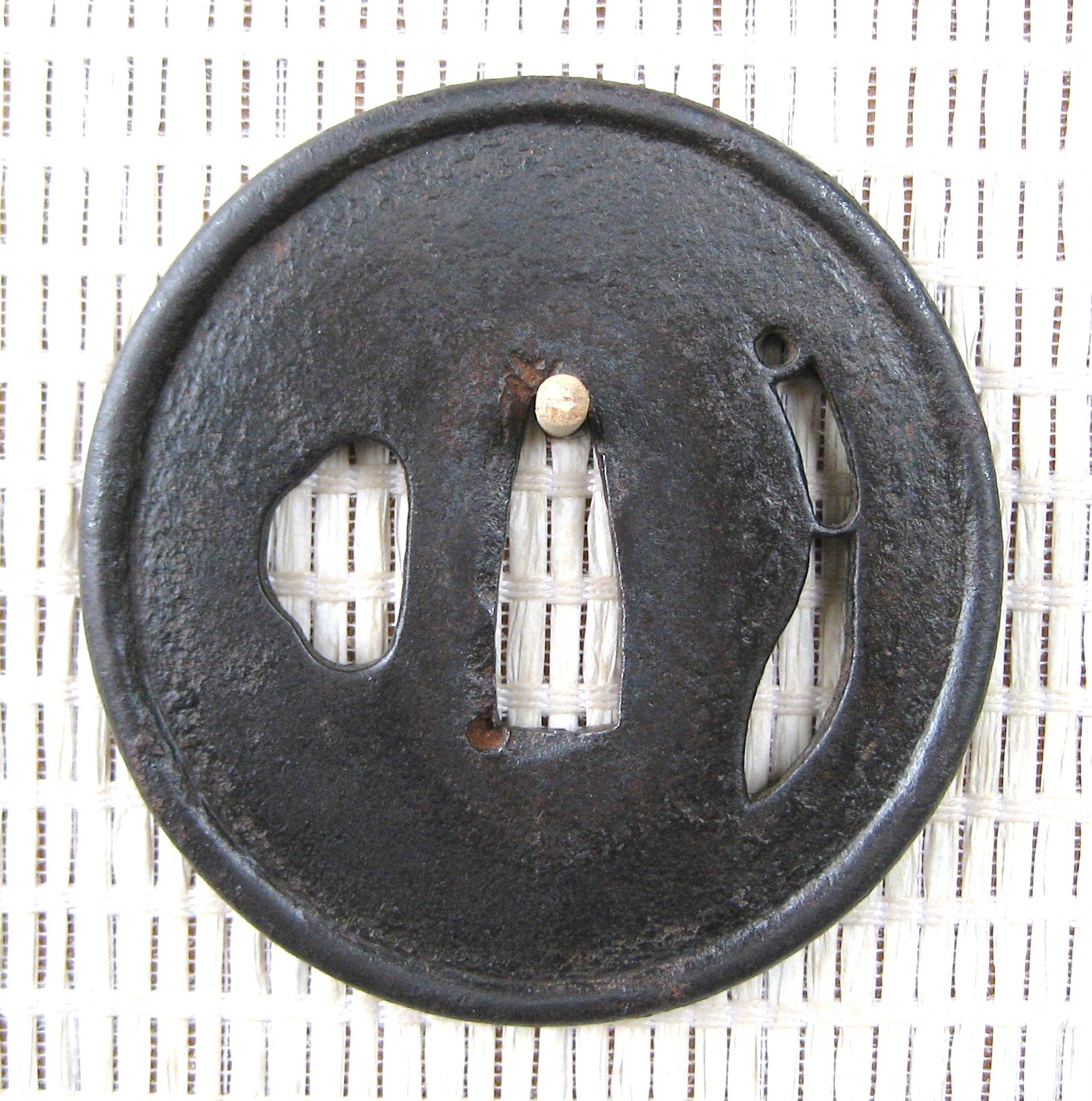 
| KATCHUSHI Please Contact Us For Price "Iron slightly oval plate with pipe rim. The web with sukashi of nata (utility knife) on right side of plate and kogai shape hitsu on the left side. The web area of the plate retains much of the original black lacquer surface, on both sides. Katchushi tsuba with dote mimi (pipe rim) are quite rare, and much sought after." (Long) |
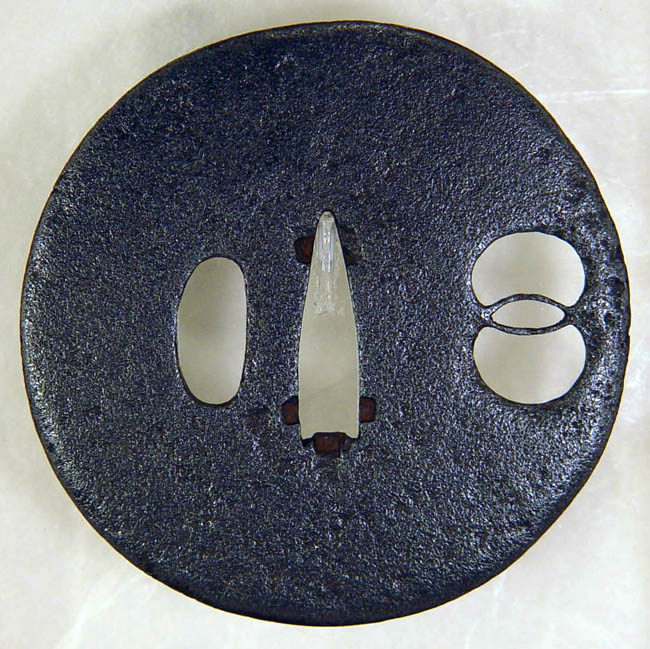  | KO-TOSHO $3000.00 "Very large, powerful Tosho tsuba, nicely forged and hammered with excellent patina and color. The hitsu-ana is original to the tsuba which was made prior to the Edo period. Sukashi of two interlocking rings having a Buddhist symbolism meaning Unity of Strength and Love, Mind and Body. Very important to the Samurai." (Long) |
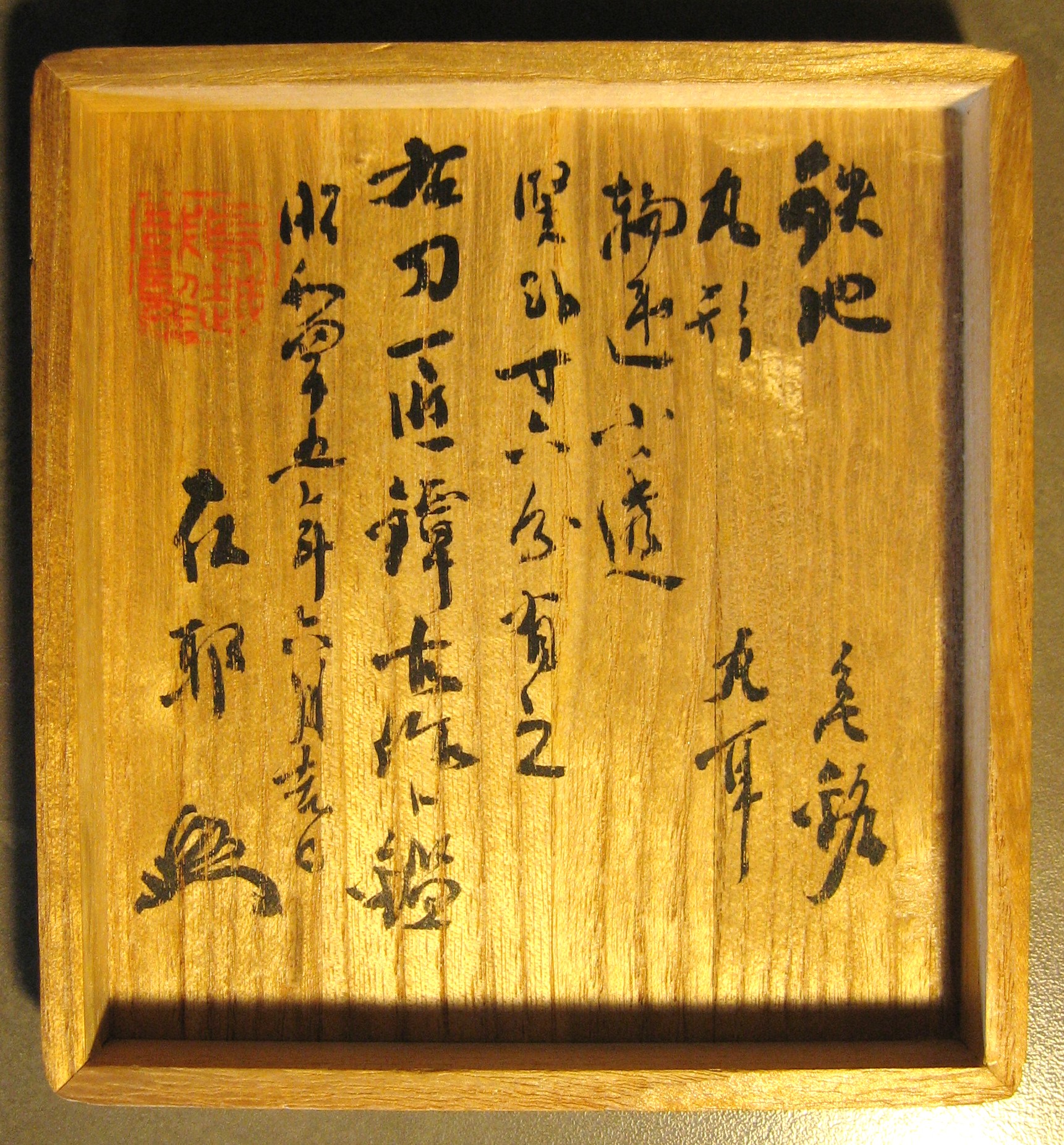
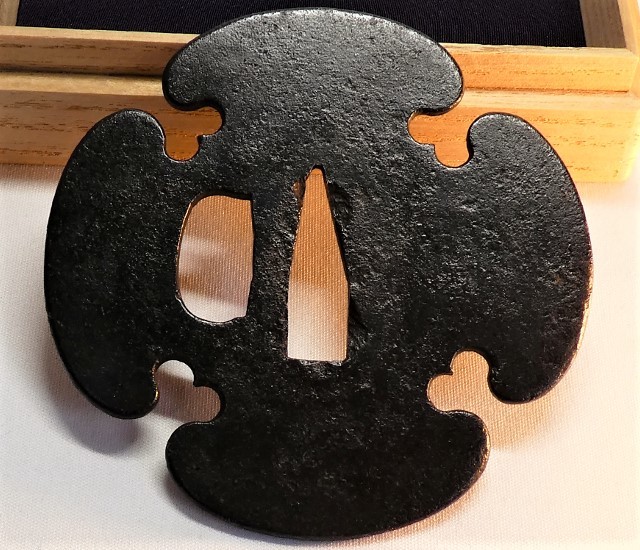 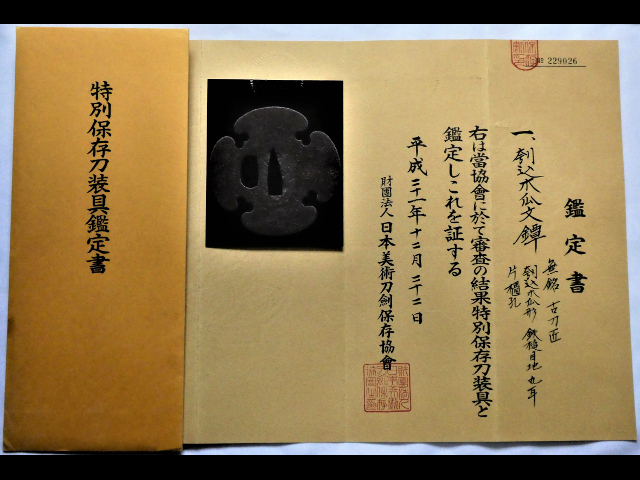 | KO-TOSHO $3000.00 "An iron mokko gata shape tsuba with inome motif at the four indentations. Circa: Muromachi period, Ca. 1400 or earlier. Even though it remains curiously controversial, the age of the earliest ko-tosho rests on evidence of when they were first worn on swords, either tachi or uchigatana. This tsuba is rather small, as ko-tosho were towards the end of the Kamakura period. The presence of the kodzuka-hitsu, while somewhat perplexing, was a value adding modification and a frugal use of something old at a time when kodzuka were eventually incorporated into the uchigatana koshirae." (Haynes) NBTHK Hozon origami. |
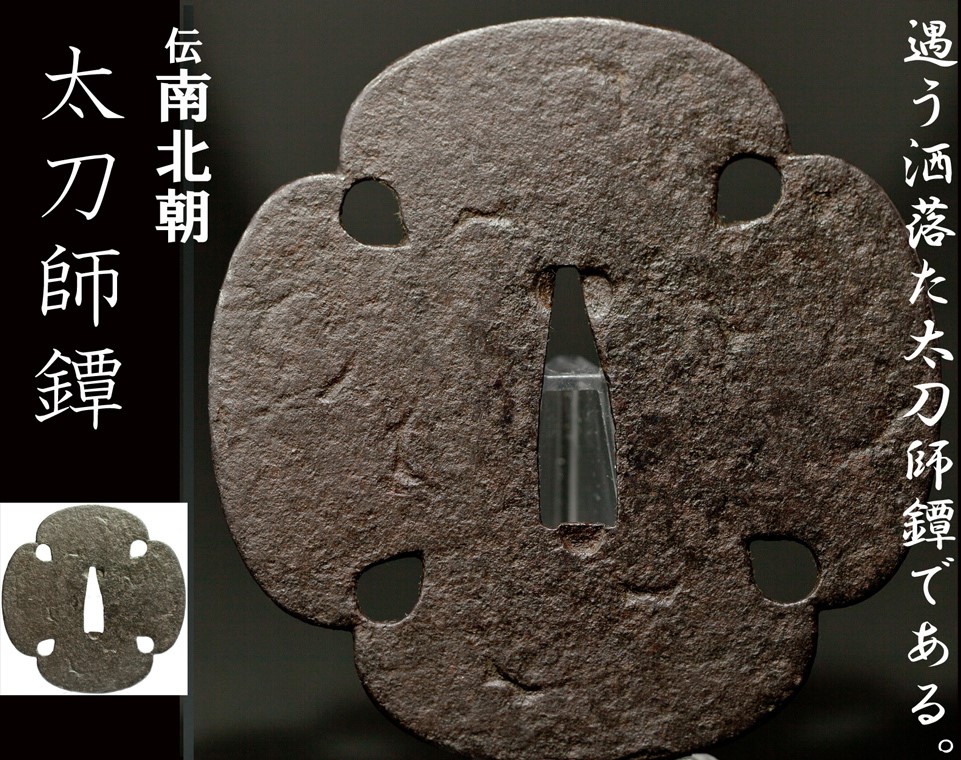 | TACHI SHI $1000.00 "A well preserved and very rare iron tsuba. Dating to Muromachi period, ca. 1450-1500." (Haynes & Long) |
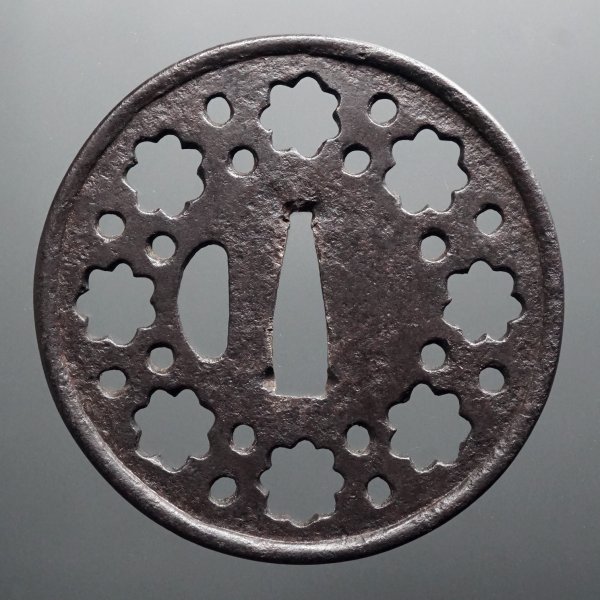 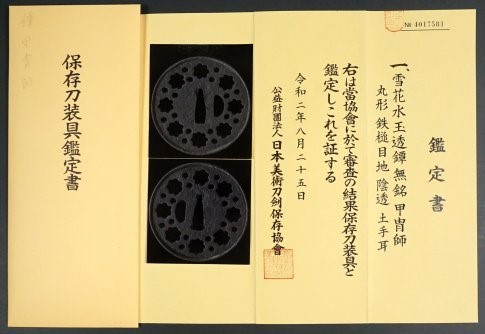 | KATCHUSHI $1500.00 "The bright quality of this symetrical group of snowflakes and stars is not typical of katchushi guards. Although the plate has an old look, the intelligent and skillful nature of the open work suggests that this is not among the earliest guards. In all likelihood, it belongs to the middle or late Muromachi period. The design is excellent and carefully worked out." (Long) 8.30cm x 8.30cm x 0.51cm (rim) x 0.36cm (face) |
 | SHIZUKADO Please Inquire For Cost "The swordsmith's tsuba is said to have originated from the tsuba that swordsmiths attached to swords in ancient times when they forged them, hence the name. It was once said that one by Akiyama Kyusaku was 600 years old, but after the war, it was believed to have originated around the mid-Muromachi period. However, in his book "The Origin of Sword Fittings," Sasano Daigyo defined it as dating from the late Heian period, as it was attached to a katana worn by a servant in the "Ban Chunagon Emaki." This tsuba features large and small circles that are openings on both sides of the tsuba. The transparent circles are tastefully shaped and exquisitely arranged. Moreover, the atmosphere is soft and evocative of infinite space. It is truly an abstract expression, like viewing stars or a constilation in the sky. The fairly thin, glossy black rust of the iron exudes a sense of time, sharing the same style and atmosphere as the Kamakura-period tsuba featured in "The Origin of Sword Fittings." It is also desirable that it is somewhat large, making it a rare masterpiece. There is a ridge on the backside and smooth on the front of the rim." (Long) |
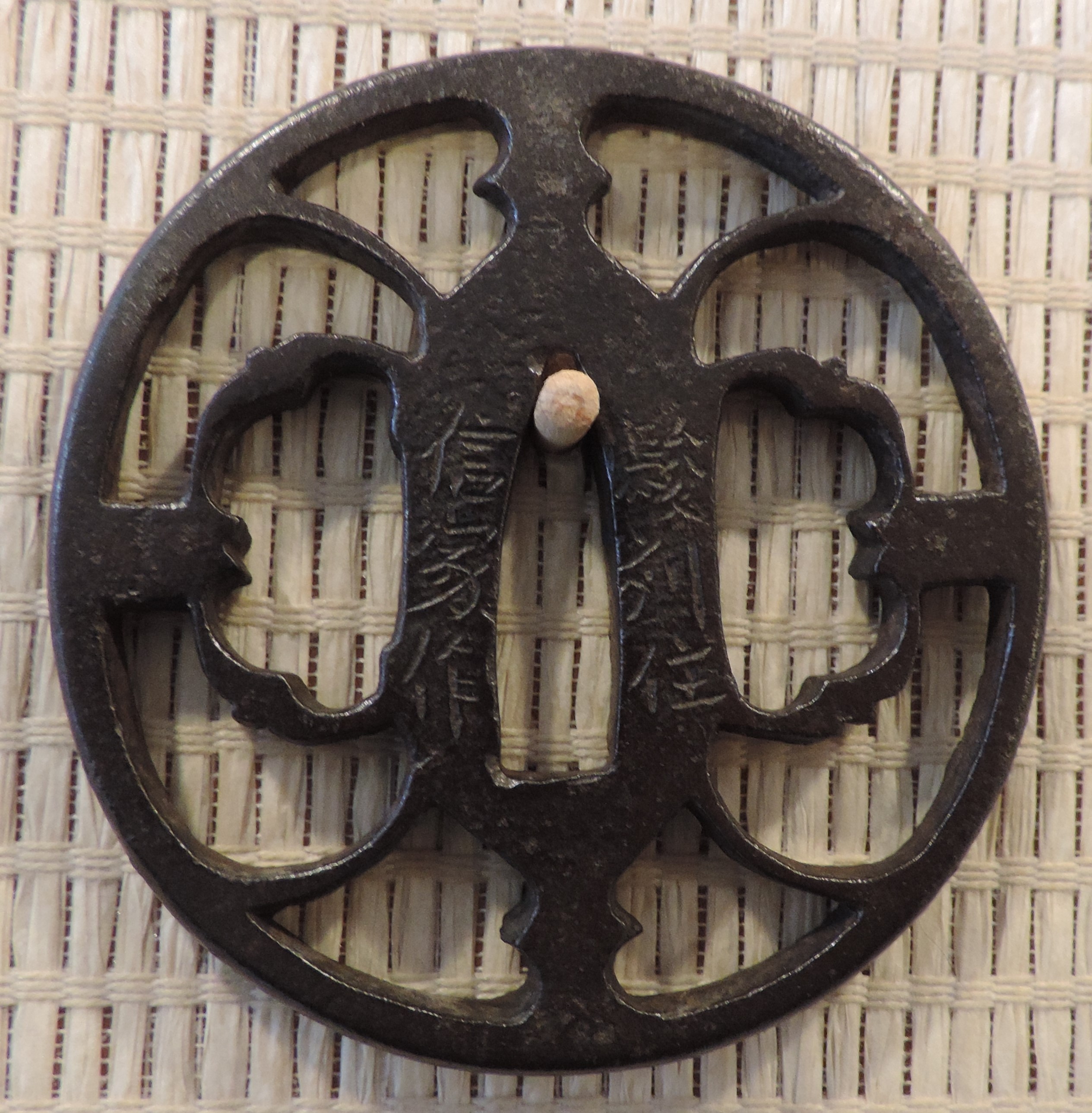
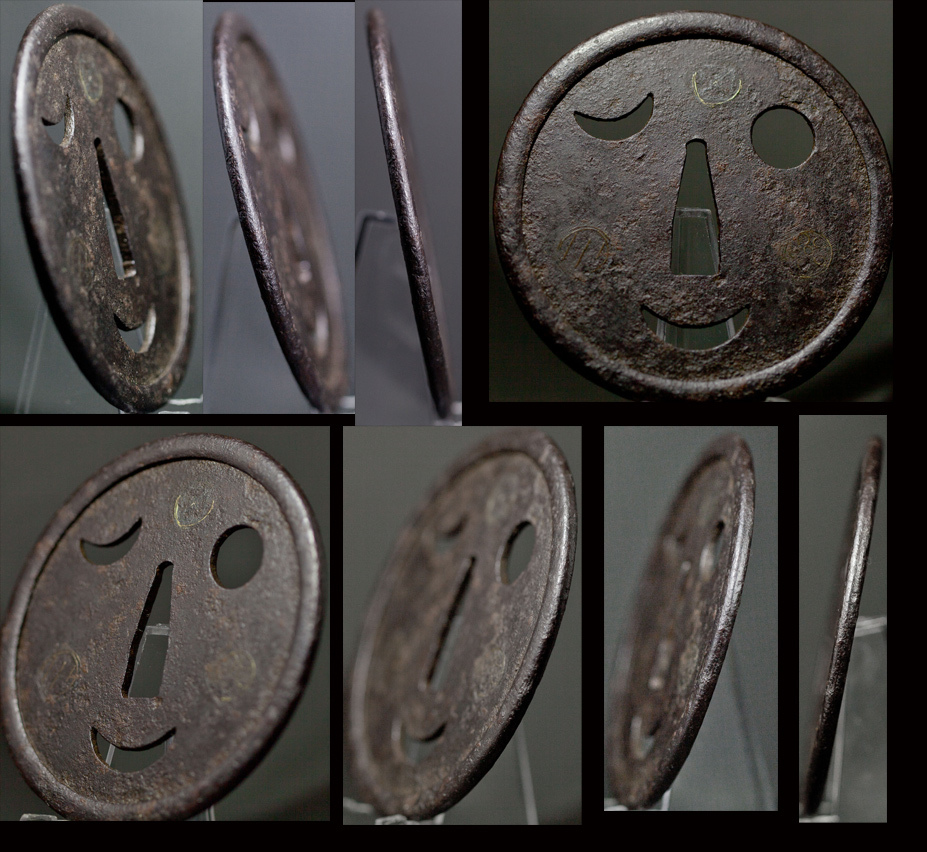 | KATCHUSHI $2000.00 "Masterpiece Ko Katchushi tsuba with dote mimi, iron thin plate. The rim is peculiar to armorer's tsuba. Also, if you look closely at this background, there is a thin inlay, which seems to have been added later. Perhaps, it is considered that the samurai who inherited the tsuba later carved a pattern like a family crest inlay. The sukashi openings represent the moon and its reflection, and a star?" (Long) |
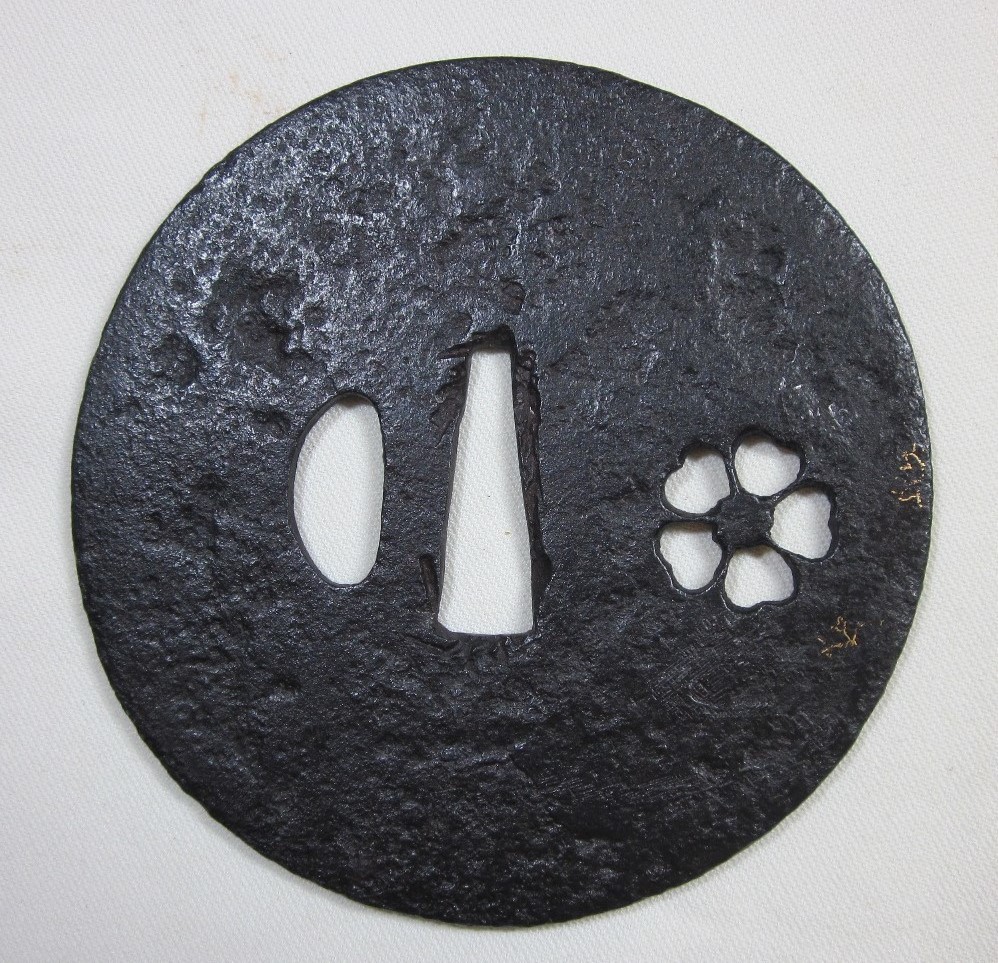 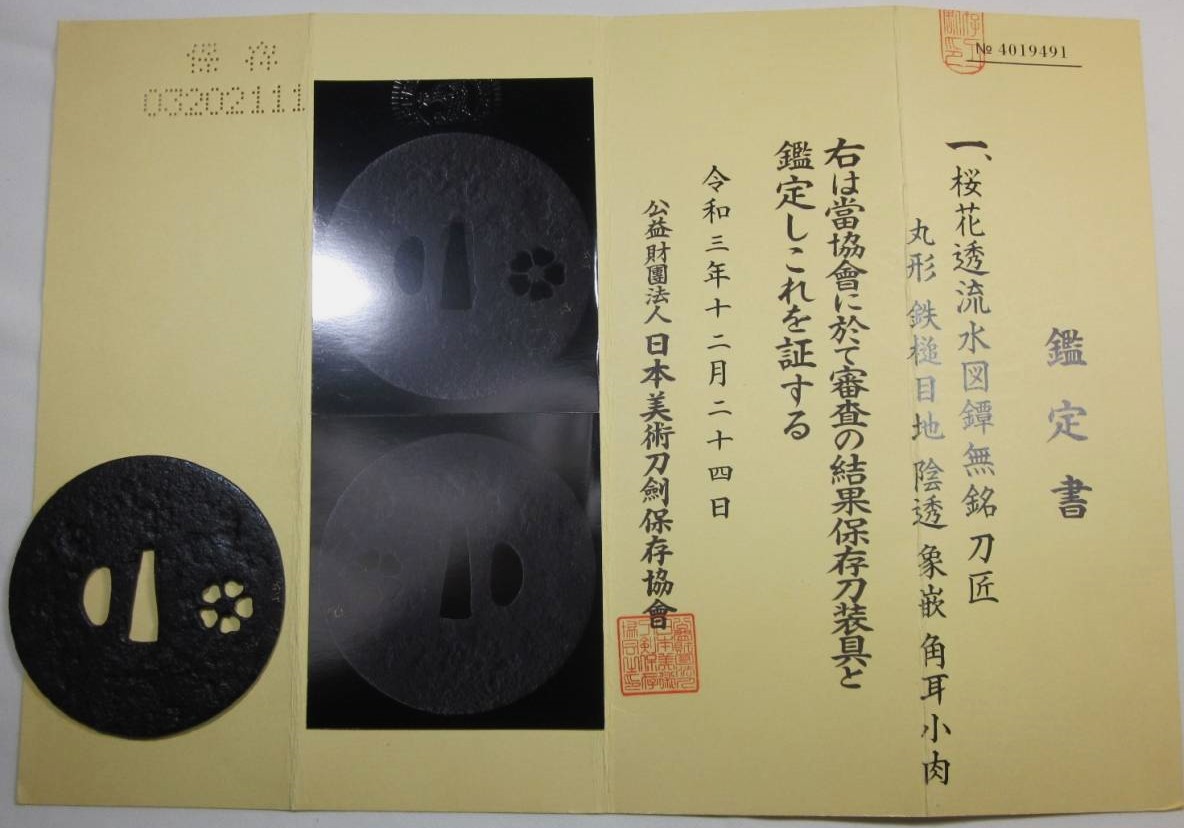 | TOSHO $1500.00 "Large iron plate with a single hitsu and Sakura (Cherry Blossom). The flower may be related to an old Japanese belief that the finest of humanity was the Samurai, as the finest of flowers is the cherry. The single flower placed on one side of the guard is neither naive nor plain. It represents a kind of ultimate beauty and has a sense of the compassion of the warrior. The strong metal, the placid cherry blossom, the large nakago-ana, and the chisel marks around the nakago-ana are all characteristic indications of early Muromachi period works. Accompanied by a Hozon certificate issued by the N.B.T.H.K." (Long) 8.85cm x 8.80cm x 0.25cm |
The BIZEN SURUGA MASTERS
| Shodai Bizen Suruga Master |
|
Early Edo period. Round iron plate with characters 'Haku-Raku-Ten' pattern in positive and negative sukashi. Sup: Hakkyoi, a great Chinese poet, lived in Middle T'ang from 8th to 9th century. He is known under the pen name 'Hakurakuten.' 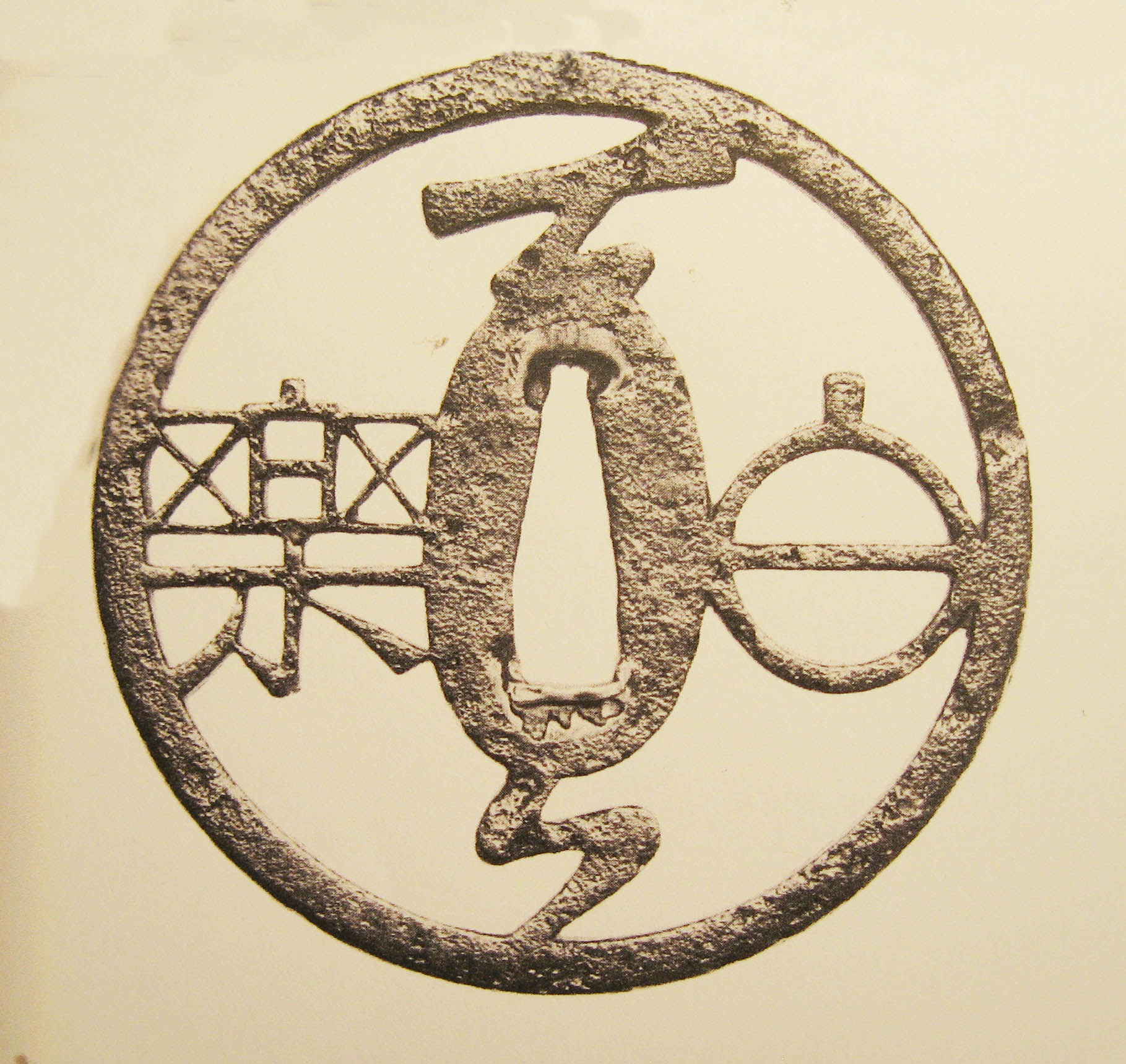 |
Early Edo period. Round iron plate with ten sword beans in positive sukashi. Kaku mimi ko niku. Thickness: 2.79mm. Sup: Notice Kuchi-beni. 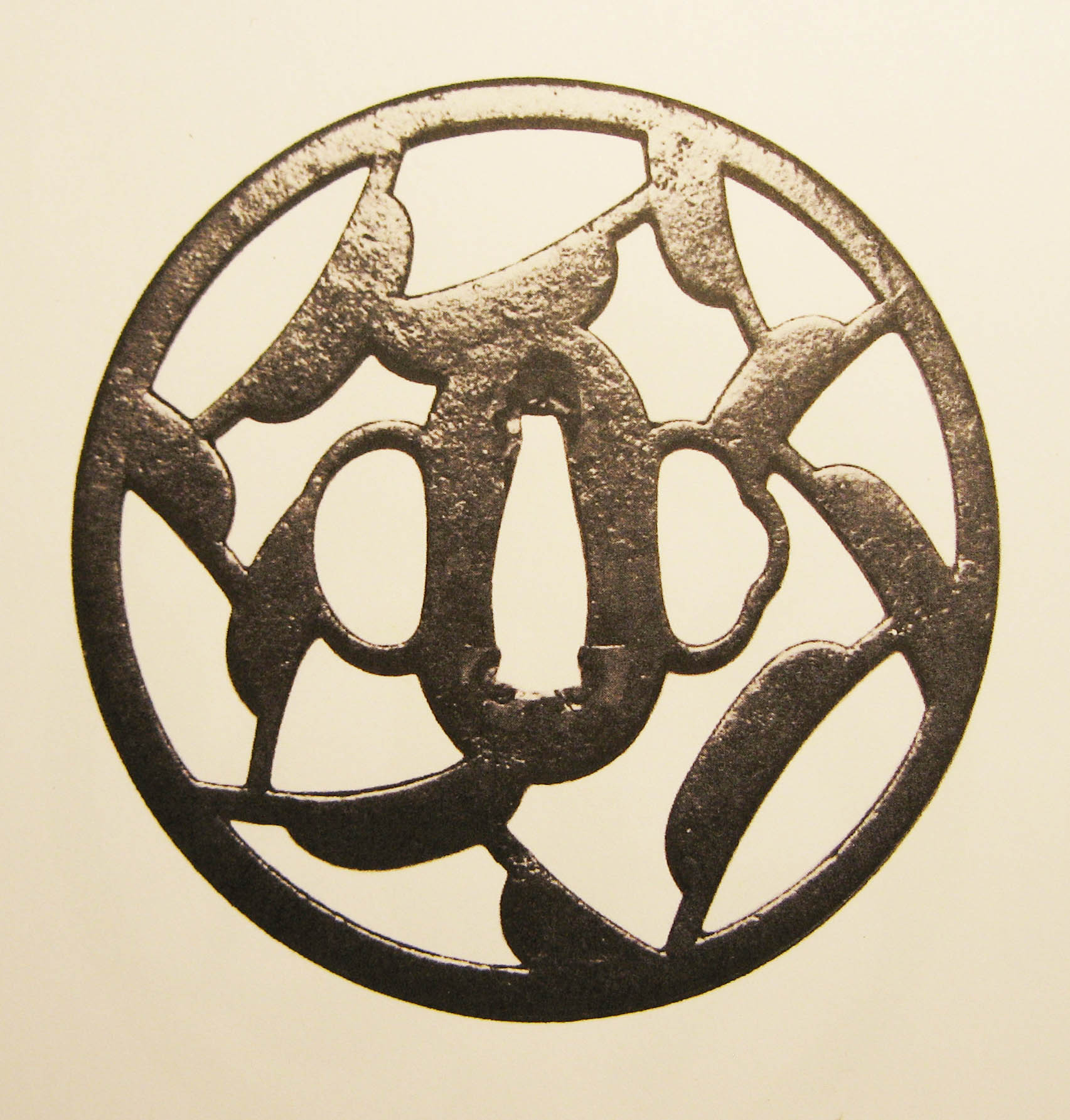 |
|
Unsigned. In the style of first Suruga (ca. 1625). 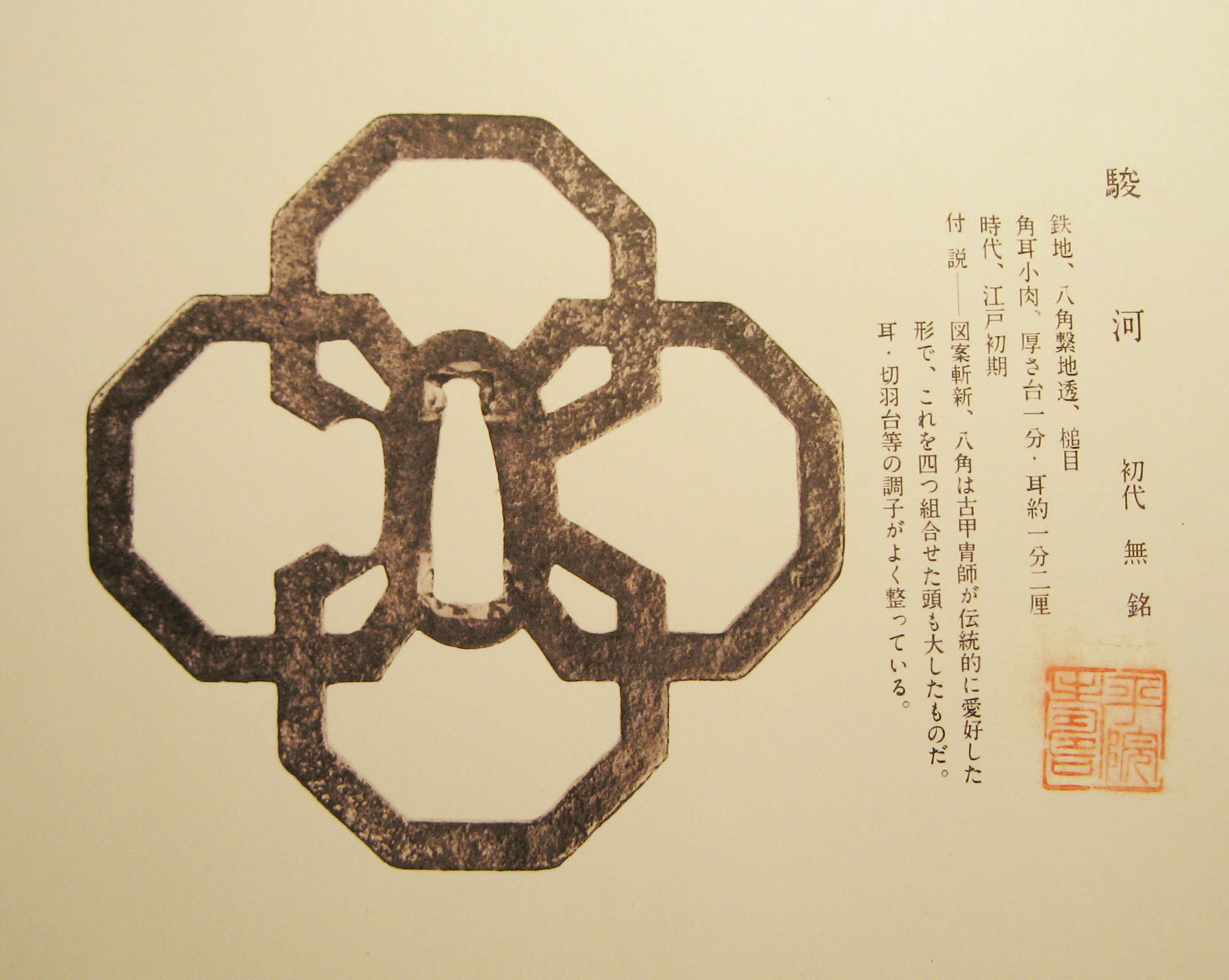 From TSUBA KANSHOKI, 1965. pg. 27 (seal belongs to Robert E. Haynes) |
"1st BIZEN SURUGA" Please Contact Us For Price Round iron plate with kaku mimi ko niku, ji sukashi of three chrysanthemums, and hitsu-ana. Note copper plugs at top and bottom of central opening, typical of this school.  |
|
"1st BIZEN SURUGA Please Contact Us For Price "Iron hammered, vertical round, hair carving, shadow inlay, round edges. This well-forged iron is finished with a hammered finish and suruga sekigane, featuring auspicious cloud openwork and fabric inlay, creating a unique Bizen Suruga piece." (Haynes)  |
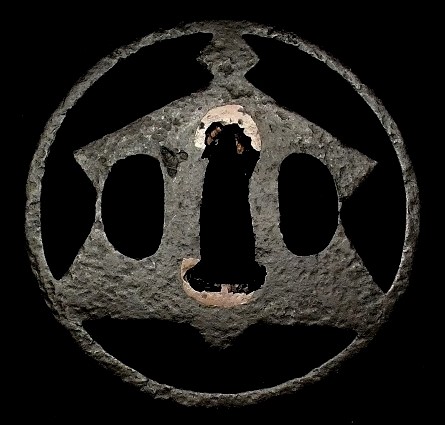 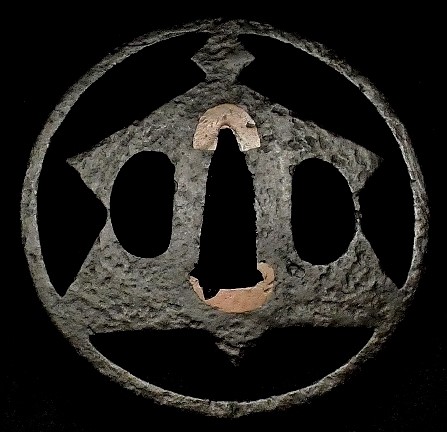 |
|
Unsigned. In the style of first Suruga (ca. 1625). Note copper plugs at top and bottom of central opening, typical of this school. Thickness at center, 3.25mm; at edge, 4.0mm. Robert E. Haynes owned this tsuba in 1963. 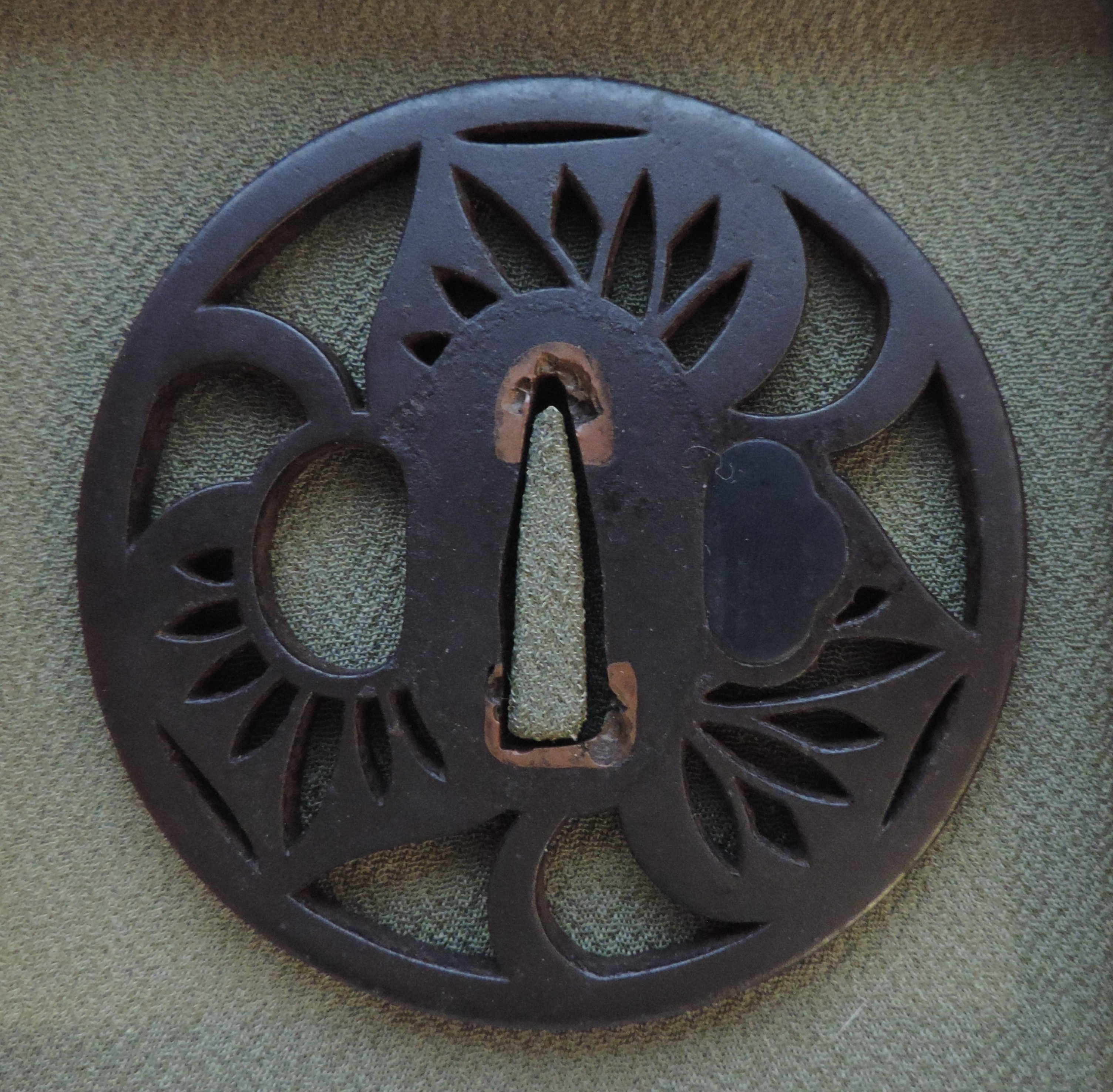 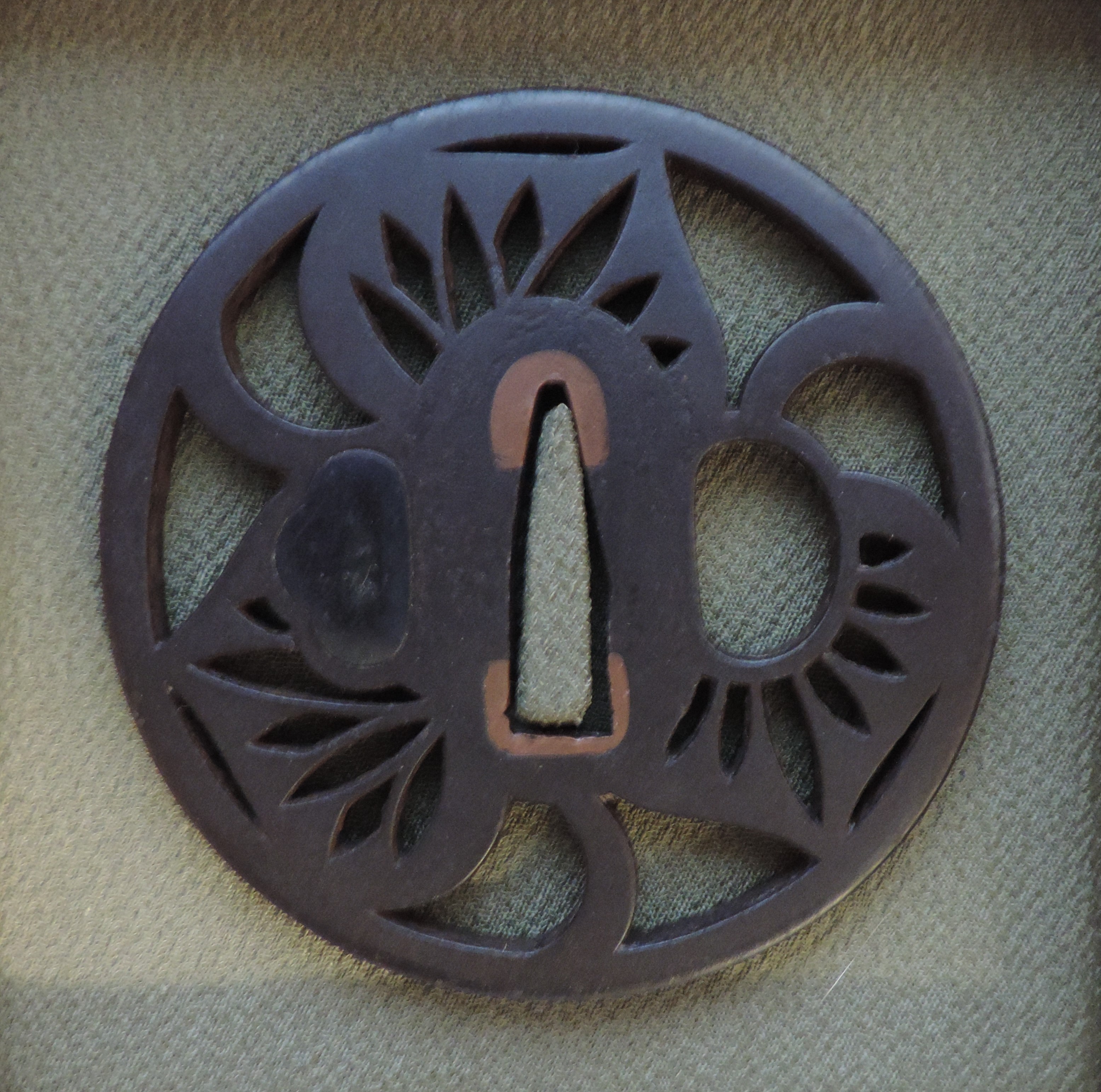 |
SURUGA Please Contact Us For Price "This large tsuba is reminiscent of the Higo "Hirata Hikozo" as it is fitted with an Odawara rim made of the finest iron and pure silver . It is a simple design, but the exquisite iron base is thick and sticky, making it a masterpiece. The sekigane is confirming the 'Suruga' classification. The rim is crafted with a nice atmosphere and rotates as per the rules." (Haynes)   |
| Nidai Bizen Suruga Master |
|
"Round iron plate with sukashi design of five boat paddles. This is the work, though unsigned, of the 2nd Bizen Suruga Master. He is Haruta, later Suruga, IETSUGU (H 01834.0). He worked in the Momoyama to early Edo period at Okayama city in Bizen Province for the Ikeda Daimyo, as did a number of the later generations of this family school. Besides the style and subject matter we can see the hand of this master in the copper plugs that he insert at the top and bottom of the nakago-ana, which his father had used before him, as did several of the later generations. The bottom copper plug has been removed in this example. This master often used the designs of his father, such as we see in this example, but in later life he created many designs of his own. A very fine classic example of the early work of this artist." (Long) 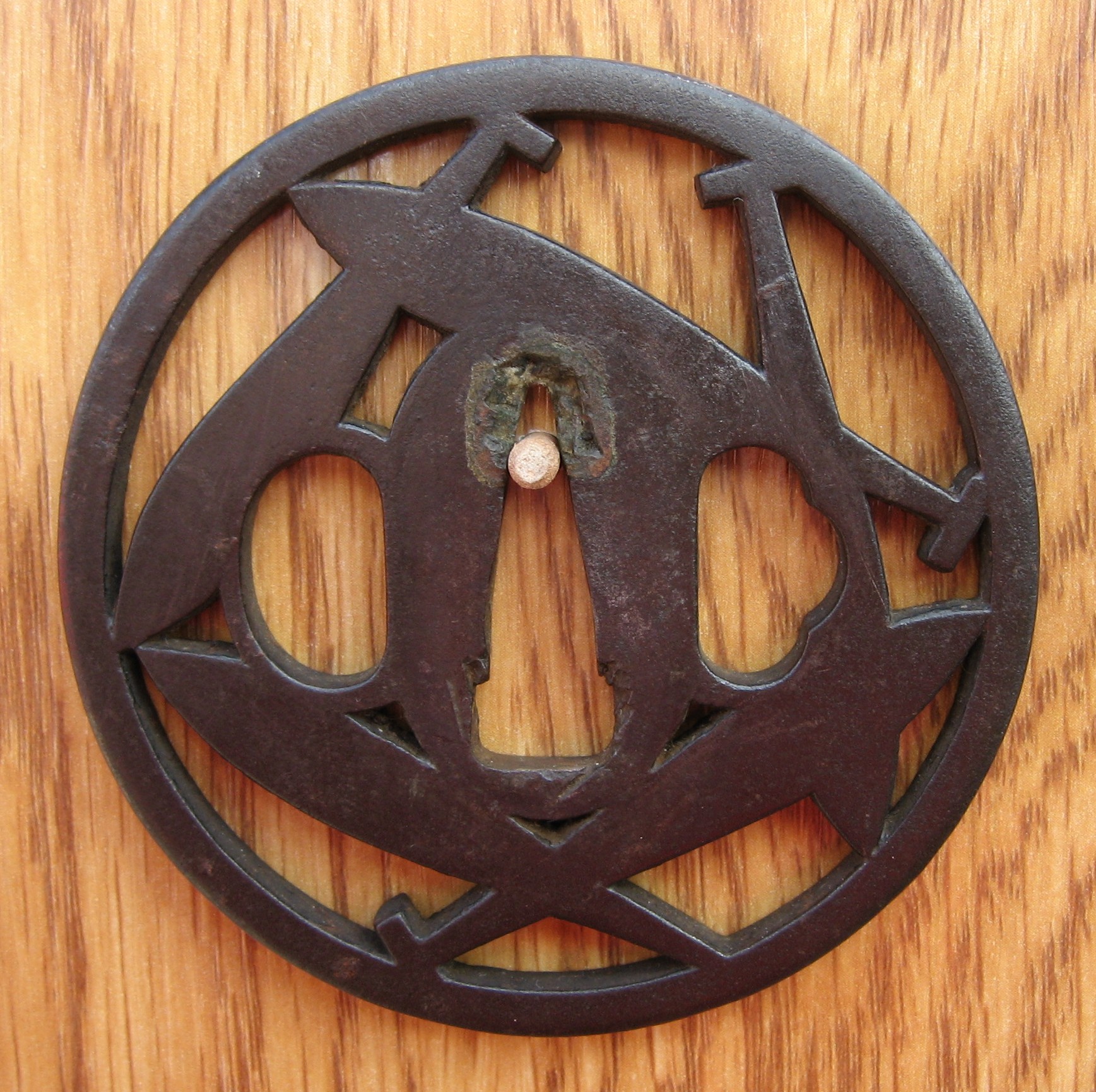 |
"'BIZEN JU SURUGA SAKU' $6000.00 Signed: "BIZEN ju SURUGA SAKU". "This is said to be the second generation Suruga master. The plate gives you some feeling of the work of Hirata Hikozo, though I doubt there is any connection. Were this an unsigned tsuba, and without the kuchibeni (sekigane) we would not know who might have made it." (Haynes)" (Long) 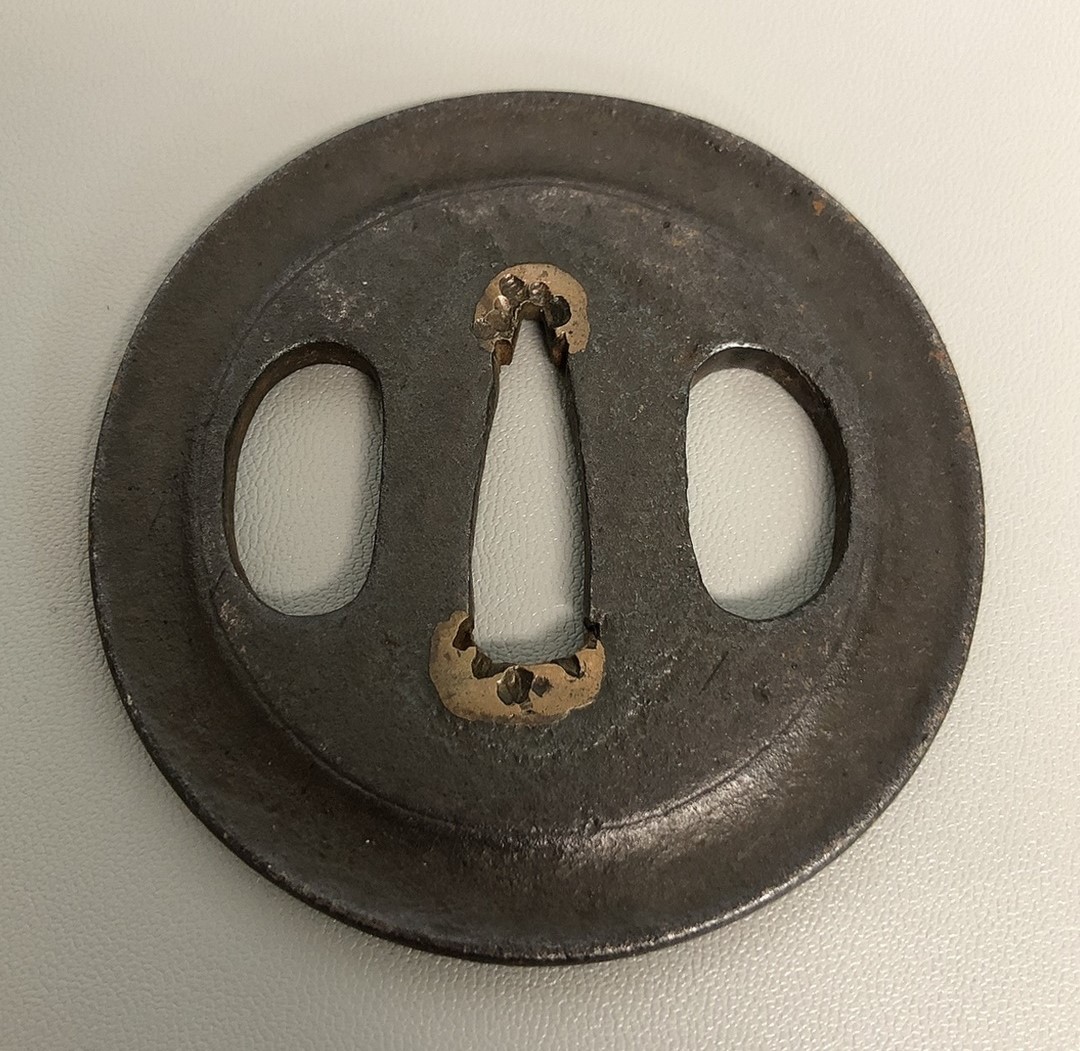 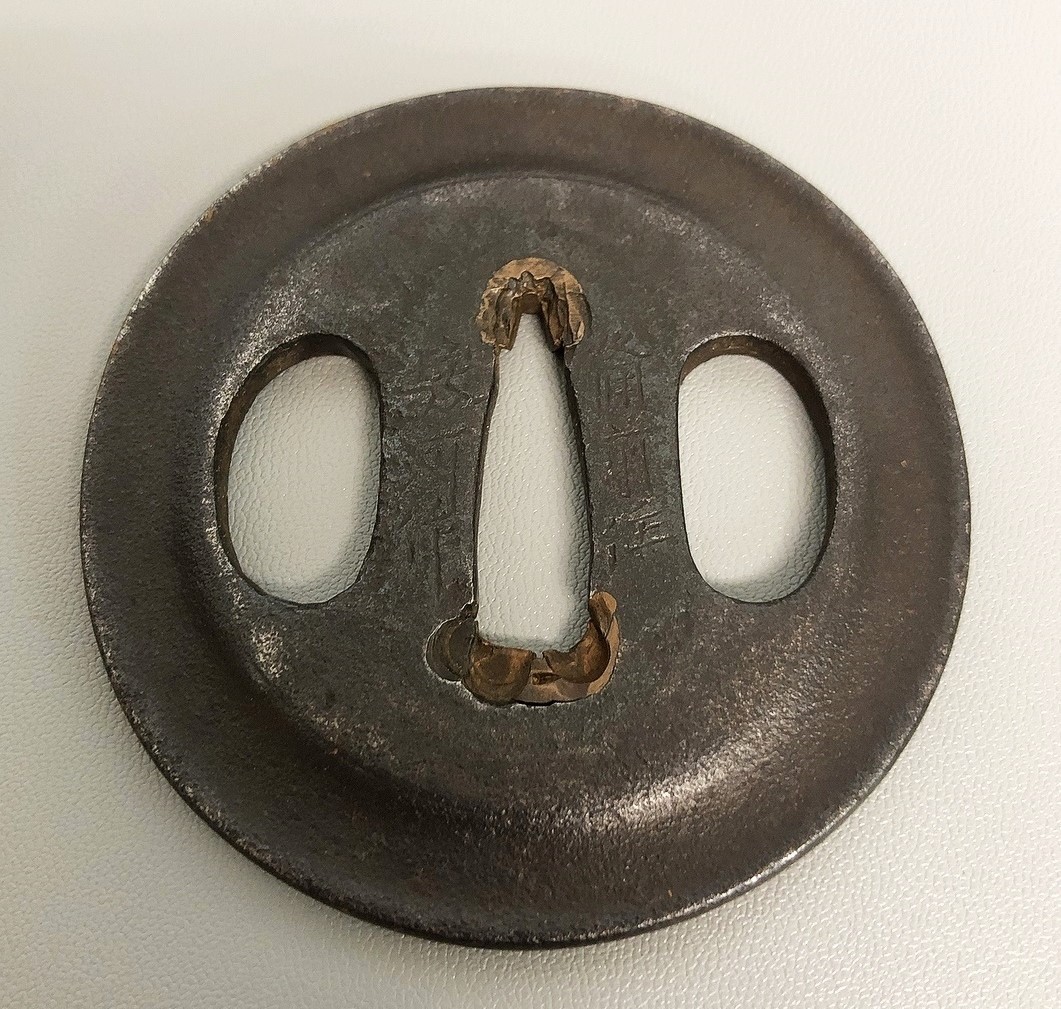 |
| Sandai Bizen Suruga Master |
|
"Round iron sukashi tsuba with design of a rudder. Symbolic meaning of steering a boat and guiding a samurai. An excellent example of the work of the 3rd Suruga Master. The surfaces have no flaws or any signs of rust or corrosion and appear as if polished (meigaku-ji). There are few iron bones (tekkotsu) present in the rim. The sekigane is in classic Suruga style and in tack. This style of sekigane is called kuchi-beni - "open mouth red lips". The signature (mei) reads 'INSHU JU SURUGA SAKU'. He is the 3rd Bizen Suruga Master, H 09041.0. This family name was used by the later members of the original Haruta family school, after they moved to Suruga Province. The third generation signed Inshu Suruga or Inshu Suruga Saku." (Long) 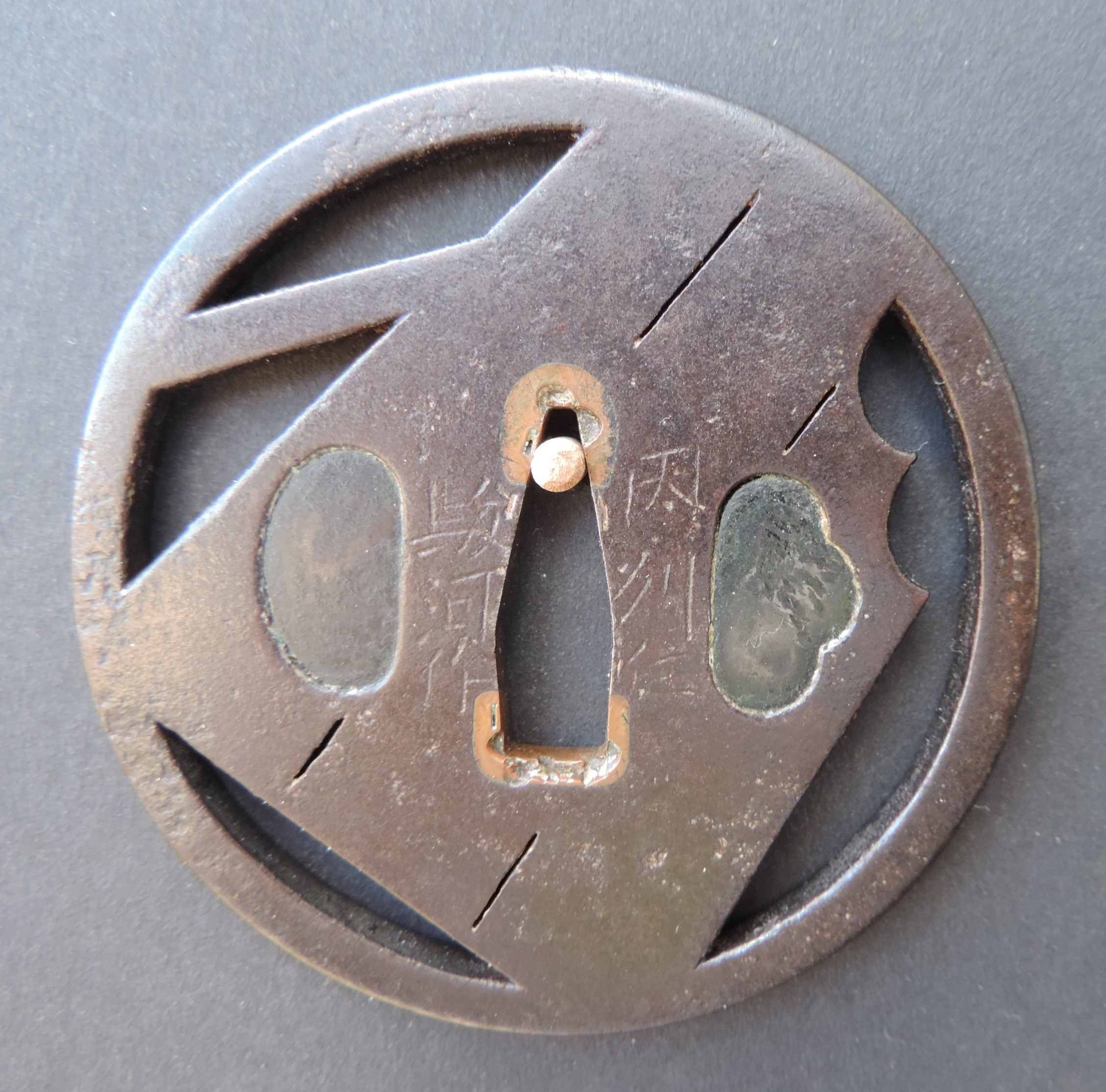 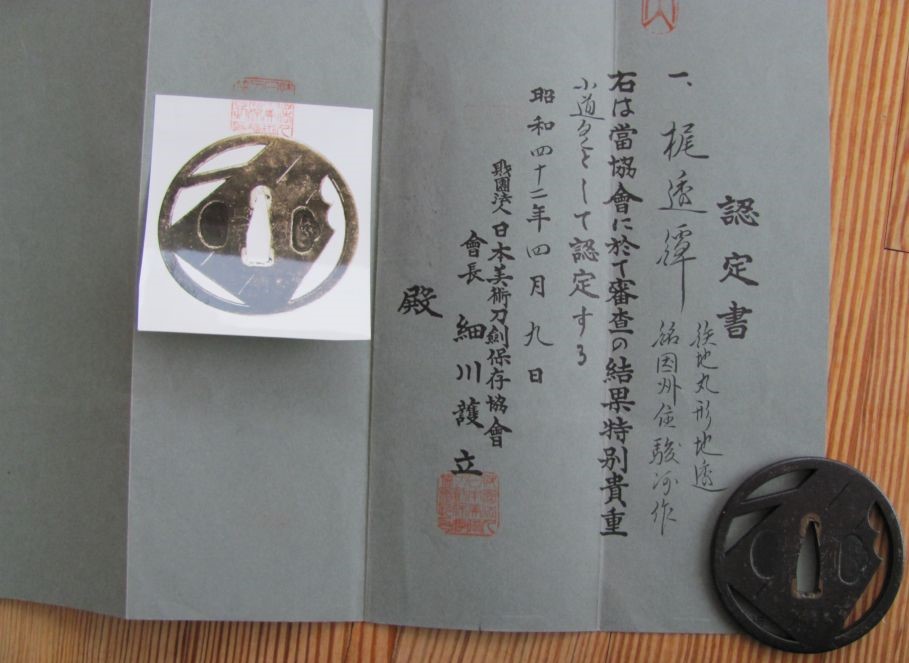 |
"Iron plate shape of the Uzume mask (Otafuku), and with a bold carved rope rim. The hitsu-ana in the shape of the half Matsukawabishi mon. The ishime ground of the plate still retains some of the original black lacquer surface, mostly on the face. The original copper plugs at the top and bottom of the nakago-ana have added copper when this tsuba was remounted at a later date. The face is signed: 'INSHU JU SURUGA SAKU'. Muneie was the third generation of the Bizen Suruga family school. He was born at Okayama in Bizen Province in 1625 as the son of the second Bizen Suruga master, Ietsugu (H 01834.0). He went, it is said on June 4, 1632 to Totori in Inaba Province, with Lord Ikeda when he was posted to Inaba, and thus he was to sign, as this tsuba, Inshu (Inaba) Suruga saku." (Long) 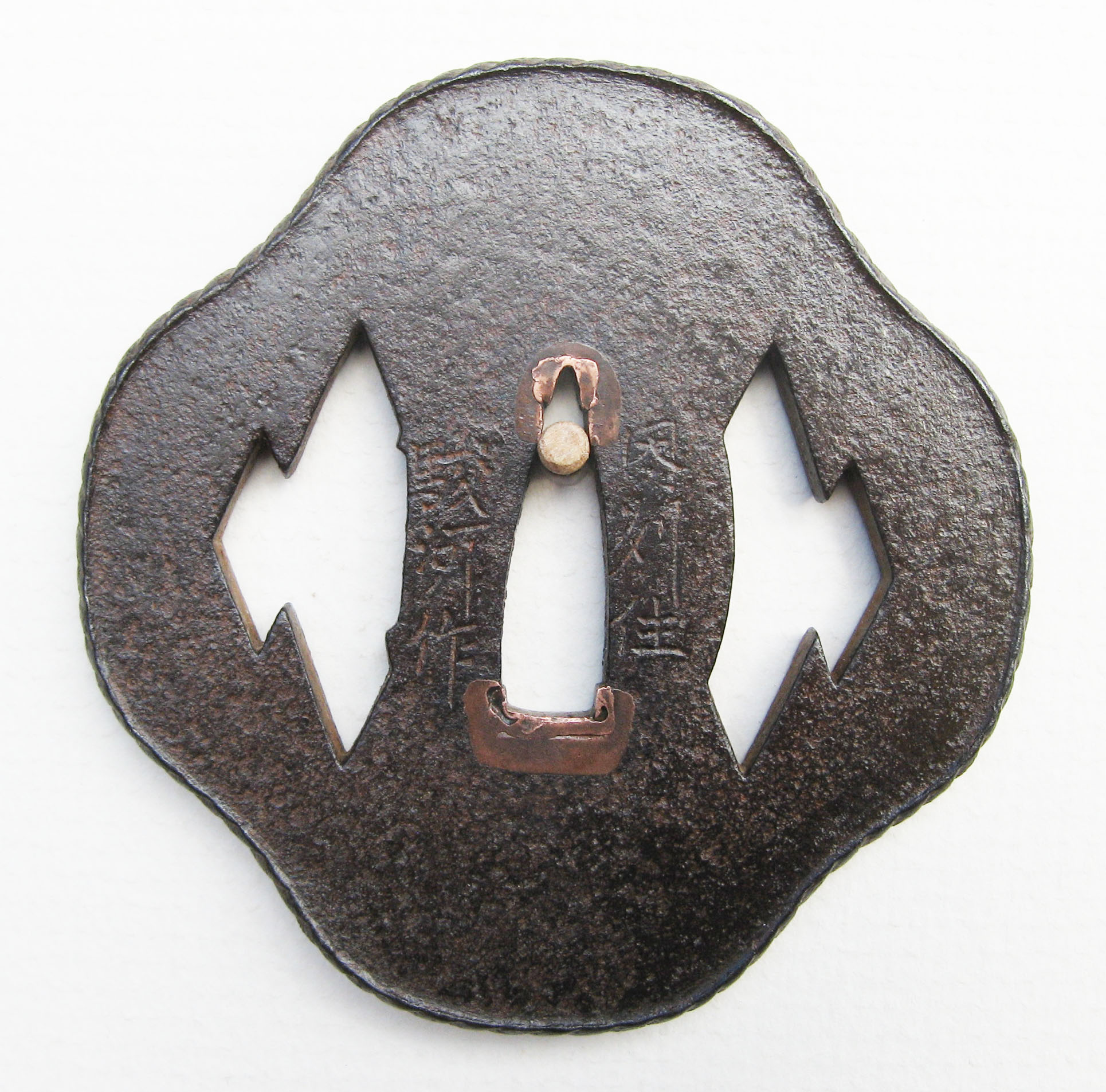 |
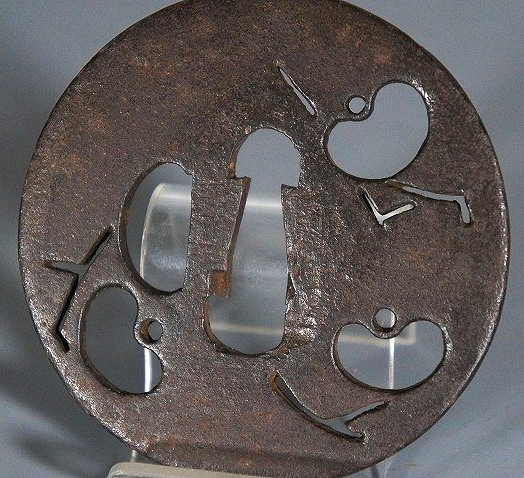 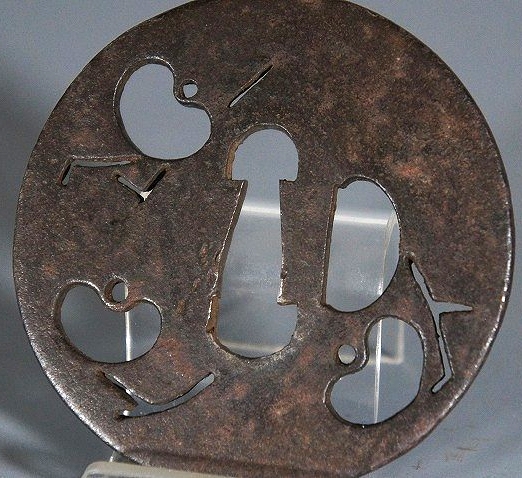 |
|
MYOCHIN HA
The Myochin was a renowned family of armorsmiths from the days of its founder Munesuke in the 12th century. Little is known of their sword guards, though they must have engaged in this branch of the art. In reality the Myochin did not begin to make tsuba until the middle of the Muromachi age when Takayoshi appeared. Guard-making became the special business of the Myochin, and the method of decoration adopted was either to impart to the outline of the guard some quaint shape, or to weld it in such a manner that the surface presented the appearance of wood graining, or to decorate it with pierced or openwork designs. The wood-grain (mokume) surface must be classed among the remarkable achievements of the Japanese armourer. It seems impossible to determine when this display of strength, skill, and ingenuity had its origin. The oldest examples of it spoken of by Japanese connoisseurs are from the hands of Miyochin Munesuke, who worked from 1154 to 1185 A.D. Munesuke is generally regarded as the founder of the great Myochin family of armourers. He was, in fact, the 20th representative, the founder having been Munemichi, who flourished in the 7th century. But Munesuke stands so far above all his predecessors that he justly deserves to be called the father of Japanese armourers. He is the 1st of the Judai, or ten great generations of Myochin experts, ending with Muneyasu in 1380. Many of his iron guards are fine examples of the 'mokume-ji', or wood-grain forging. Munesuke marked these guards 'Shinto gotetsu-ren' or "five-times-forged iron of the sacred way" and it may be added that the ideographs used in his inscriptions for guards are of the kind called 'kabuto-ji' or "helmet characters", that is to say, the grass script (sosho) with curled strokes; an ornamental style of writing always employed in marking helmets. From the time of Munesuke down to the Edo era the production of wood-grain effects has been among the remarkable achievements of Japanese workers. The Myochin master used iron only. As to guards having designs chiselled in 'sukashi-bori', it is generally believed that up to the close of the 15th century they were more or less roughly executed.
Some connoisseurs claim that Myochin Nobuiye, who worked during the early part of the 16th century, was the first to carry this method of decoration to a point of really high excellence. Nobuiye was third of the Myochin family, or "Three Later Masters", of the Myochin family, and it is scarcely credible that his two immediate predecessors, Yoshimichi (1530) and Takayoshi (1490), the other two of the renowned trio, can haved failed to produce fine guards in the sukashi style. All of the guards of the Myochin experts, from Munesuke to Nobuiye, are slightly rough to the touch, though they present the appearance of finely finished work. This peculiarity, called by the Japanese 'moyashi' (fermentation), is the result of the patina-producing process. It need scarcely be said that the patina was a point of the greatest importance. The most prized variety had the color of the azuki bean, or dark mahogany.
PRIOR TO ASHIKAGA: Amongst the armor makers was Munesuke (1190-1198) who originated the Myochin School and became the founder of that family which existed until the last days of the Tokugawa. The oldest tsuba in existence are made by them, but most of them are later than the 7th Myochin. There is a tsuba with a dragonfly in sukashi which is unsigned but is attributed to Muneyasu.
ASHIKAGA PERIOD: Myochin School; After the Jo Judai there were three people: Takayoshi (14th master); Yoshimichi (16th master); and Nobuiye (17th master) who were known as the "Three Masters". With tsuba, many are signed Nobuiye and almost none by Yoshimichi and of those with the Takayoshi signature only one is known. Many of Nobuiye's are different from those of the armor makers; the shape is generally mokko and they are thick, so that you can see a change in style in the work of katchushi mono.
MOMOYAMA: The katchushi in this period were the Myochin, Haruta, Horai, and Saotome Schools. In general they gave up their armor makers style; some of them imitated Nobuiye but remained inferior to him. The Horai School worked in Kaga and their oldest work is dated 1585 and is signed Horai Munenaga. The specimens are very thick ita tsuba with simple perforations.
TOKUGAWA PERIOD: Myochin School; In this school the manufacture of tsuba was increased in this period. The work of the 22nd generation, Munesuke (1688-1704), exists in larger quantities than those of the other people which, when compared with others, show large differences. They became very thick and small, roughly forged, with figures in high relief, and many of these have mokume ji in iron. The other Myochin School workers scattered throughout the provinces also changed their style.
  |
'SHINTO GO TETSUREN MYOCHIN OSUMI NO KAMI KI MUNESUKE' Please Contact Us For Price "A tsuba made of sturdy, thick iron with Bodhidharma Daishi depicted with his mouth closed in a downward frown, revealing his stubborn, single-minded disposition to endure any hardship for the sake of spreading the teachings. However, the overall face and appearance are humorous. The udenuki for the strap to secure the wrist are probably a commandment against the unnecessarily drawn sword. The splendor of the iron, the reliable carving technique, and the use of crystals in the eyes of Dharma are perfect in every way. The artist, Myochin Munesuke, was a native of Azabu in Edo around the time of the Kyoho era. He was the head of the Myochin school and made tsuba along with armor. Haynes Index H 06238.0. Born 1641, Died 1724. Accompanied by a Tokubetsu Hozon certificate issued by the NBTHK." (Long) |
  |
'MYOCHIN KI MUNEHARU'
Please Contact Us For Price "The Myochin Ha is the main line of the Katchushi, and the number of artisans was the greatest. During Bakumatsu (the end of the Tokugawa or Bakufu period), the Myochin Ha made tsuba that are well forged tetsu-ji and most were especially skilled at ko-sukashi. Mokko-gata is the most common shape. This tsuba is exquisitely executed as would be expected of katchushi. Two gold-plugged Hitsu-ana. Highly decorative "Pine trees under Fuji" sukashi motif. Late Edo period (ca.1800)." (Long) 2 7/8" x 3 3/16" x 7/32" thick. |
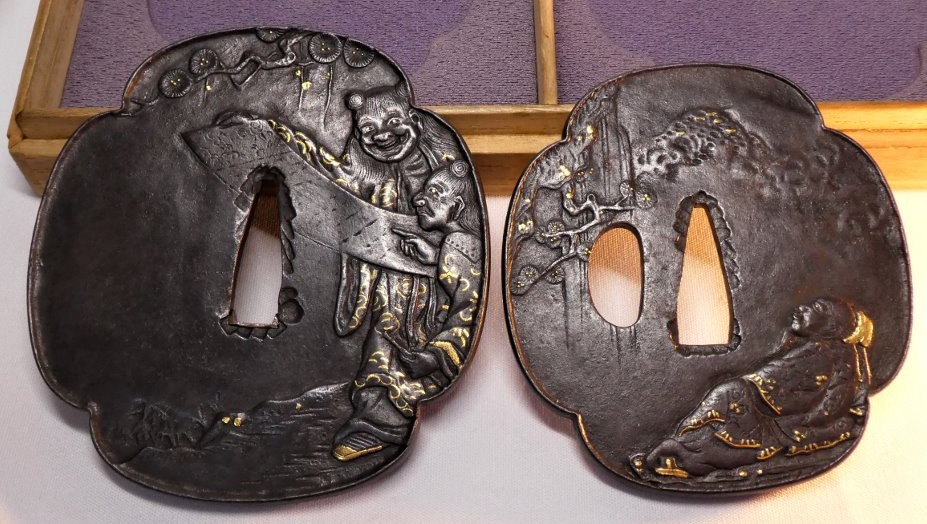 |
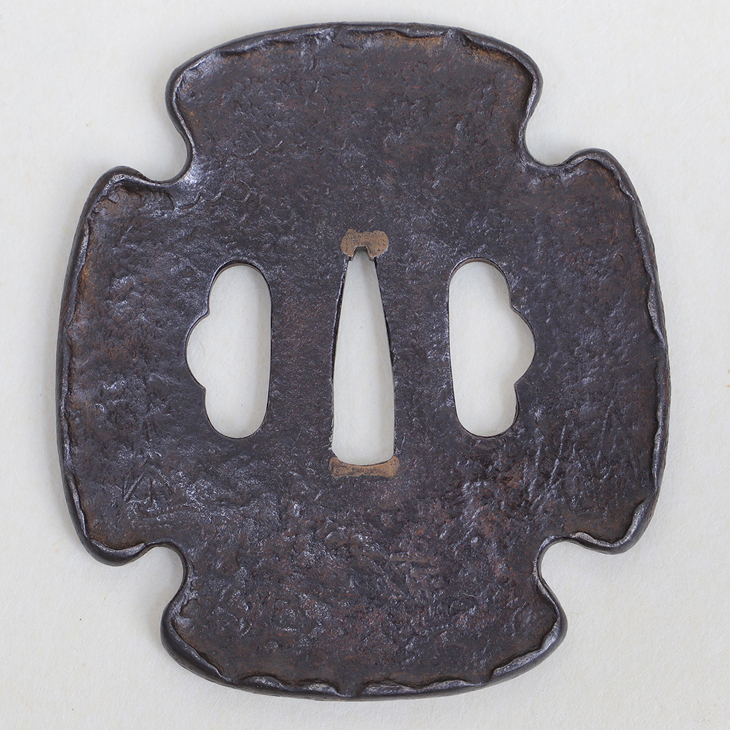
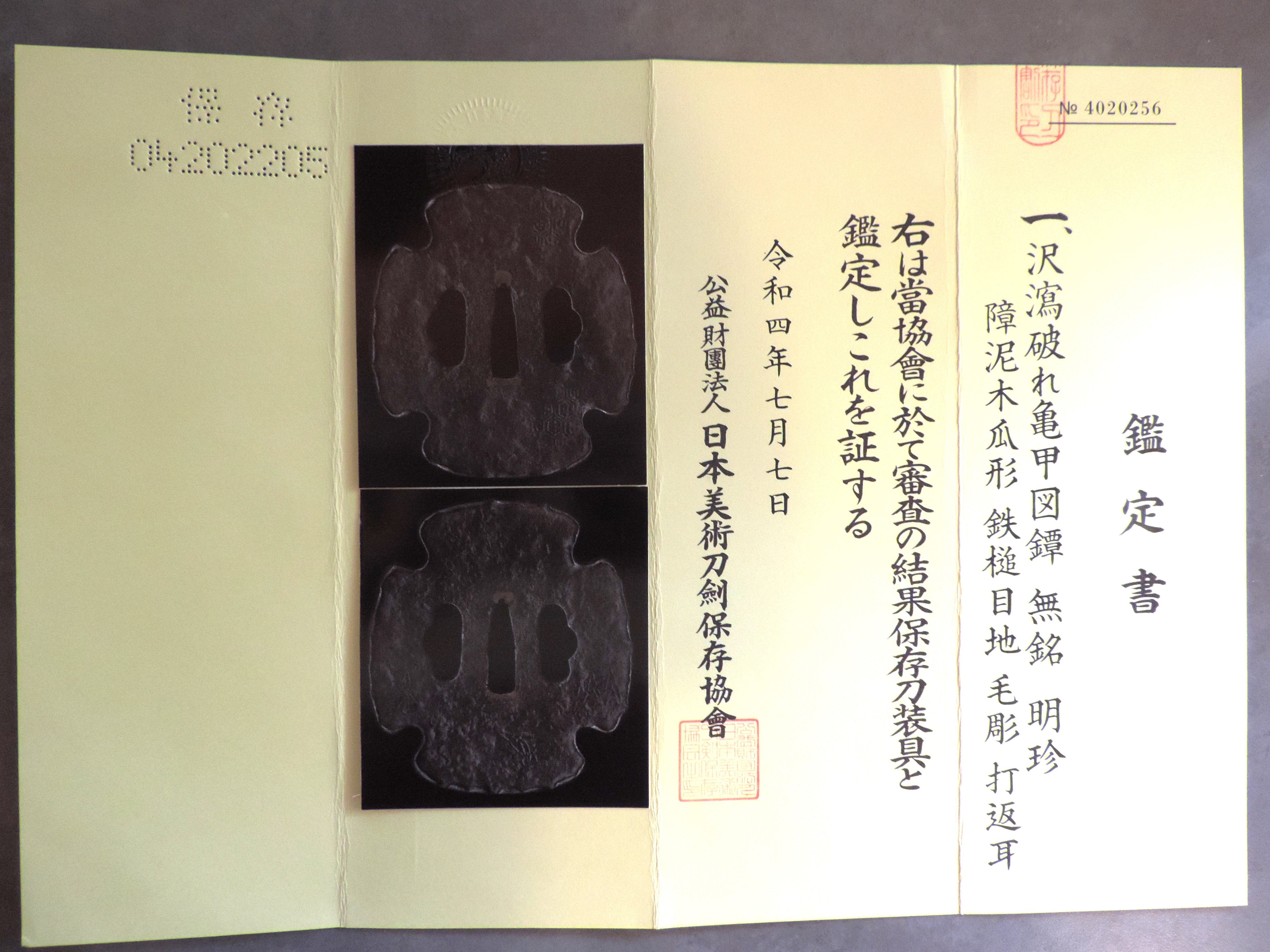
'TOSHU JU MYOCHIN MUNETERU' Please Contact Us For Price
|
  |
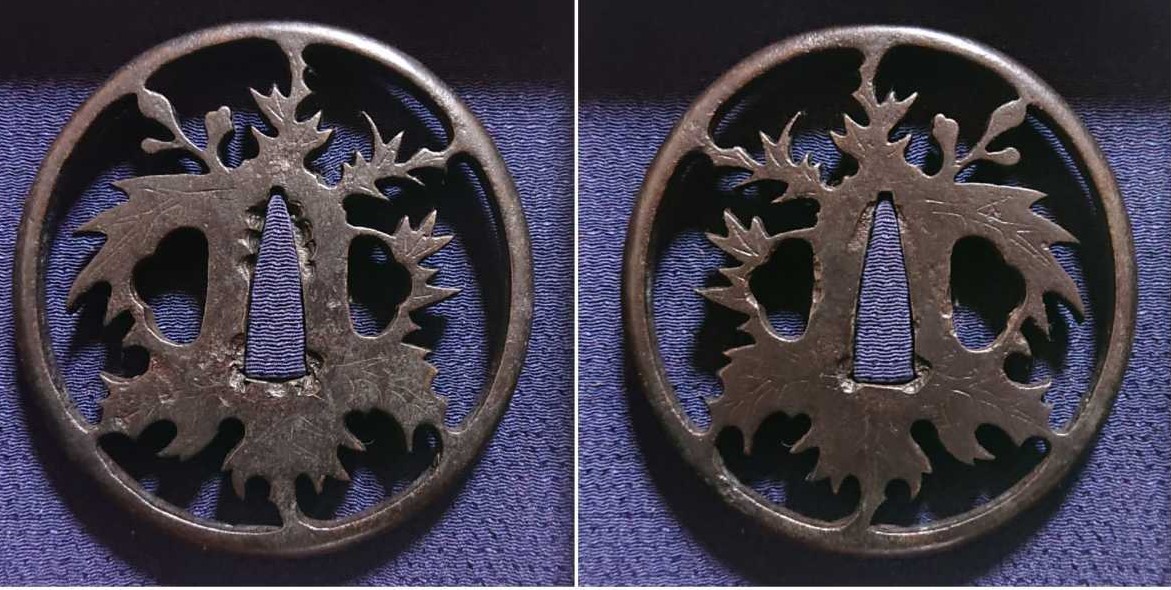
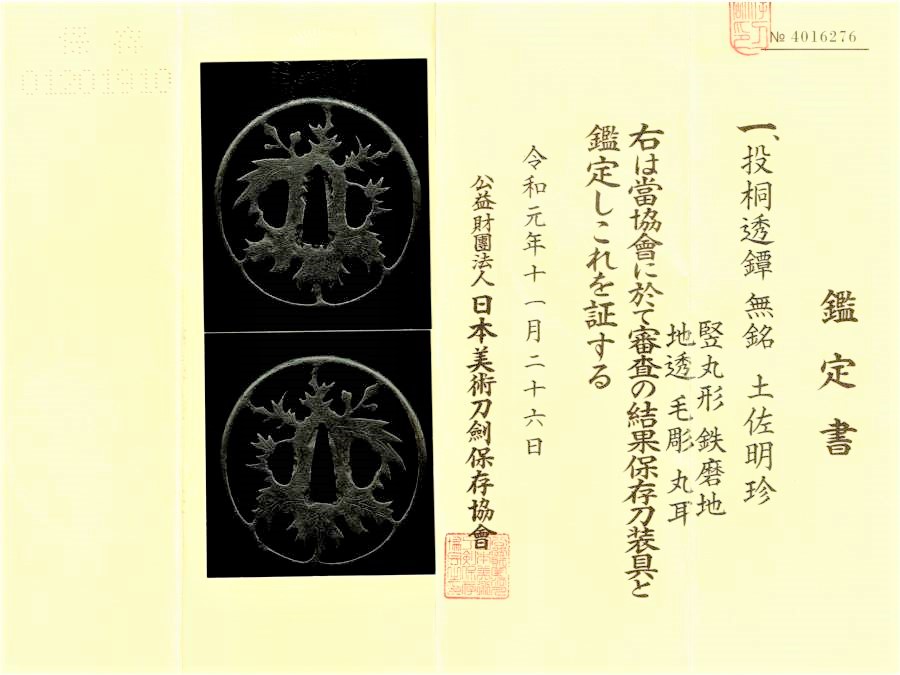
MYOCHIN $1000.00 "The tsuba presented here is a large mokko shape of excellent well forged iron. The rim is produced by hammering from the outside called uchikaeshi mimi. There are carved designs of omodaka and turtle shell. Early Edo period. Accompanied by a Hozon certificate issued by the NBTHK." (Long) |
  |
TOSA MYOCHIN
Please Contact Us For Price "A group of the Tosa Myochin smiths went to Edo to study with the Akasaka masters Tadatoki andn Tadanori. It was the lord of Tosa, Yamanouchi, who inspired the Tosa school masters to work in Akasaka style. The best of their work is equal to the later Akasaka tsuba produced in Edo. In some of their work there is strong influence by the Higo style mixed with the Tosa Akasaka style." (Long) 8.15cm x 7.85cm x 0.60cm |
  |
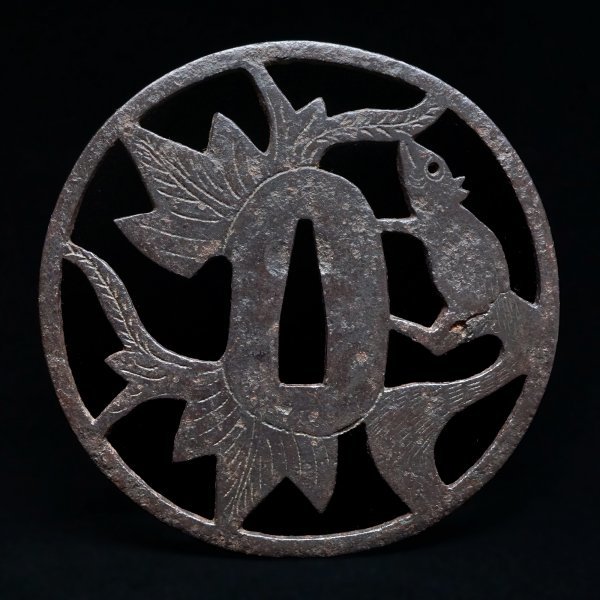
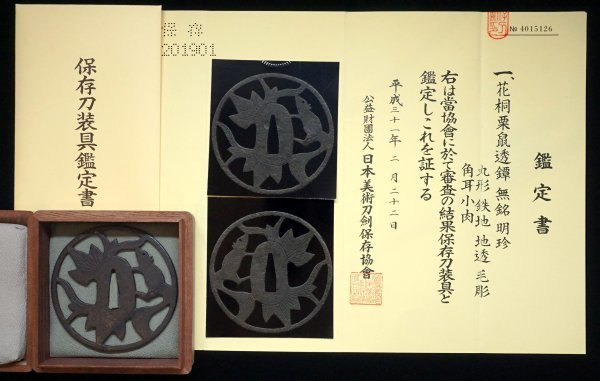
TOSA MYOCHIN
Please Contact Us For Price "Leaf design openwork tsuba. This design also represents the Kanji for DAI (Big). Inscription: Tosa Kuni ju Myochin Munetoshi (H 06292.0). Iron hammered ground openwork. Large, well-made, with a beautiful design, this is an excellent sword fitting." (Long) 9.30cm x 8.50cm x Rim thickness 1.00cm |
  |
MYOCHIN Please Contact Us For Price "This tsuba is highly regarded as 'Hana Kirigiri Tsuba' by an unknown Myochin. It is a large tsuba with a rustic design that is timeless. The iron is very good, and the base iron feels good in hand." Published in the 'Nihon Toban Zusetsu', 1968 Edition. Accompanied by a Tokubetsu Hozon certificate issued by the NBTHK." (Long) |
  |
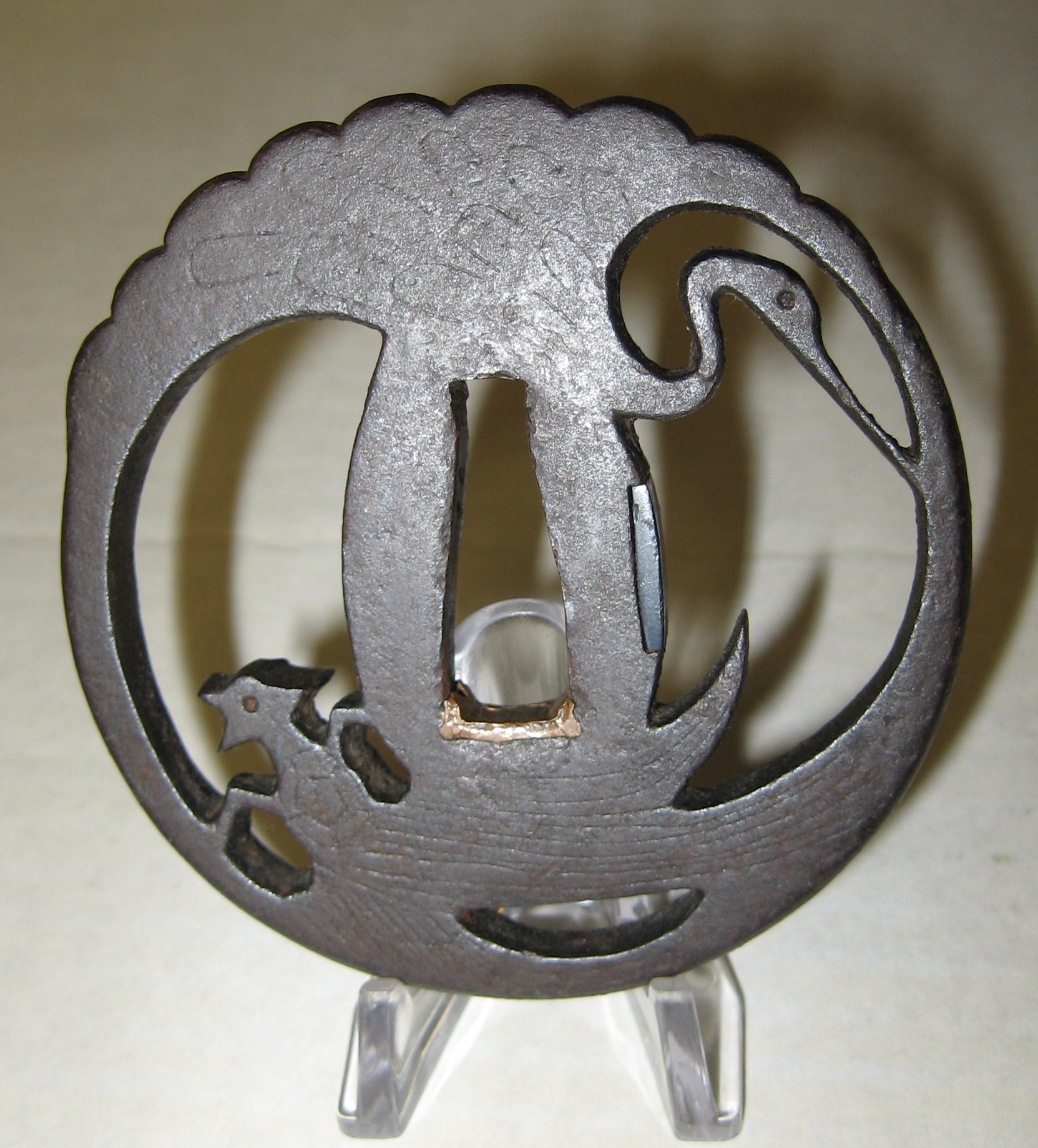
'MYOCHIN MUNENOBU' Please Contact Us For Price
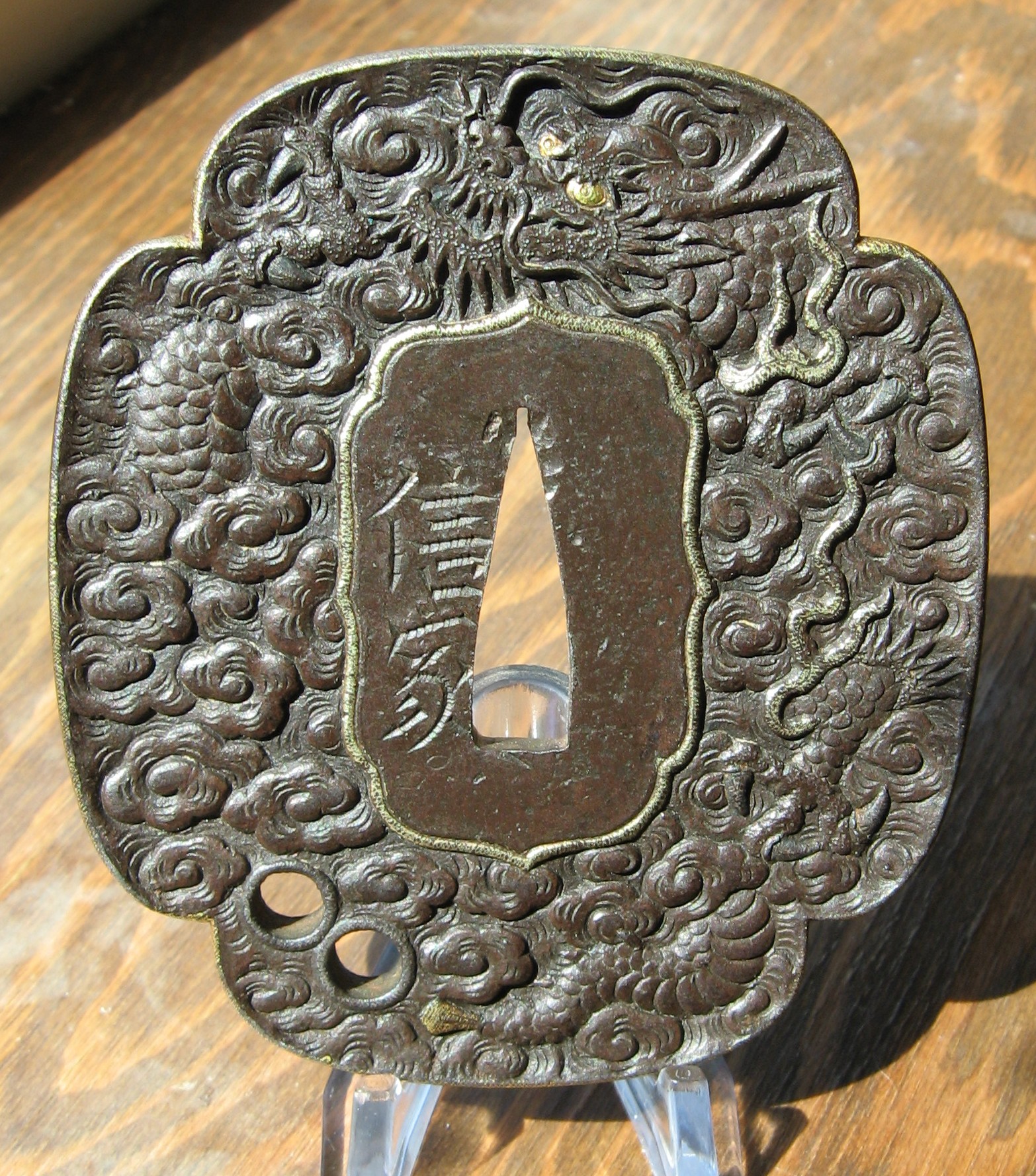
"Armorer Myochin Munenobu's iron tsuba with cloud and dragon motif, shakudo ring, excellent item, rare item, further write-up coming." (Haynes & Long) 8.60cm x 8.50cm x 0.50cm |
 |
KAGA MYOCHIN $1200.00 "In this case the plate is very thick, more than the thickest Akasaka school plate. This example would seem to be the work of the Edo period Myochin school. The original Horai school was related to the Kaga Myochin group, and this example was probably made by a later master of that school. The plate has a very fine patina and the edge has some iron bones. There is fine line carving detail on both the crane and the tortoise (crane and tortoise emblematic of longevity). It would seem that this tsuba was made to emulate the original Horai examples, of the Momoyama period, some of which are signed." (Long) 7.9cm x 8.0cm x 0.7cm. thick |
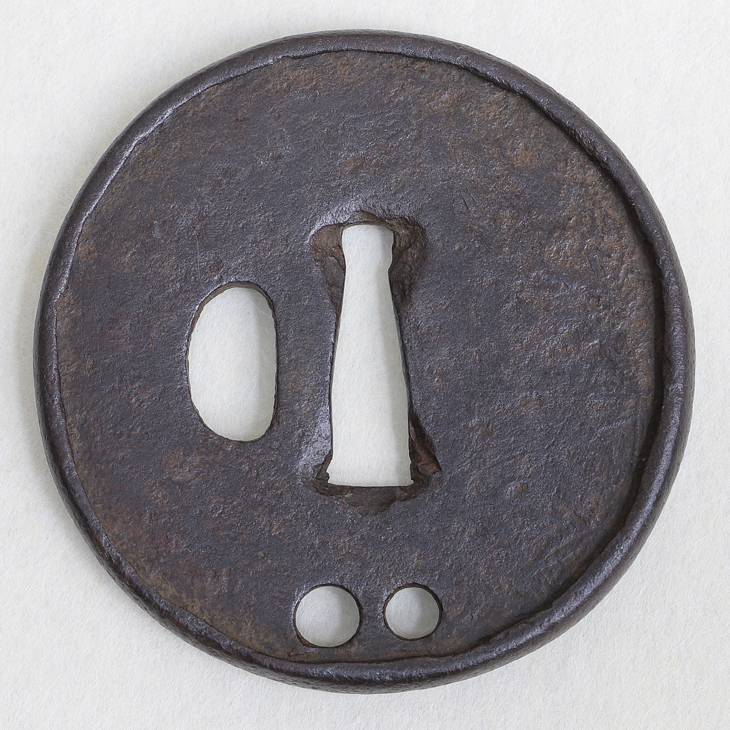 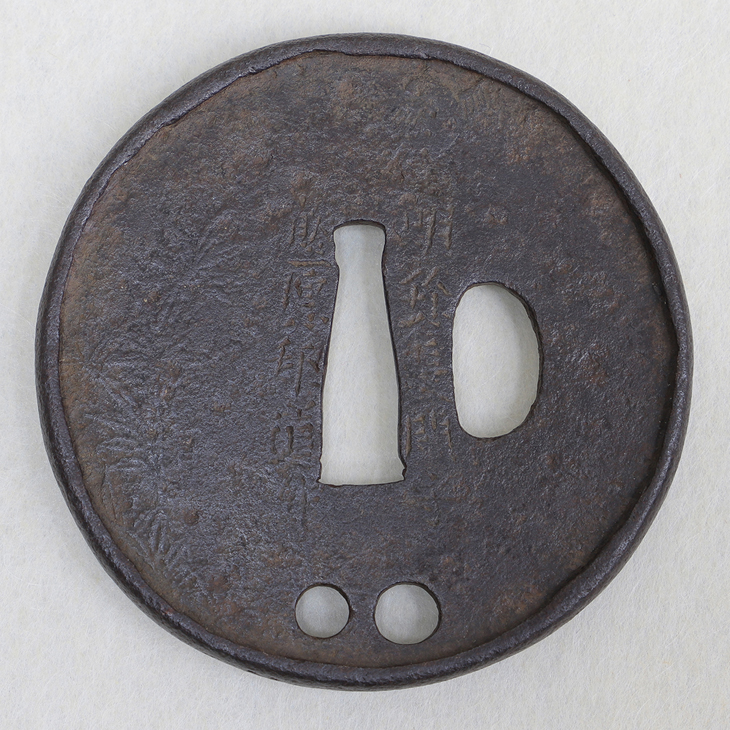 |
'MYOCHIN NAGATO no KAMI FUJIWARA KUNIMICHI' $1000.00
"Hammer mark pattern on well-tempered iron ground, maru gata, with bamboo pattern carving. Mei: 'MYOCHIN NAGATO no KAMI FUJIWARA KUNIMICHI'. This is H 03612.0 in the Haynes Index. A tsuba craftsman working in Kanda in Edo ca. 1700-1750." (Haynes & Long) 7.65cm x 7.57cm x 0.40cm |
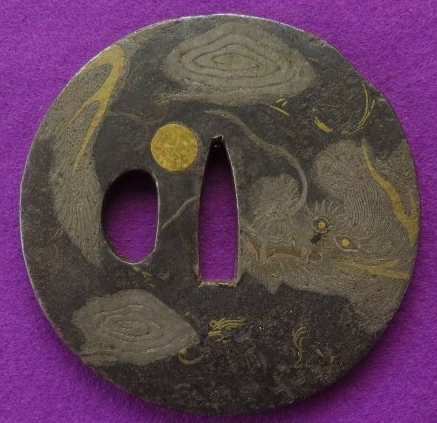 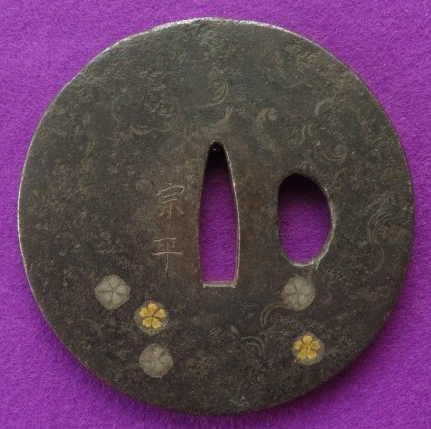 |
'MUNEHIRA' $800.00
"A round iron tsuba with inlays of a dragon and folage design. A wonderful example of this tsubaco's work. Signed: 'MUNEHIRA'. Refer to Haynes Index H06063.0." (Haynes & Long) 7.90cm x 7.90cm x 0.50cm |
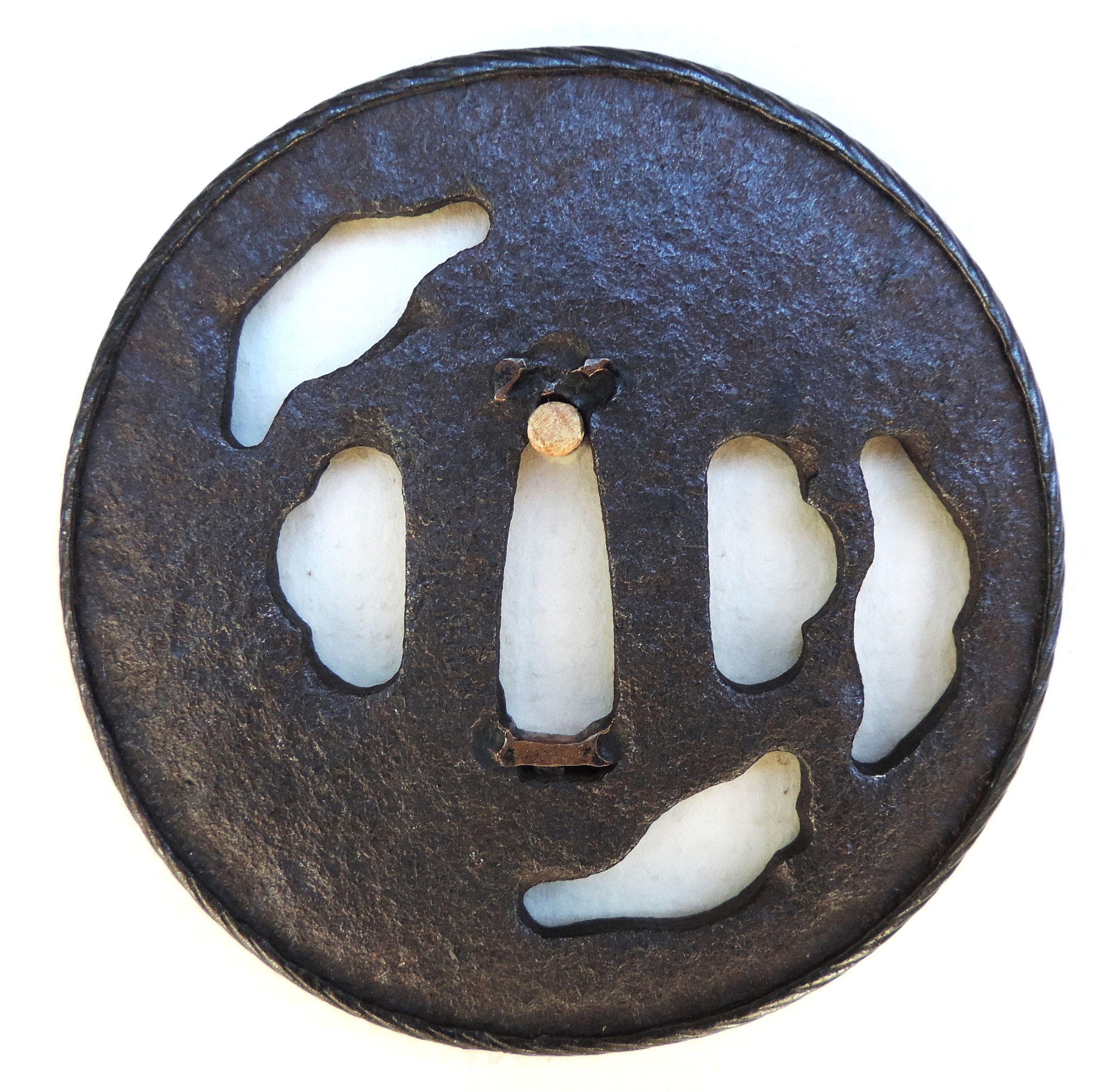  |
'SHIGENOBU' $800.00
"Iron plate with rope styled shakudo fukurin. The three openings depict clouds possibly. Both hitsu kogai shape. Signature: 'SHIGENOBU'. This is the Myochin Shigenobu who worked in the Kozuke Province." (Long) 7.65cm x 7.70cm x 0.35cm |
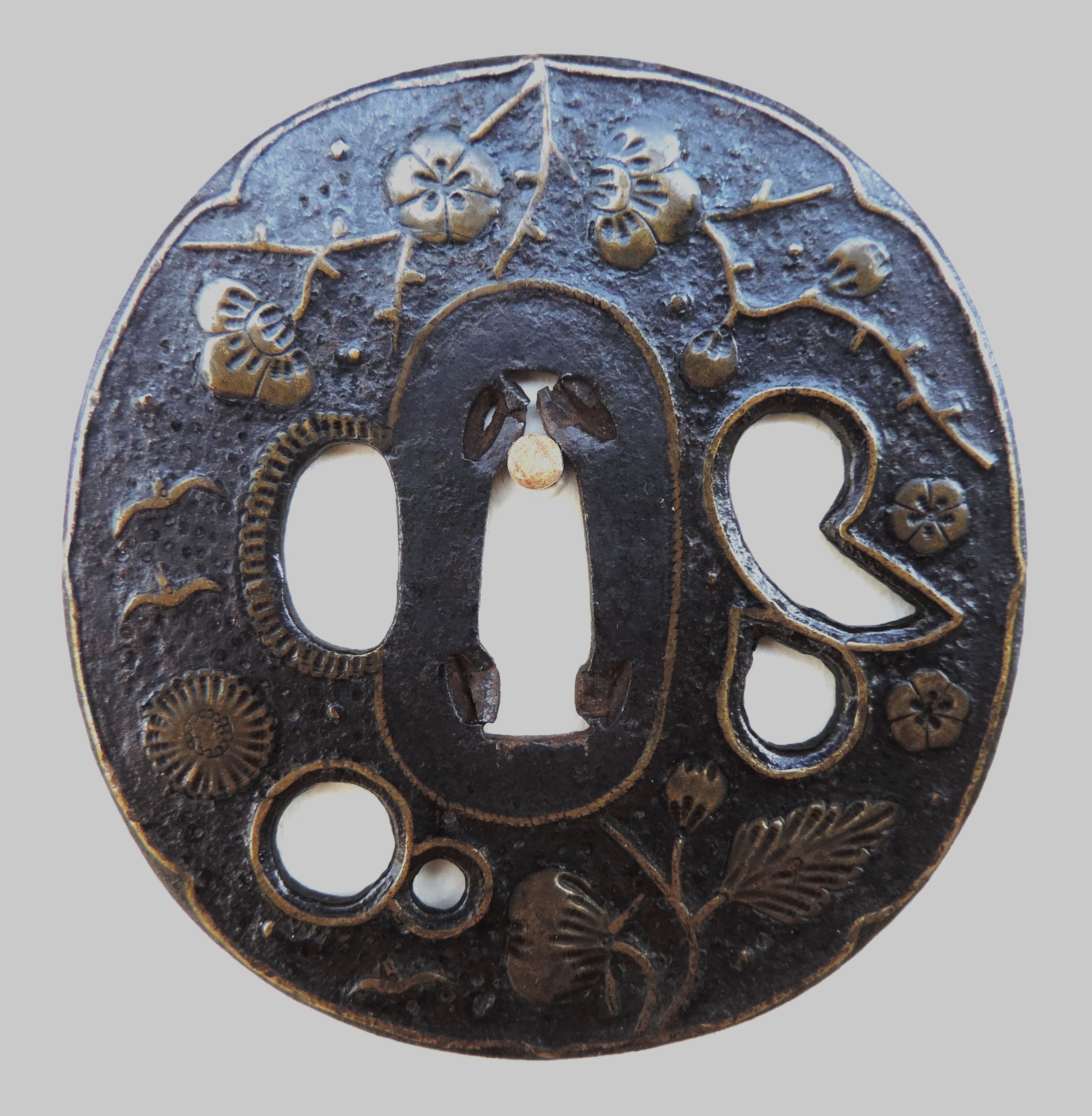
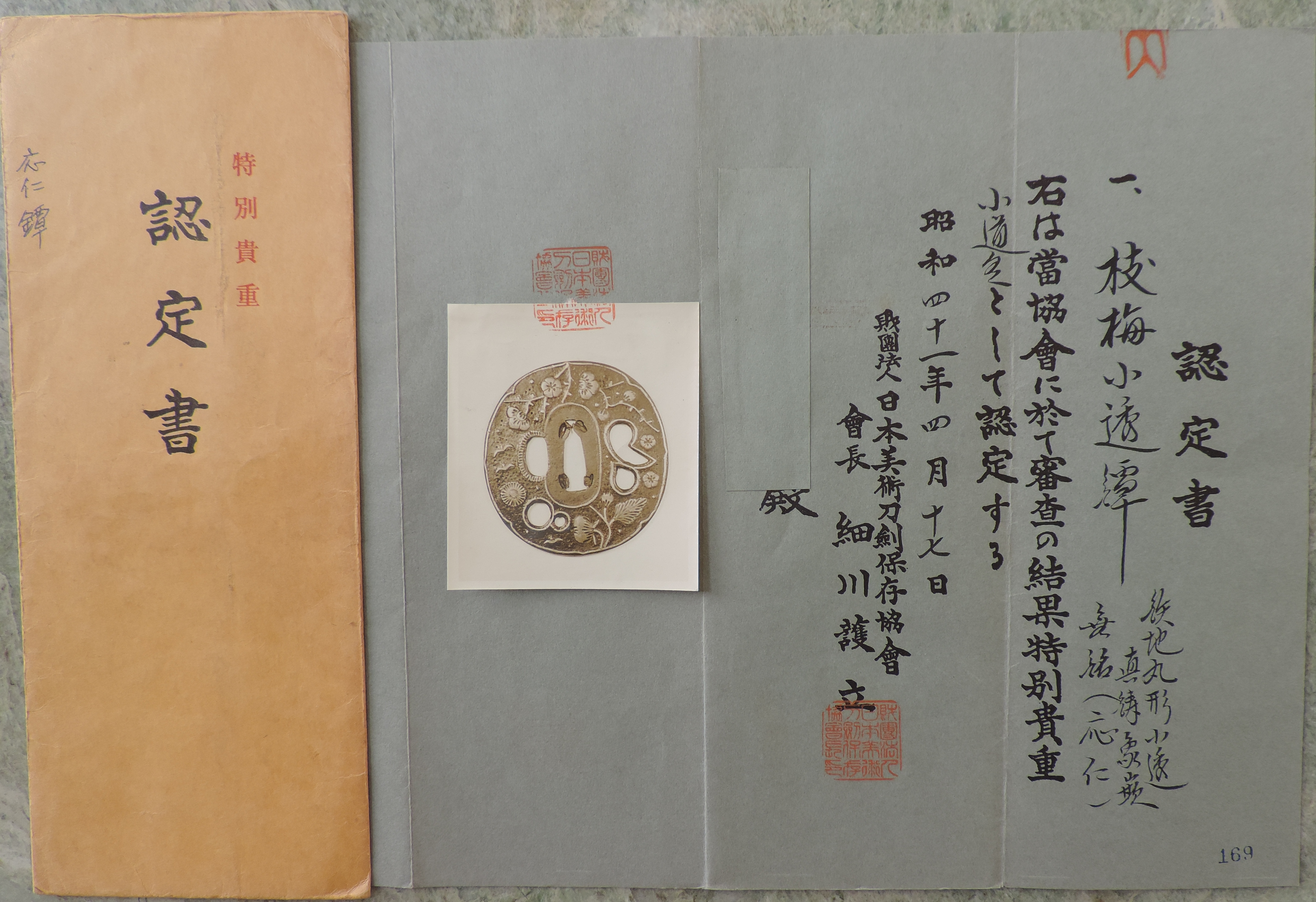
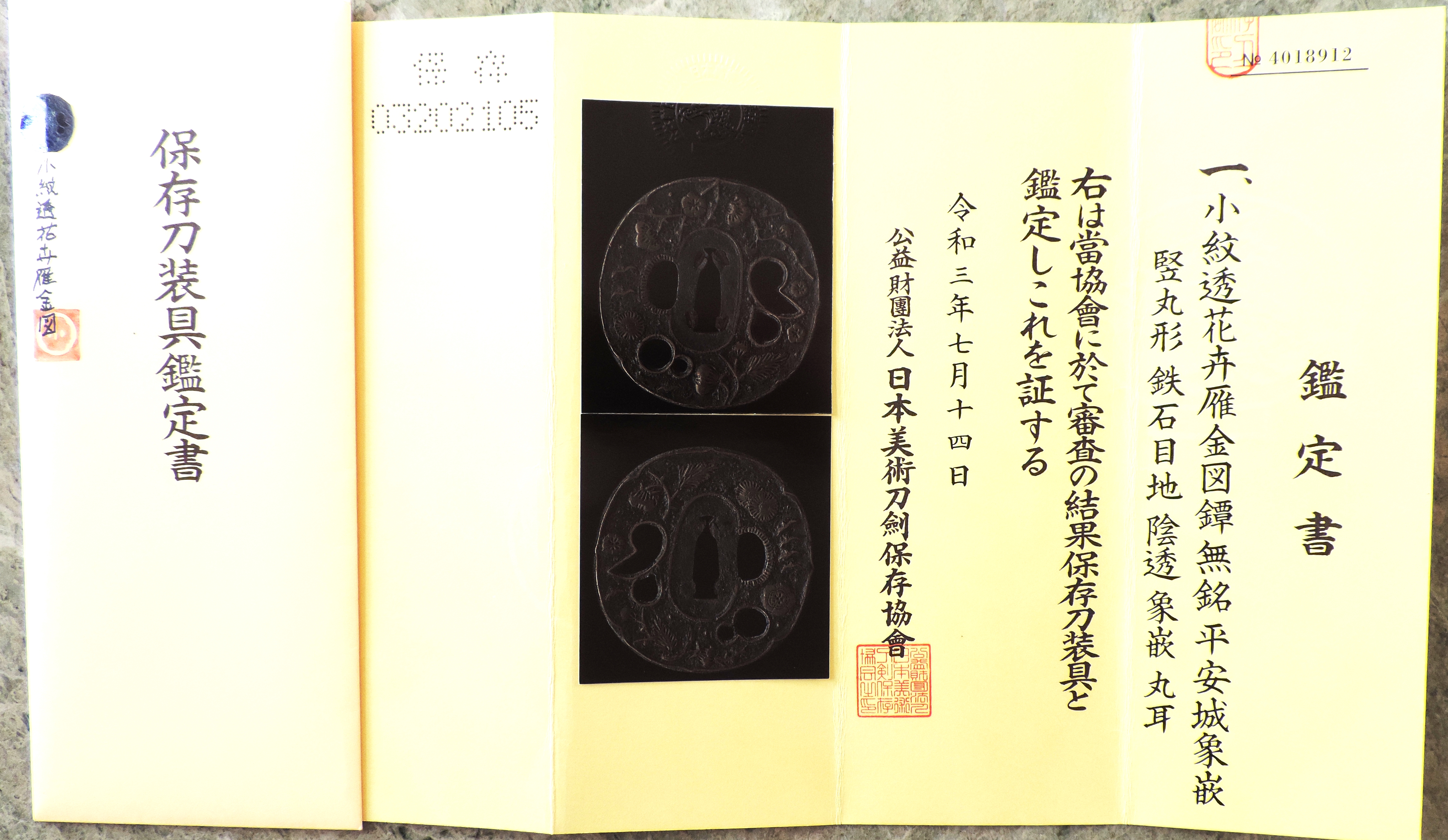
The term "Onin tsuba" is well known. The full definitions for the two types of Onin tsuba are: Onin shichu suemon-zogan tsuba, and Onin shinchu ten-zogan tsuba. These two names refer to the style of inlay employed in the decoration of Onin tsuba. Both types were made at Kyoto (prior to the making of Heianjo-zogan tsuba in Kyoto) from the Onin era (1467-1468) to the Tenmon era (1532-1554), though there are cast brass tsuba inlayed tsuba of the Edo age which seem to be the last vestiges of this school.
Since tradition decrees that brass was first imported from China in the Eikyo era (1429-1441), it is natural that it should be employed in the decoration of tsuba shortly thereafter. It was both new and novel, and because of its great monetary value was regarded as rich and valuable material for the enrichment of tsuba. At the height of its production, the Onin tsuba was the most sought after style. The color of the brass of the Onin tsuba is most important. It is rich and deep in color, not the shallow yellow color of the native metal used in the Edo age. The imported metal is far superior in quality to the later native brass of the Edo age.
   |
ONIN Please Contact Us For Price |
  |
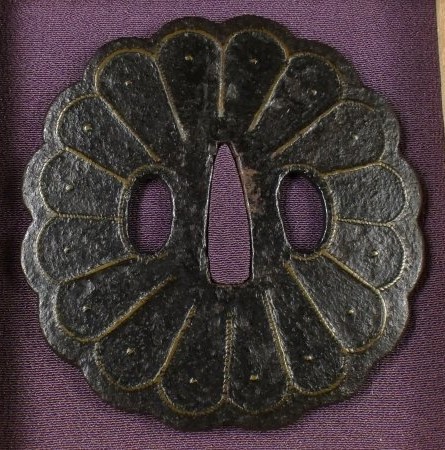
ONIN/HEIANJO
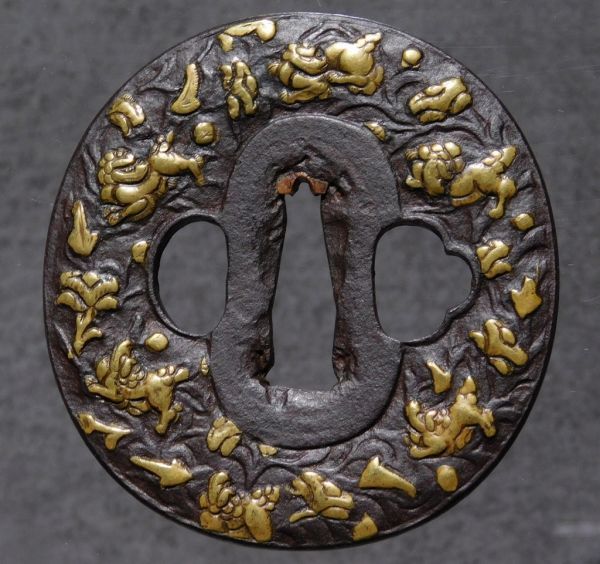
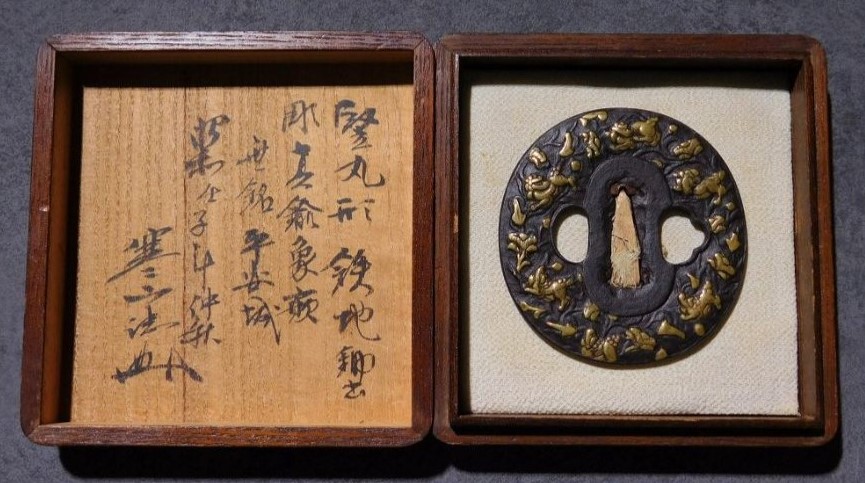
Please Contact Us For Price "A masterpiece of Heianjo style tsuba. The lion and peonies are old-fashioned and interesting. The stubby face and shape of the seppa-dai also confirms the age dating ca.1400-1450. There is a border, so you can see that the two hitsu are naive. Seems to date to the end of the Muromachi period. There is no missing inlay. Attributed with Hakogaki by Dr. Sato Kanzan, dated mid-Summer 1972. Box lid states 'Heianjo Style'." (Haynes & Long) |
  |
ONIN
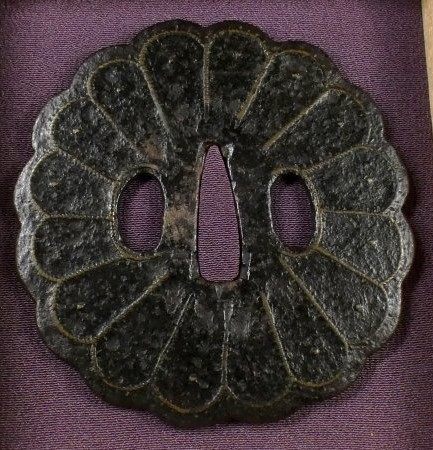
Please Contact Us For Price "Chrysanthemum flower design on excellent forged iron from the Muromachi period. The age of the Onin inlaid brass confirms the age to ca.1500." (Long) 8.34cm x 8.09cm x 0.31cm |
  |
ONIN
Please Contact Us For Price "Excellent quality Onin Tsuba "Nakachigaimon Openwork". This is a thin, large-sized tsuba with a richly patinated finish. While some of the dot inlay has fallen off, it is in excellent condition. The openwork appears to be a chigi or nakachigaimon pattern. Onin tsuba are items that were produced mainly in Kyoto from the Muromachi and Onin periods, this one dated ca.1400, and the term first came into use in the Meiji period. It is characterized by brass inlay of dots and lines on a thin iron base, and often has small openwork designs added." (Long) 8.80cm x 8.70cm x 0.28cm |
  |
ONIN
Please Contact Us For Price "Onin tsuba is a thin plate tsuba with brass dots inlaid at regular intervals in a circular pattern and geometric pattern of a horn drawn with line inlay. It is said that the tsuba craftsmen in Yamashiro Province began making these tsuba around the time of the Onin period in the early Muromachi period (1400), and the more dots inlaid around the circumference, the better the quality. This tsuba has three layers. It has passed the Hozon Tosogu shinsa in 2020." (Long) 8.52cm x 8.52cm x 0.50cm |
  |
ONIN
Under Study "Presented here is an iron eight flower-shaped (yatsu mokko-gata) Onin tsuba with one hitsu-ana. There is no missing inlay. Unlike the shining gold inlay, the countless dots of astringent brass that match the rust color of the iron make the depth of the era more pronounced. It is an extremely rare gem among Onin tsuba. Dates to the Muromachi period, ca.1450." (Long) 8.52cm x 8.52cm x 0.50cm |
  |
ONIN
Please Contact Us For Price "Muromachi period Onin tsuba with Nine Stars Pattern. Iron base, Yagi-guri (gourd-shaped) shape, square-edge edges, small indentations, and brass inlay. The base is well-forged and moist, with faint steel grain visible in some areas. While the brass inlay has some missing areas, the circular nine-star inlay remains in good condition." (Long) 9.10cm x 9.17cm x 0.44cm |
  |
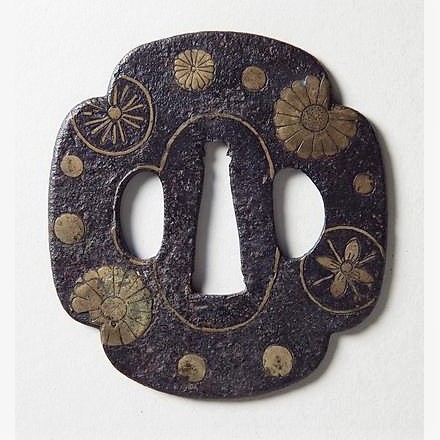
ONIN/HEIANJO
Please Contact Us For Price "The iron plate is surrounded by a brass ring that resembles bamboo. The three-ring design; iris, chrysanthemum, ivy, and maple motifs are scattered throughout. The mon of the ABE family is also displayed." (Long) 9.02cm x 9.02cm x 0.30cm |
 |
ONIN $1000.00 |
  |
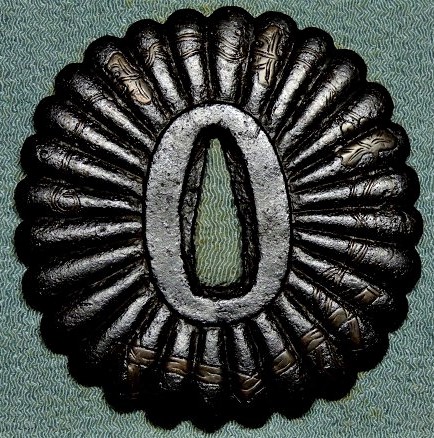
HEIANJO Tsuba Please Contact Us For Price |
 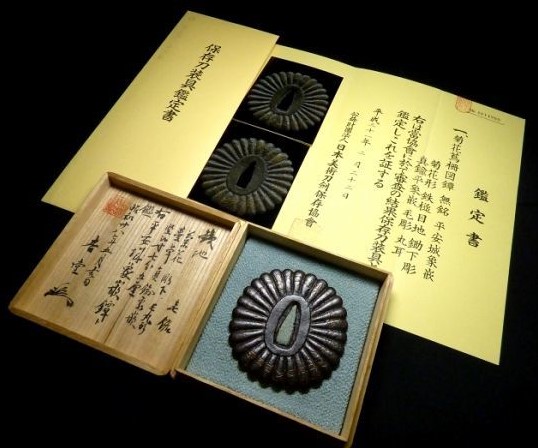 |
KAGA HEIANJO Tsuba $6000.00 |
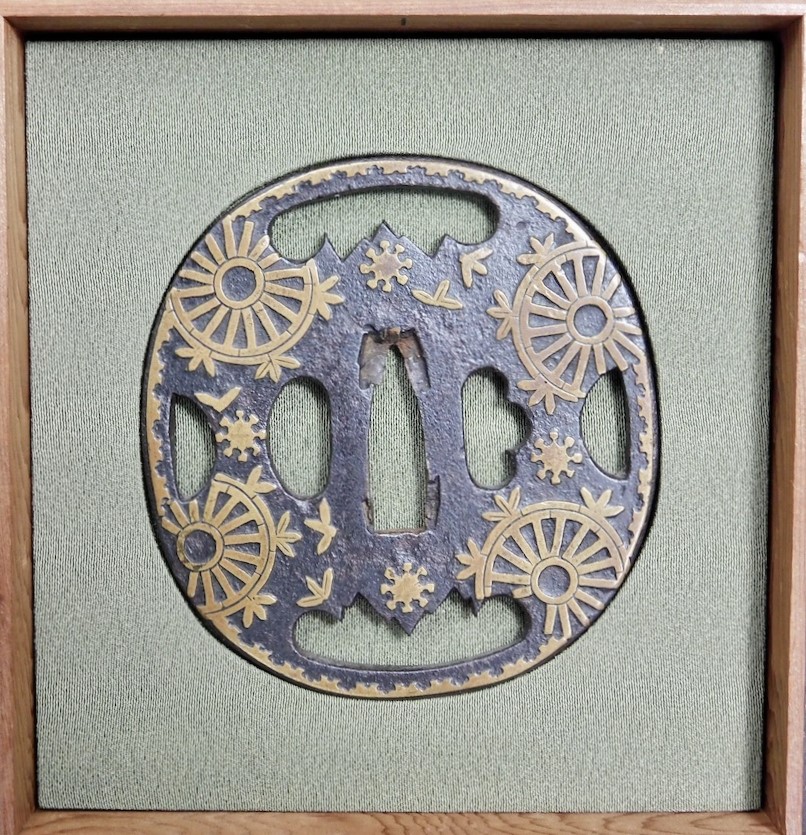  |
HEIANJO Tsuba $1700.00 |
  |
KYO HEIANJO |
  |
EDA KIKU ZU |
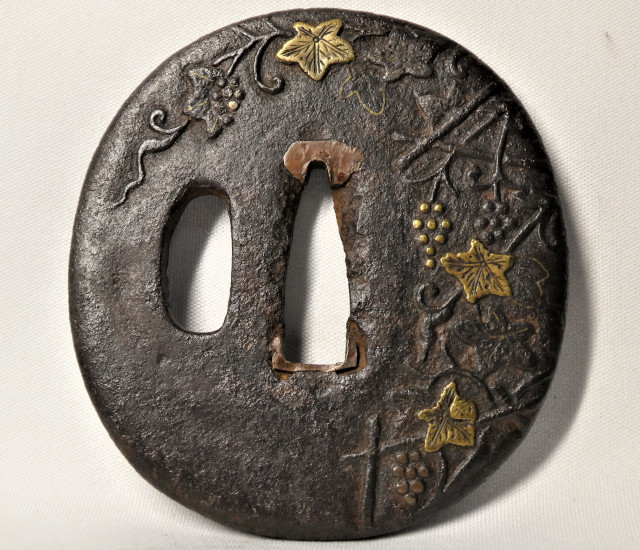 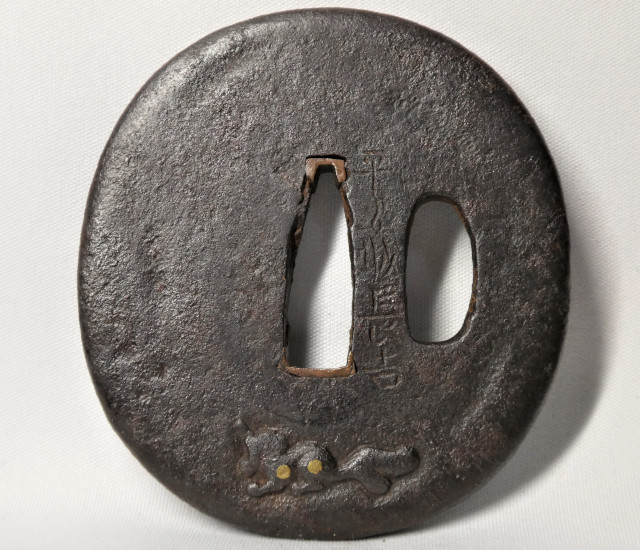 |
'HEIANJO CHOKICHI' |
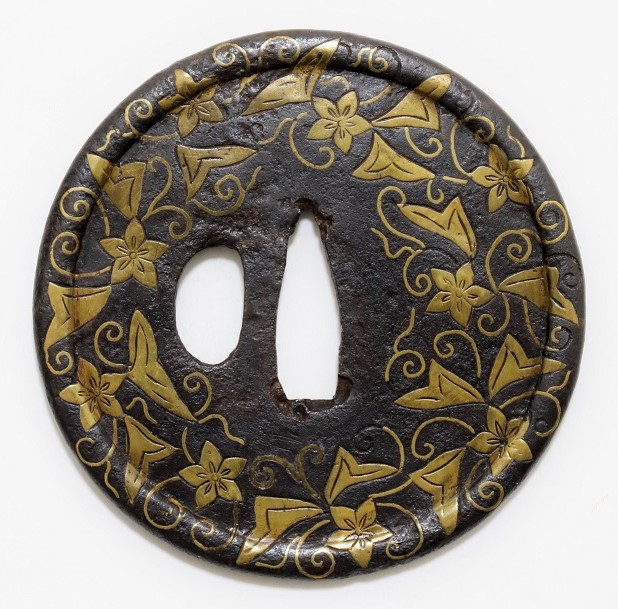 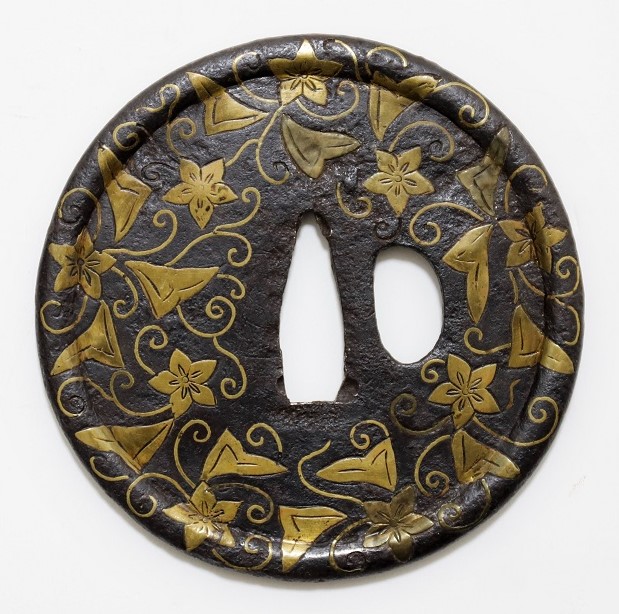 |
KIKYO KARAKUSA Please Contact Us For Price
|
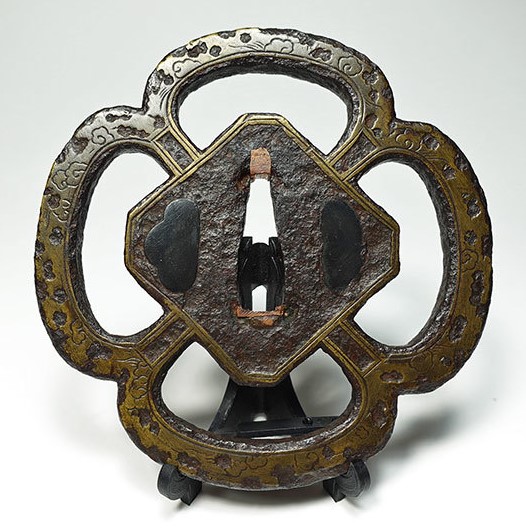 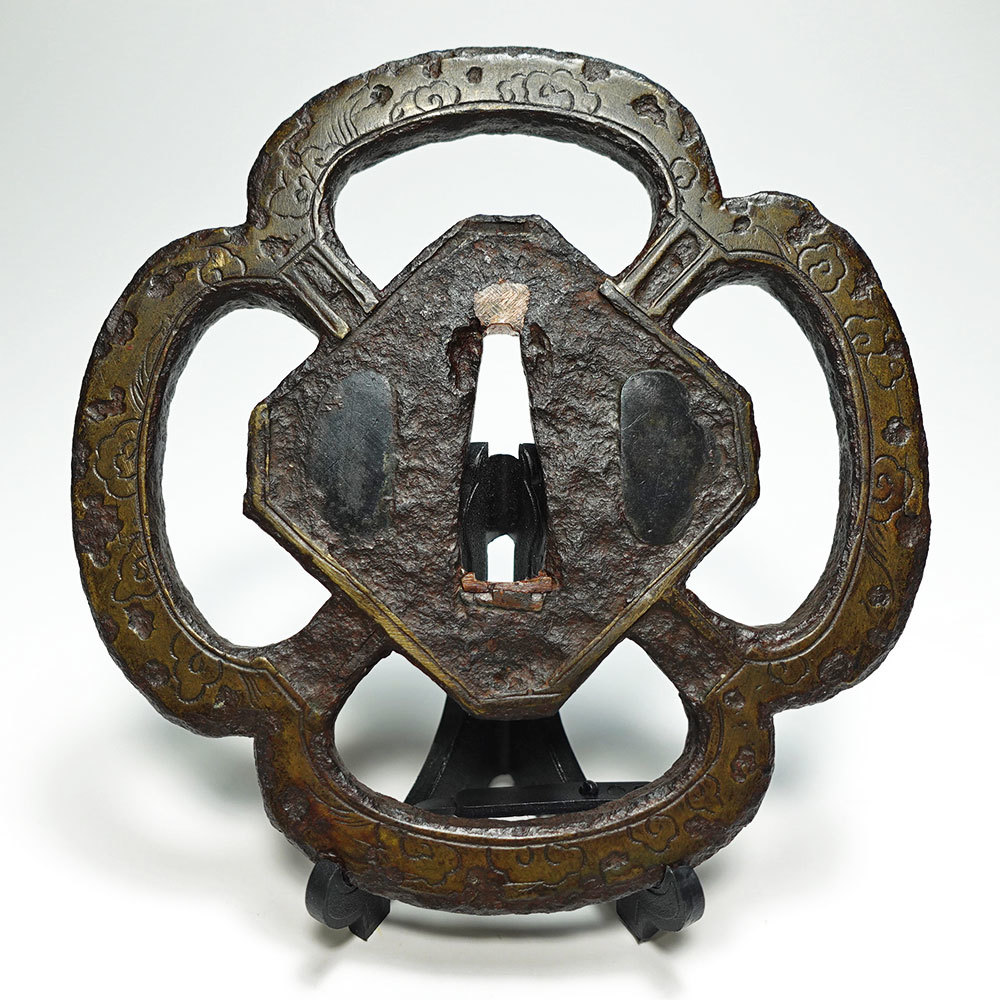 |
SENDAI (Heianjo) |
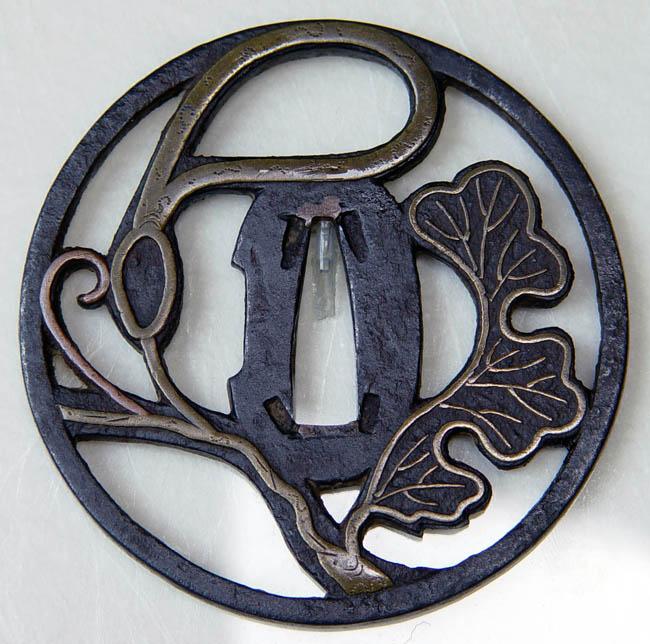 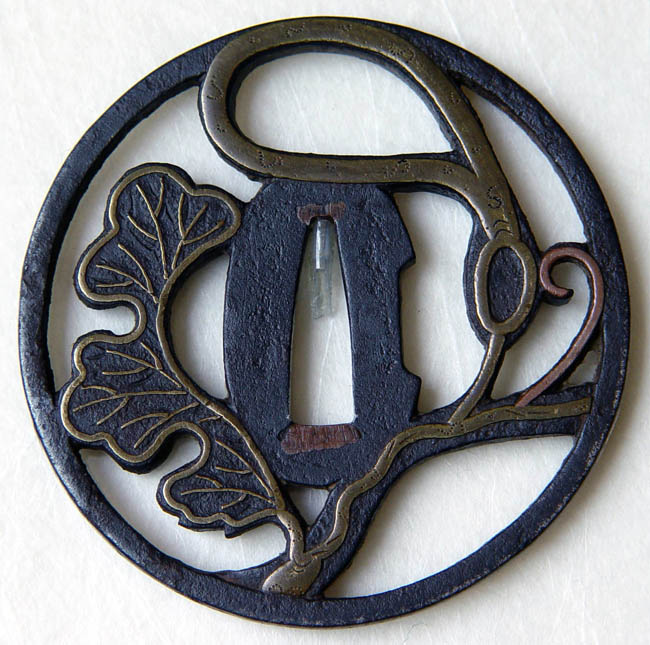 |
HEIANJO EGGPLANT |
  |
HEIANJO ZOGAN |
KYO-SUKASHI, HEIANJO/ SUKASHI
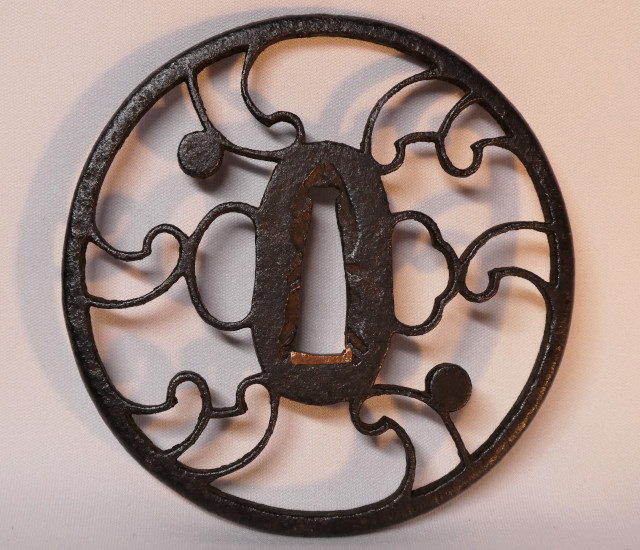
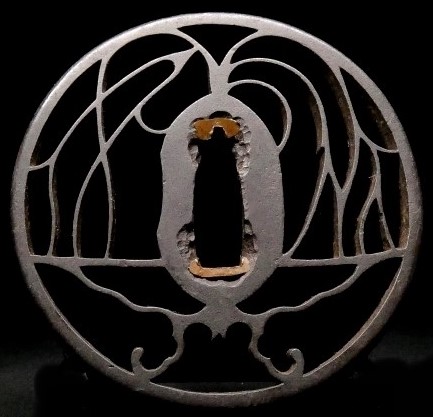
KYO-SUKASHI & HEIANJO SUKASHI Tsuba:
It is said by tradition that the sukashi tsuba was invented in the middle Muromachi age at the time of the Yoshinori Shogunate (1428-1441). This idea was suported by Akiyama, Wada Tsunashiro and others. However, the work of the Kyo-sukashi and Heianjo sukashi schools was not this early. They seem to have originated in the Eisho era (1504-1520). The work produced in this gap of time has not been found as yet. The tsuba that Akiyama used as his example of the earliest Kyo-sukashi tsuba, made in the middle Muromachi age, in reality is not as old as he had thought. It is most certainly an example of the first period of Kyo-sukashi tsuba. It must be concluded that the first period of the Kyo-sukashi tsuba is from the late Muromachi to the early Momoyama age.
The Heianjo sukashi tsuba, though made at the same time as the first period Kyo-sukashi work, is slightly different in style but the two schools might be confused in some cases. There is undoubtedly some relationship between them but what it might be is not known. The openwork of both schools is complex and by the Edo age, the two styles had merged until it is impossible to distinguish the work of one school from the other.
Naturally the Heianjo sukashi school is closely related to the Heianjo zogan school. In fact, it would seem that the same artists produced either style interchangeably. From this fact it can be seen that a separation of the work in these two styles can be made only on the basis of the tsuba alone. In the second period of these two schools it is almost impossible to say which school might have made a given piece. In many cases it would seem that artists of both schools worked on a single tsuba, each restricted to his speciality; Kyo-sukashi the plate and Heianjo the inlay decoration. For this reason the brass inlaid tsuba of this group are all called Heianjo work and the openwork pieces are all called Kyo-sukashi regardless of who might have made them.
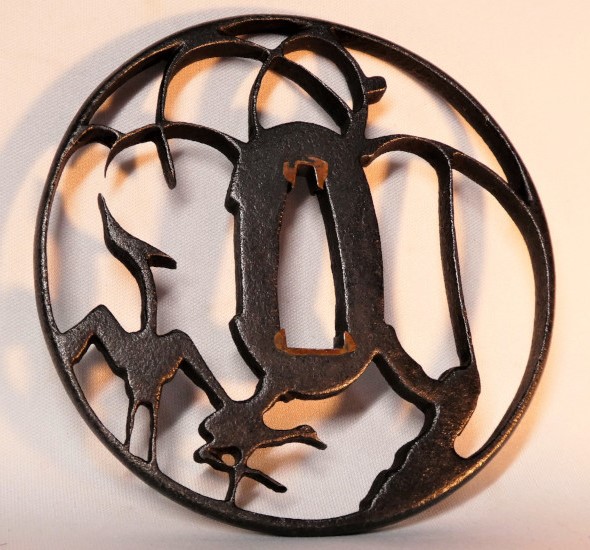 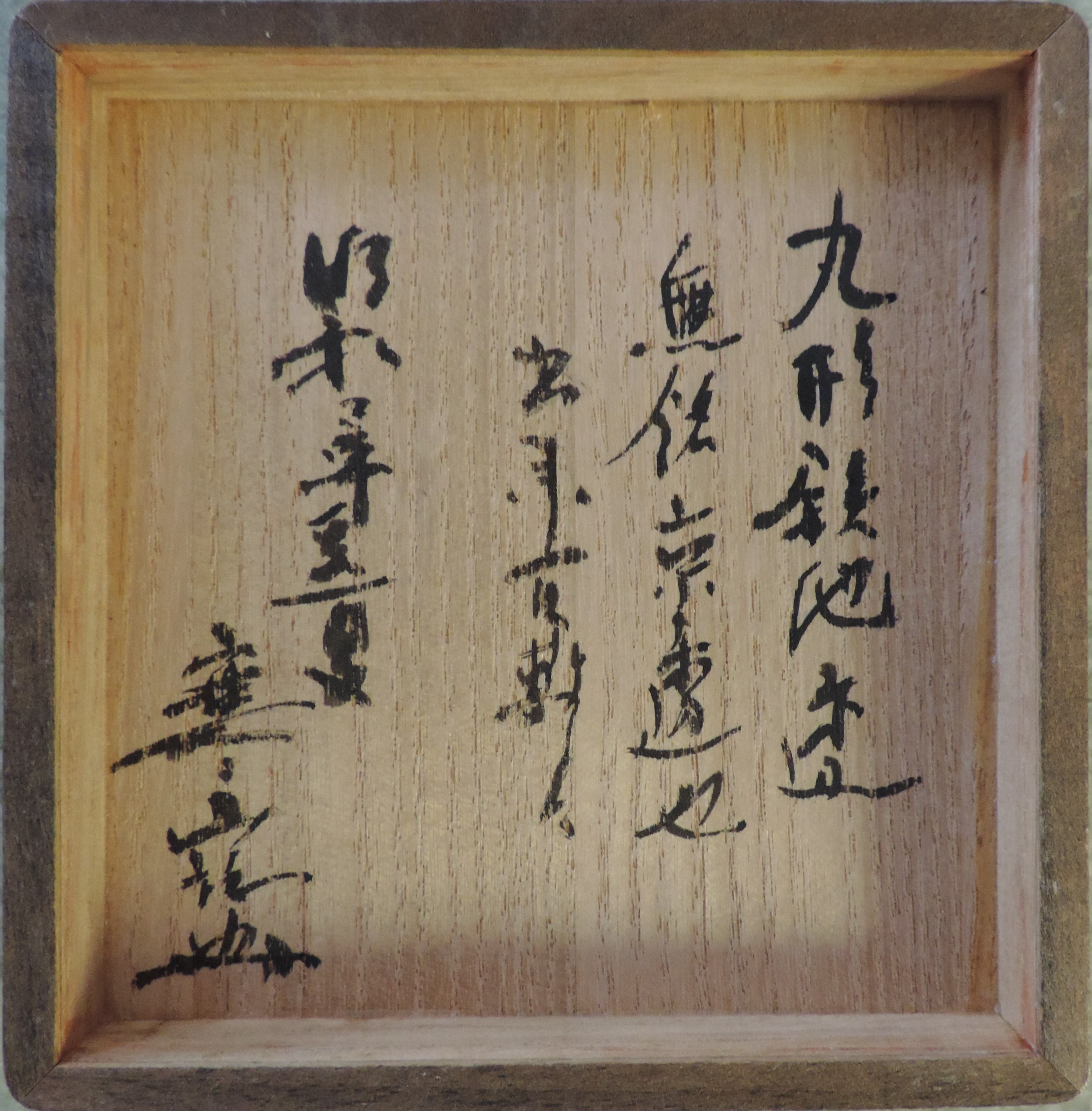 |
KYO-SUKASHI |
  |
KYO-SUKASHI |
  |
KYO-SUKASHI |
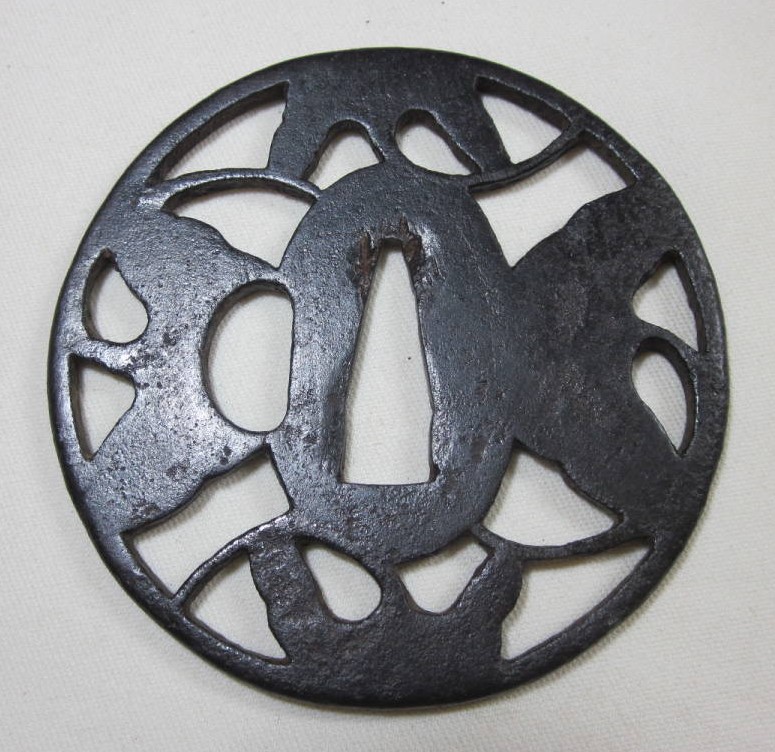 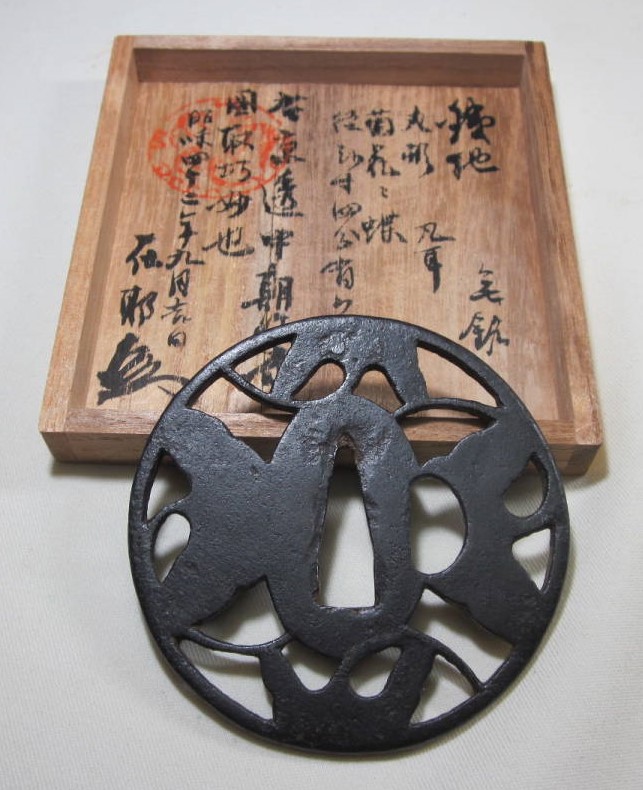 |
KYO-SUKASHI $2200.00 |
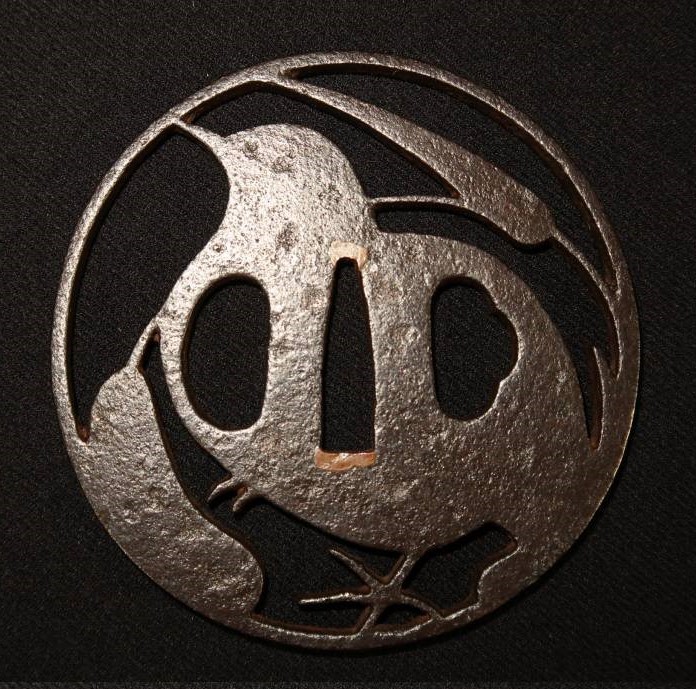 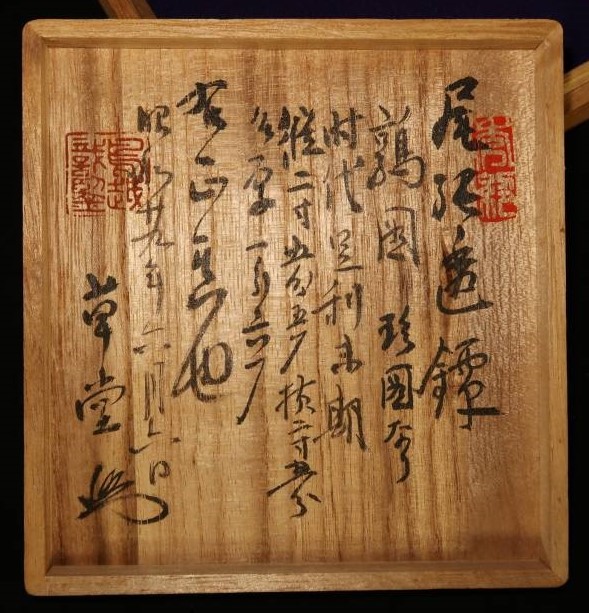 |
KYO-SUKASHI |
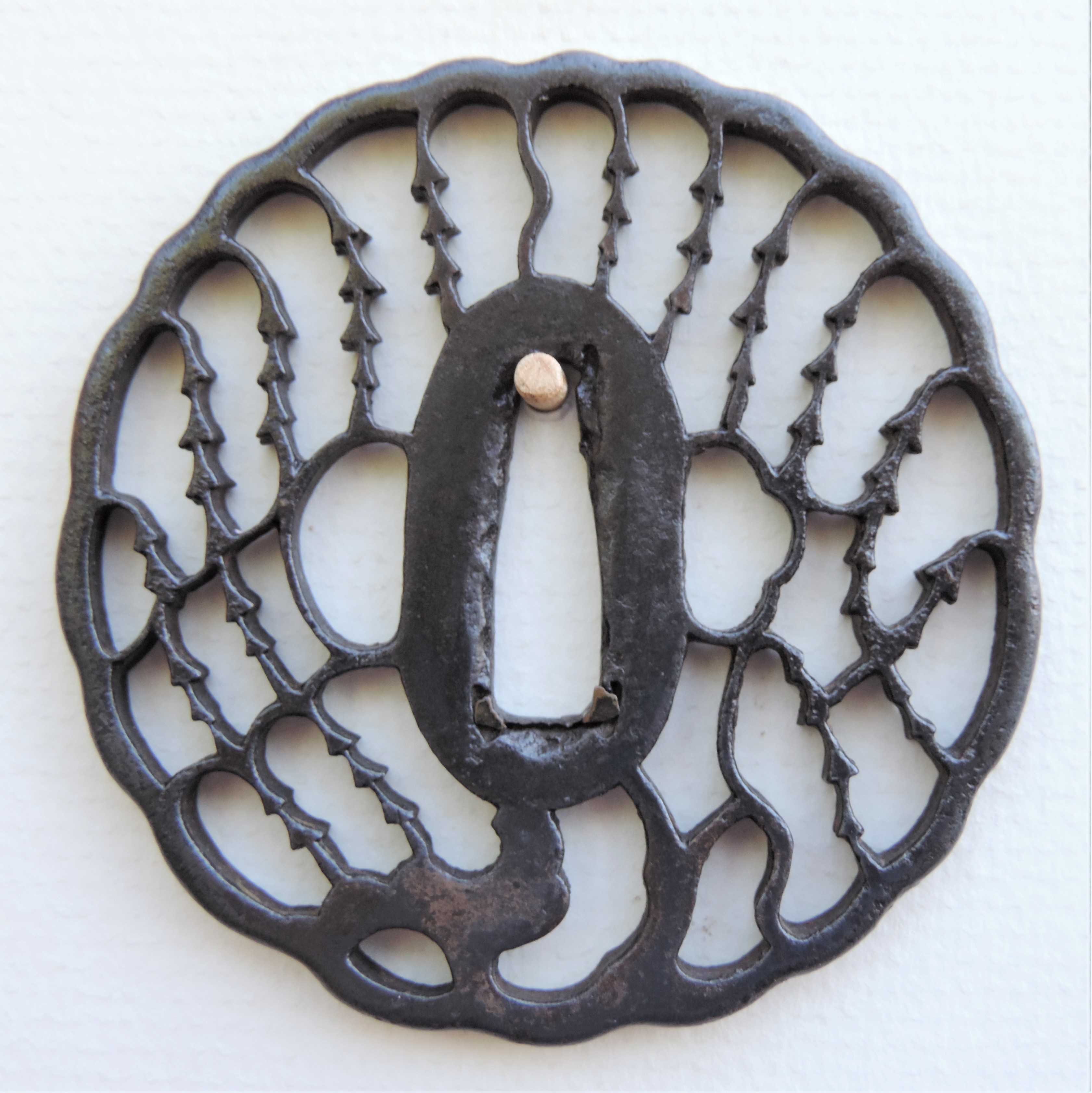 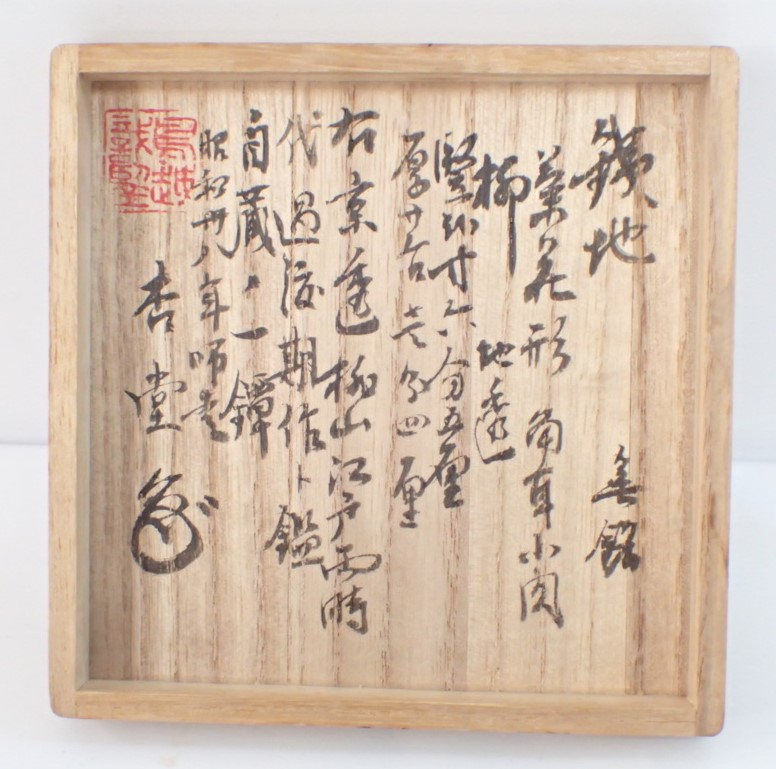 |
KYO-SUKASHI |
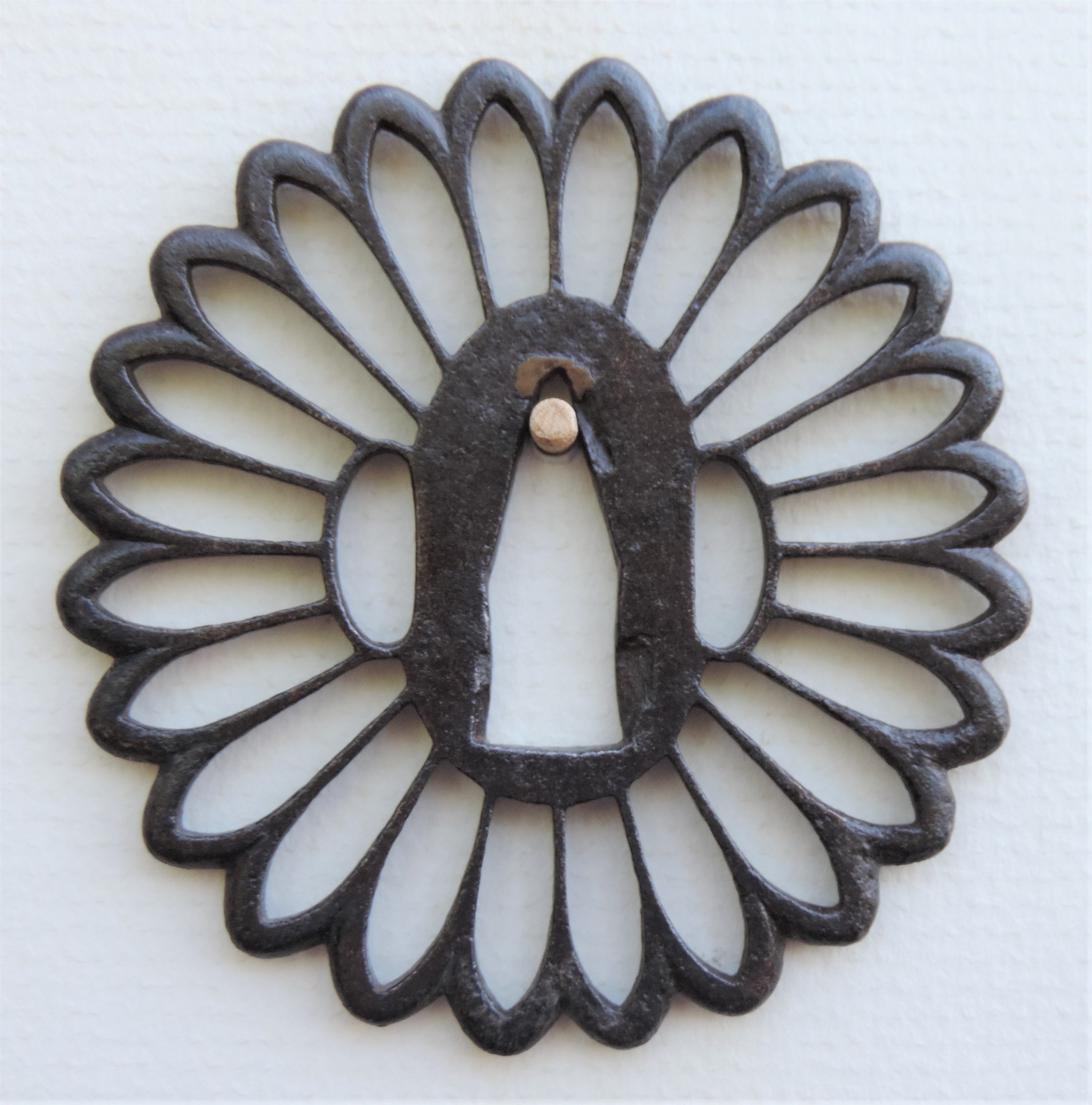 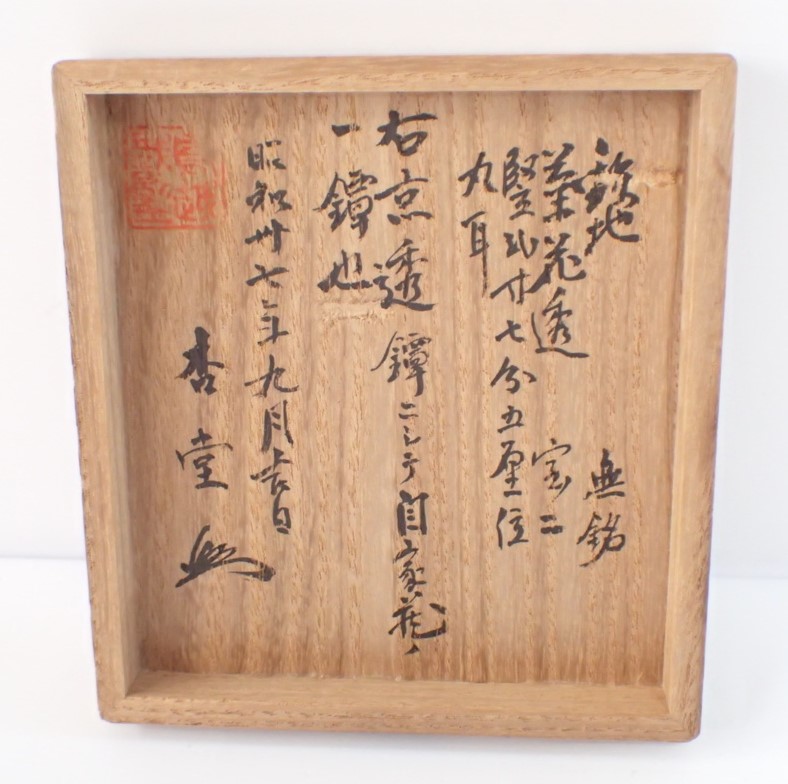 |
PROTO KYO-SUKASHI |
  |
KYO-SUKASHI |
  |
KYO-SUKASHI |
  |
KYO-SUKASHI |
  |
KYO-SUKASHI |
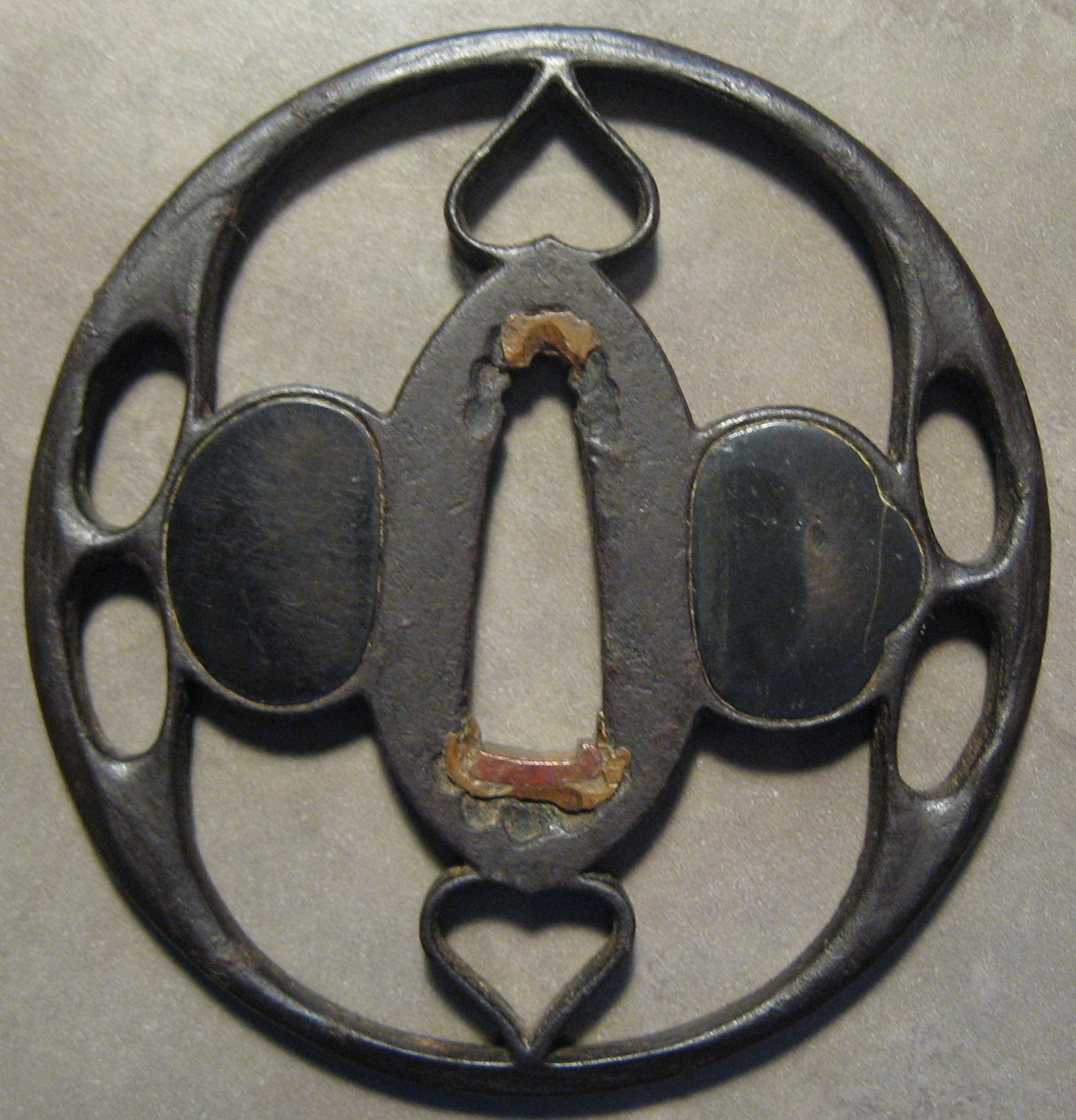 |
SUKASHI Tsuba |
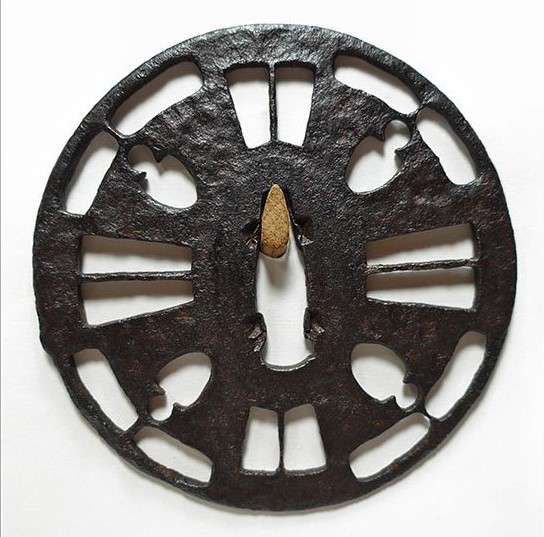 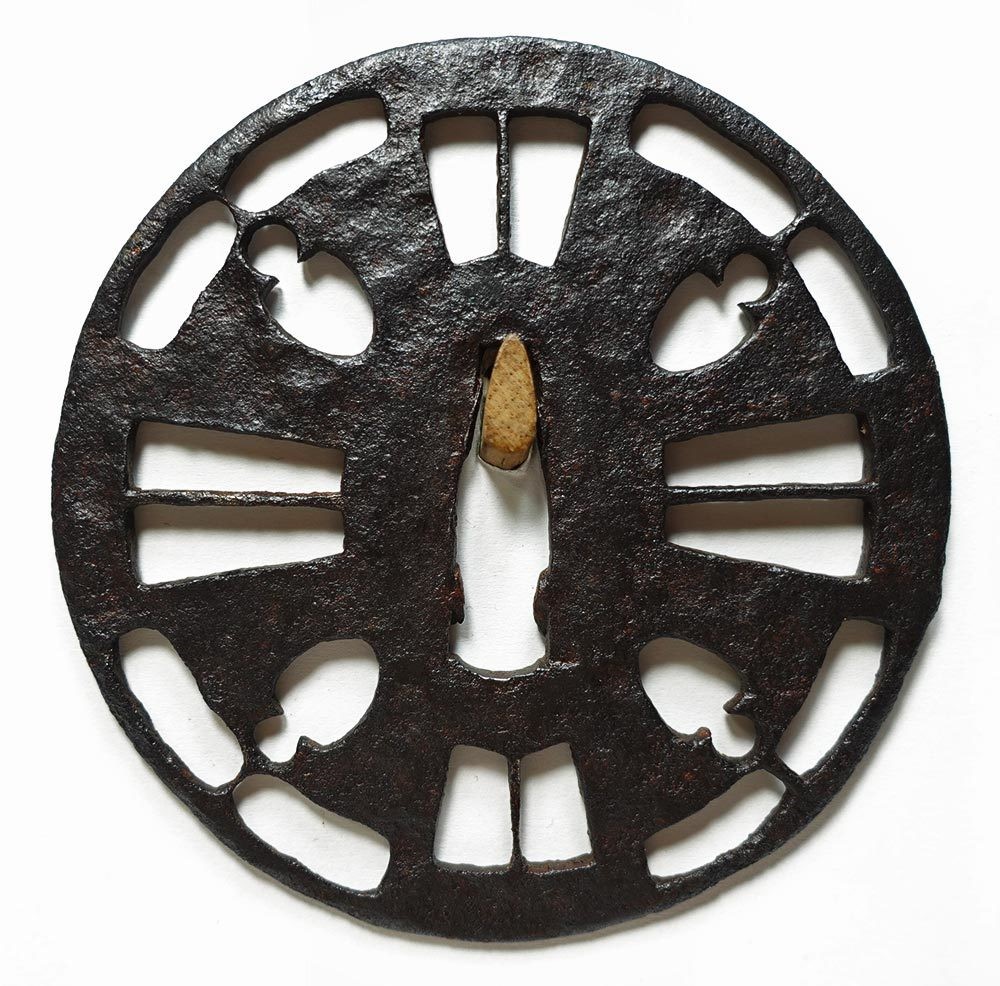 |
SUKASHI Tsuba |
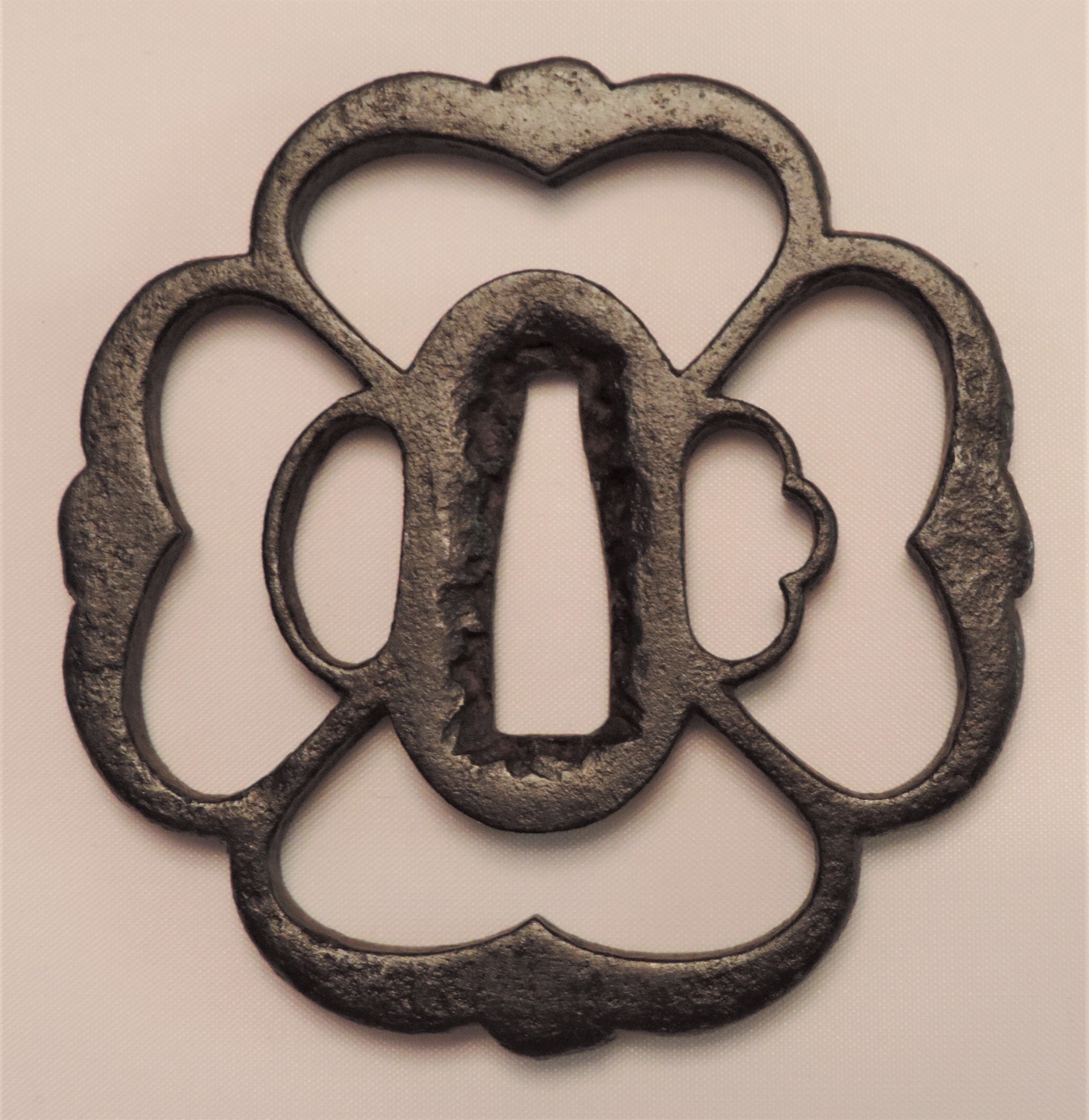 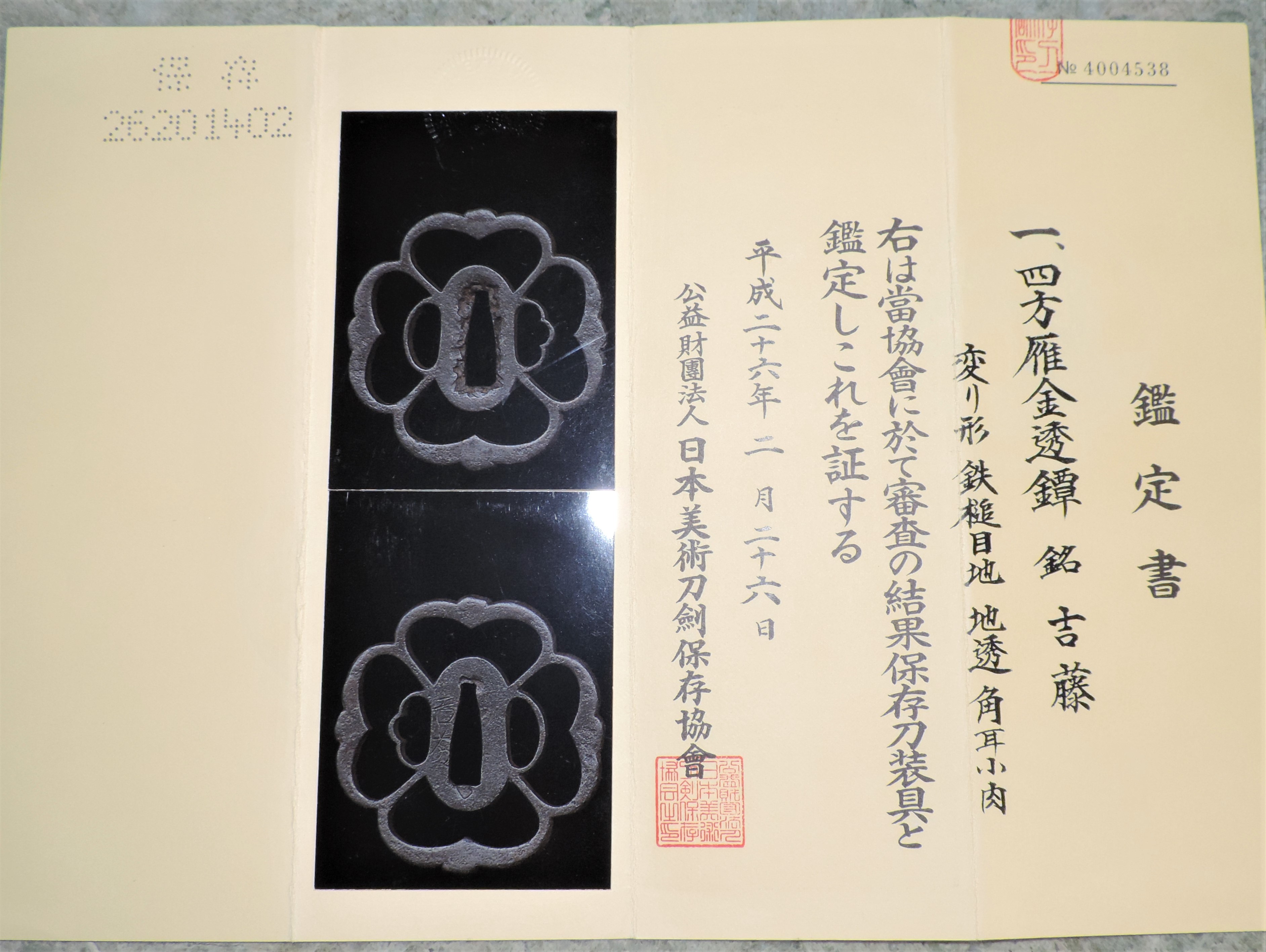 |
SUKASHI Tsuba |
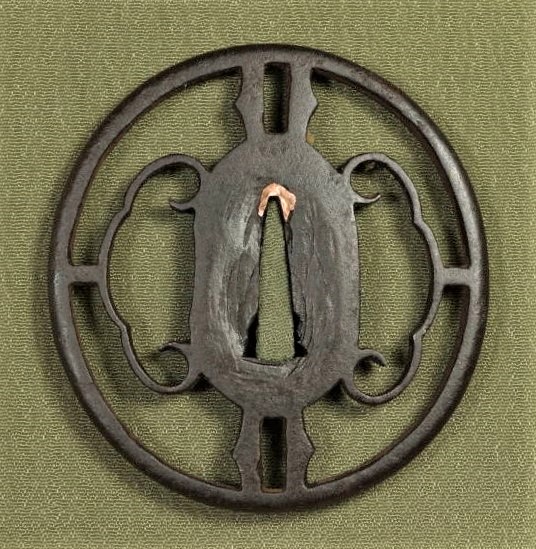 |
SUKASHI $200.00 |
Kamakura tsuba of the first period date from the early Muromachi age to the end of that age. The second period was an imitation of the first period. The style became more naturalistic and complicated in design in each successive period. It was the samurai class who kept this style alive for more than two hundred years. The samurai saw in the Kamakura tsuba his own ideal of taste and reserve.
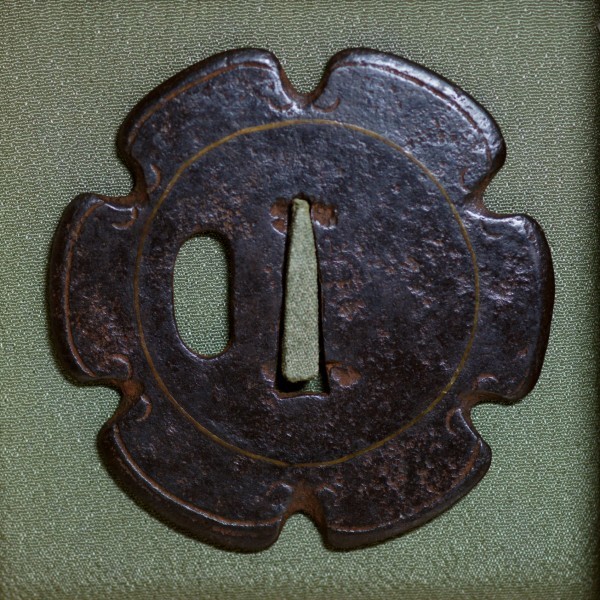 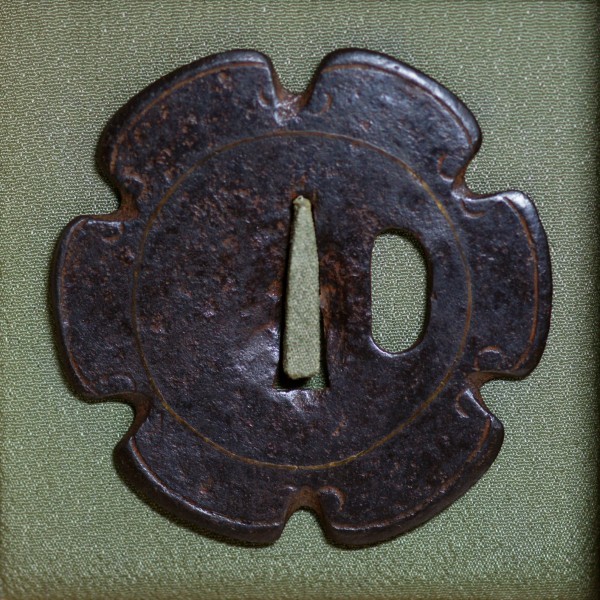 Price On Request |
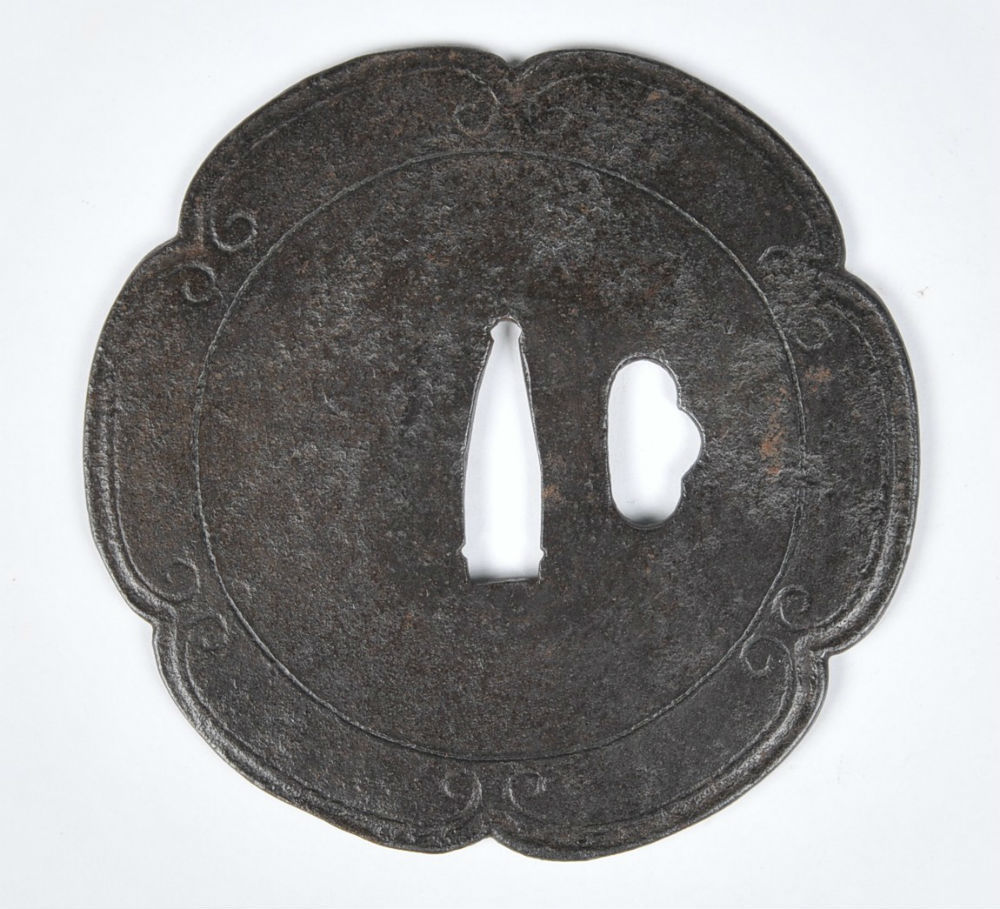 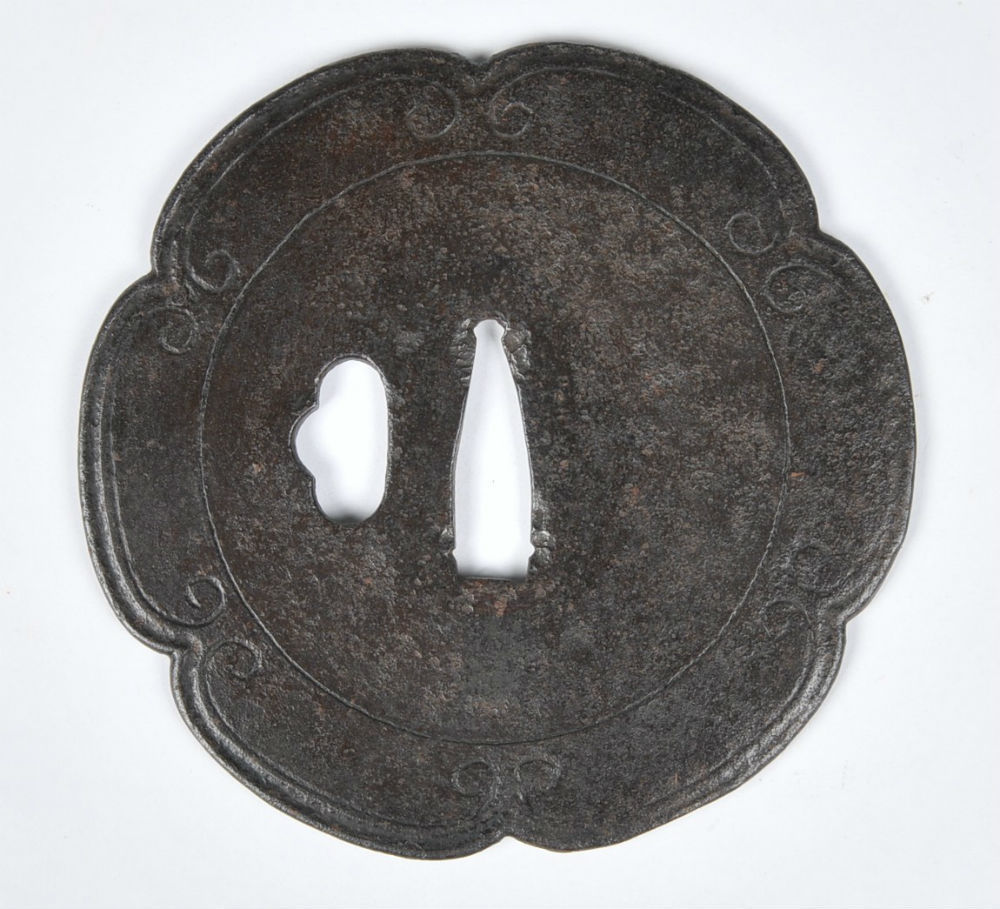 $5000.00 |
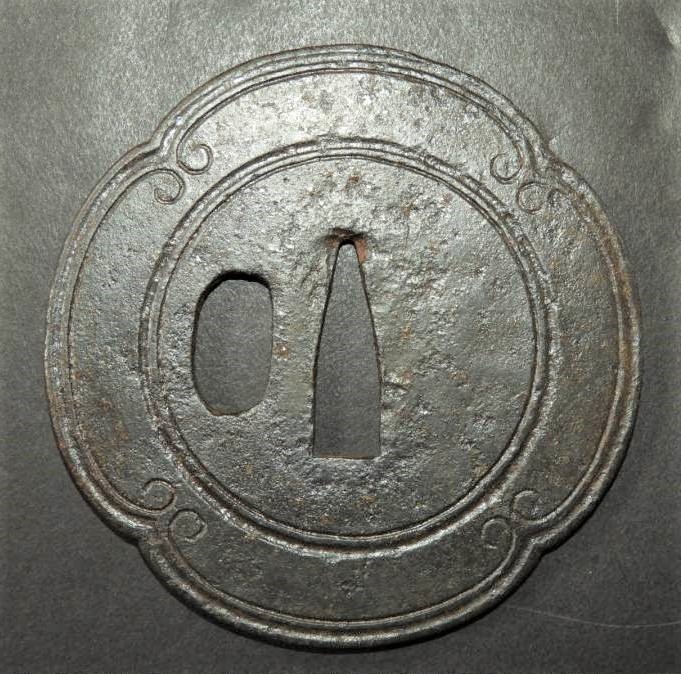 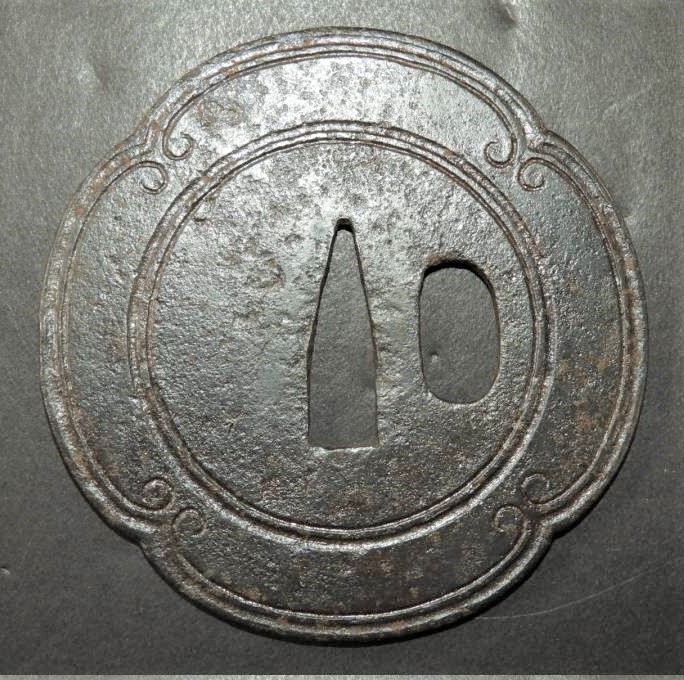 $4500.00 |
  $2500.00 |
  Please Contact Us For Price |
  SOLD |
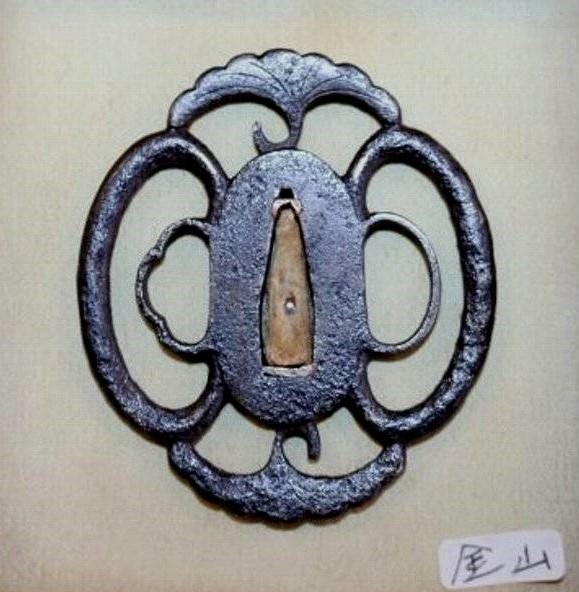
"A generally accepted characterization describes Kanayama guards in this way: they are thick; they have raised, squared rims with tekkotsu (iron bones) visible in the rims; their openwork design frequently defies interpretation; and they are often small." (Masayuki Sasano)
The late Akiyama, after intensive study, concluded that the place of production of Kanayama tsuba was in the province of Owari. He said, "Kanayama's name may be either the name of the family or the place they lived, I am not sure, but these tsuba are much admired and are very excellent and rare."
During their production the Kanayama style tsuba was very popular with the samurai. They were greatly appreciated, by all, for their simplicity, noble designs, and great strength. This school would seem to be the earliest to use ji-sukashi (positive silhouette).
The Kanayama tsuba is an excellent example of the best quality in the fundamental aesthetic principles of the tsuba. The best examples of this school stand in the first rank of the art of the tsuba.
 Please Inquire |
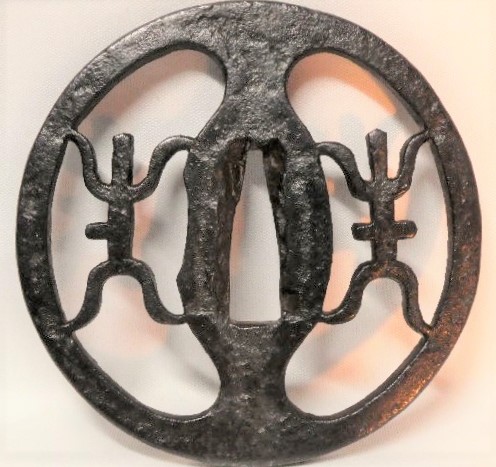 Please Inquire |
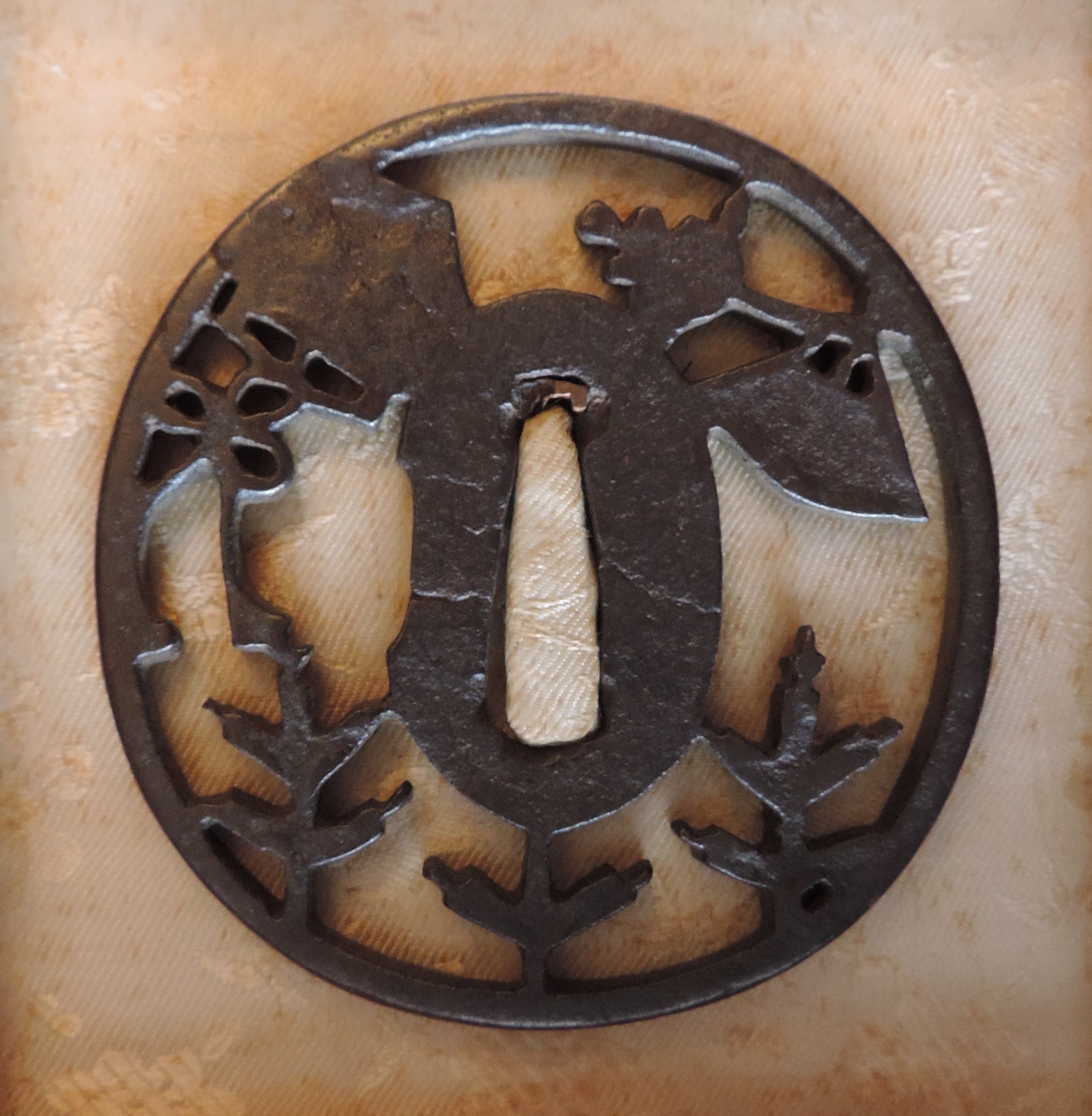 Please Inquire |
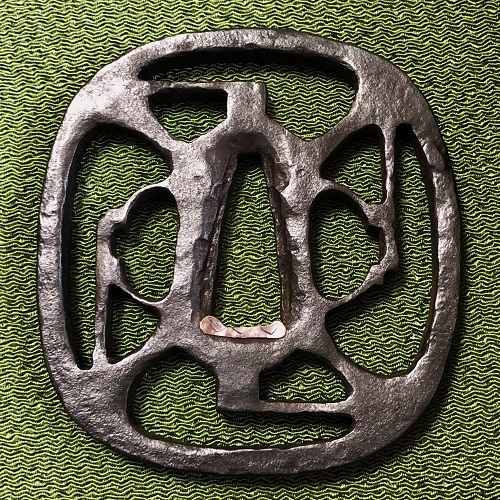 $2000.00 |
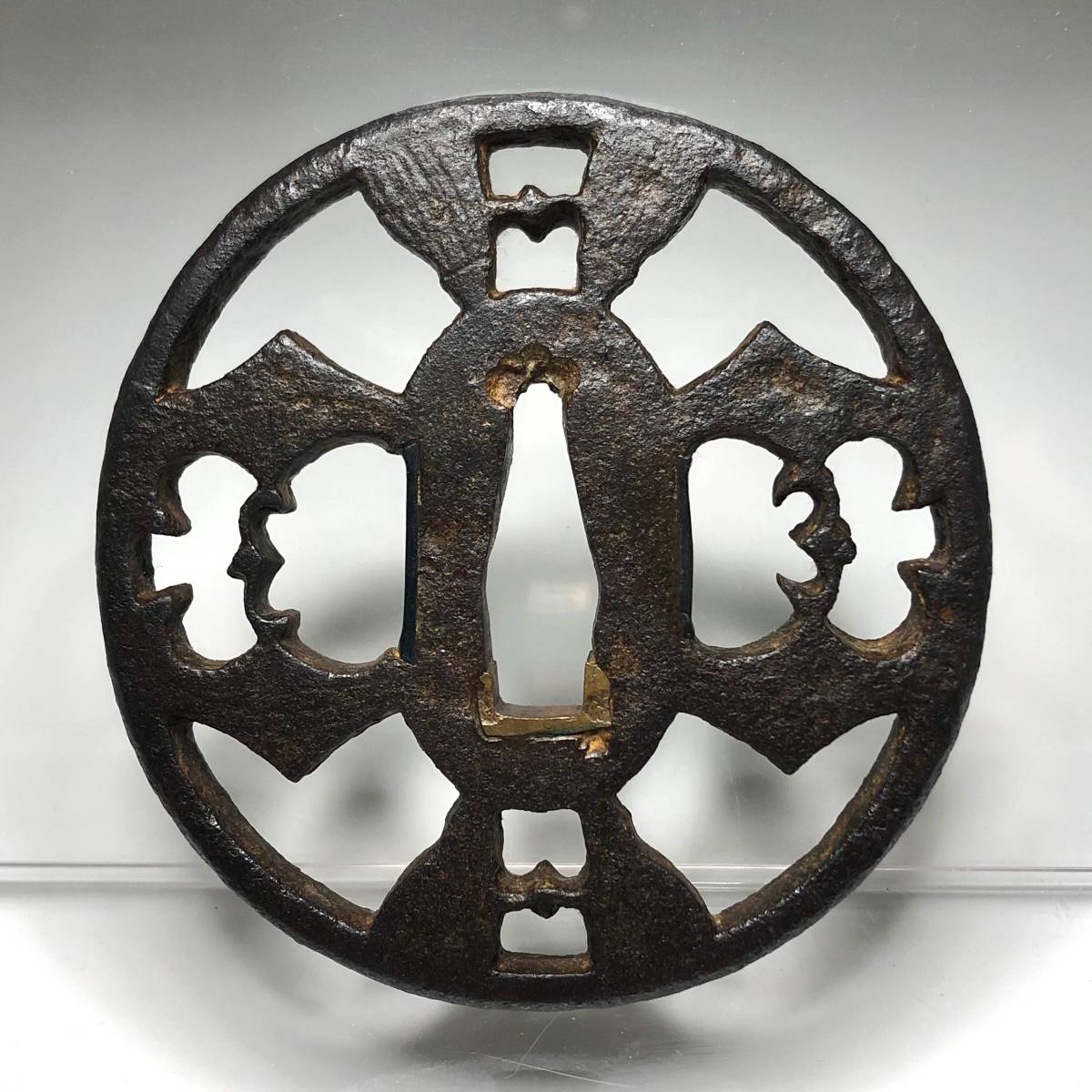 $4100.00 |
 $500.00 |
 $3000.00 |
Shoami is a name you will hear and read about, and you will not give it much thought – but you should, from the point of view of there having once been a very large number of them, with a subsequently very large output. The main problem about identifying older examples of Shoami work is that it would seem that no contemporary physical records of their ‘organisation’ exists today. This is not to say that it is impossible to ascribe a School to a Shoami tsuba that you may find – far from it. Later Edo works of Shoami tsubashi are all too well known to tsuba collectors simply because there were so many workers in very many places in Japan who followed the established traditions of Shoami. This makes it possible to find Shoami tsuba everywhere you go, if you can read the signs, but it has to be admitted that, with some remarkable exceptions, late Edo works are a change of what the School began to produce in the late Muromachi period.
Ko-Shoami
The first tsuba of the Ko-Shoami type appear in the late Muromachi age. From that time to the end of the Momoyama age constitutes the period in which tsuba of the Ko-Shoami type were produced. Since this term means "old Shoami it simply refers to the beginning of the Edo age. In the Edo age this school is simply called Shoami. There do not seem to be any signed examples of Ko-Shoami tsuba. In contrast to this, the majority of the Shoami tsuba made in the Edo age are signed. The reason why this school did not sign in its early stages can only be surmised.
There are diverse opinions concerning the origin of the Ko-Shoami style. Some say it was derived from the Onin school. Others say it came from the Heianjo school. Both of these ideas would seem to be invalid. The forging, edge, web, and hammering point to the origin of the Ko-Shoami in the katchushi workers of the Muromachi age. The ability of the Ko-Shoami exceeds that of either the Onin or Heianjo workers of that period. This ability in forging a good plate would not have been possible unless this school had been a group of katchushi workers who took to decorating their plate with inlay work. Near the end of the Momoyama age the Ko-Shoami school split into several groups. Each group moved to a different area. After settling in the new area they started independent schools with their own characteristics, not necessarily depending on the style of the Ko-Shoami for their basis. Naturally the decorative style will be seen in the early examples of these divergent schools, much as it was in the Ko-Shoami period. These provincial branches of the main school were to greatly influence the style of the native artist in each area. To some extent the style that developed in each branch school was to have characteristics that distinguish it from one another. During the Edo age the size and power of the many Shoami schools was to grow until by the end of that period it was the largest family group of all the tsuba workers.
The outstanding capabilities of the Ko-Shoami workers will be seen in their subtile designs, good shape, fine tempering, and strong forging. The graceful appearance of their designs shows the sophistication of the capital where they worked. There is harmonious beauty between the fine inlay and the quiet plate metal. The Ko-Shoami nunome inlay shows the finest skill in this technique of any group. They secured the nunome to very strong cross-hatching, using sheets of metal a little thicker than those of the nunome inlay of the Edo age. Even though the Ko-Shoami inlay is earlier than the majority of the nunome work, it is often in far better condition. In the Edo age the Shoami were often not as skilful in applying their nunome and it has been wholly or partially destroyed through their ineptitude. In most cases the Ko-Shoami tsuba will be in better condition than the Shoami tsuba made a hundred years later.
Kyo-Shoami
From the end of the Muromachi age, to the begining of the Edo age we have the decline of the tosho and Katchushi schools, the last of the Owari sukashi, and the origin of the Bushu, Higo, and Akasaka schools; but the largest and most powerful of all was the Shoami school. The majority of the Shoami workers had moved to provincial areas but a few stayed on in the capital, as the descendants of the Ko-Shoami; these artists were the Kyo-Shoami workers of the Edo age.
The early Edo age was the greatest period for the Shoami and the Kyo-Shoami surpassed all their provincial relatives. Their designs were richer,more detailed, and far more sophisticated than the other schools who worked in iron plate. They begin to sign their work in some cases, and their fame grew throughout the country for their elegant style and superior craftsmanship. This glory was to last until the Kyoho era (1716-1735), when such schools as Higo, Akasaka, and the kinko surpassed the Kyo-Shoami in the race to opulence and dominated the field. For the rest of the Edo age the Kyo-Shoami show a steady decline to the point where their work in its last stages bears hardly any resemblance to its renowned style of two hundred years previous.
Awa-Shoami
From recent information and a study of the actual tsuba it is clear that there are two styles of Awa Shoami tsuba. One is inlaid decoration in gold and silver nunome on a brass plate. The designs are flowers, birds, fretwork and scroll work. These are usually in geometric patterns. Some carving of lions, flowers, and other objects will be found. The second style is iron plate usually with fan shaped or diamond shaped plates of soft metal inlaid on the surface. These inlays are decorated with gold and silver nunome or carving. The designs are flowers and landscapes. In some cases suemon zogan is used instead of carving. The inside surface of the carved lines may be covered with nunome inlay. Those Awa tsuba of iron plate are of later workmanship than those of brass plate. The first style is not as common as this second style. Those of iron plate were probably made at the time of the fifth generation and after.
Bizen-Shoami
This family of artists was regarded highly by Lord Ikeda of Bizen Province. For their services they were given an allowance from the castle stores. From the provincal records and those of the Ikeda family, the history of the Bizen Shoami school is very well annotated. These records are in good order and reveal a wealth of information heretofore unknown to the authors of the past. The style of the Bizen Shoami school is rich in its decorative quality. The designs are naive but very tasteful. It has a resemblance to the Kyo-Shoami tsuba of the same period but it is not as delicate nor sophisticated as the work of the capital. The subjects of the designs are more applicable to the countryside, having a strong and bold quality. The majority of the subjects of the designs are of openwork in ubuzukashi style. They are decorated with nunome and/or iroe inlay.
Iyo-Shoami
One hears that the Iyo-Shoami school existed from very early times. They are thought to have struggled with the Kyo-Shoami workers for leadership of the Shoami family. There does not seem to be any documentation to support the idea that the Iyo-Shoami school is older than any other branch school. It is more likely that it was formed at the same time as the other schools that were dispersed to the provinces. If any branch school may be considered anterior to the others it would have to be the Kyo-Shoami school, for they were the direct descendants of the Ko-Shoami and remained at the capital. All other Shoami schools were formed slightly later than the Kyo-Shoami in the early Edo age. The majority of work of the Iyo-Shoami school is in low relief carving, line carving, flat inlay, large areas of raised inlay, or mixed inlay. The common characteristic of most Shoami schools, i.e. nunome inlay, is rarely found in the work of this school. In essence the style is simple, naive and has a country feeling. Nevertheless, it is not without interest.
Aizu-Shoami
There are numerous opinions to explain the origin of the Aizu-Shoami school. The most logical of these theories was the one put forward by the late Nagaoka Tsuneki, author of the Shonai Kinko no Kenkyu. In this kenkyu, Nagaoka stated that Jirohachi was the founder of the Aizu Shoami school. There does not seem to be any tsuba by Jirohachi bearing his place of residence. In fact, we are not sure that he ever worked in Aizu. He seems to have been an independant artist without apprentices who might have carried on the style of his school in the Aizu area. Thus we cannot state for certain the origin of this school, for there do not seem to be enough facts to tell us anything of the early period of the Aizu Shoami. By the Genroku era and after, the style was a combination of Shoami and later Umetada school styles.
Aizu Shoami tsuba mostly have an iron ji, and kinko works are very rare. The shinmaru gata (true circle) shape is encountered regularly. Most round tsuba are a bit taller than they are wide. Both hitsu-ana are often shaped like kogai-hitsu as opposed to the standard kozuka kogai configuration. A motif showing a person or thematic object with a natural landscape in the background is common. Motifs such as a bird or a group of birds, an animal or animals, or insects, are also often seen. The bottom right section will contain the main design carved in takabori and/or detailed with nunome or inlay work, while the upper left section area is carved with comparatively less detail - moresoft and suggestive. This effect implies visual distance, draws our eye to the main section of the work and gives the illusion of depth to the overall design. It is common to see some details in gold nunome as with all Shoami works. Also, often small design elements such as foliage, branches, etc. are inlaid in shakudo. Aizu shakudo inlay is often of good quality with a deep luster. Sukashi work executed on the entire tsuba is rare to non-existant with the exception of the 'cloud' motif favored by Shigenobu. Some makers liked to use small sections of sukashi as a design element, but it is normally a secondary embellishment to the main theme of the work. Iron ji can be encountered in several varieties. One is a thick plate with a dark brown patina and strong variations in the surface, having a rough appearance. This type of ji is often highly tempered and will show abundant hard martensite crystals on the surface. A second type is a more polished ji with a chocolate brown patina. Another type has a deep rich purple-black patina on a thick plate having a similar luster to first tier iron sukashi works from Genroku times.
Shonai Shoami
Shonai is located in the remote northern part of the main island of Japan. This detachment from the rest of the country has given the work of this school a simple elegant feeling. The quiet sincerity of the work of the Shonai Shoami rarely fails to be interesting. The Sakai family controlled the extensive lands of the Shonai area and for this received one hundred and forty thousand koku of rice annually.
This school originated from the great-grandson of Jirohachi, Shoami Matahachiro, he was a retainer of the Sakai family after he came from Edo in Kambun 4 (1664). The earliest style of work from the Shonai area is that of the Ko-Shoami school. This style was used by the Yoshida family of the Shonai Shoami. Their work is later than the Ko-Shoami tsuba produced in Kyoto, but it has about the same feeling. It may be separated from the Kyoto work if one observes the iron plate which is considerably later than the Ko-Shoami. The school of Matahachiro was greatly over shadowed by that of the first Yasuchika, who was a native of Shonai. When the style of Yasuchika became popular he greatly influenced the schools of Edo and, in turn, those of Shonai. This cross current of style and influence was very strong at this time and the winds that blew the popular styles of the early Shonai Shoami toward Edo were to be reversed later and the Edo style (with Shonai influence) returned to Shonai in later years. It is interesting to note when comparing the work of Kiyonari and the first Yasuchika that Kiyonari was twenty-three years older than Yasuchika. Though he was senior in years, Yasuchika was to influence his work as his fame grew.
Another school of the Shonai area is that of Sato Chinkyu, and his father Shirozaemon. It is not known if they were members of the Shoami family, even though they worked in pure Shoami style. Little is known of Shiozaemon, but Chinkyu is famous as the teacher of the first Yasuchika and of Arinari. Their early style closely resembles that of Chinkyu and is strong in the Shonai Shoami style. This was before Yasuchika created his own style after moving to Edo.
The work of the Shonai Shoami is diverse, but with a common bond in the old Shoami style. A clue to the work of this school will depend on a feeling for the mood of the area and an understanding of the influences and trends of the age.
Akita Shoami
In the past there have been four opinions as to the origin of the Akita Shoami school. One says Dennai was the originator of this school when he camefrom Edo. Another says that he founded this school coming directly from Shonai. A third idea put forward by Nagaoka says that "Dembei was the creator of the Akita school." A fourth idea is that there was a Ko-Shoami school line working in Akita before any of these artists reached there. The fourth idea seems to be the most logical. The name Yoshinaga is to be found from an early period in the Akita area. He is said to have been the teacher of Dembei, but their full relationship is not known. Nor do we have any names of artists before that of Yoshinaga. However, from an examination of the work of these men it would seem clear that Yoshinaga introduced the Shoami style into the Akita area, and if anyone can be called the father of the Akita Shoami school it would have to be he. Dembei is the most important artist of Akita and his master works resemble fine Umetada tsuba or Ko-Shoami work. He occasionally worked in a style closely resembling that of Oda Naonori of Satsuma. His work is about equal in rank to that of Kiyonari of Shonai. By the Kansei era (1789-1800) the work of the Akita school cannot be found. From that time forward it seems the school disappeared without leaving a trace of the artists who had lived there.
Subsidiary Schools of the Shoami
There were a number of other Shoami workers in various provinces who were either independent artists or members of such small groups that their existence has been overlooked. The late Akiyama doubted that there had ever been a Shoami school in Edo, but after careful investigation he found evidence indicating its existence. This school is now called the Bushu Shoami. These workers must have been the descendants of Jirohachi who had remained in Edo. The work of this group is in the Kyo-Shoami style or that of Jirohachi. The Bushu Shoami tsuba in Kyo-Shoami style are often mistaken for the work of the Kyoto school. This may be avoided by an examination of the iron plate. The Bushu Shoami plate is not as old or rich as that done in Kyoto. The Bushu Shoami school existed at a later date than did the Kyo-Shoami school.
Another school of note is that of the Sakushu Shoami of Mimasaka Province. Their style resembles the Inshu Suruga school work. In this respect the work of the Sakushu Shoami differs from that of all other Shoami schools. With this adopted style a provincial feeling is also to be found.
By the middle of the Edo age the Shoami style had lost much of its popularity. The rise of the BUSHU (Ito family) and the CHOSHU schools as well as the power of the new kinko aided in the decline of the power and prestige of the Shoami. They were forced to copy the style of these more popular schools until the original Shoami style was lost altogether. Only the Bizen Shoami school retained its original style to the end of the Edo age.
Read about Early Inlays from 'Jaspanese Sword Mounts' by Helen C. Gunsaulus.
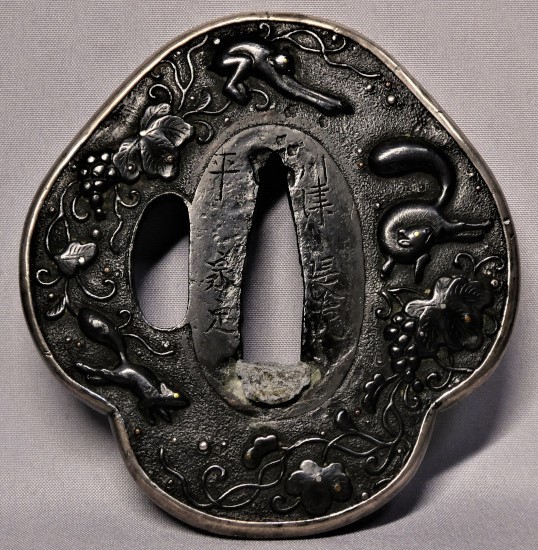 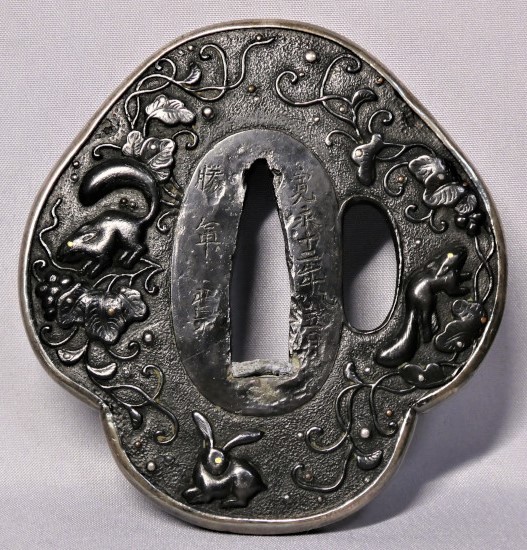 |
'KAWATSU CHOZA TAIRA IESADA' Please Contact Us For Price |
  |
'HASHU AKITA ju SHOAMI SHIGESADA' Please Contact Us For Price |
 |
'YOSHU JU SHOAMI TANESHIGE' |
 |
'SHOAMI IETAKE' Please Contact Us For Price |
  | 'IYO SHOAMI IETAKE' Please Contact Us For Price "This is a rare piece among the works of Shoami Ietake, who is known for his prolific work on the ground. This piece is included in the "Tatakara Kodomo Inscription Taikei" (Comprehensive Collection of Sword Fittings and Accessories) as one of the artist 's personal inscriptions, and is described as "rare examples of an inscription that simply reads 'Yo' without the inscription 'Yo' (Yoshu/ Iyo)." It is a valuable item. This is a magnificent item that allows you to appreciate the beauty of the iron tsuba within its unadorned construction, with round carved grooves and a trefoil openwork on the outstanding, thick iron base. Dates to ca. 1750." (Long) |
  |
'FUJIWARA MITSUNOBU' Please Contact Us For Price |
  |
'SHOAMI SHIGEHIRO' Please Contact Us For Price |
  |
BIZEN SHOAMI Please Contact Us For Price |
 |
BIZEN SHOAMI Please Contact Us For Price "Plum branch with flowing water design , unsigned, Bizen Shoami. Iron base, round, openwork, with a touch of gold cloth inlay. Plum branch and flowing water, both sides are beautifully carved. Dates to ca. 1700-1750." (Haynes) |
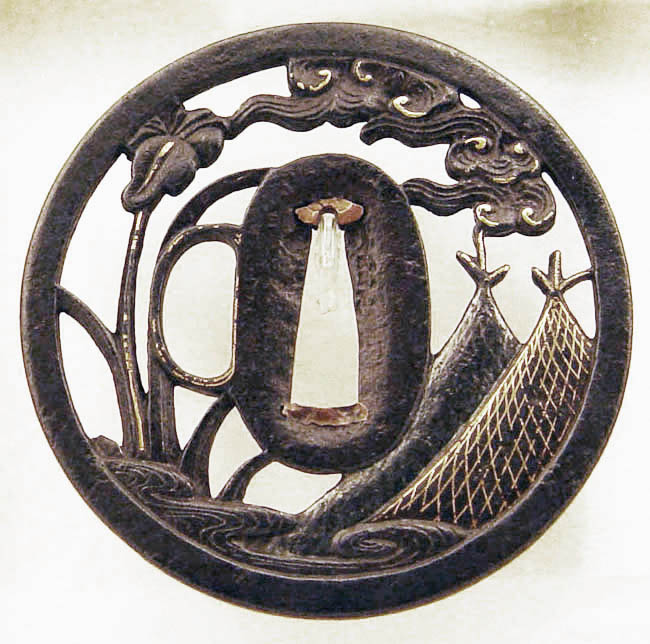 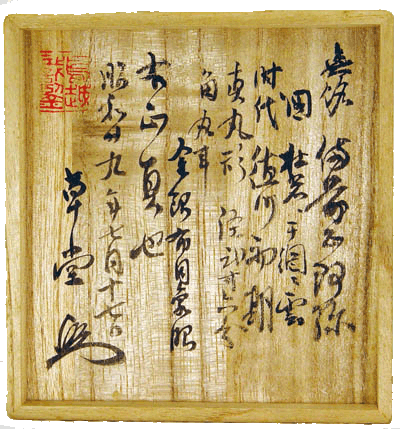 |
BIZEN SHOAMI $8000.00 |
  |
KO SHOAMI or Ko Umetada Please Contact Us For Price |
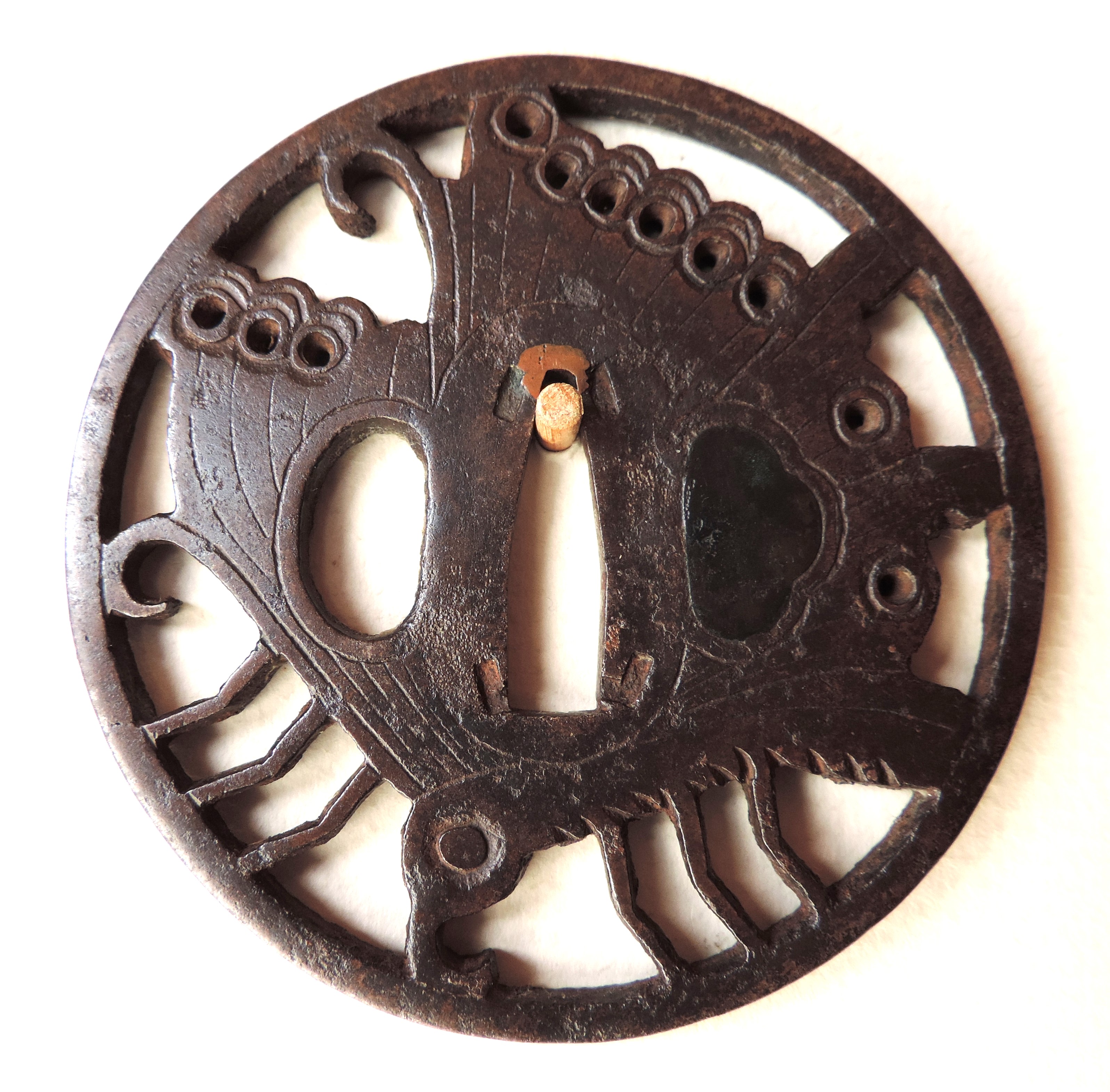 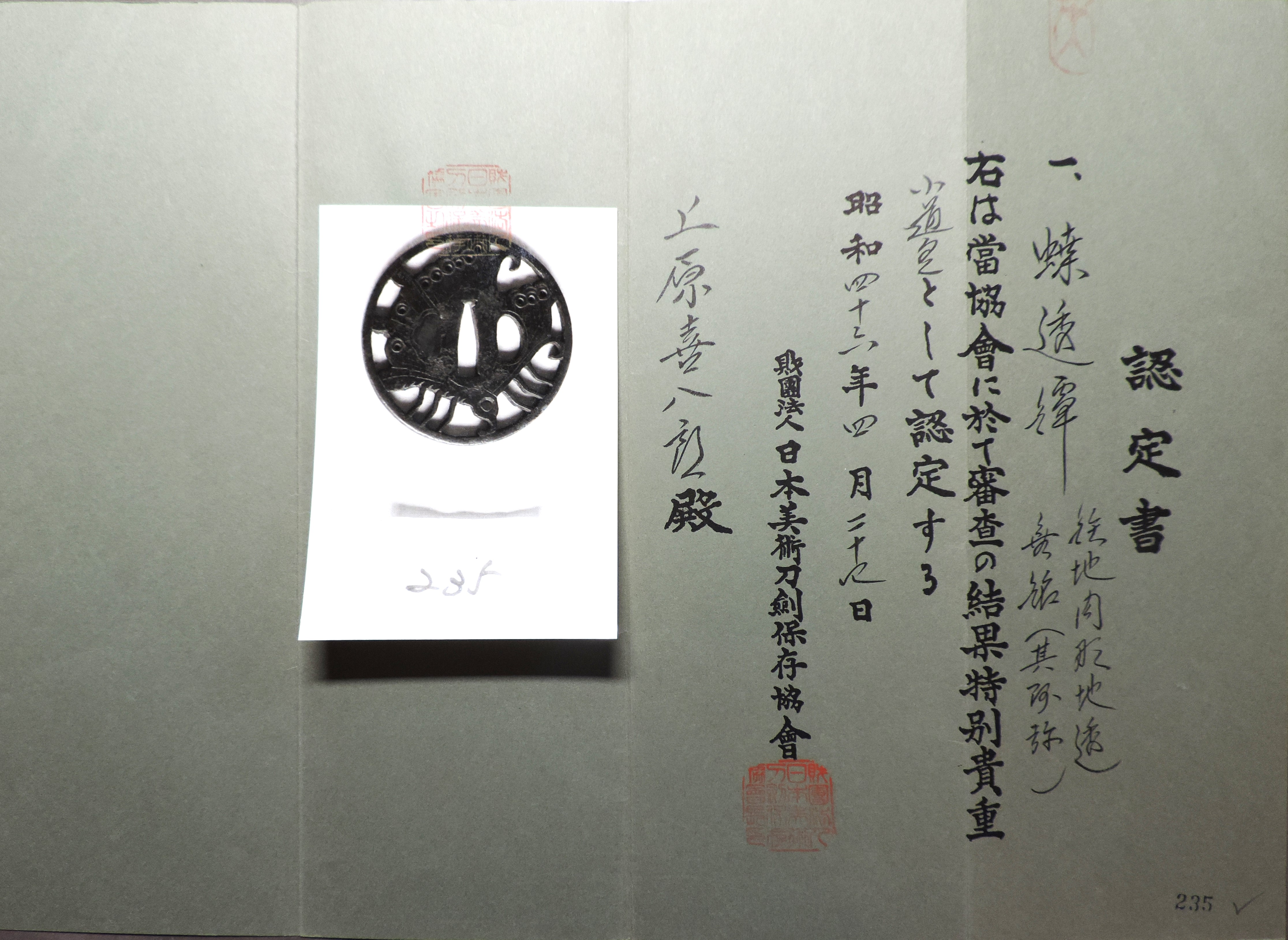 |
GO SHOAMI Please Contact Us For Price |
  |
'JOSHU NISHIJIN JU SHOAMI MASANORI SAKU' |
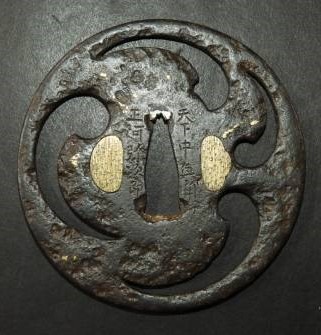 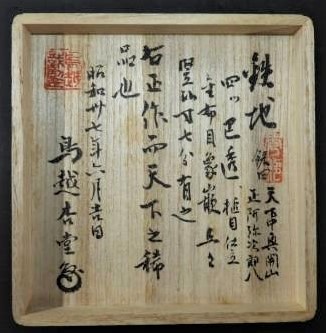 |
'TENKA CHUKO KAISAN SHOAMI JIROHACHI' |
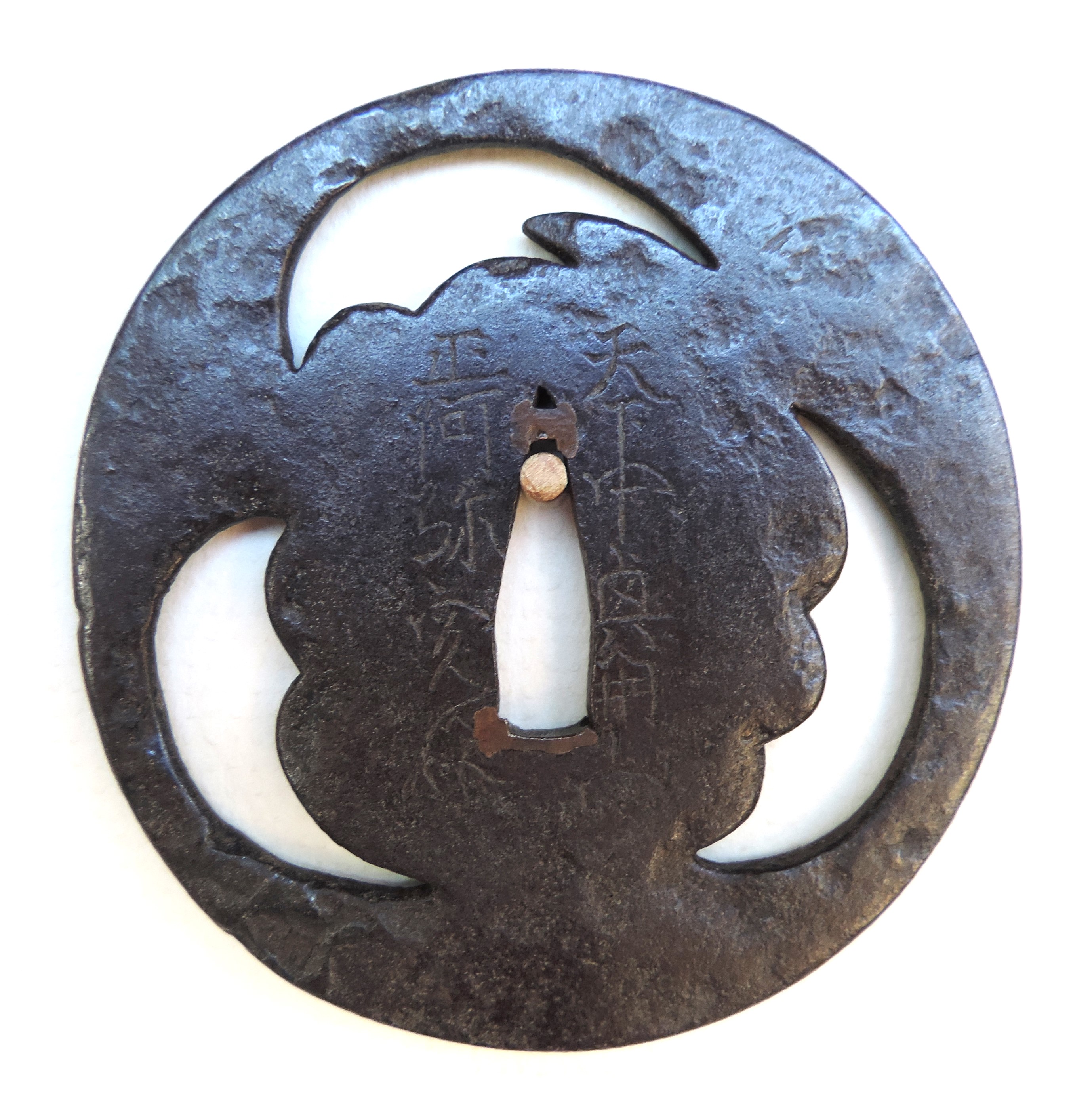  |
'TENKA CHUKO KAISAN SHOAMI HIROYOSHI' |
 |
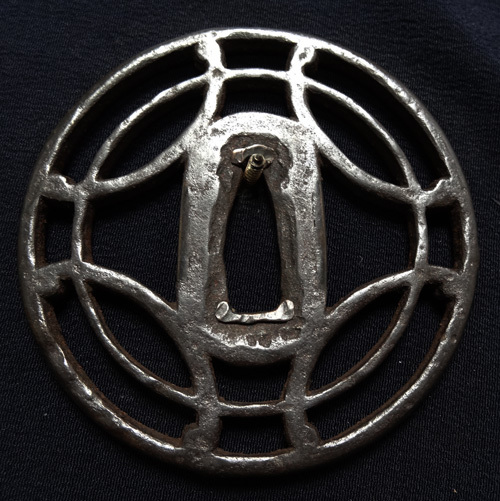
SHONAI SHOAMI Please Contact Us For Price "Well forged iron plate with rope style rim of copper. The two hitsu along with openings top and bottom filled with black shakado. Further study will determine if there are vestiges of a signature." (Haynes) |
 |
KO-SHOAMI |
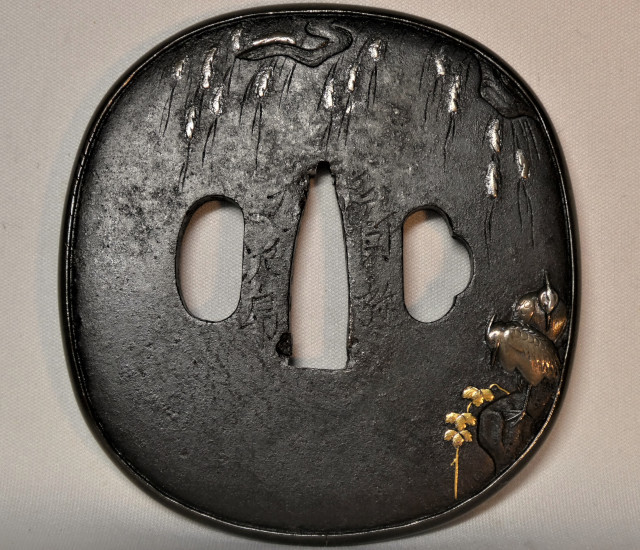 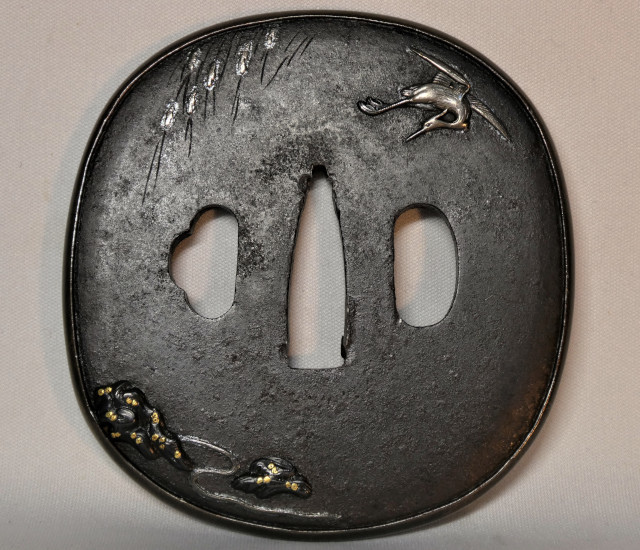 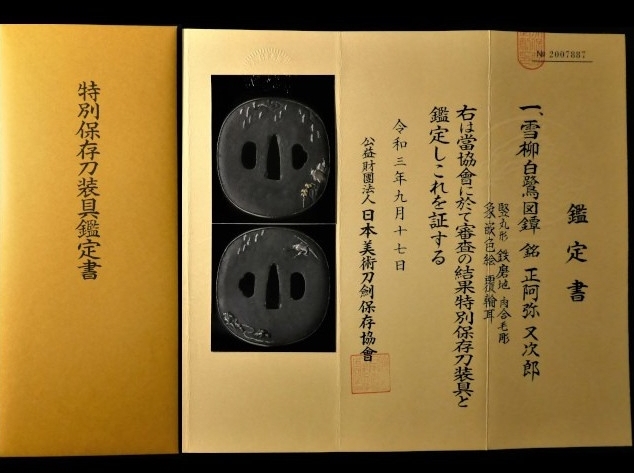 |
'SHOAMI ?DENBEI?' Price On Request "Large rounded square iron plate nicely forged and hammered with excellent patina and color. Further study of mei and description coming soon." (Haynes & Long) |
  | SHOAMI DENBEI Price On Request "A rare box inscription by Kawaguchi Chikara, author of "Tsuba Taikan" and author of many books on Japanese swords. The box inscription is dated 1958 and includes a detailed description of the tsuba, "Iron round shape bamboo Niku carving ears bamboo Niku carving Jin-O, Unsigned Akita Shoami Denbei masterpiece, around the Kan'ei period," as well as "masterpiece." The tsuba is well-forged jigane with excellent iron flavor and moist skin. It has strong but careful Niku carving Jin-O, and no noticeable scratches or stains." (Long) |
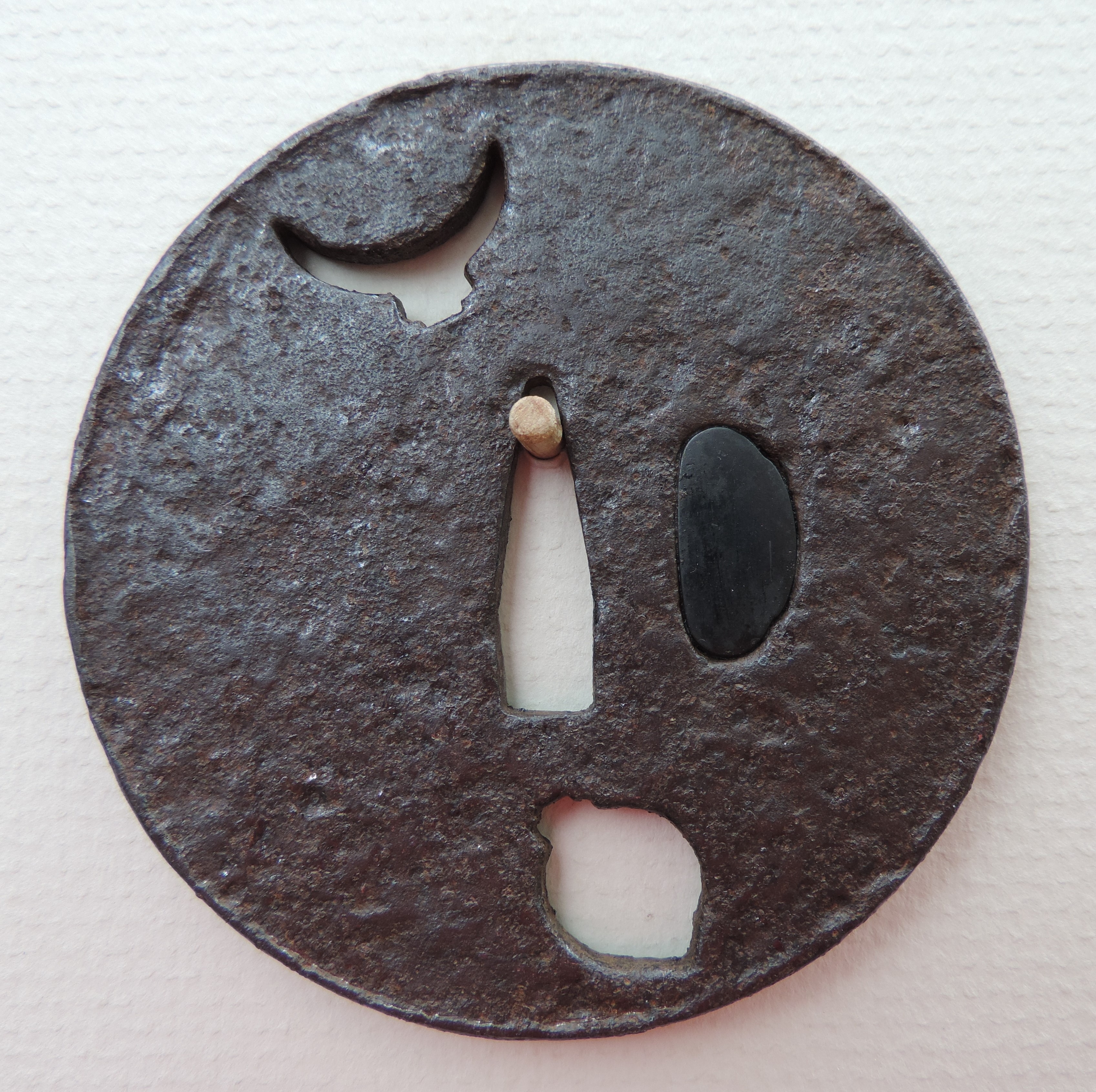 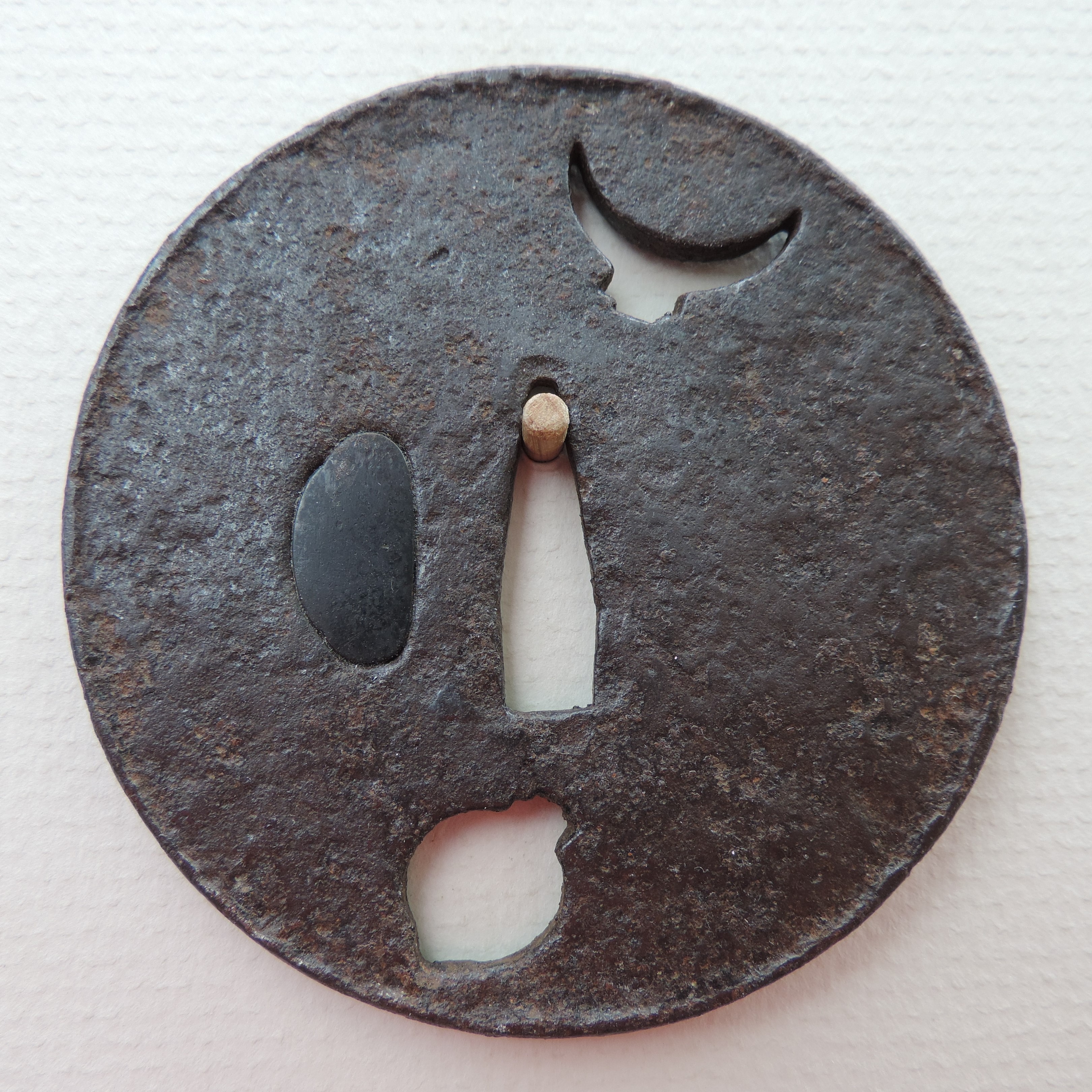 | KO-SHOAMI $1200.00 "Presented here is a early Shoami tsuba around the late Muromachi/early Momoyama period (ca. 1550). In terms of era division, the Northern and Southern Courts, Muromachi, Sengoku, and Momoyama periods were traditional for Katchushi and Tosho style tsuba. This is a very bold, strong plate of well forged iron. The iron base has hammer marks as a whole, and the rim is square and stout. The sukashi openings represent a sake cup and gourd." (Long) |
  |
AIZU SHOAMI |
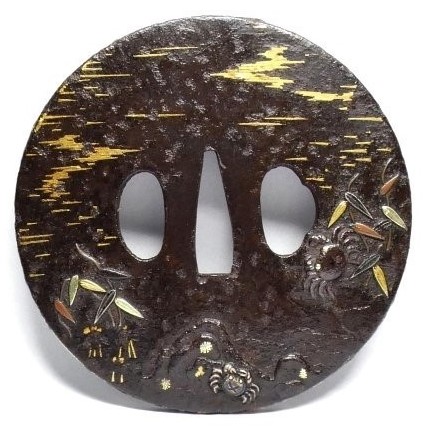 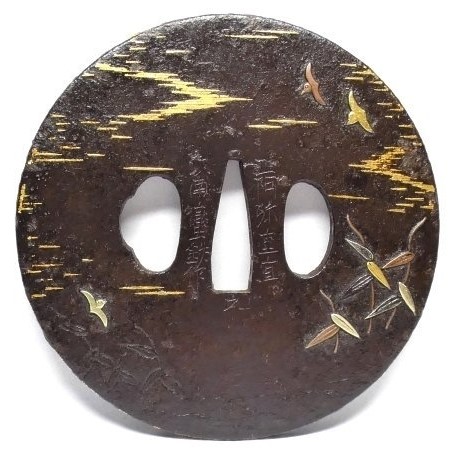 |
'SHOAMI SHIGENOBU' |
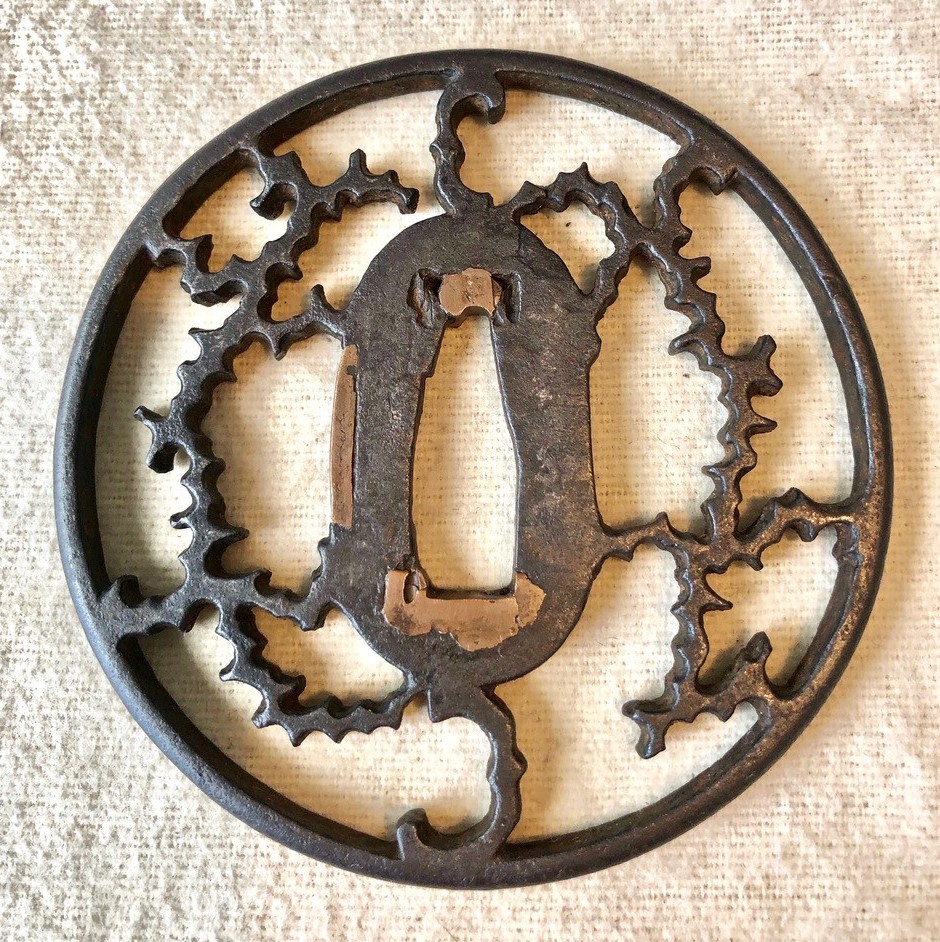 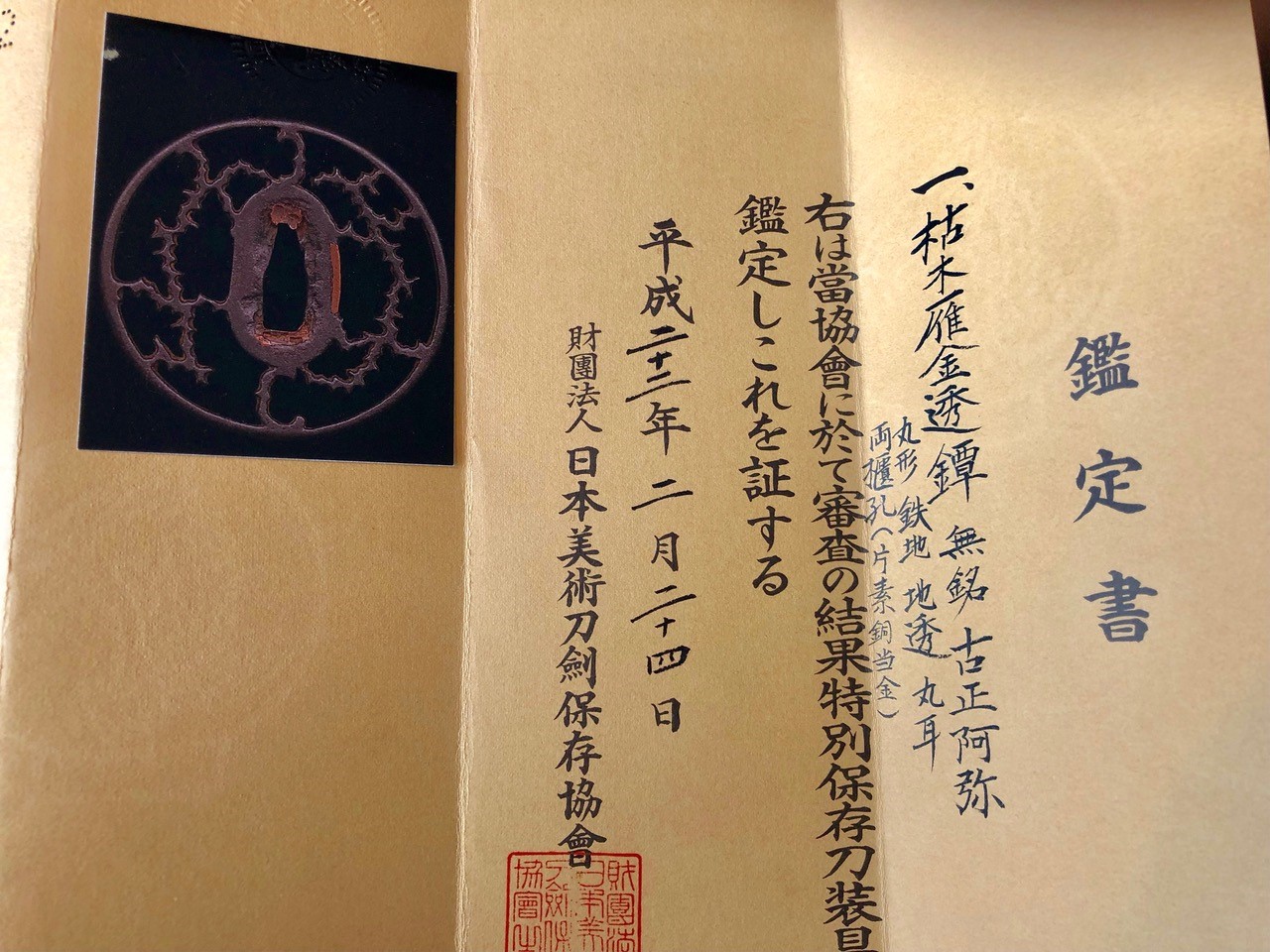 |
KO-SHOAMI $2000.00 |
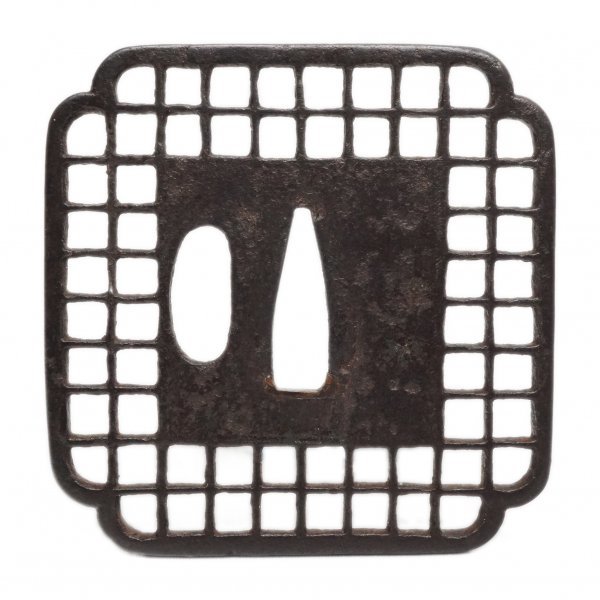 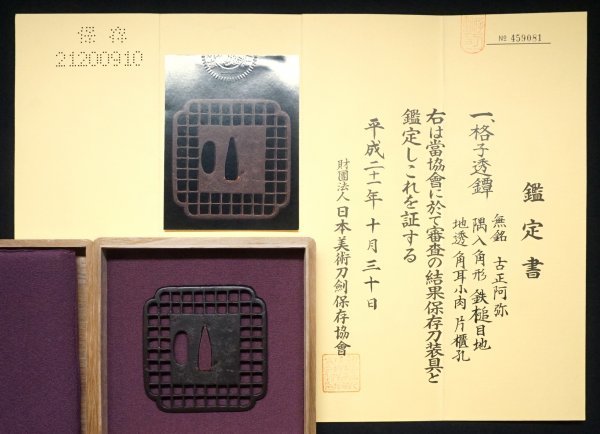 |
Ko-Shoami $3000.00 "From a square mokko-shape iron plate comes a lattice Shoji design. A very rare design that is not often found. Certified by the N.B.T.H.K. to Hozon Tosogu. Mumei, to Ko-Shoami school. Continued study is under way." (Haynes) 7.61cm x 7.58cm x 0.35cm |
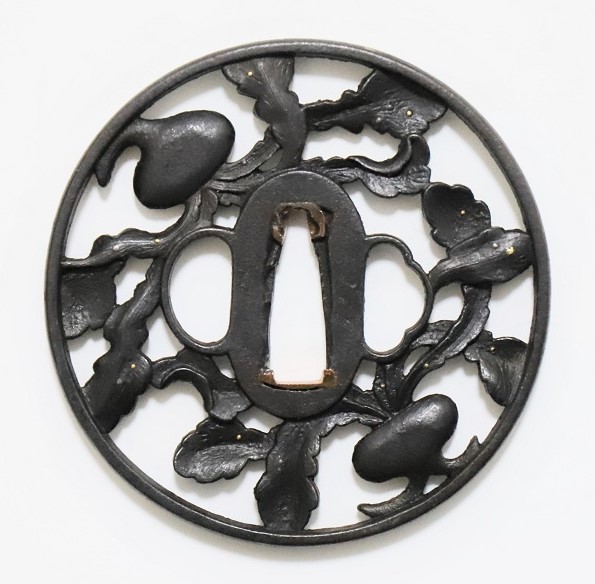 |
KYO-SHOAMI Price On Request "The theme of this tsuba is turnips. It is one of the seven Spring plants that is eaten. The tsuba is mumei but has all the features of this tradition. There are details, dew drops in gold and the refinement of the design along with the elegance of the workmanship leading to a date of Mid Edo period." (Haynes) |
 |
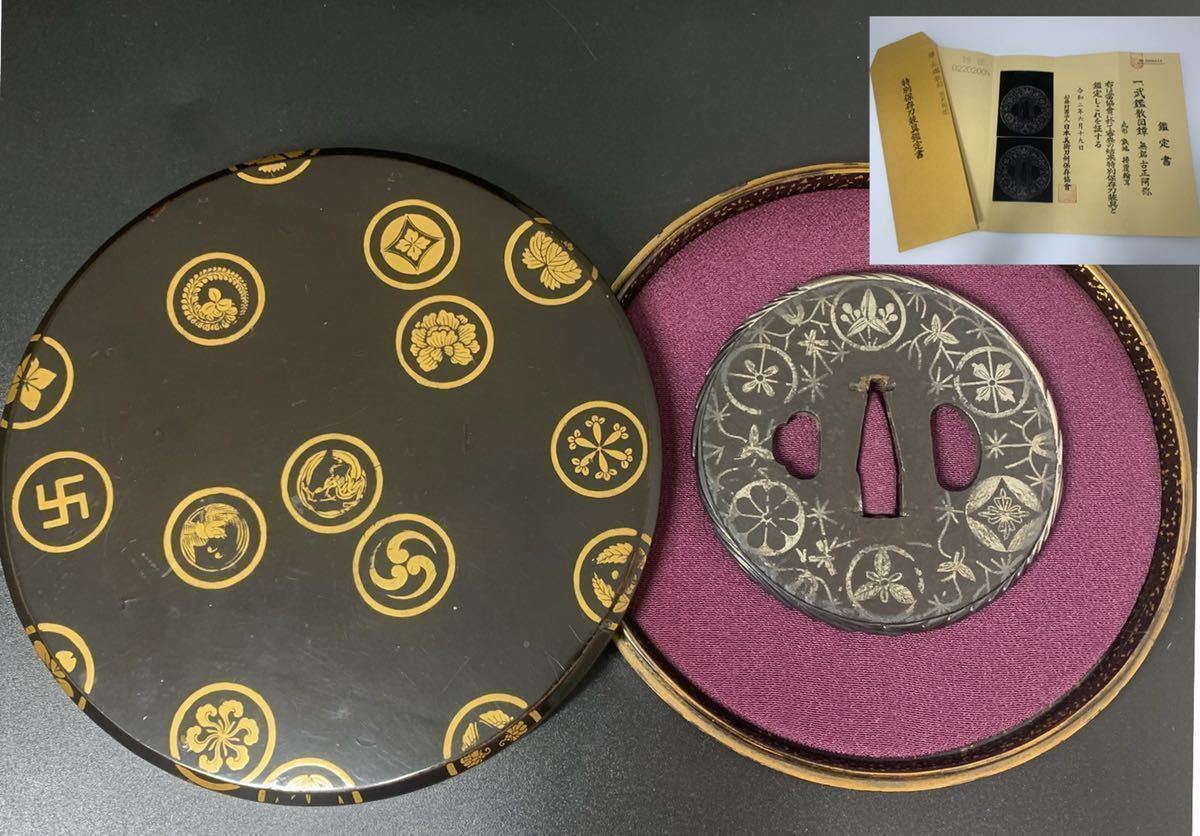
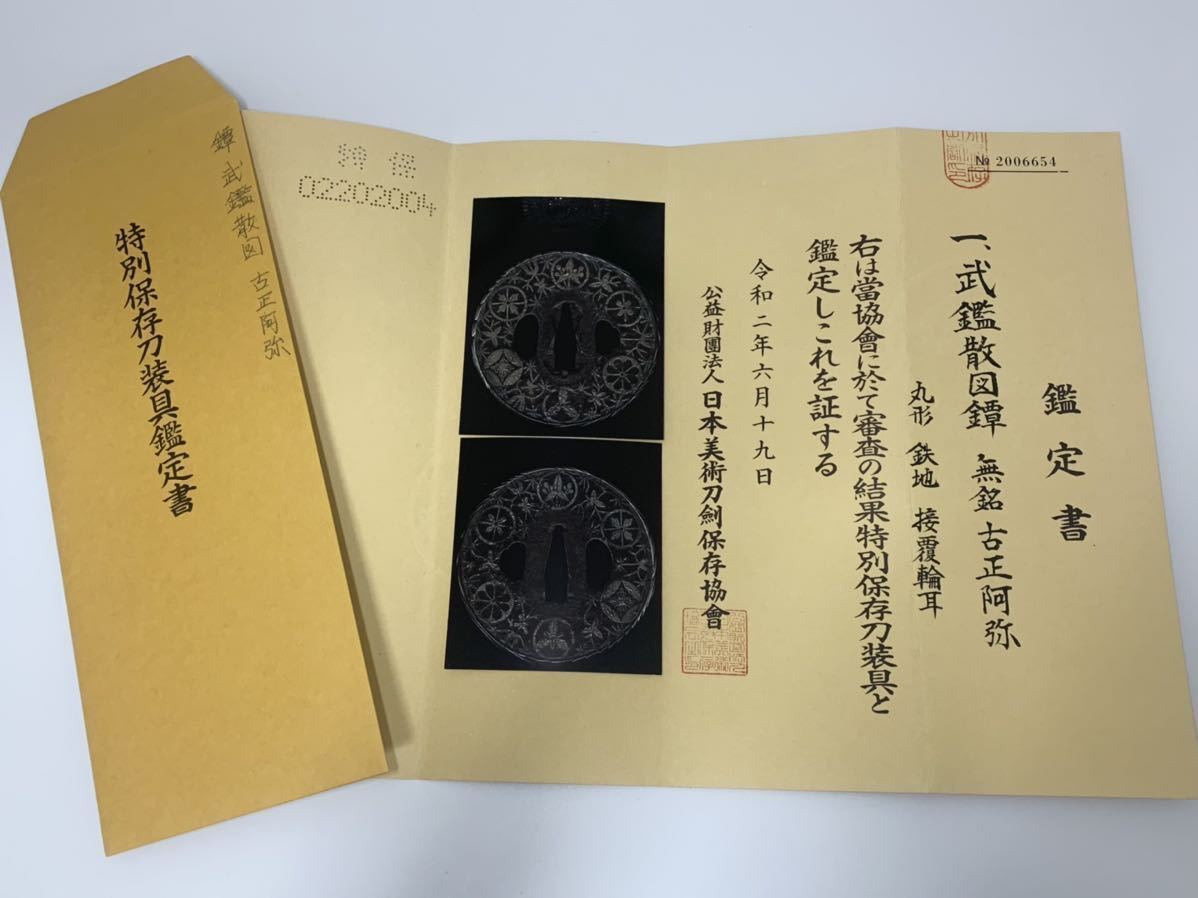
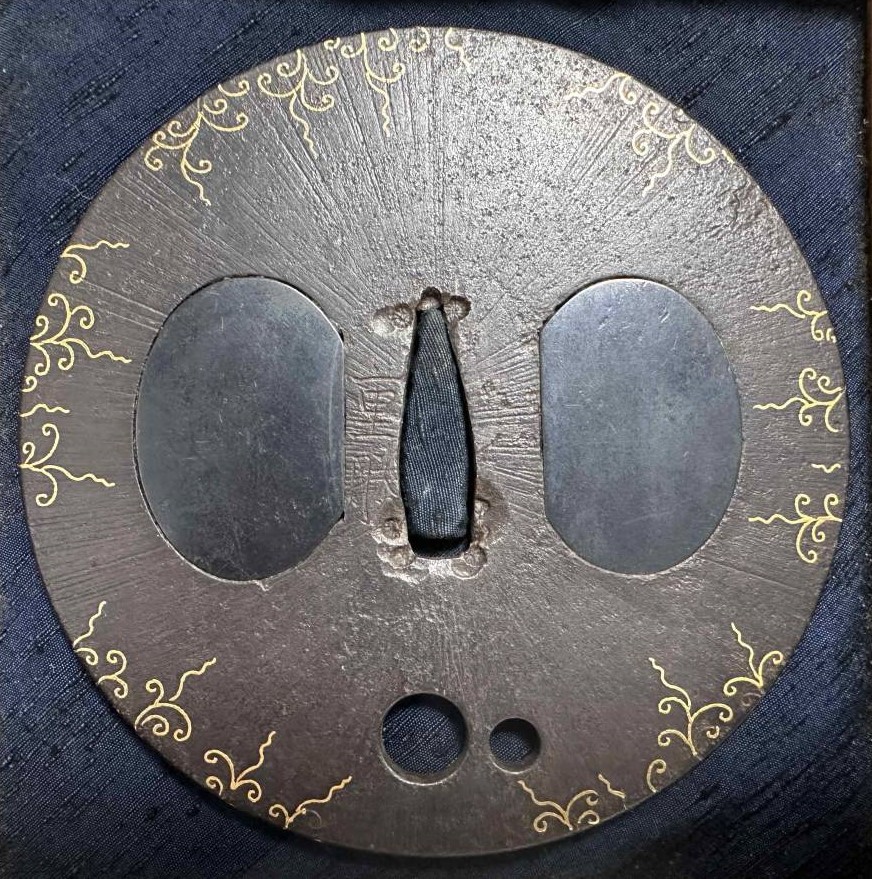
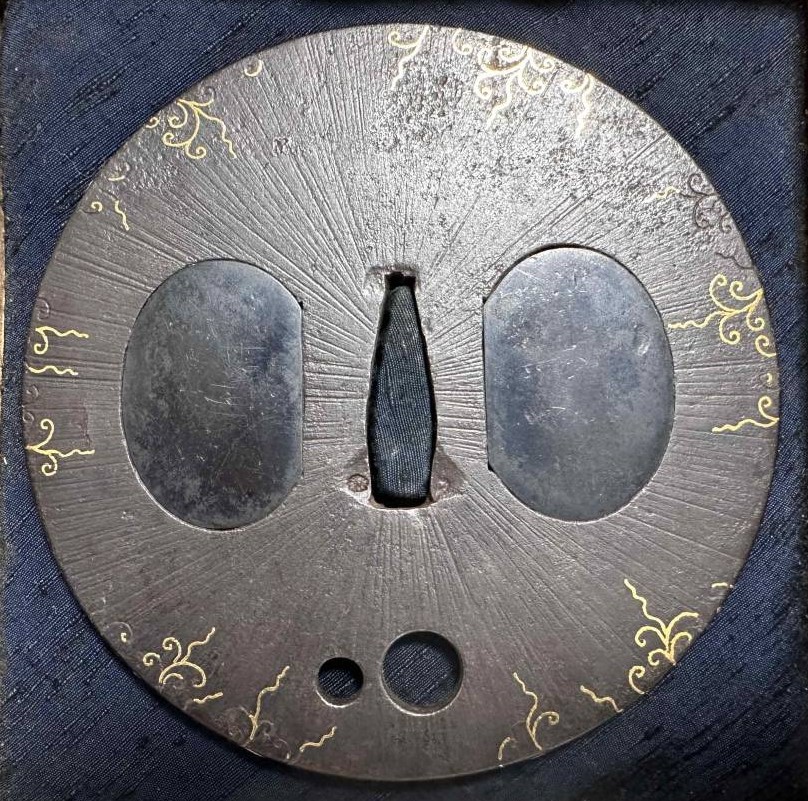
'MUTSU KAI YOJI' 'SHOAMI KANESUKE' Price On Request "Zabotsutsu (selected by Ken Kokubo) Hakogaki signed by 'Shoami Kanesuke', tea ceremony tsuba, Shoji preserved sword fittings. This is an actual item listed in the Ko Kinko Meikan. It has an inscription on the box by the artist, Kenichi Kokubo. It is in good condition. Comes with a certificate of authenticity for sword fittings. See Ponceton p. 447 #186 illus." (Haynes) |
  |
|
  |
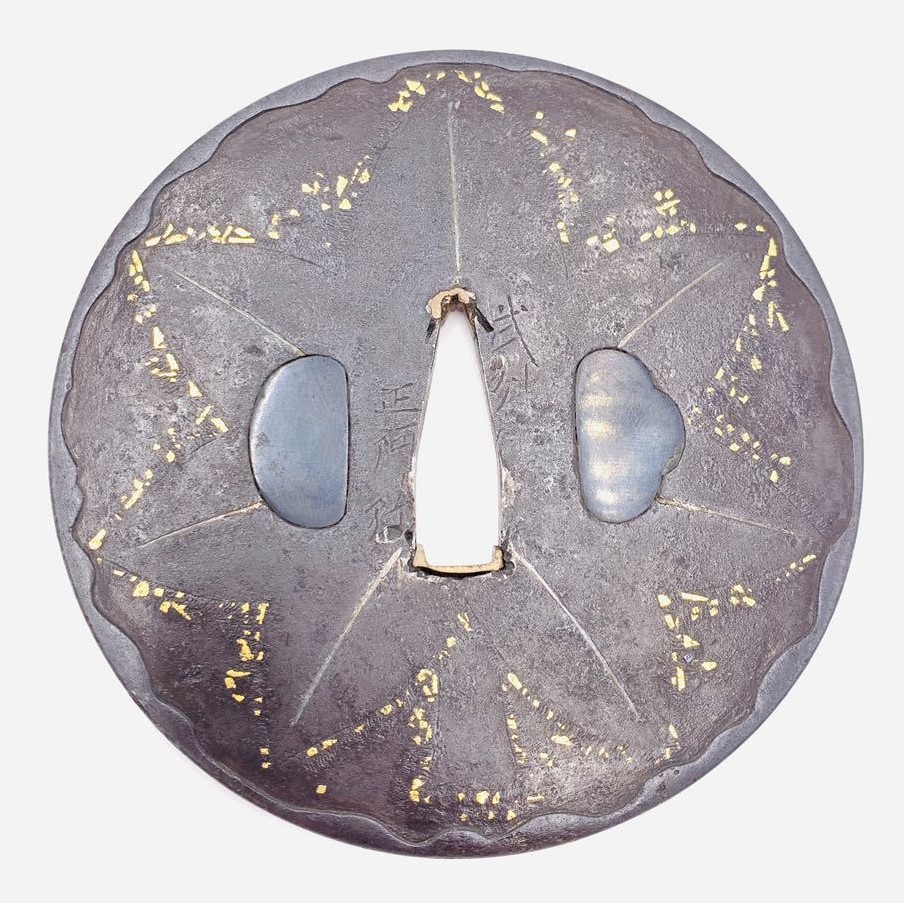
'SHIGEKATSU' Price On Request "Presented here is a large iron work of beautiful Amidaba accentuated with gold inlays of karatake that extend to the sides. The state of preservation is good, even though there are areas of missing gold inlay. Though a simple design it has a powerful presence. Signed: 'SHIGEKATSU' of the Iyo Shoami school. He was a master craftsman who is believed to have been active in Kyoto in the mid Edo period." (Haynes) 9.00cm x 0.50cm |
 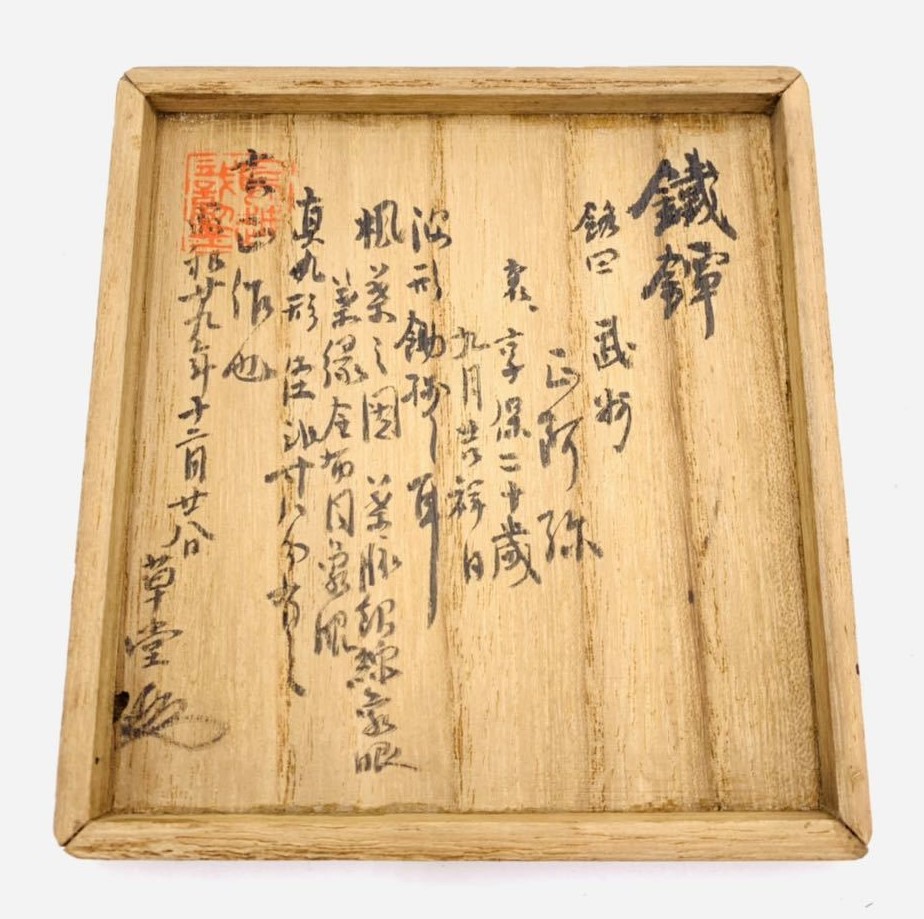 |
'BUSHU JU SHOAMI' Price On Request |
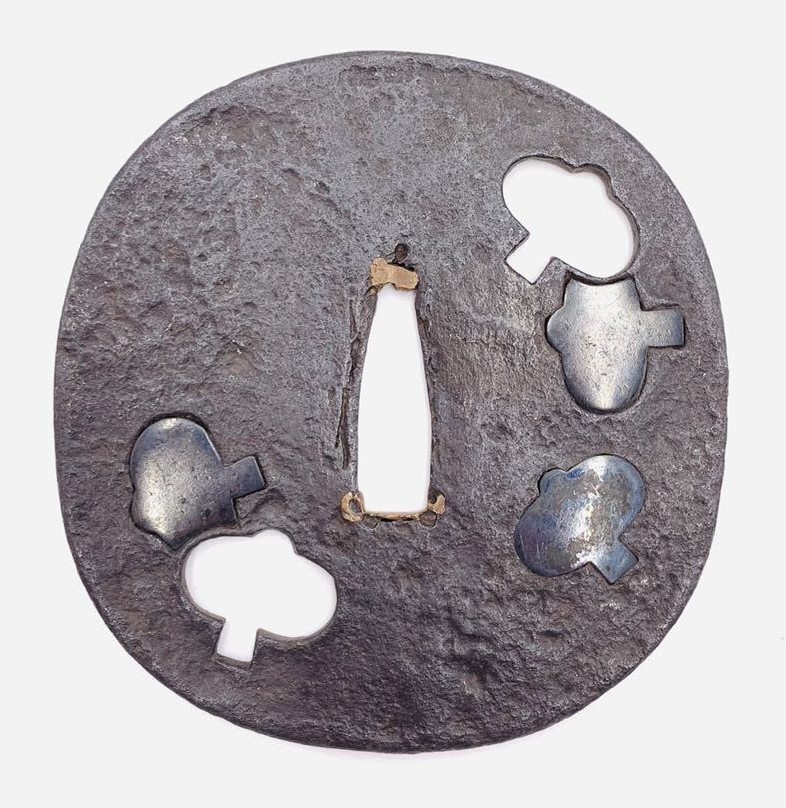 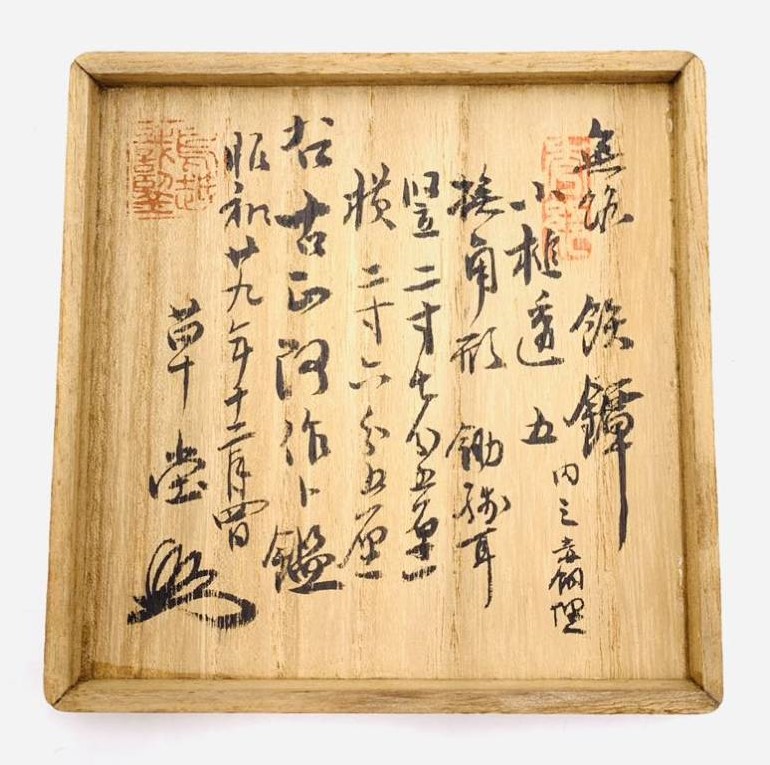 |
KO - SHOAMI Price On Request |
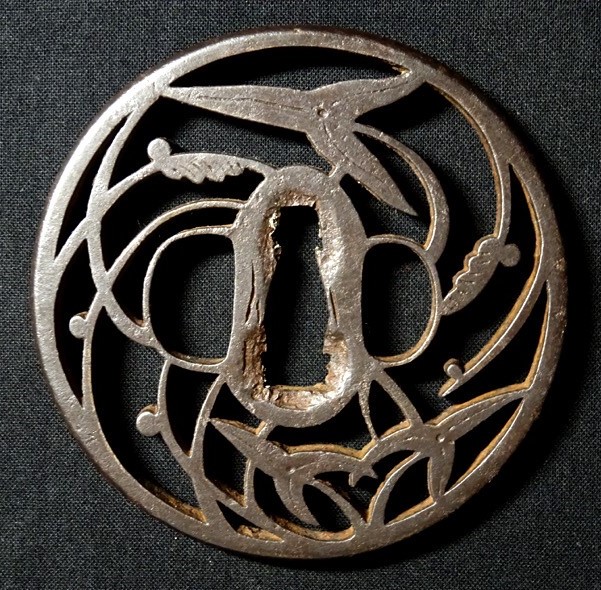 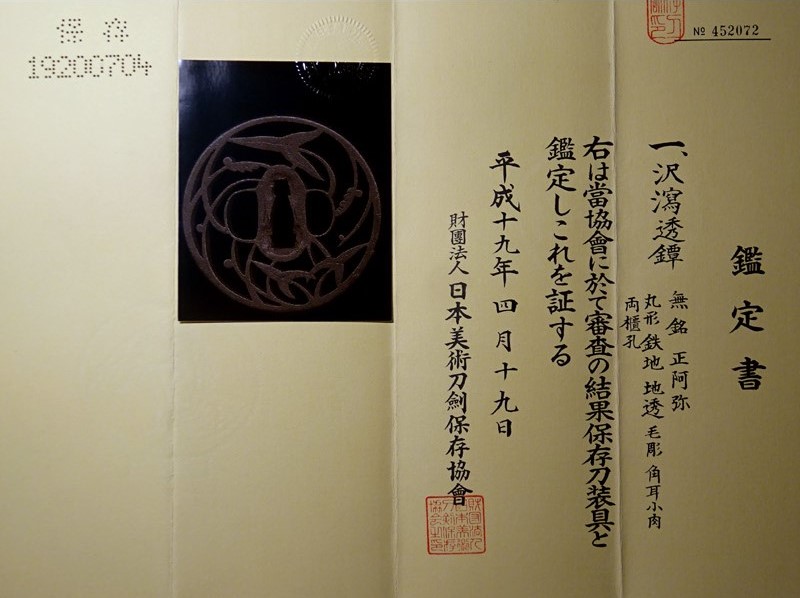 |
Omodaka Shoami $2000.00 "Round marugata shape iron tsuba with toru hair carving on the leaves. Both hitsu-ana same though different size. Preservation appraisal by NBTHK Hozon Mumei: Shoami." (Long) 8.60cm x 8.60cm x 0.60cm |
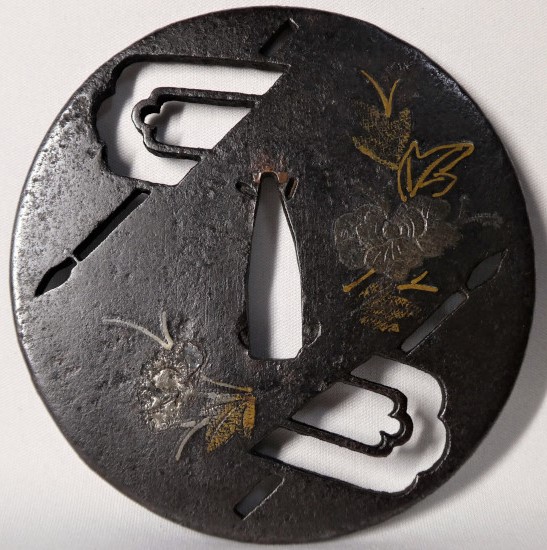 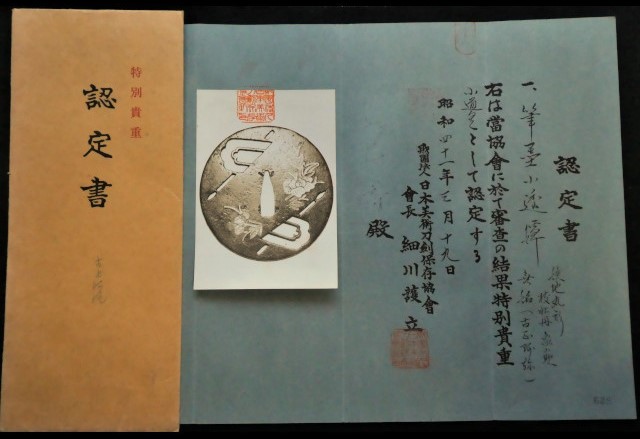 |
Ko-Shoami $1600.00 "Write up to follow. NBTHK 'GREEN' paper attribution." (Haynes) 8.90cm x 8.60cm x 0.40cm |
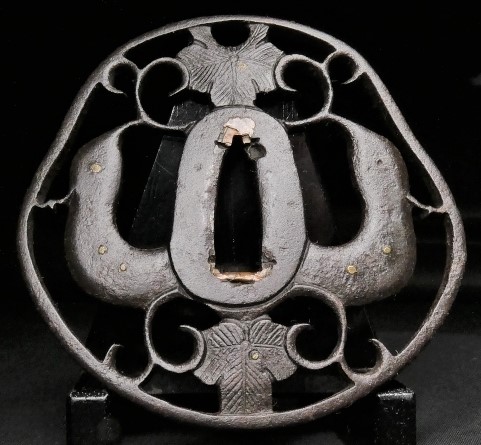 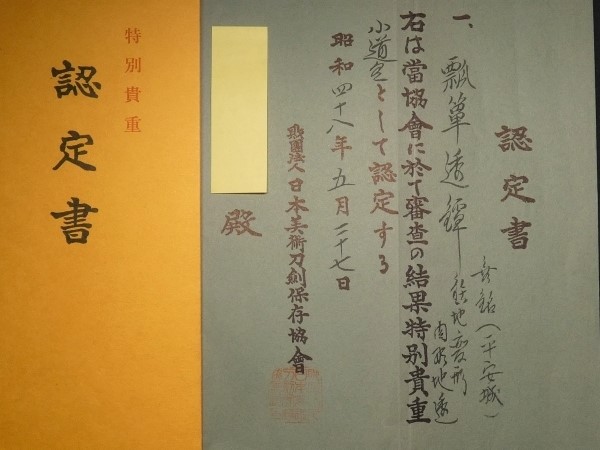 |
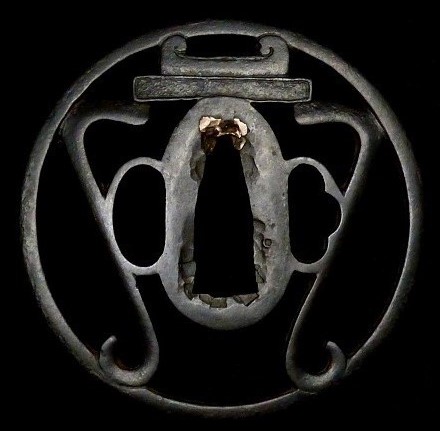
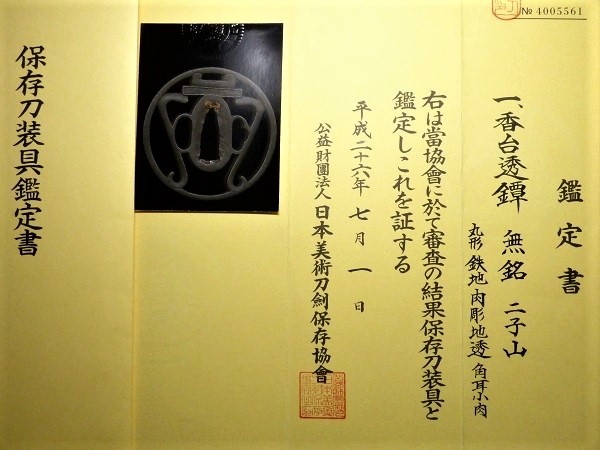
Ko-Shoami Price On Request "Write up to follow. NBTHK 'Green' paper. This piece dates to ca. 1500." (Haynes) |
  |
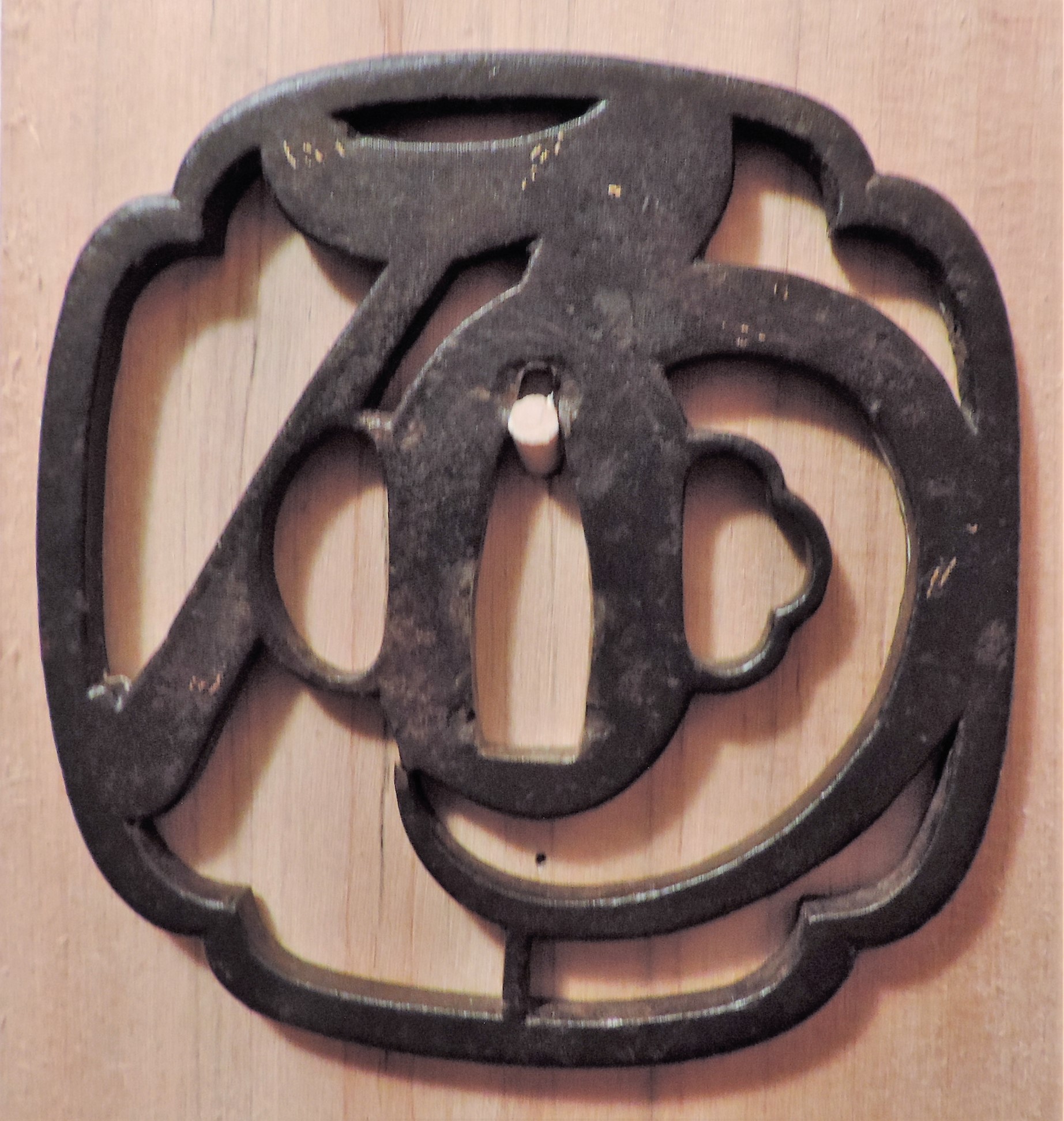
KYO-SHOAMI $800.00 A marugata niku bori ji sukashi tsuba depicting a table used on an alter of a temple to place offerings on top of. The entire surface of both sides and rim are smooth, made first by filing and then by the use of a whetstone. Dates to ca. 1700. (Long) 7.32cm x 7.33cm x 0.56cm |
 |
KO-SHOAMI $500.00 "Iron square mokko shape (iri-sumi kaku) of sukashi design of a kanji meaning 'for you'. This was a gift tsuba. Remnants of gold and silver inlay, gold representing the sun and silver representing the moon. A fair amount of the inlay is missing but cherry blossom flowers can be seen. Dates to Momoyama period, ca. 1700." (Long) 7.90cm x 8.15cm x 0.45cm |
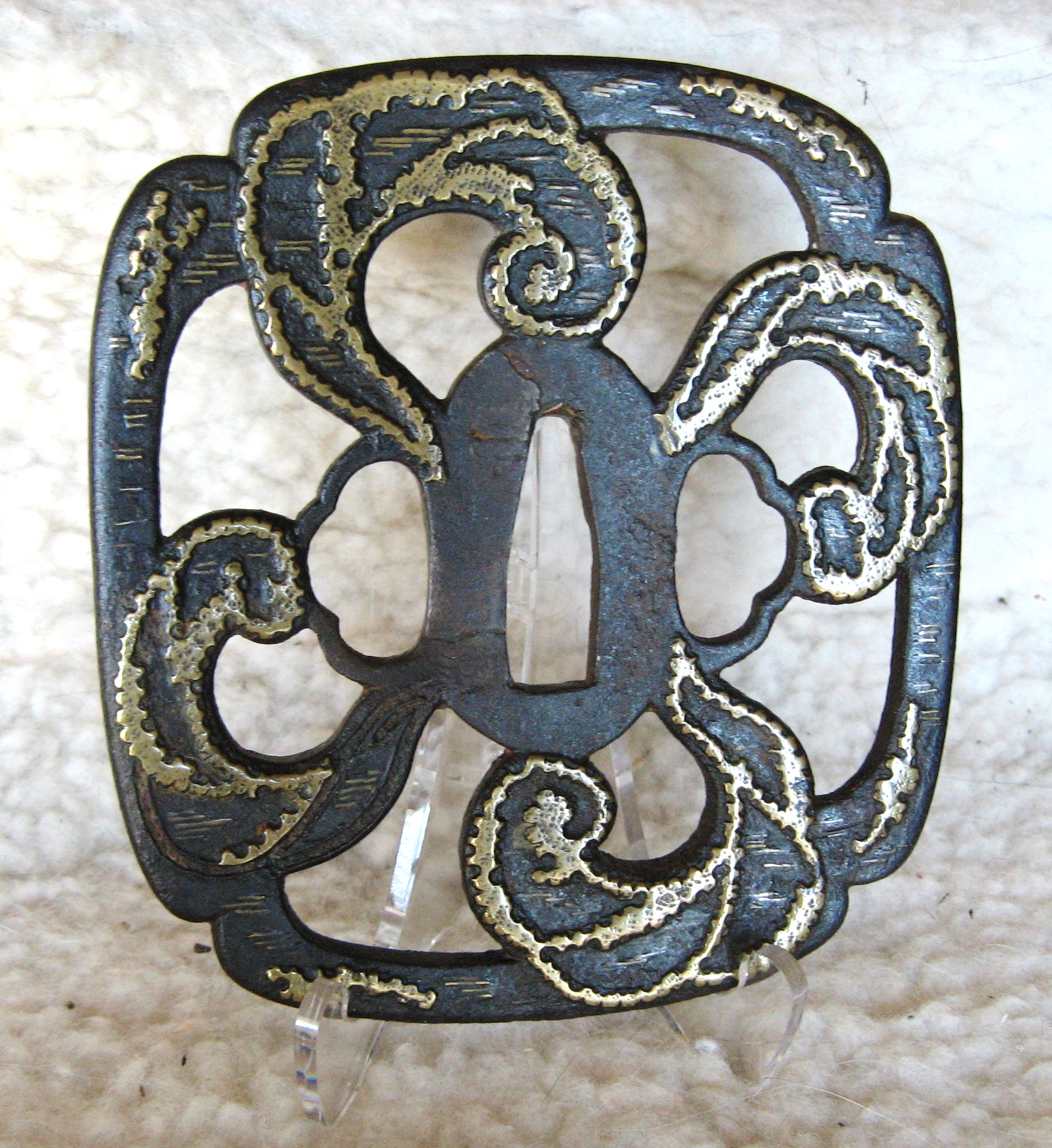 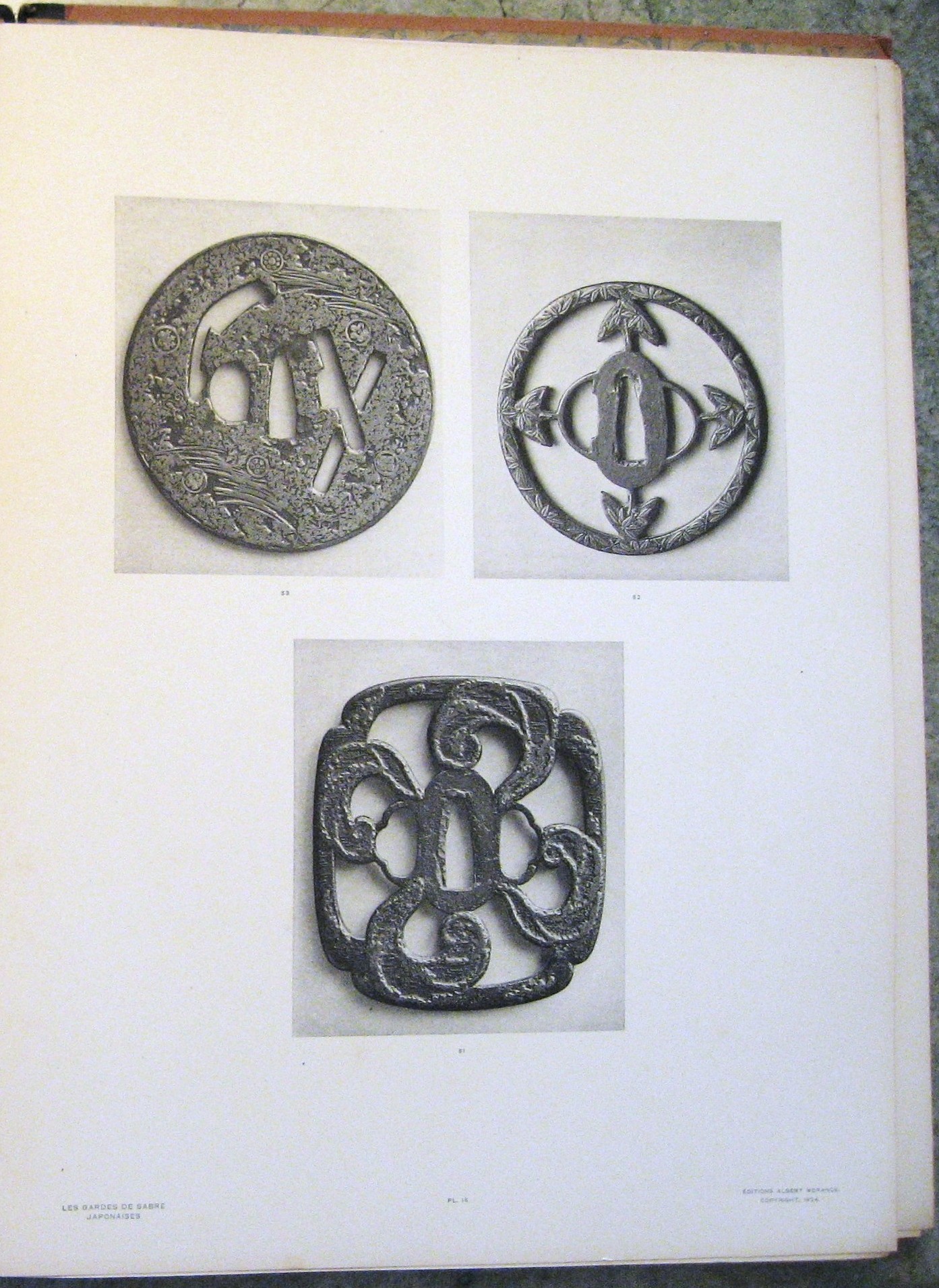 |
SHOAMI $1000.00 Momoyama Period (ca. 1600) "The elaborate and detailed design of cloves, the use of refined iron with abundant brass inlay, contribute to the strong impact of this masterpiece. There seems to be two different colors of brass inlay used. Fine tekkotsu on the rim. The representation seen here of cloves (one of the objects of the Takaramono, associated with the Gods of Luck), define Sweetness and Health. Only missing inlay at 8 o'clock position (see at right)." (Long) |
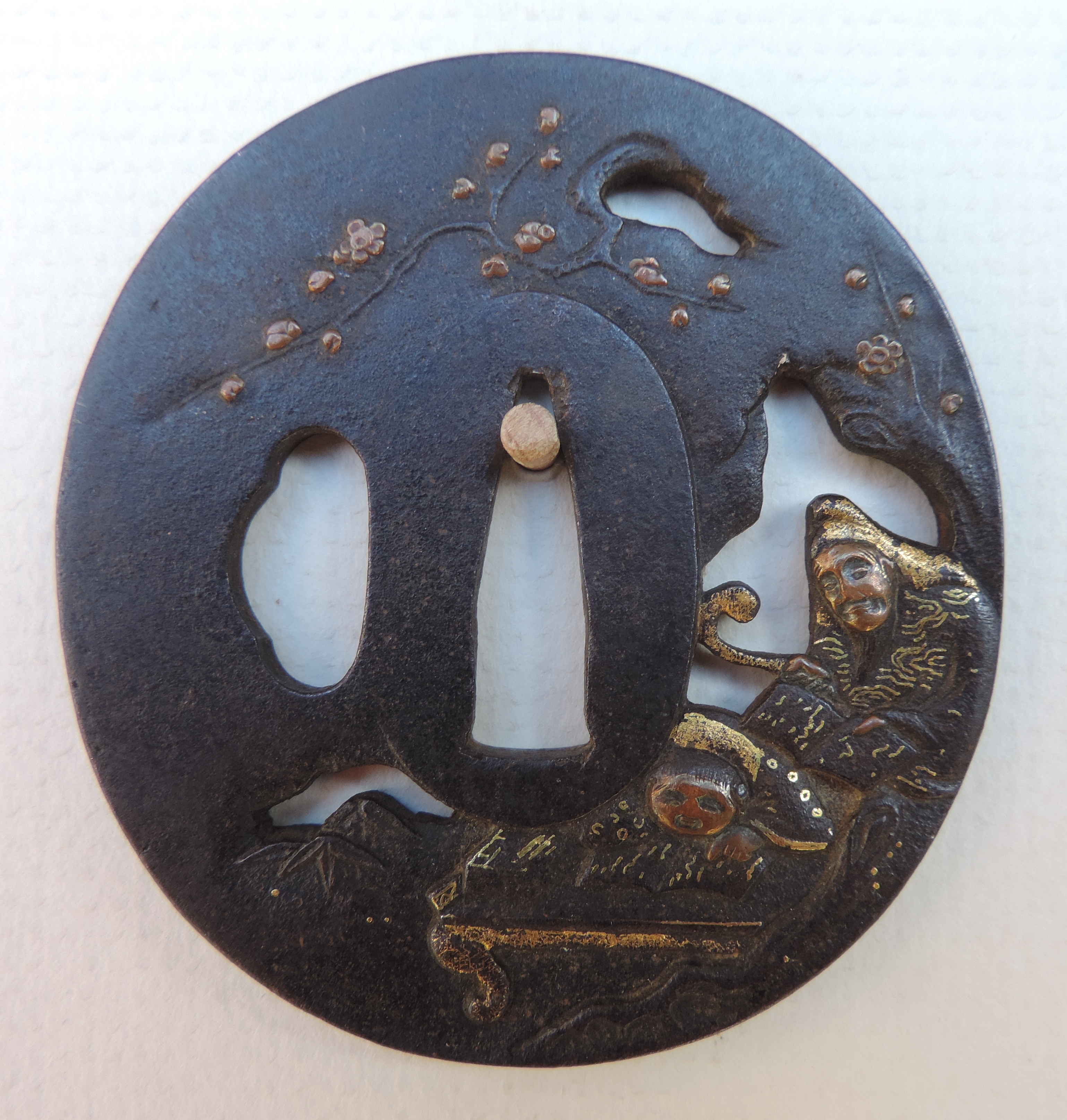 |
AIZU SHOAMI $300.00
"Aizu Shoami tsuba mostly have an iron ji, and kinko works are very rare. The shinmaru gata (true circle) shape is encountered regularly. Most round tsuba are a bit taller than they are wide as is the case here. Both hitsu-ana are often shaped like kogai-hitsu as opposed to the standard kozuka kogai configuration. A motif showing a person or thematic object with a natural landscape in the background is common. Motifs such as the Chinese subject shown here, are often seen. The bottom right section will contain the main design carved in takabori and/or detailed with nunome or inlay work, while the upper left section area is carved with comparatively less detail - moresoft and suggestive. This effect implies visual distance, draws our eye to the main section of the work and gives the illusion of depth to the overall design." (Long) 6.90cm x 7.35cm x 0.40cm |
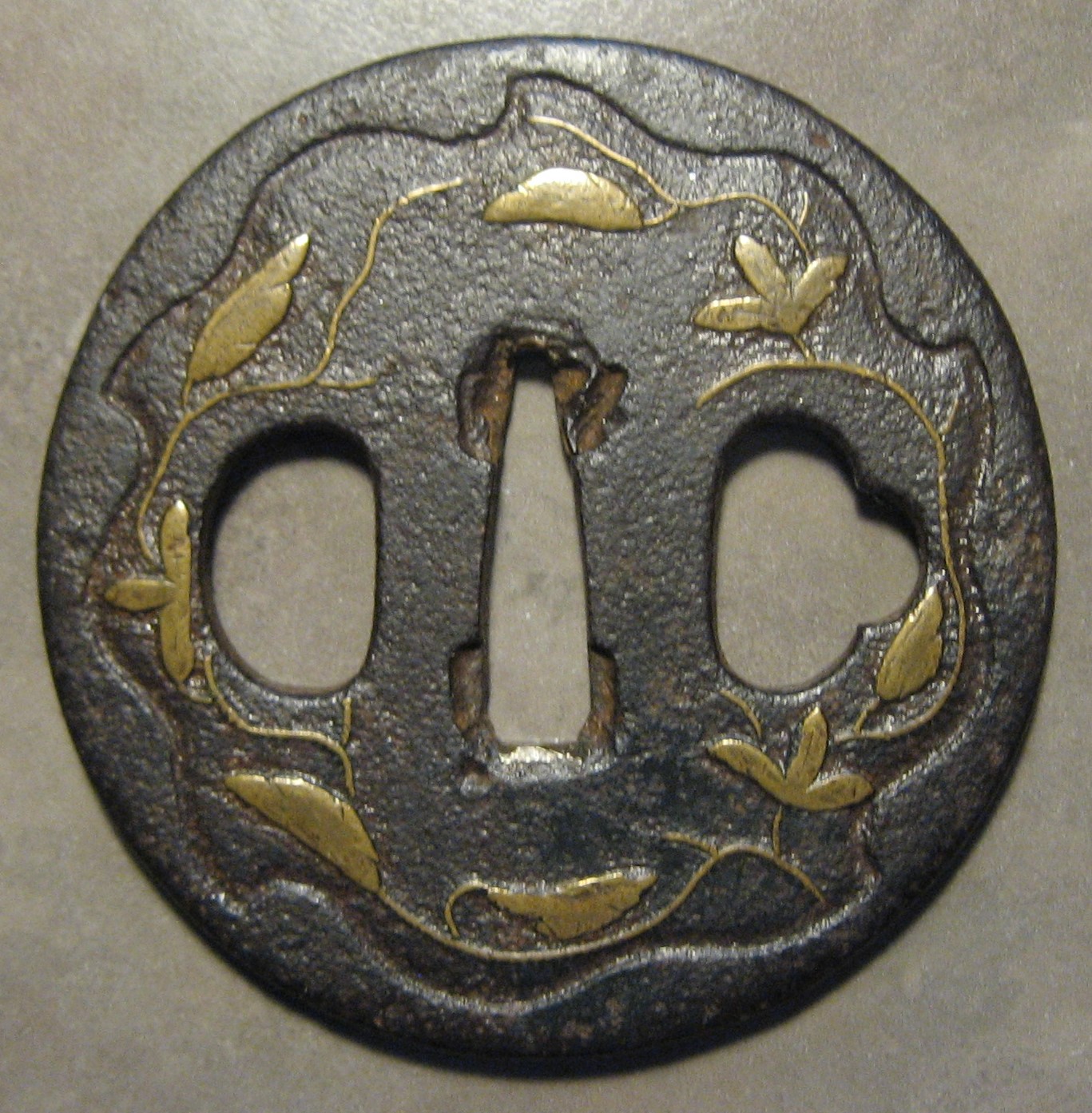 |
SHOAMI $600.00
"A round iron plate tsuba with scalloped rim edge. The brass inlay of three leaf plant with vines occurs on both sides. On the ura side, left of nakago-ana, is carved 'Ten' meaning heaven, sky, the air, Imperial, etc. It seems this was added after the tsuba was made. The hitsu-ana show Shoami style influence. Dates to the Momoyama period, ca. 1550-1600." (Long) 7.30cm x 7.85cm x 0.45cm |
KANEIYE TSUBA
Throughout the entire history of tsuba one name stands supreme: Kaneiye. It is most curious that the name of Kaneiye was not widely known until the Temmei era (1781-1789), which was already late in the Edo age. There is much conjecture that attempts to explain this belated recognition, but it would seem that there are only two answers. The first will be found in the taste and personal finances of the samurai of the early Edo age. Their taste ran to such austere types as the Katchushi, Tosho, Kyo-sukashi, Owari-zukashi, and the Yoshiro and Heianjo-zogan styles, followed by the Higo and Akasaka schools. The second reason was the rise of the kinko school in the middle of the Edo age. First the Nara school appeared and shortly after came Yokoya Somin, followed by the vast group of late kinko. They were to vie with the old established styles, and soon they won out. During this onslaught the nobility, high ranking samurai, and connoisseurs adhered to the style of such workers as Kaneiye and Nobuiye. Because the work of Kaneiye was so highly regarded by the upper classes it never came into the hands of the masses. With their existence virtually unknown they never were popularized by the early Edo artists.
When the upper classes took to the new kinko styles the work of Kaneiye and Nobuiye was put away and forgotten, but by the end of the late Edo age the nobility began to tire of the beautiful kinko work and they wanted something to take their place. The merchant class was very strong and had the opportunity to see the work of Kaneiye, at this time, when it was brought forth again by the nobility. They appreciated his style and wanted his style for their own tsuba. They thought the quiet good taste was most applicable to this period of peace and prosperity. They made the name of Kaneiye famous in all classes causing the late school of Tetsunin and the Saga Kaneiye into production to fulfill this great demand. By the Temmei era the fame of Kaneiye was spread far and wide.
Today we cannot give credence to any generations but the first two. All later work must be classed as the product of the Saga Kaneiye school, or later imitators. There are various stories concerning a number of
generations with this same name of Kaneiye. The Kansai region said there was one
Master Craftsman, and in Kanto, they said there were two people, the Daishodai
(Grand Master) and Meijin Shodai (First Generation Master). Three distinct Kaneiye who worked before the eighteenth century are thought to have existed, judging from the technique and decoration of specimens determined as originals. Research defines as
follows:
DAI SHODAI KANEIYE: The first Kaneiye signed his work Joshu Fushimi (no) Ju Kaneiye. By tradition he is called the 'Great First Kaneiye'. The work of the first Kaneiye was not known to the connoisseurs of tsuba until the Tempo era. At that time Akiyama saw three tsuba that were unquestionably the work of the same hand. To this day these three tsuba are the only work known to be by the first master. Since his work is so rare we may conclude that he began the making of tsuba late in life. In addition much of his work must have been lost in battle or through the many disastrous fires of later times. It is not certain when the first Kaneiye began to make tsuba. The few facts we have are these: From close observation of the three extant tsuba it is clear that he must have descended from one of the katchushi schools. We may find precedence of his style in such early work as the fine inlay of the hoju tsuba or in the brass inlay of the Onin style. It is not unreasonable to suppose that a superior worker of the katchushi school could have combined the best qualities of the schools of the past and created a superior style of his own, and this would seem to be just the case. Each facet of his work, after careful examination, will be found to be finer than anything the past had to offer. Kaneiye the first is commonly thought to have worked in the middle of the Muromachi age, but this is too early. It would be safer to say that he worked about the Eiroku (1558-69 to Tensho (1573-92) period, that being the heigth of the Momoyama age.
The style of the first may be called engraved pictorial style. In design, he followed the style of Mokkei, a Chinese painter (Sung dynasty), and Sesshu, a Japanese painter, who worked after the Chinese style during the 15th century. He used high relief in his decoration combined with inlay of various metals. His iron is of the oroshigane type. It is of the highest quality, forged to perfection and remarkable for the brown or reddish color of the iron and their wonderful finish, unsurpassed by that of any other tsubako. He commonly used the final-two-fold method of the katchushi to form his plate, but with such perfection that one cannot readily see the line of the final folds. His tempering is exceedingly fine. The iron bones are similar to those found in the later Kanayama school. The ground of the plate has an irregular hammered surface well under his control. It shows careful work with close attention to detail. The small hammer marks are in groups and patterns that give variety and change to the surface. This attention to the aesthetic beauty of the plate surface sets the time of production in the Momoyama age.
His style closely resembles the old katchushi with a mixture of Heianjo-zogan and Ko-shoami styles of inlay. The decoration is a summation of the best of the best of the Heianjo-zogan and Ko-shoami schools. From this we may deduce that he was slightly later in time than the high point of these schools in the Muromachi age. He brought to perfection the styles they had originated, thus giving us the indication of his period being the Momoyama age. It might be said that he was the climax of the true aesthetic feeling, for later artists were only rarely to touch his genius.
MEIJIN SHODAI KANEIYE: The artist referred to as the second Kaneiye worked during the Tensho to Keicho period (1573-1615). His work was known long before that of the first Kaneiye, which is the reason why he was originally called shodai. An analysis of the styles of the second based upon extant examples tells the true story. He used many designs, always of a noble nature. They are quiet, graceful, and show somewhat the contemplative feeling seen in the work of the first master. Occasionally he used openwork designs such as the tomoe shape or undetermined shapes. It has been said that the inspiration for his designs came from the work of the famous painter Sesshu. If this is so it was not a direct relationship, for Sesshu died in Eisho 3 (1506). It is more likely that he took some designs from the work of Tohaku and others of the Unkoku school, especially the second, Unkei. His designs are commonly of naturalistic landscapes in the Chinese manner, or a few religious subjects. These themes were the accepted fashion of the Muromachi and Momoyama ages. He no doubt took his early themes from the subjects used by the first Kaneiye, for a few of his pieces show the direct inspiration based on the first, such as the Bishamonten tsuba which is a close replica of the one by Dai Shodai Kaneiye. His work is not as strong or bold as that of the first nor as great in feeling, but there is no doubt he must have received his training from the first master. His relief carving is not as high as that employed by the first, and his inlay work shows a more direct connection with the contemporary Heianjo-zogan school. Even more important is the technique used in the application of his inlay. This will be found to be firmly grounded in the style of the Goto school of his period.
SAGA KANEIYE SCHOOL & TETSUNIN SCHOOL: The true story of Tetsunin is clouded with many legends. Some say he was the preparer to the first and second Kaneiye. He was thought to have forged the plates that they decorated. Others say he was a student of the second Kaneiye. All that can be said for sure is that he was to use the style of the second Kaneiye as his own and probably developed a school based on that technique. We do not know when he moved from Fushimi to Higo, or if he ever lived in Fushimi. It is more probable that he only studied there for a short time. He seems to have moved from Higo to Saga in Hizen Province, or at least his school did. The majority of the pieces turned out by this school are signed with a facsimile of the signature of the second Kaneiye. Occasionally we see the signatures of the artist who actually made the piece. The best of the Saga Kaneiye work is either unsigned or with the artist that actually made the piece. The unsigned pieces, in later work, sometimes show the best craftsmanship.
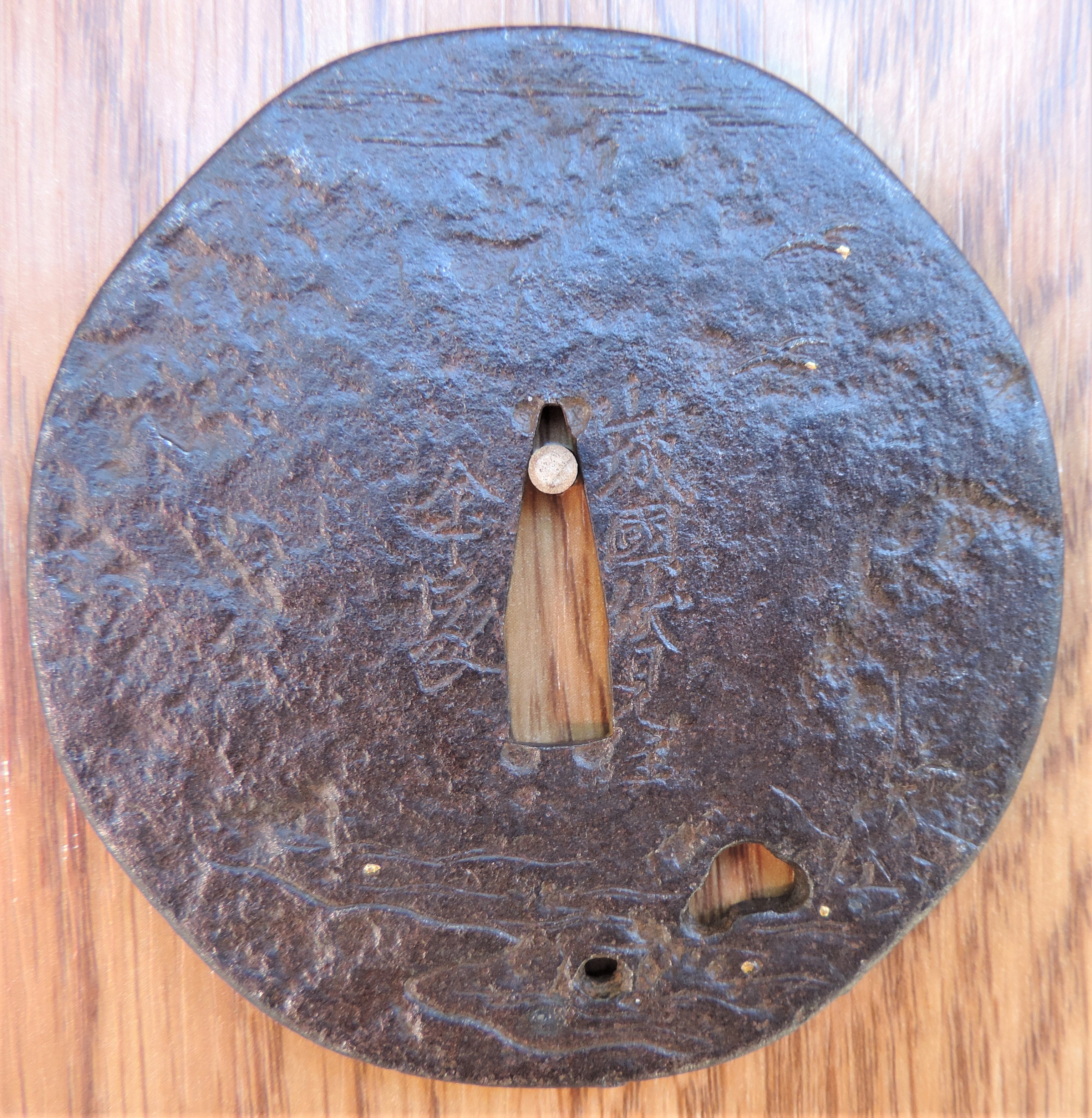 $450.00 |
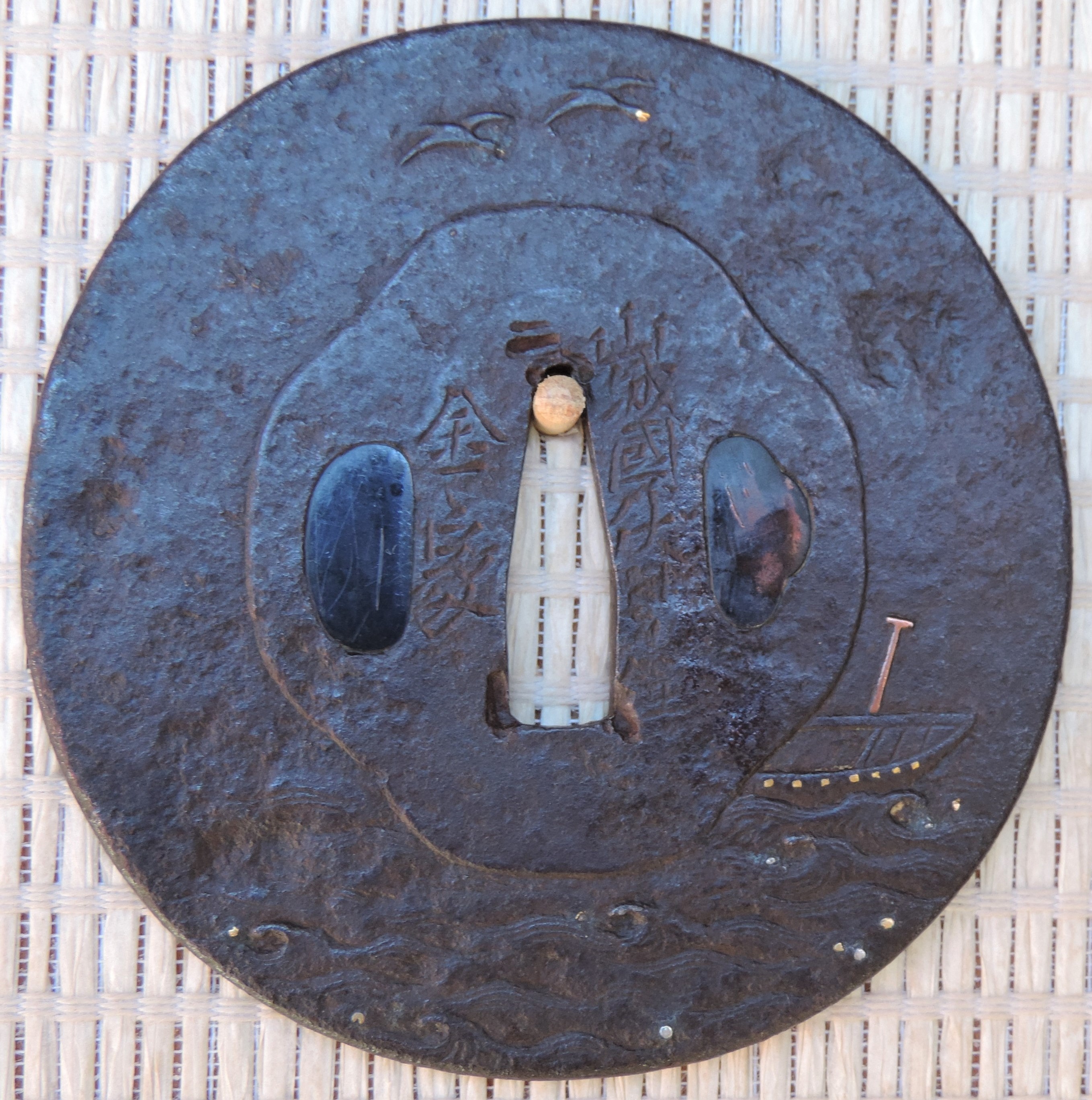 $400.00 |
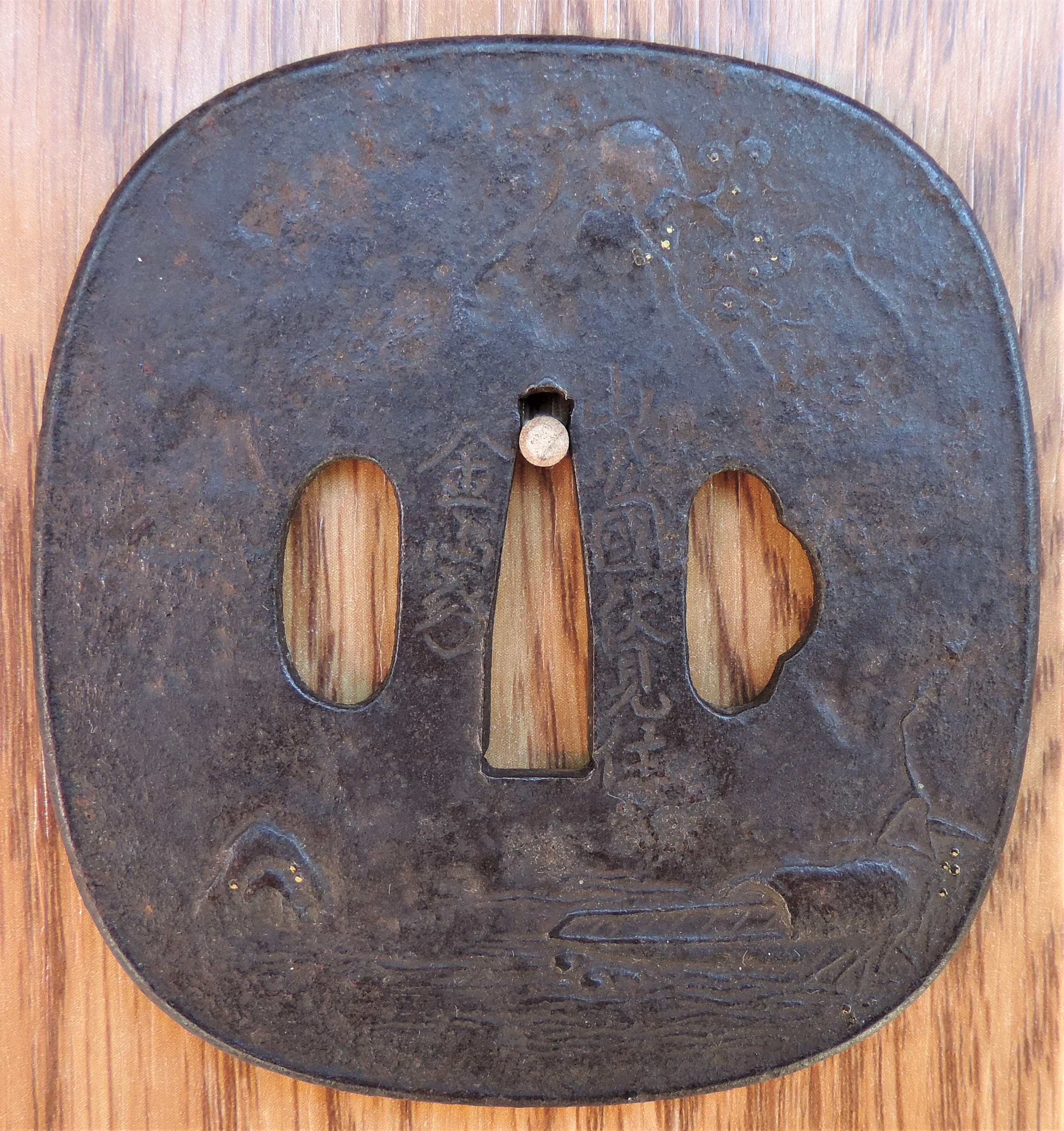 $300.00 |
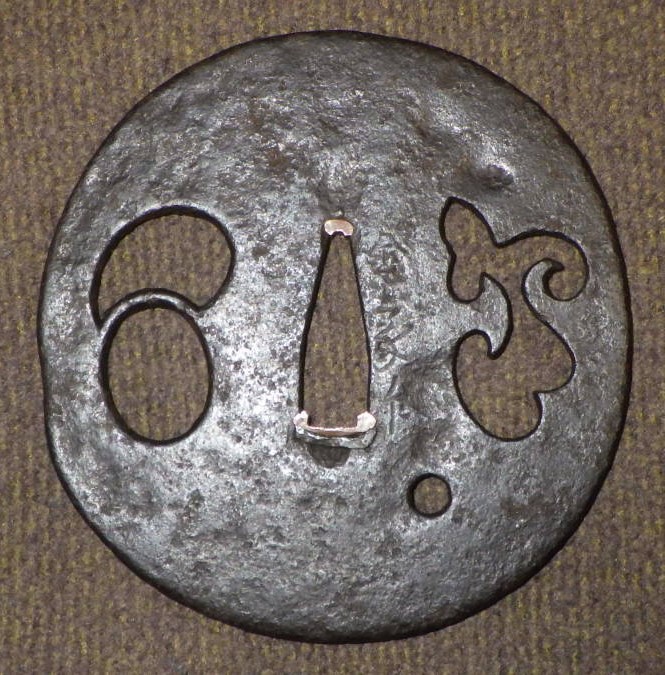 $900.00 |
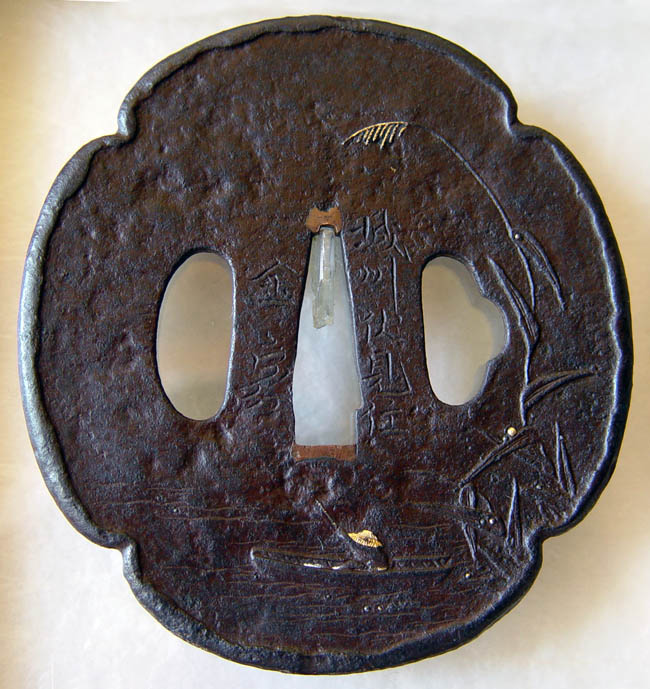 $1000.00 |
 Price On Request |
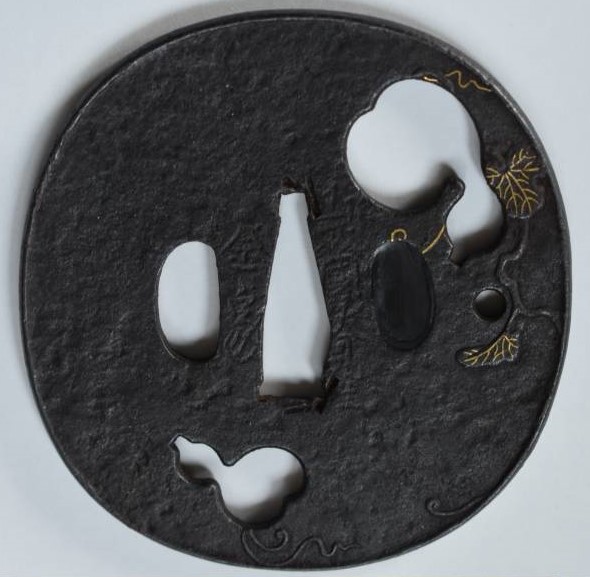 $5200.00 |
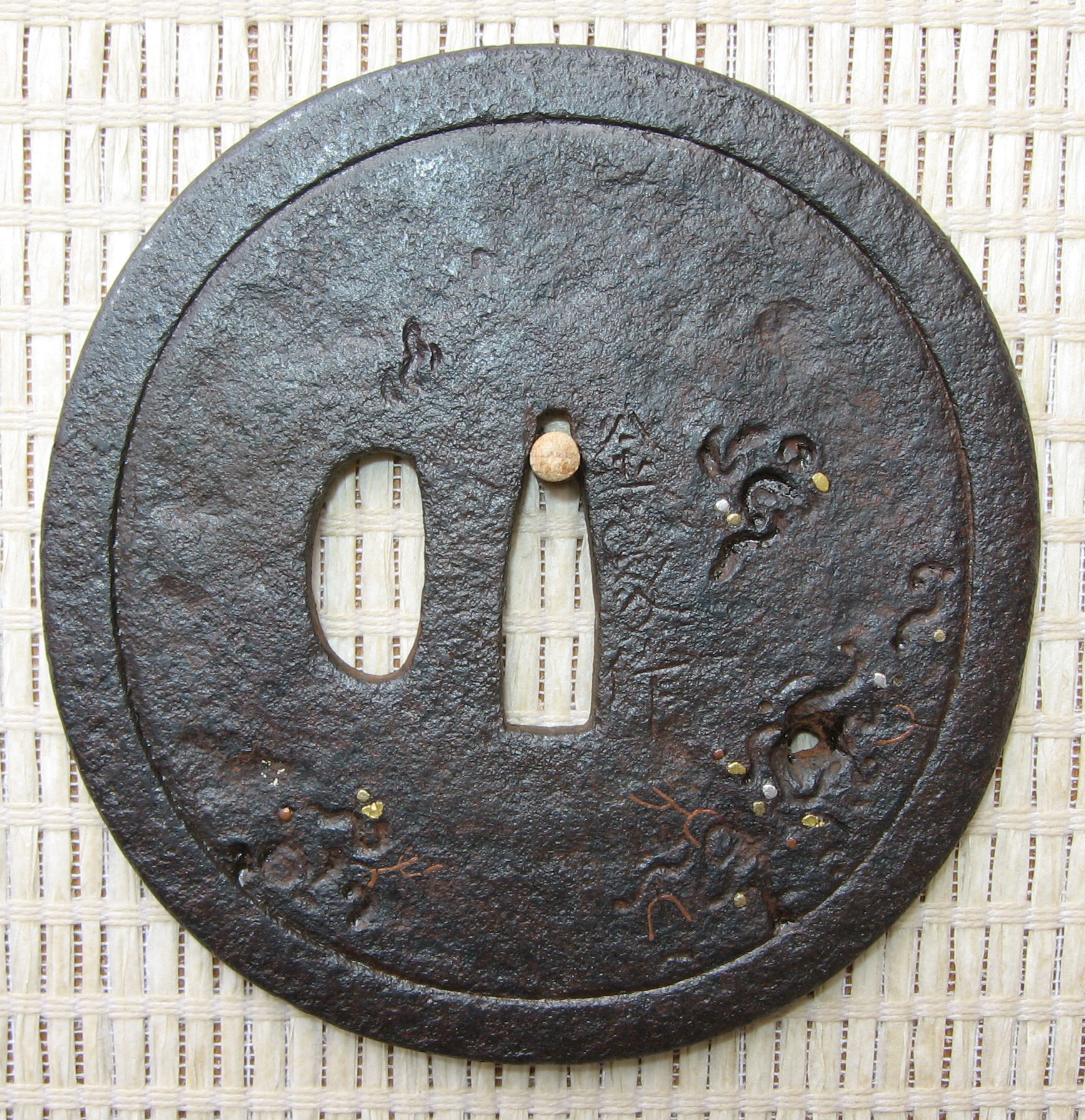 $2000.00 |
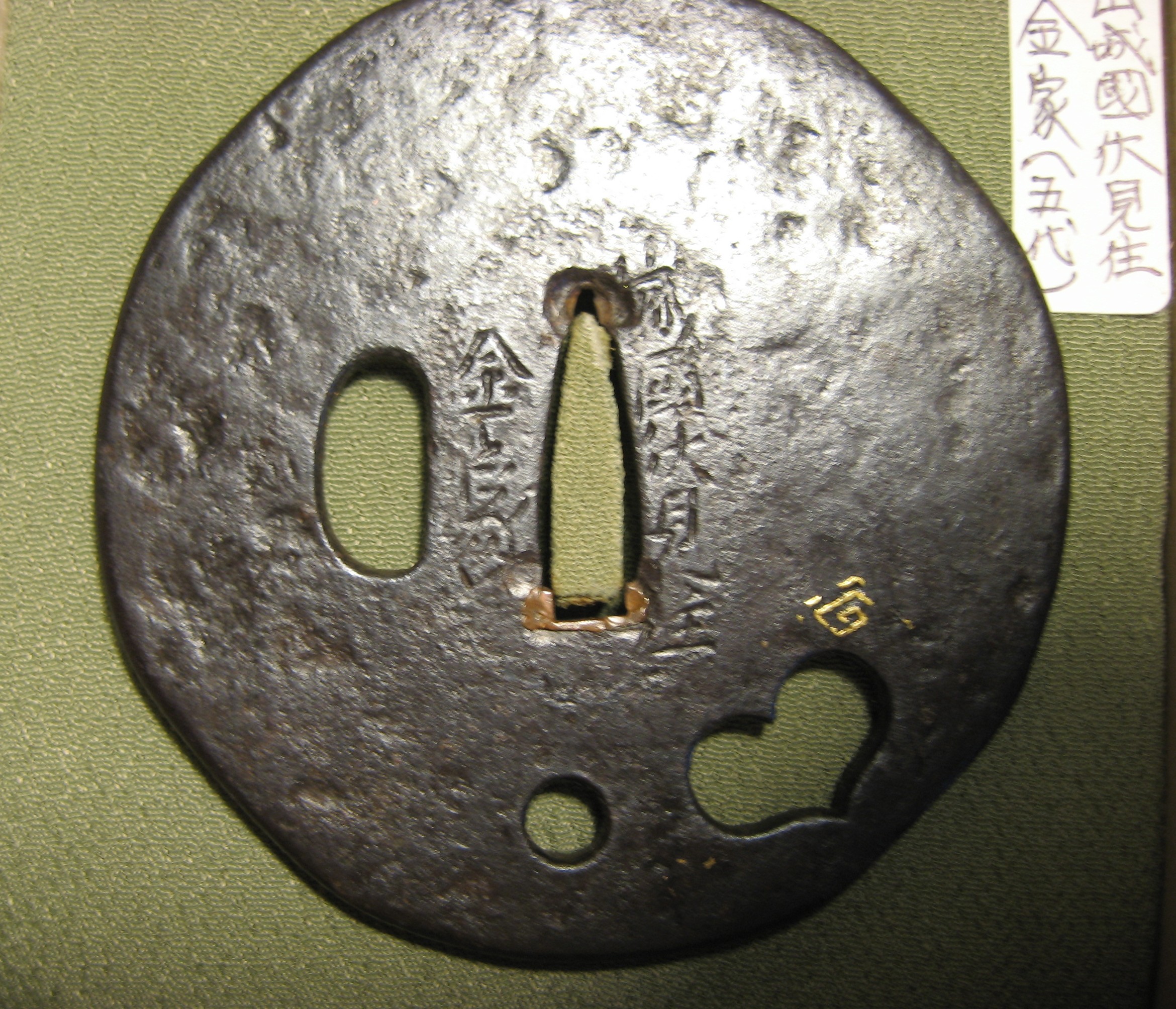 $1200.00 |
 Price On Request |
 Price On Request |
Read about Kaneiye and Myochin Nobuiye from 'Japanese Sword Mounts' by Helen C. Gunsaulus OR
read Takeuchi Fumio's ONE WAY OF LOOKING AT KANEIYE
NOBUIYE Tsuba
The opinions about Nobuiye soon reveal that no-one seems to agree upon any of the facts that we would consider relevant or usable in a search for examples.
Starting with the commentary of Henri Joly - and recognising that in
his time he was, like all the late 19th century collectors and students, at the
mercies of those who advised and helped him arrive at his judgements. Joly says in 1912.....
He was the same man as the Miochin Nobuiye, 1496-1564, whom we know as the Armourer.
That he did make tsuba, but not why,
and that the story of his having received the character Nobu
from Takeda Shingen (also known as Nobuharu) is possible.
He goes on to say that tsubako
of this name worked in various locations at different times in places such as Koshu, Geishu, Kyoto, Akasaka, Kaga and Echizen. Some of these locations actually do fit in
quite well with the accepted story of Nobuiye’s
progress through life. Koshu is
The next book is the Nihon To Koza circa 1935, translated by Harry Watson in the USA, who begin's by saying that the Tsubako Nobuiye was the 17th generation of the Masuda Myochin working in the last part of the Muromachi period. The story of his service to Shingen in Kai Province (Koshu) is repeated as fact and there is a decent critique of the various signatures that can be encountered, including a version that is described as being’ thin and tall’ and neatly composed with a thin tagane– this is considered to be the signature of the Shodai. Secondly there is a ‘thick’ version of the name, inscribed with a broad tagane, that is a bit scrunched up and done in a compressed form and is seemingly regarded by them as the signature of the Nidai. There is also a very scratchy and weedy form of the signature that is present on a variety of tsuba described as ‘beautiful’, but they do not say how or why. This last group is regarded by the Koza Team as having been the most desirable variety in the past (presumably because the tsuba demonstrated good quality, rather than because the mei demonstrated indisputable veracity) and because of this they spawned a lot of spurious fakes. It then (from the 1935 viewpoint) appears that the ‘thick’ mei versions became more desirable due to their being very ‘masculine’ in style – and also because of the number of fakes of the ‘thin mei’ version undermining confidence in the buying public. Geishu Ju Nobuiye (or Geishu Ju Fujiwara Nobuiye) is admitted to be probably a pupil of a later time, as is the most enigmatic of all the Nobuiye signatures; Mitsu Nobuiye. Sticking to the subject of mei, they go on to say a most surprising thing; that these major, and several other minor, variations in mei point to there having been a ‘Collective’ or perhaps even a Workshop of Tsubako ALL signing Nobuiye!! Even more surprising there seems to be no resentment of this possibility, only a placid acceptance of a situation whereby several skilled craftsmen working closely and cooperatively could actually maintain a high standard which finds approval in the eyes of the many Sensei who have judged their works ever since.
It is impossible to
ignore the opinion of Masayuki Sasano.
Sasano says that he has experienced
seven different mei without
saying what they are (I suppose he wants to make us go hunt them down for
ourselves and benefit by the effort!). Armour
enthusiasts won’t like this at all but he goes on to say, in a very gentle
fashion, that the two men, Armourer and Tsubako, are not the same person because the works of the Armourer Nobuiye are simply not
up to the quality of the Tsubako Nobuiye.
Obviously the differences in the simple
intention of forging a typically thick tsuba
of Nobuiye at around 3-4 mm and a plate for, say, a Shikoro, are going to be vast but he seems to make no
allowance for this
I think he just believed instinctively (from the evidence of the
Tsuba before him) that a Katchushi
of this time could never have made the switch to Tsubako,
or perhaps he could just not admit that possibility because to do so would be
stepping beyond the bounds of convention.
I have noticed something that is never mentioned in catalogues,
books or articles that include Nobuiye and it may be
something or nothing.
When examining tsuba made by Nobuiye, there are those deemed shosaku (genuine work) whose signatures do not adhere to just one style. There are many variations. For one person’s style of mei to vary so much is the question of all questions. The experts say it is due to his longevity, variations due to the different stages in his life. Being a member of the Myochin family, Nobuiye moved from Sagami to Kozuke and finally to Kai (in obedience to an invitation of the Takada family). Though people speculate that he was a tsuba smith, he was of an honorable family of a line of armor makers. This was the period of continuing warfare and katchushi (armor maker) were kept very busy. I don’t believe that he would abandon his main occupation of creating armor to engage in making tsuba. Since Nobuiye had many pupils, he might have had them do his work on his behalf.
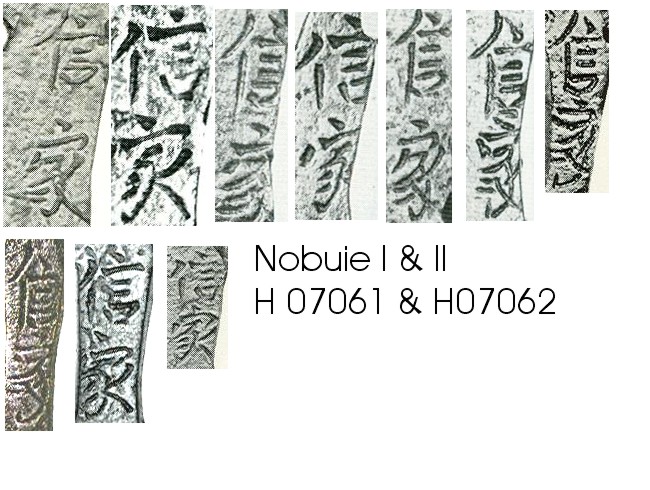
Among his tsuba with various types of mei, there are a small number of katchu-mei (armor maker’s signature) pieces. These signatures have the same characteristics as those on his armor and the tsuba styles are slightly different. Upon examination of the shosaku (genuine work) of Nobuiye, these should be attributed as his own and all other mei-furi (appearance, or style of signature) pieces as those of his disciples. There is a distinction among the daisaku (ghostwriting; a stand-in; double) work; mei is separated with ko-sukashi and kikka uchikomi (chrysanthemum pattern hammered in), and there are other signatures with many kikko (tortoise shell) patterns, many with monji (Japanese written characters) designs, and some with jimon (patterned surface). To copy a style, one should try to create an extremely believable work. These Nobuiye have various mei-furi (style of a signature) with no evidence of copying, they all endeavor to demonstrate their skill. Perhaps it is closer to the truth to see them as daisaku (a stand-in; double).
Now for styles. The Shodai
Nobuiye is credited with a particularly apt form of Mokkogata which everyone agrees is a shape that sits just
perfectly with the sword and, in fact, does not really work well in the eye until it is fitted to a sword. I cannot
believe that he stuck rigidly to this shape alone and actually there are a
couple of Nadegaku (rounded square shapes)
illustrated in the Koza which seem to me to sit very
well indeed for the time of the Shodai and the style
attributed to him. (see pages31-33 in the Kodogu part 1 volume.) He demonstrates his skill as a
Smith in the way he forges his thick plates (Tsuchime
finished and about 4mm in thickness) and very subtly turns up the rims, (Uchikaeshi Kaku Mimi). Also the
sheer strength and quality of his iron appears to universally impress, and the
way he handles it to reveal its structure in such features as the rim, the Ji etc. If you look carefully at a few examples you begin
to realise that this was a craftsman who knew when to
stop hitting the thing with a hammer.
Decoration seems to be quite limited with Kebori
engraving often done to about the same depth as the Mei,
and a very restrained amount of Ko-Sukashi piercing.
At this point I don’t know quite how to put it but, returning to
the Koza, I see that under Work Styles they disavow
their previous certainty and state categorically that, because of the great
thickness of the tsuba in question, they cannot admit
that the Tsubako Nobuiye
can possibly be the same man as the Katchushi Nobuiye. The stated reason for this is that Katchushi tsuba are almost always
very thin (about half the thickness of a Nobuiye) and
so he obviously did not come from an armourer’s
tradition of forging. Far from giving up here, we should actively argue a point that
they have already made; that the works of Nobuiye
stand out as being totally unlike the other, more standard, Katchushi works of the time. This is what seems
to have made them admirable and desirable in the eyes of the Samurai of that
period, and they bought them because of it. Is it therefore unreasonable to
dismiss the possibility that he could be the same man on that basis? Perhaps,
but I think that single reason a bit thin and would have liked to hear
something else in support of the contention.
The Kebori engraving is not just the
rather quiet type of Karakusa vines we often see, it
is also in vivid tortoise shell patterns like Kikko,
floor tiles, peonies, clouds, dragons and Ho-O birds. Another specialty is to
use Sosho inscriptions such as the Namu Myoho renge
Kyo Sutra, or the more common Hachiman
Daibosatsu invocation. The sukashi
designs, though usually small, are also vibrant in their choice and their
placement. (See the one on page 32 of the Koza with
an Ono – axe- for a lesson in how to place a sukashi
design in just the right place on a plate). You can find Gunpai, Water Wheels, Mitsu-Tomoe,
and the enigmatic Matsukawabishi Mon used in the
‘less is more’ sense of a Master Sukashi
worker. The only large scale Sukashi
piece I know of is the famous Kamo Shrine tsuba in Sasano’s book where the
Torii and its surrounding bushes are given a flourish that only someone very
confident of his skill can accomplish. Using themes such as these I
find it very understandable that the Samurai of the late Muromachi
could take these to their hearts with enthusiasm. Up to that time tsuba for the average Samurai would have had to be sober to
the point where only he could find something in
them to like. Nobuiye gave his patrons strength,
style and feelings with his bold offerings and they liked them to the point
that, Sasano says, in 1800 a Nobuiye
tsuba changed hands for the equivalent of 100 pounds
sterling in the 1960’s.
The truth about NOBUIYE
Despite the fact that the name of Nobuiye is well known, the mis-understanding concerning this artist is huge (read above). Far more than was evident in the case of Kaneiye (see Kaneiye above). The information presently available is so vague concerning his life and history that it is difficult to make a conclusive statement about him. The majority of facts available at the present time were uncovered by writers of the past. We would hope to glean some information from this mass of material, but most of it is so erroneous that it will only hinder a proper study. It is best if at first we set the record straight.
Even today it is commonly believed that the Nobuiye who made tsuba was the same man who made armor and is called Myochin Nobuiye, the 17th master of the family. It is true that the man who made tsuba came from an armorer family. But, we cannot look for his origin in the Haruta, Saotome, or Iwai schools of armorers. We must go to the Myochin family for his origin. The genealogy of the Myochin family is far from certain, and not nearly as reliable as the authors of the past and present would have us believe. The first tsuba made by members of the main line artists of the Myochin family do not appear until the time of the Myochin Munetoshi, 21st master of the family, about 1625. This was considerably later than the working period of the tsuba Nobuiye. The main line masters of the Myochin family made tsuba as a side line. On the other hand Nobuiye was a professional maker of tsuba. We have a great many pieces bearing the signature of Nobuiye. There are too many extant examples for any one artist to have made tsuba as a side line when not engaged in the making of armor. To show the reason why the 17th Myochin is not the same man who made tsuba, it is necessary to give the background and an analysis of the characteristics of their signature. The style of signature used by the armorer Nobuiye is of two types. Though these two styles show a similarity they are vastly different from the style of signature found on the tsuba. To complicate matters, there are some who feel that all the helmets bearing the Nobuiye signature are forgeries. Even if we accept the few pieces thought to be the real signature, the signature found upon them bears no relationship to that of the tsuba Nobuiye. It seems unnatural for an artist to use such radically different styles in his signature.
It is clear from a comparison of the technique used in the tsuba, with that used in the armor, that the tsuba artist was far superior in ability. Every indication of the work and the signature points to there having been two separate artists with the same name. These two men must have lived about the same time. Two artists living in close proximity would not usually wish to have the same art name, unless theyweremembers of the same family. We may deduce from this that these two men were related in some way. Since it is clear that the tsuba Nobuiye was not the 17th Myochin, we shall have to determine his relationship to other members of the family. It is most probable that the tsuba Nobuiye was the younger brother of the armorer Nobuiye or he was the son or younger brother of Sadaiye, the eighteenth Myochin. In any event he did not inherit the title of the family leading us to believe he wasthe second son, thus the family title passed to his elder brother. The working period of Nobuiye is very close to the time of the 19th Myochin, Muneiye, which would place him in the Tensho era (1573-1591).
His style very definitely shows his Katchushi family background. He used the two-fold method in the construction of his plate. In fact, all the characteristics of his work are katchushi but far superior to the common non-professional katchushi tsuba maker. There is common thought that his style came from the Owari school group and that there is a strong relationship between his work and that of the 1st Yamakichibei and the 1st Hoan. It may besaid that the work of Nobuiye is in no way directly associated with the schools in Owari Province. It is true that his tekkotsu resemble those found in the Kanayama, and other Owari schools, and that he was as skillful in his tekkotsu as they were. This similarity may be explained through the fact that Nobuiye and the various schools of Owari have a common origin in the katchushi tsuba makers. The schools of Owari did not need Nobuiye to teach them the art of making tekkotsu, as is often stated, for it was a family art with the artists of Owari and will be seen on their tsuba long before the time of Nobuiye.
Rather than the Owari schools we may find the origin of the style of Nobuiye closer to home. Namely in the work of Myochin Takayoshi. He used a style of yakite shitate that is very similar to the style used a little later by Nobuiye. There is some speculation that he might have learned some of his technique directly from Takayoshi,but the famous tsuba by Takayoshi seems to date earlier than the time of Nobuiye.
The area where Nobuiye worked is not clear. He seems to have been a traveling tsuba maker, for he is mentioned as having lived in several places. During his time the great center of samurai culture was the area called Kiyosu (a town between Kyoto and Nagoya). Naturally Kyoto was another great center of culture and the area between there and Kiyosu was much traveled. We may be sure that Nobuiye took this course often in his wanderings. There is no evidence to tell us the length of time he might have spent in either place. We are not even sure where in this area he might have died. It is traditional to speak of Joshu or Koshu as the areas familiar to Nobuiye. These places are the ones that should be associated with the 17th Myochin, the armorer Nobuiye.
The spirit of the Sengoku Jidai (1490-1600), will be seen in the religious, moral, and inspiring words that were the mood of the day. These incantations will be found emblazoned on the works of Nobuiye. This spirit of his time we see expressed often in his work, showing that he must have been well versed in the current thoughts of the day. In addition to the philosophy of his day there is a direct connection between Nobuiye and the great men of his period, such as Nobunaga, Hideyoshi, and Gamo Ujisato the Christian. The Christian religion had been brought to Japan only a few years before the time of Nobuiye and the tsuba artists were greatly interested in using the designs and signs of the new religion as decorations for their work. From this it is very easy to place the time of Nobuiye at the Momoyama age.
Thus far there has been mention of only one tsuba Nobuiye. We know through the rubbings of Nobuiye tsuba (seen in Nobuiye Tsuba Shu, 1926) that there are several distinct styles of signatures to be found on the many Nobuiye tsuba. These various styles were classified at great length by Akiyama. Though it would seem that several men with the same name might have made Nobuiye tsuba it can be stated that these various signatures should be grouped into two styles, thus giving us only two tsuba Nobuiye, a first and second generation. It is not difficult to distinguish between them. The first generation may be termed Gamei (elegant signature), this being the style called 'hanare' by Akiyama. This style is gentle, slight, and tasteful. It shows the quiet nobility of the subjects used in his decorations. The second generation which Akiyama called 'futoji-mei', 'katchu-mei', 'sakei-mei', and 'sumari-mei' are all the signature of this one generation. This style of signature may be called 'Chikara-mei' (mighty signature). It shows the strong,bold style seen in the thick plate and forceful carving. It can not be stated with any certainty what the exact relationship was between these two artists. It is possible that they were father and son, son-in-law, or brothers. In any event they seem to have been closely related. From the evidence, based on the style and subjects used, we have placed the working period of the first Nobuiye in the Momoyama age, from the Kiroku era to the Keicho era (1558-1614). The working time of the second generation is about the Tensho era to the Kanei era (1573-1643).
Nobuiye tsuba possess the highest form of the true aesthetic art. They are the work of master artists who could make their media bend to their slightest command. On close inspection one will see the detail of the hammer work and the quality of the forging rarely to be seen in any other tsuba. There are several artists who worked after the middle of the Edo age who signed Nobuiye. Though in appearance they may resemble the first and second Nobuiye, their work is inferior,though the signature is legitimate. The most important of these artists are: Joshu Nobuiye (H 07072.0), Kashu (Kaga) Nobuiye (H 07066.0), Akasaka Nobuiye (H 07065.0), Owari Nobuiye (H 07058.0 & H 07070.0). Two other artists of note are Echizen Nobuiye (H 07064.0) and Shoami Nobuiye (H 07069.0).
When the work of Nobuiye became famous through the rubbings of Nakamura and others in the late Edo age, the demand for his work and style grew very quickly. The armorers and sword-smiths who made tsuba in the late Edo age attempted a revival of the style of Nobuiye. The revival pieces show only the most cursory resemblance to the spirit and quality of the real Nobuiye tsuba. The best of the late imitators is only a shadow of the aesthetic principles expressed in the tsuba of the Momoyama age. The revival style tsuba are either unsigned, signed by the artist who actually made the tsuba, or forged with the name of Nobuiye.
Read about Nobuiye Tsuba from 'Jaspanese Sword Mounts' by Helen C. Gunsaulus.
An on-going study about the Wide - Space signature of NOBU IYE
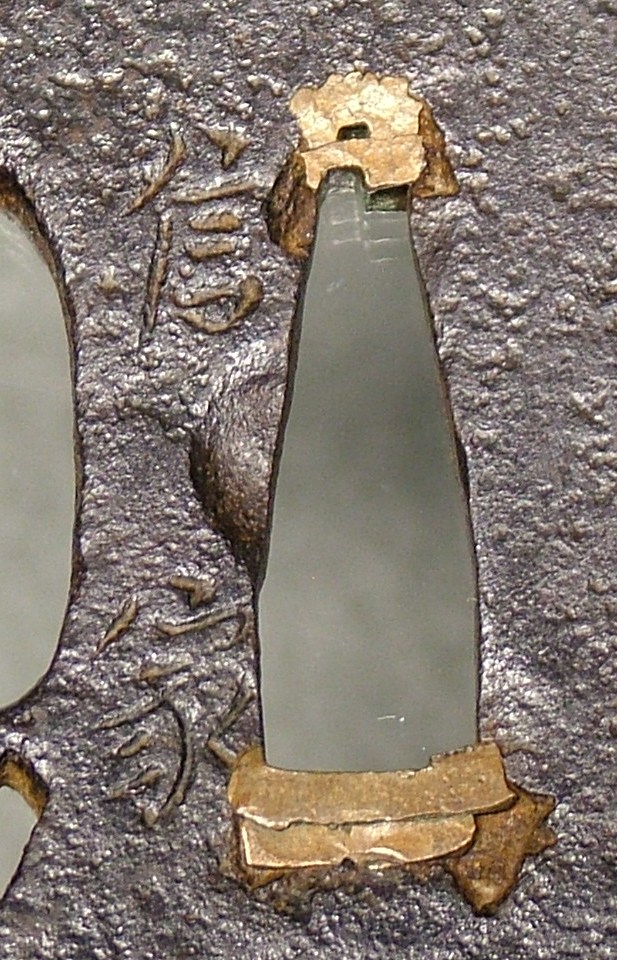 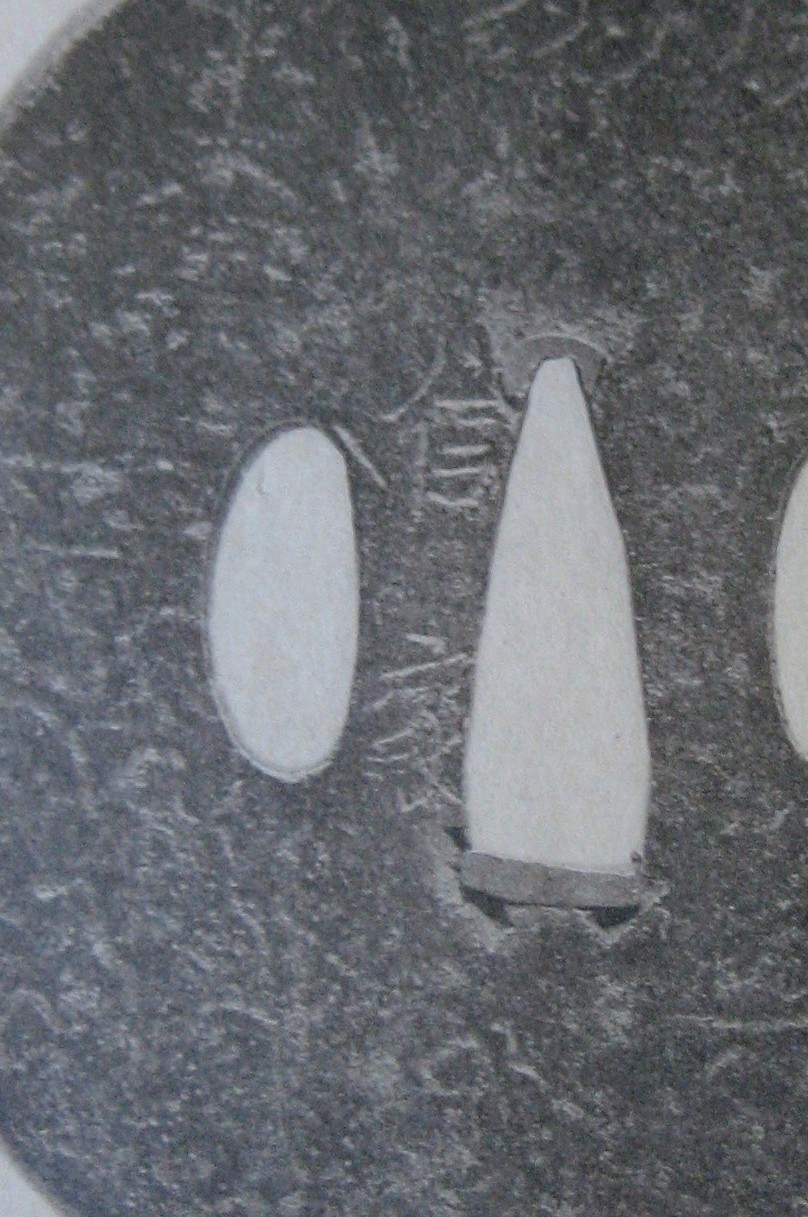 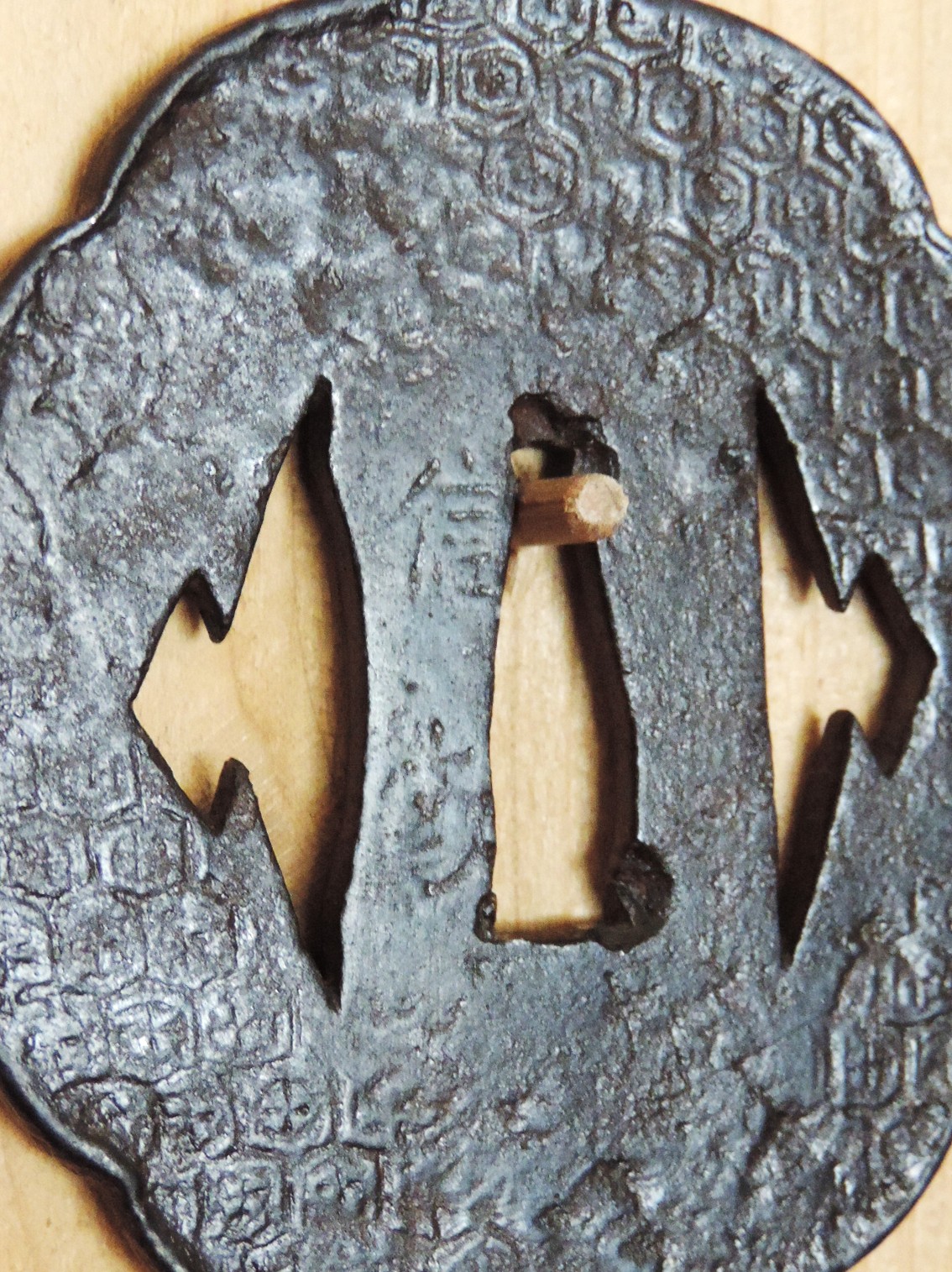 |
H 07074.0 |
YAMASAKA KICHIBEI YAMAKICHIBEI YAMAKICHI
Yamasaka Kichibei was the name of the first tsuba artist of this family. Later members of this school shortened the name to Yamakichibei, still later on we see the name Yamakichi. The working period of the first Yamasaka Kichibei is from Tensho to Keicho eras (1575-1615), about contemporary with the second Nobuiye.
Yamakichibei tsuba are among the very best iron sword guards ever made. Their mastery of certain features/processes such as tsuchime, yakite, and tekkotsu, especially in combination, reached heights never to be surpassed, and rarely equaled, resulting in tsuba with great predominance.
Study has shown that from the 1570's on up to the 1620's or so, the Yamakichibei atelier featured five or six supremely talented tsubako. There clearly were some fundamental ideas concerning aesthetics and techniques of production, but each tsubako was an individual whose work as an individual becomes clear when we take the time and trouble to study them carefully.
"In a world where the term 'unique' is among the most overused, Yamakichibei tsuba are unique. Nothing else looks like a Yamakichibei tsuba. They are distinct from all other sword guards, offering an instantly recognizable aesthetic. No other tsubako combined tsuchime, yakite-shitate, yasuri, and tekkotsu so distinctively and masterfully as did the Yamakichibei smiths. No others brought together design and motif as they did. The bold power of their expression is matched by few if any others. But even beyond their appearance, the sheer quality of workmanship in genuine Yamakichibei guards is second to none. And as metalworks embodying and emanating the values and principles informing the exquisite aesthetics of Buke Tea in Momoyama Japan, they are at the top of the mountain, superior to all others. The Yamakichibei tsubako stand with the few who produced the very finest sword fittings in Japanese history, and absolutely should be so recognized." ( Steve Waszak )
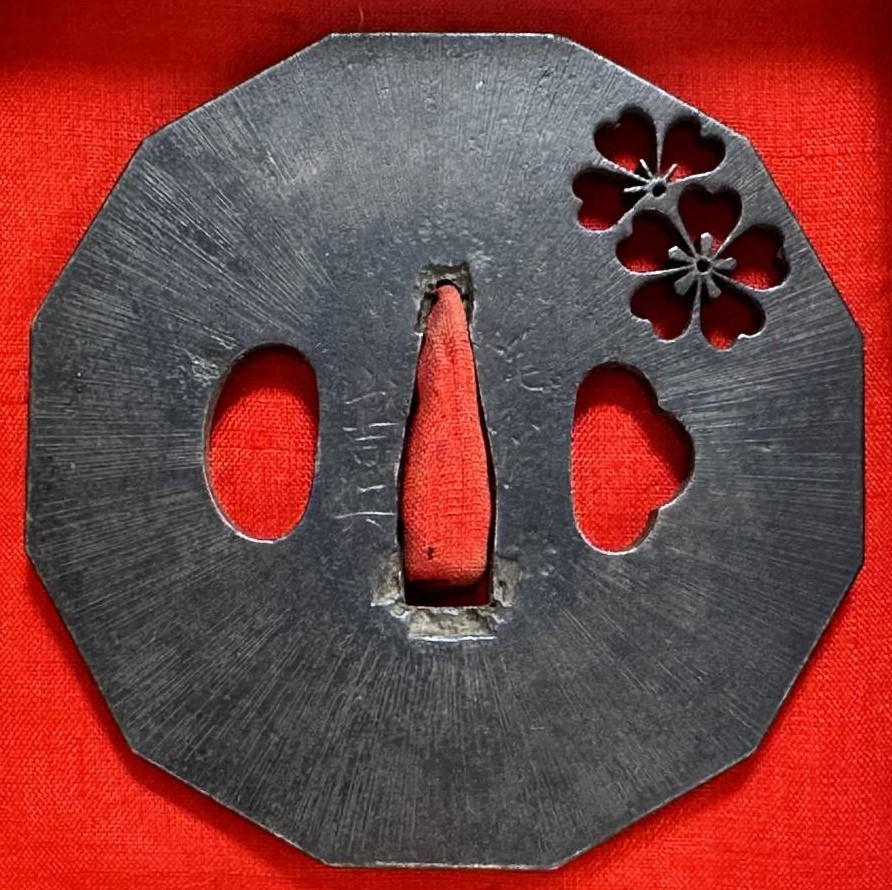 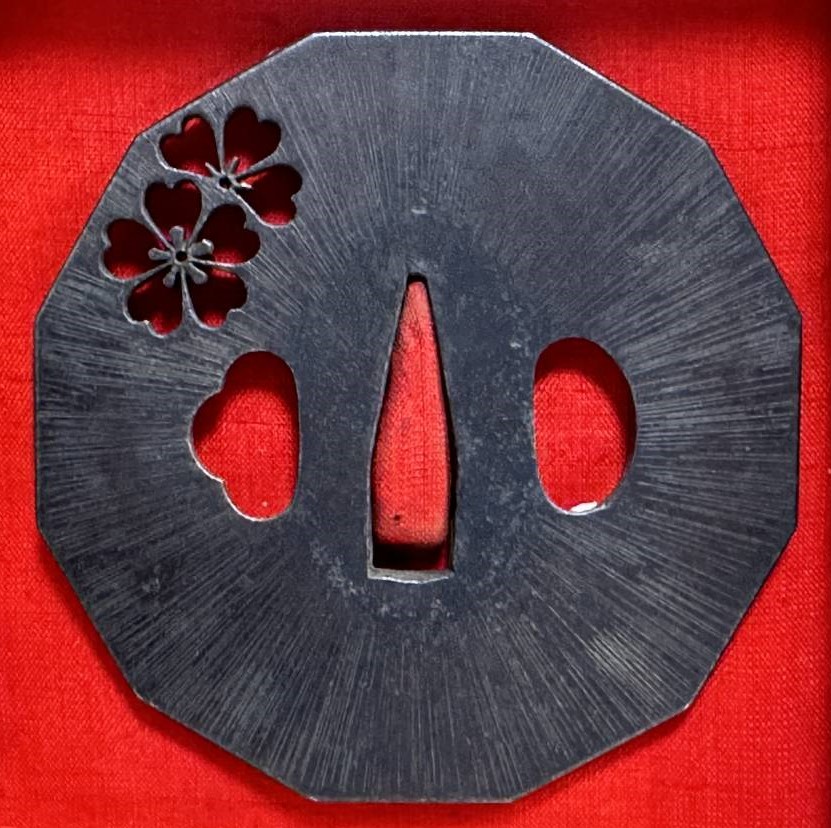 |
'SAKURA YAMAKICHIBEI' Price On Request |
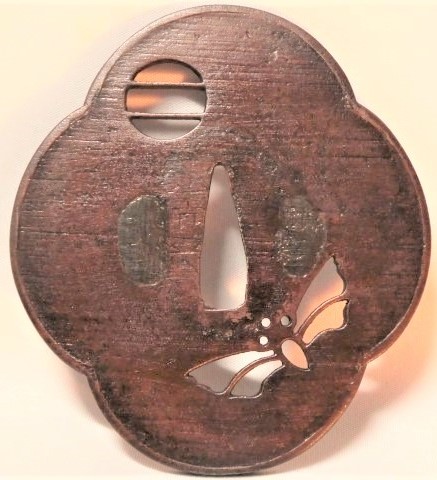 |
'YAMAKICHIBEI' $2500.00 |
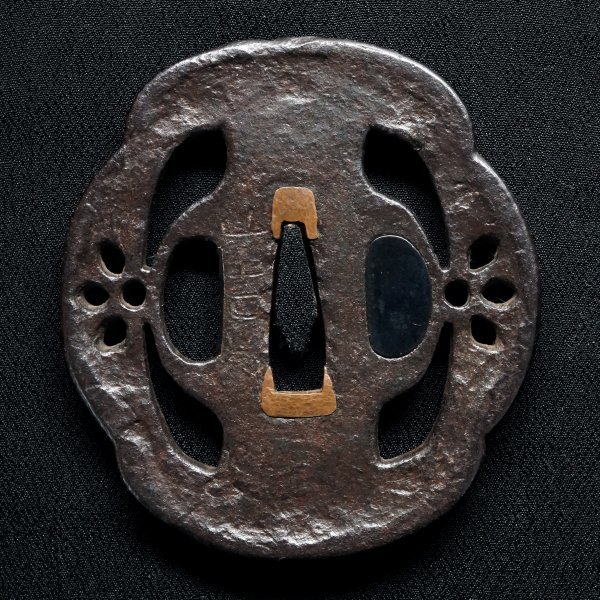 |
'YAMAKICHIBEI' Price On Request |
  |
'YAMAKICHIBEI' Price On Request |
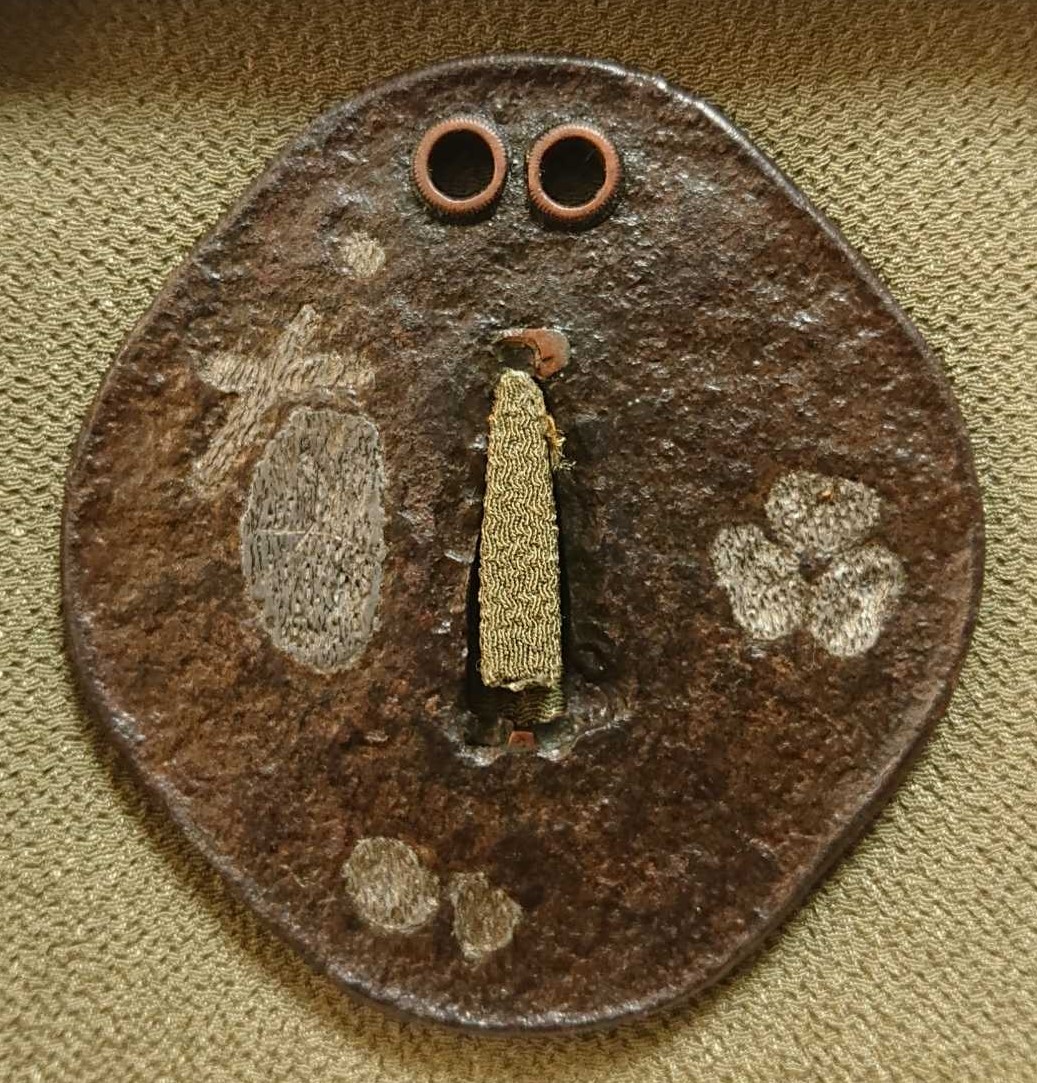 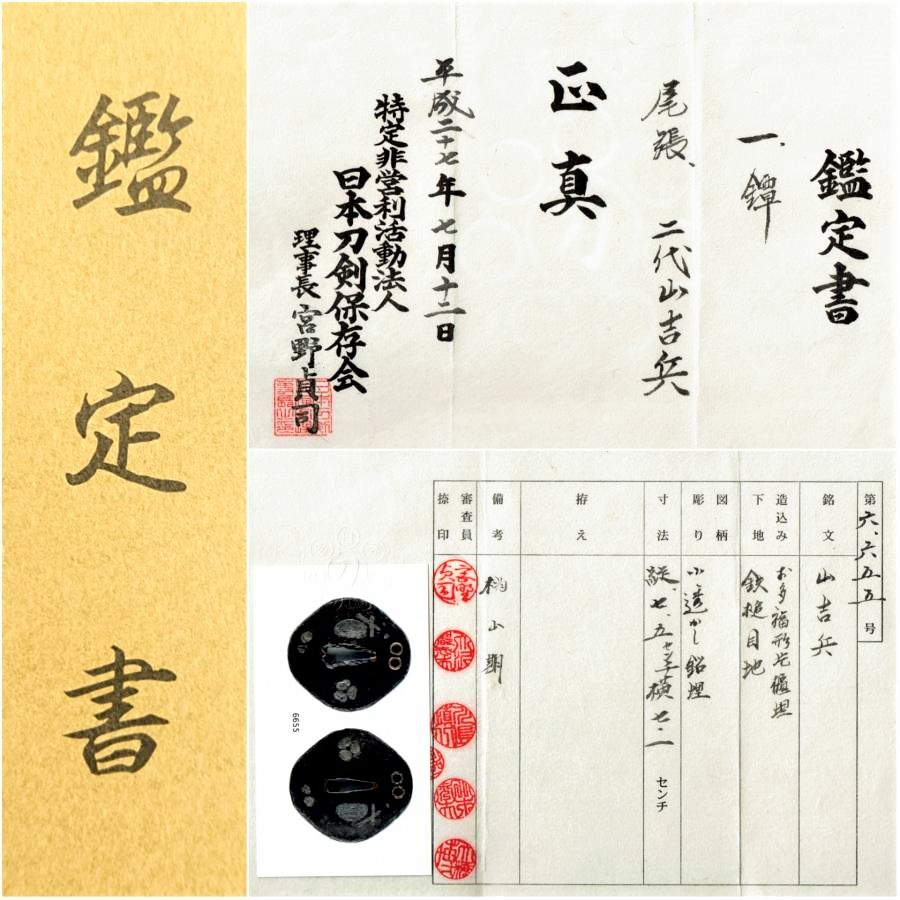 |
'YAMAKICHIBEI' $3000.00 |
SADAHIRO TSUBA |
Two of the finest artists living in the early Edo age were the second Yamakichibei and the first Sadahiro. Since they were contemporaneous it is thought that the first Sadahiro must have been a student of the first Yamakichibei. This seems doubtful, for his early work, which he signs 'SADAHIRO', resembles the style of the katchushi more than it does that of Yamakichibei. In his later work his style resembles that of the second Yamakichibei, especially the iron quality and forging. The first Sadahiro used decorative carving and inlay that is a combination of the style of the Umetada and Shoami schools. |
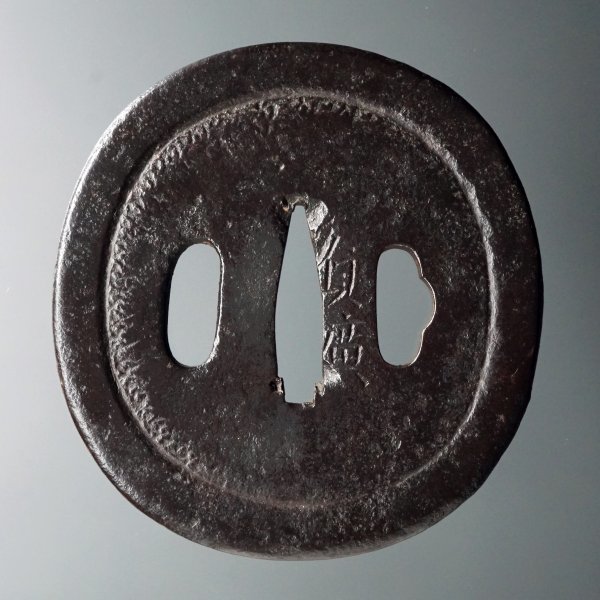 Price On Request |
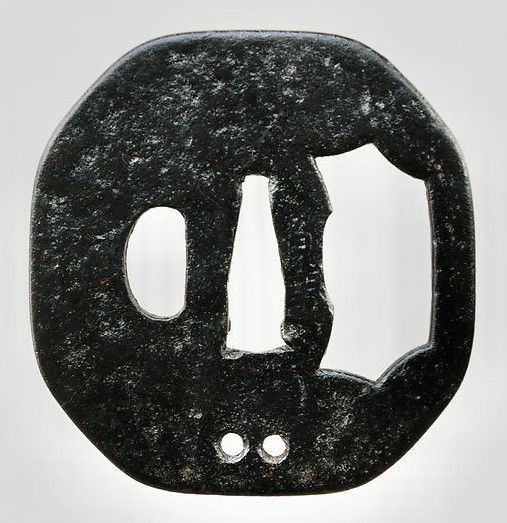
Price On Request |
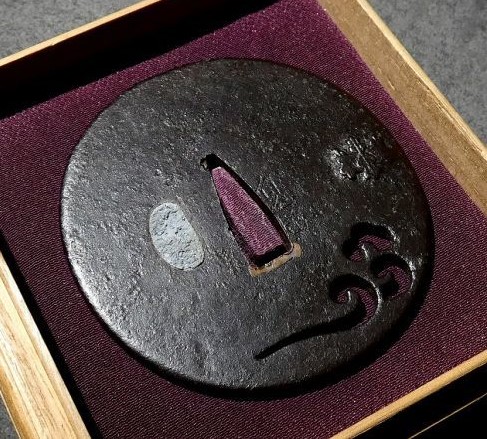 Price On Request |
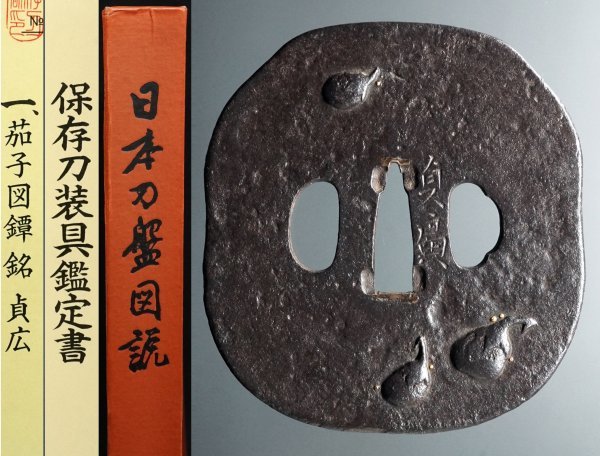 Price On Request |
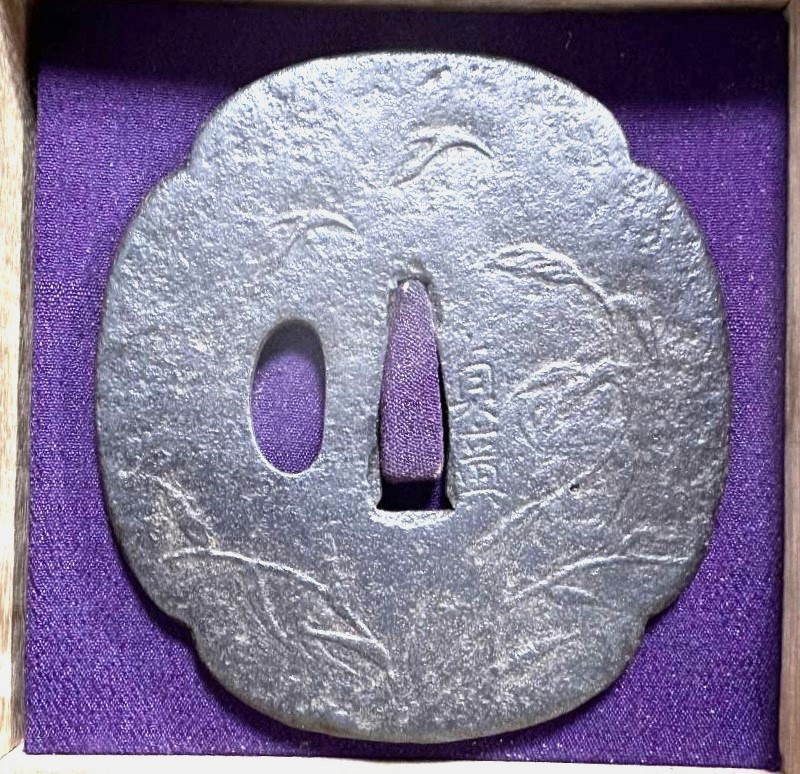 Price On Request |
 Price On Request |
SADAYUKI TSUBA |
(Sadayuki Bio) |
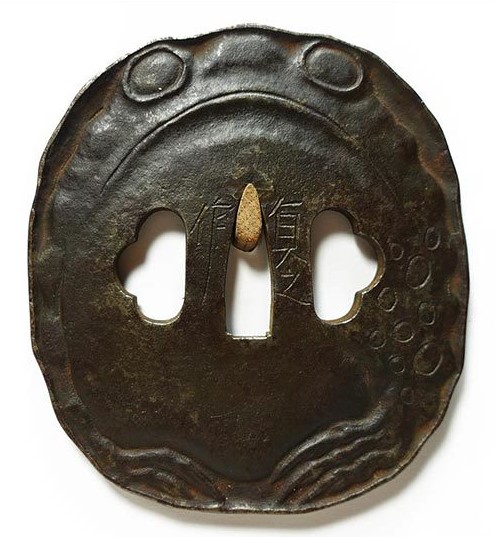 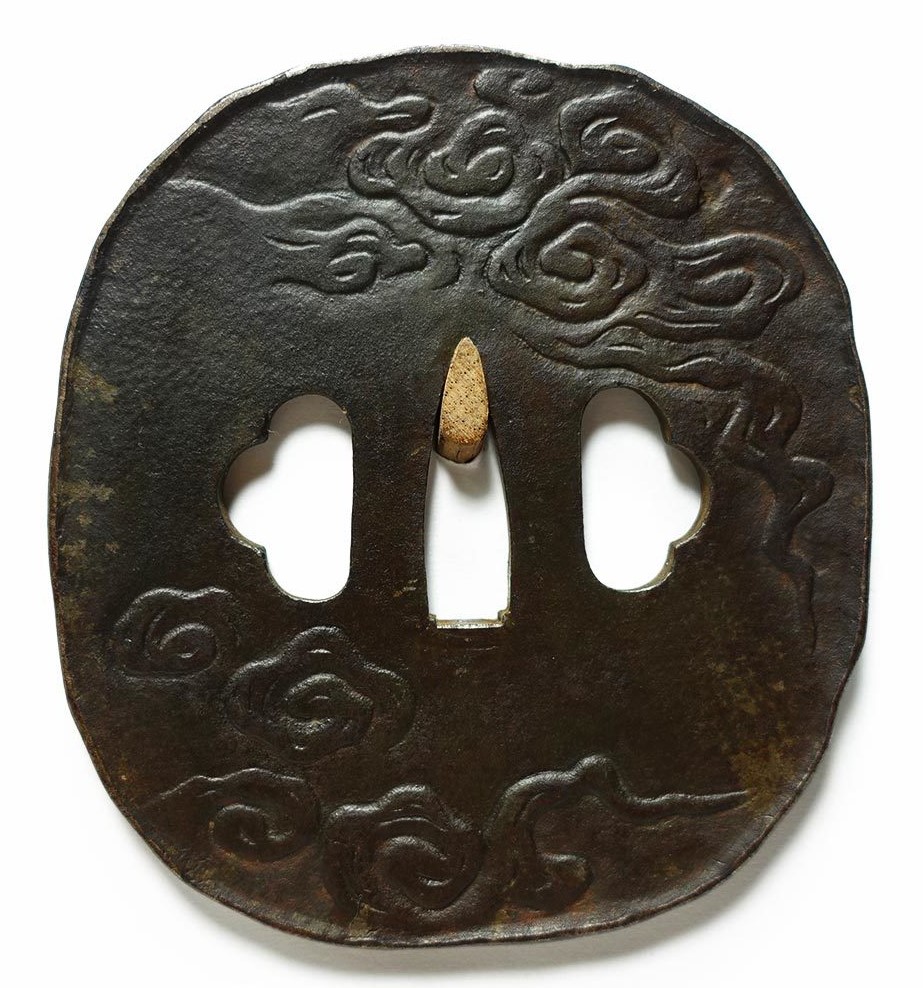 |
'SADAYUKI' |
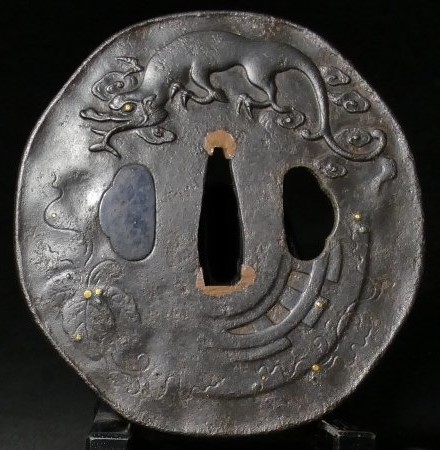 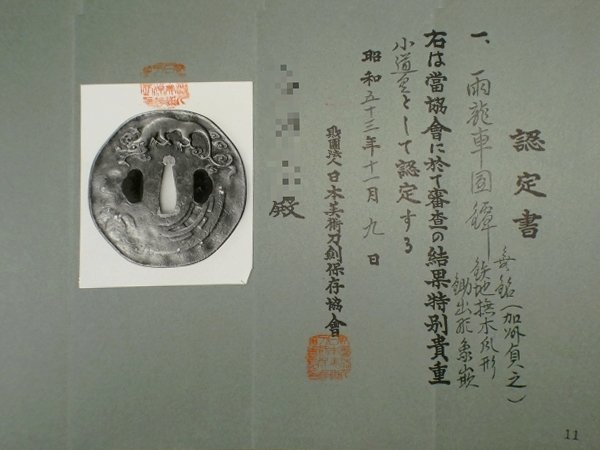 |
'SADAYUKI' |
|
The OWARI school should be divided into three periods. The first period comprises those pieces made in the Muromachi age. The earliest tsuba of the first period are a little younger than the earliest Kanayama tsuba. The second period is the work of the Momoyama age. The third period is from the early Edo age to the Genroku era (1688-1703). A few facts may be stated based on examination of the work of this school. They are always of positive silhouette design. The subjects of the designs vary greatly but they always have in common a strong masculine feeling. They are a noble tsuba whose influence may be seen in many contemporary schools. |
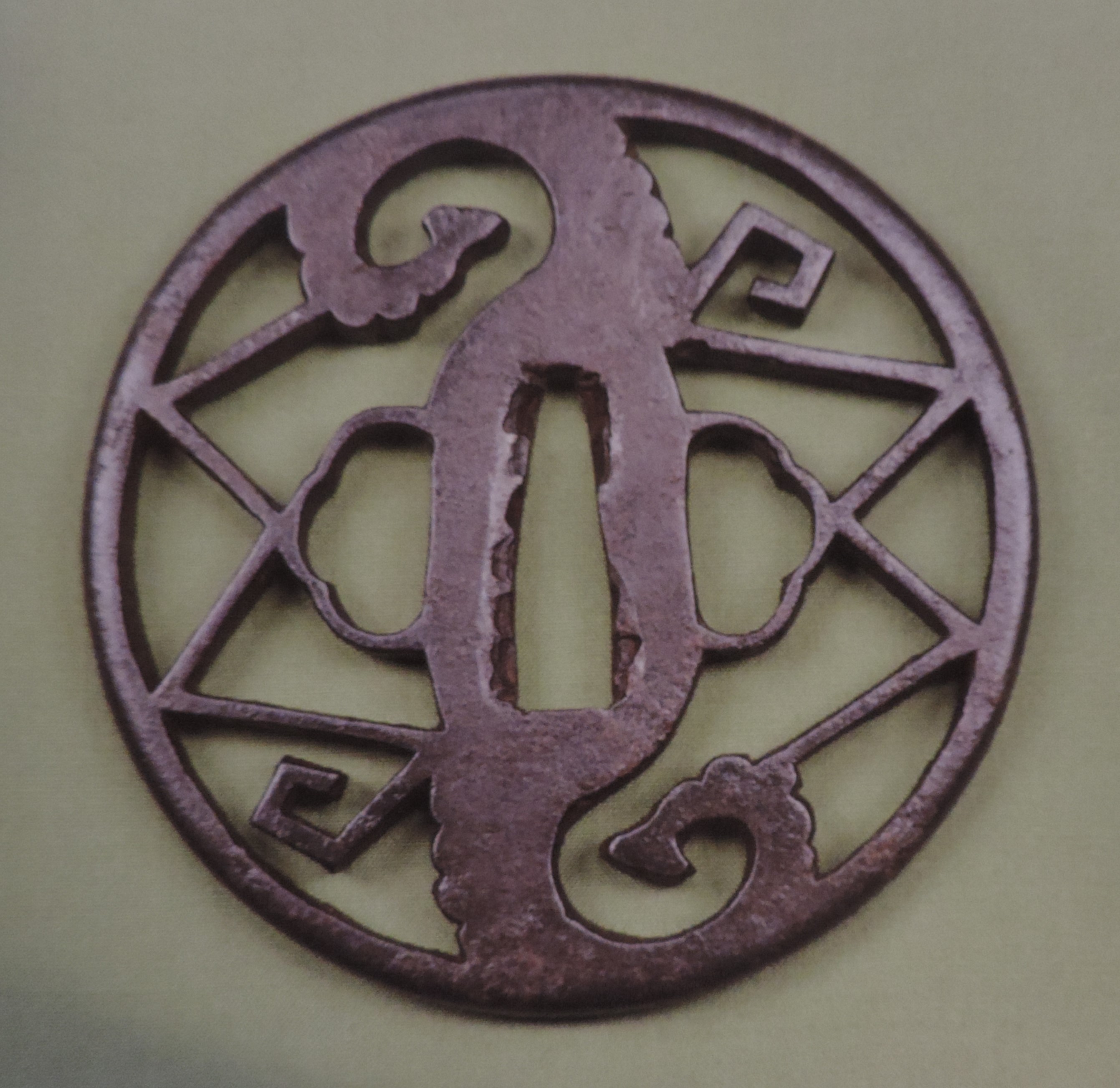 |
PROTO-OWARI |
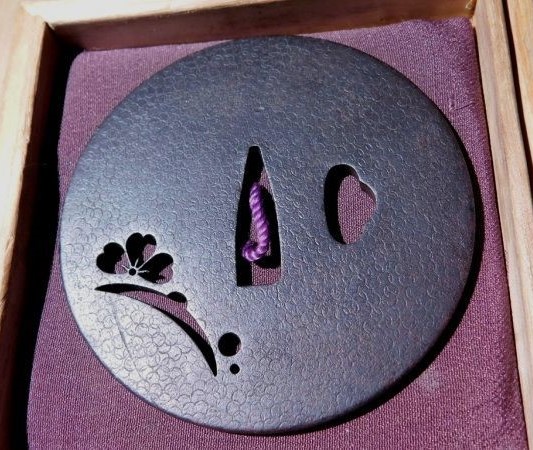 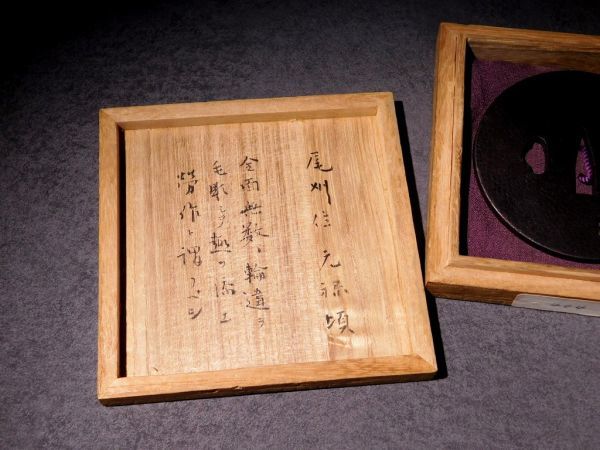 |
'TODA HIKOZAEMON' |
  |
'OWARI YAMAYOSHI' |
  |
OWARI |
  |
OWARI |
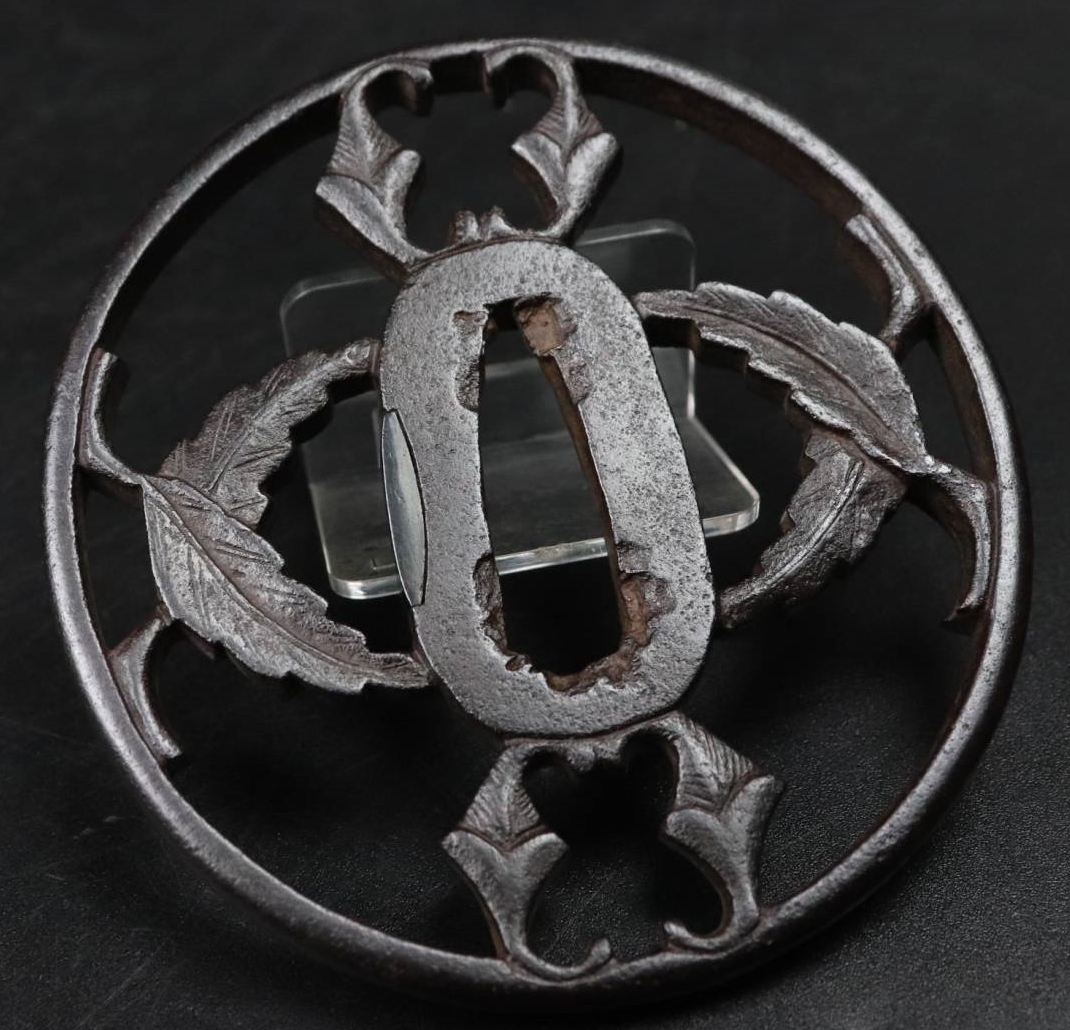 |
OWARI |
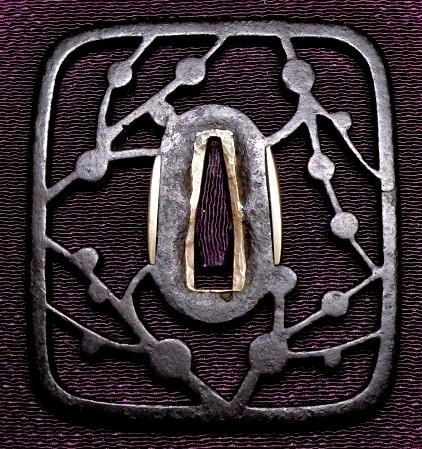 |
OWARI School. $2500.00 |
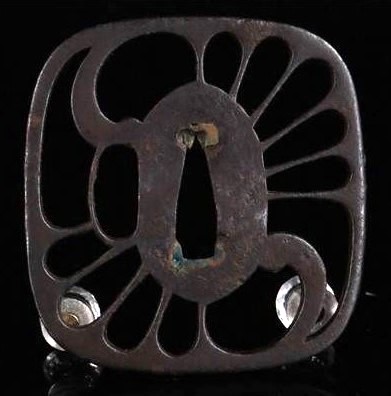 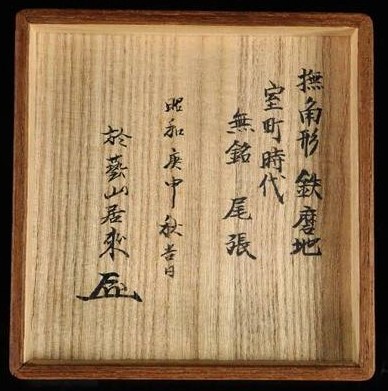 |
OWARI $2000.00 |
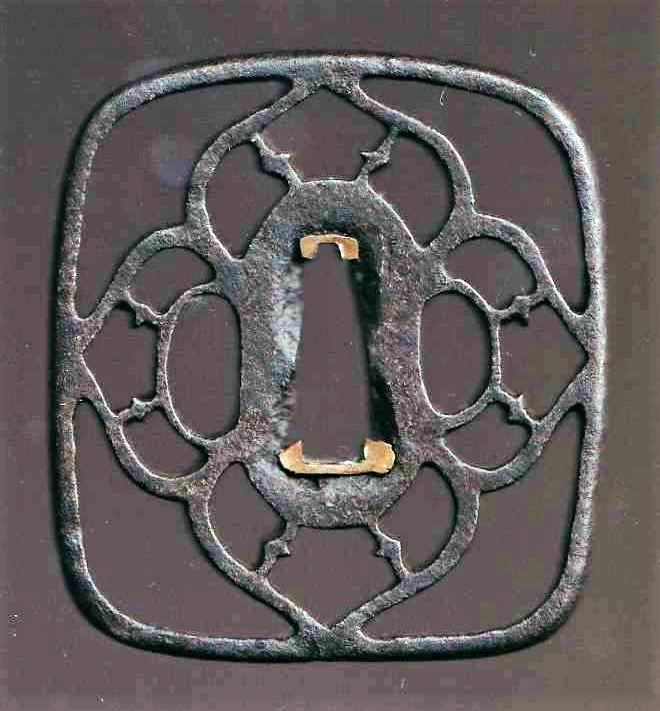 |
OWARI $600.00 |
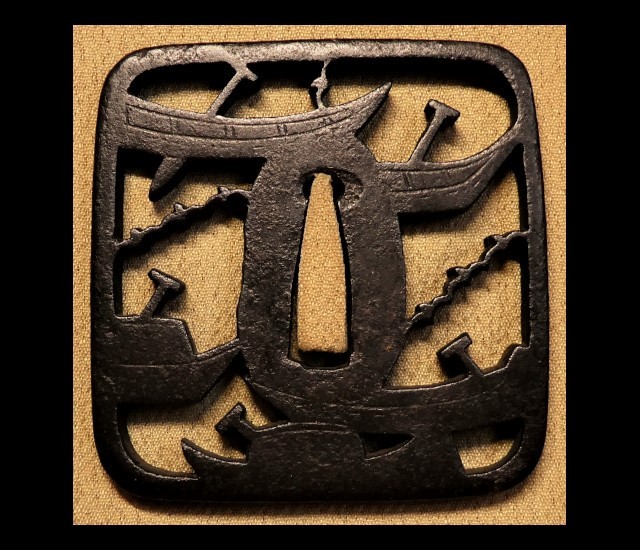  |
OWARI $1500.00 |
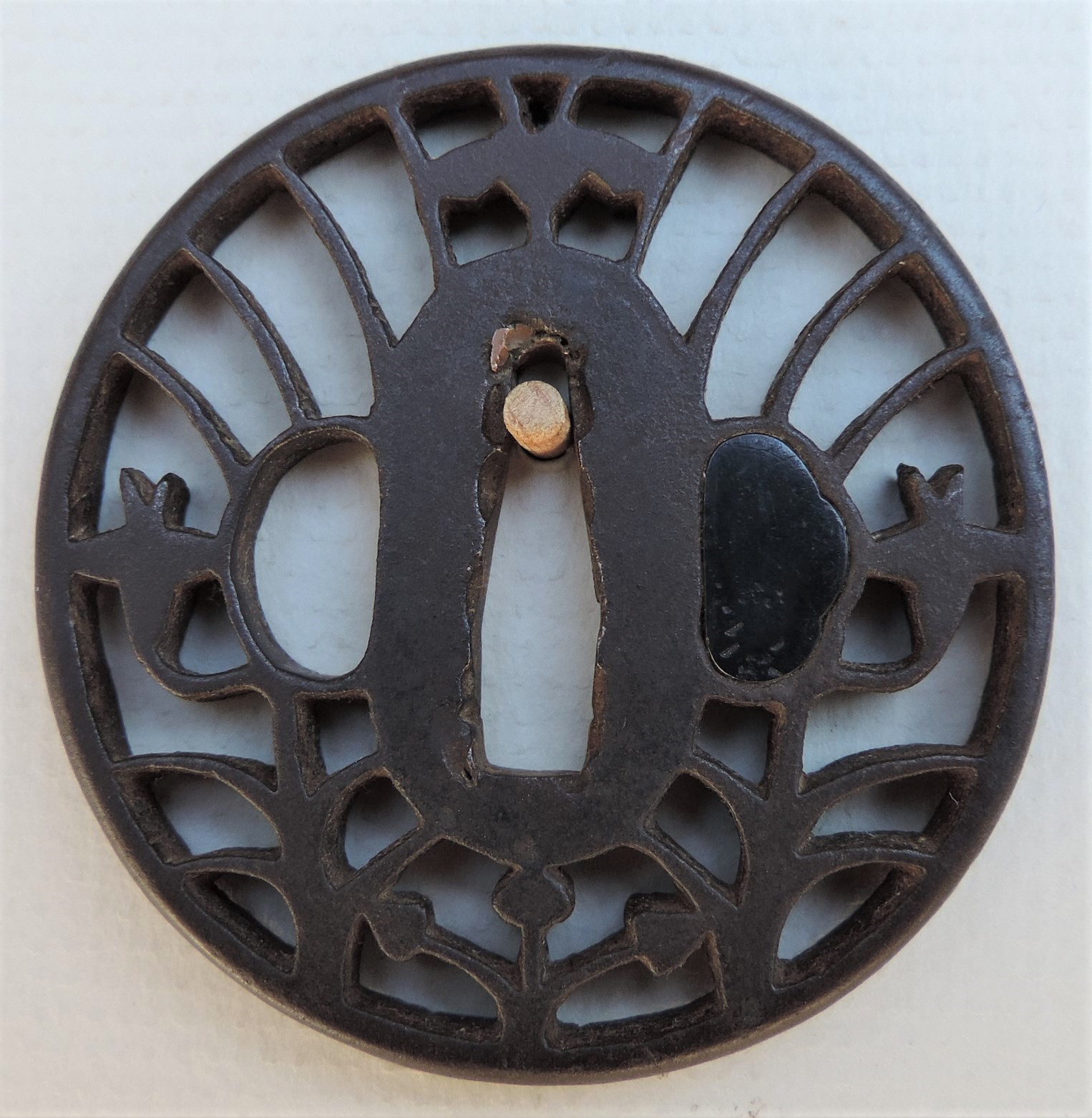 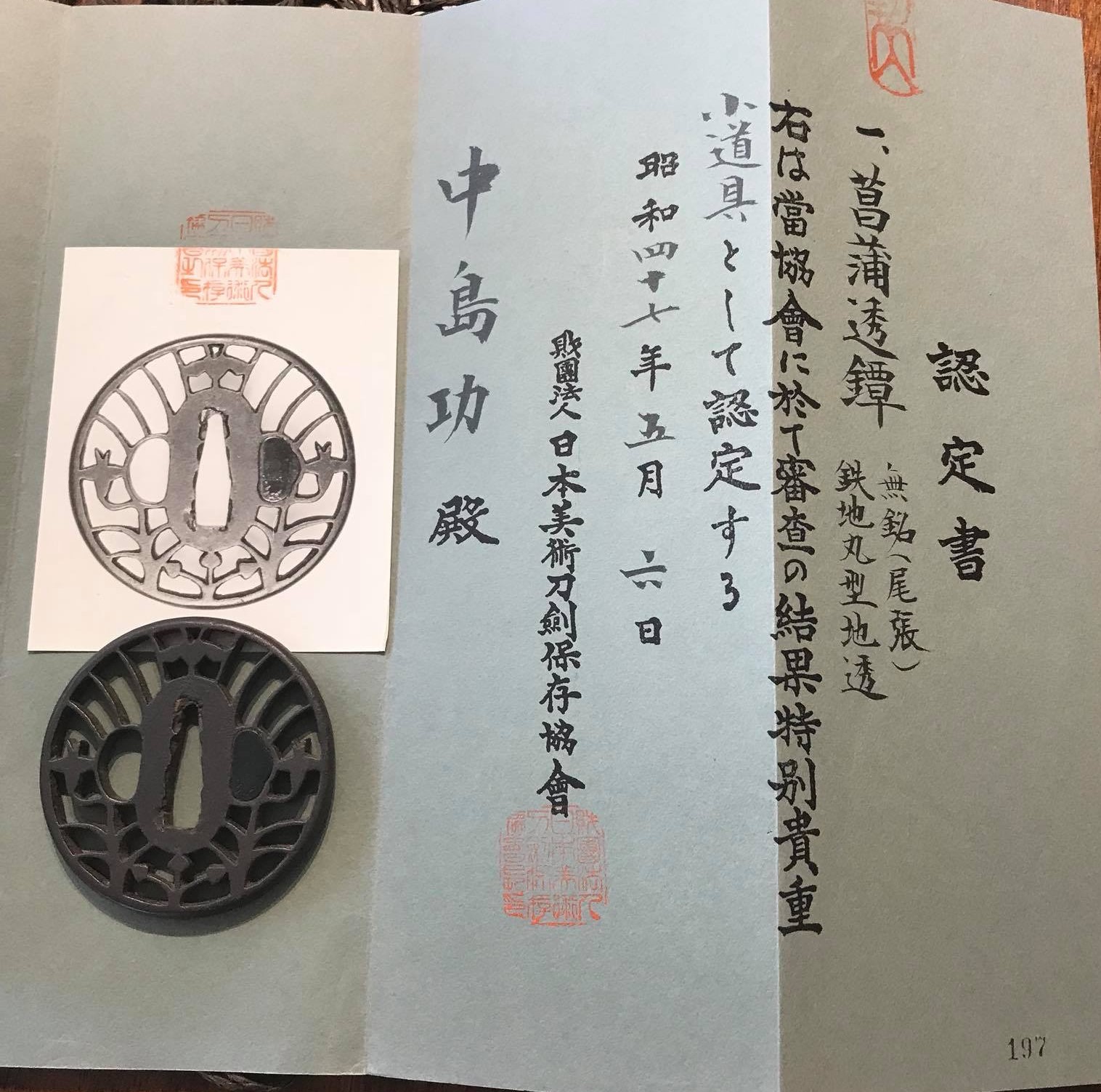 |
OWARI $900.00 |
There is another name by which Hazama tsuba are known, Kameyama school tsuba. In the period from Hoei to Kyoho (1704-1736) at Kameyama, in the province of Ise, the Kunitomo family made this style of tsuba. The original members of this family were from Kunitomo village in the province of Omi, just east of Lake Biwa. In the Momoyama age they had been gunsmiths. The later descendants moved to Ise Province. The sahari style of inlay had been used by this family for generations in the decoration of gun barrels. The Kunitomo family adapted the technique from the decoration of guns to that of tsuba. The three artists who are best known for the sahari style of inlaid tsuba are Teiei, Sadahide, and Masahide.
The Tsuba-Ma (Hazama) school, which descends from Kunitomo gunsmiths gained widespread popularity for their style of decorating iron with various motifs using an exotic metal called sand-bari (sahari). Sahari is an alloy of copper, tin, and lead, and is a material with a long history, having been used in the joints of Buddhist alters and maki-e writing boxes in ancient times. The sensitivity and technical skill in applying this to tsuba is highly commendable, and the work itself exudes a unique charm.
The sahari inlay is melted and poured into an iron ground carved with a pattern in advance, and is interesting because the appearance of the pattern changes depending on the condition of the lighting. The subtle unevenness caused by the shrinkage of the molten sahari creates a unique insect-like depression that forms a natural landscape, creating an aesthetic contrast to the entire scene.
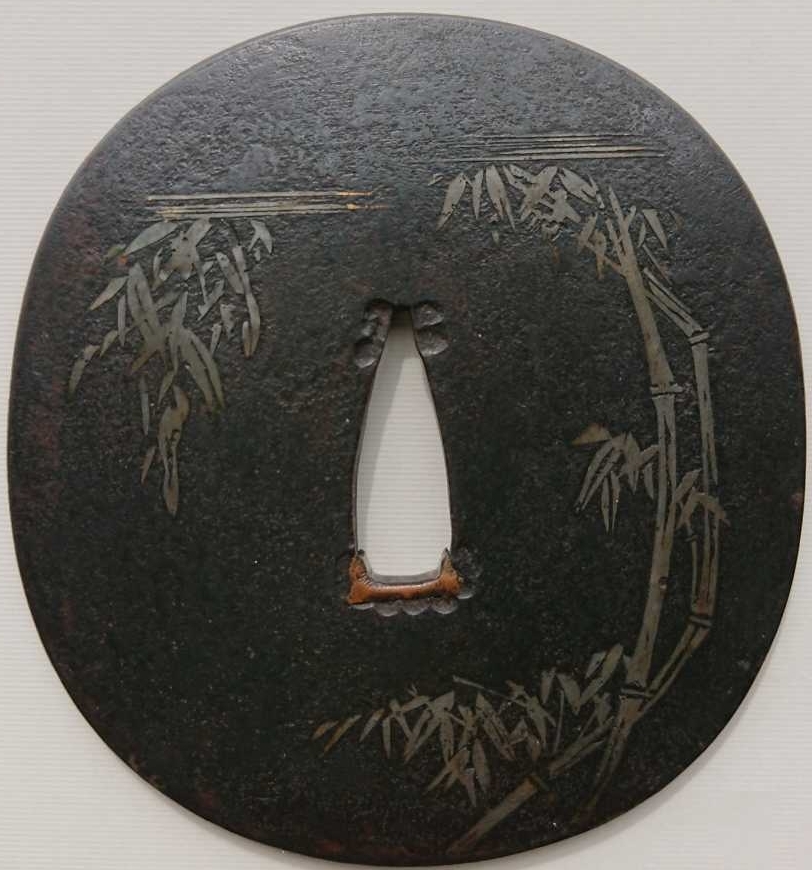 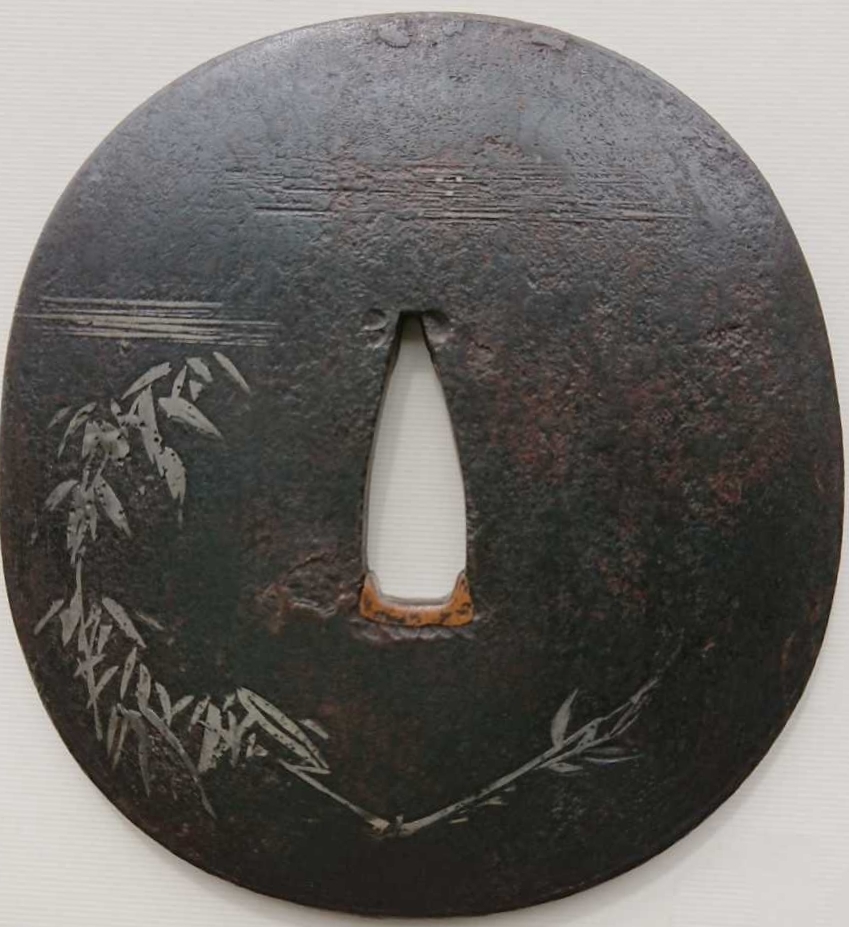 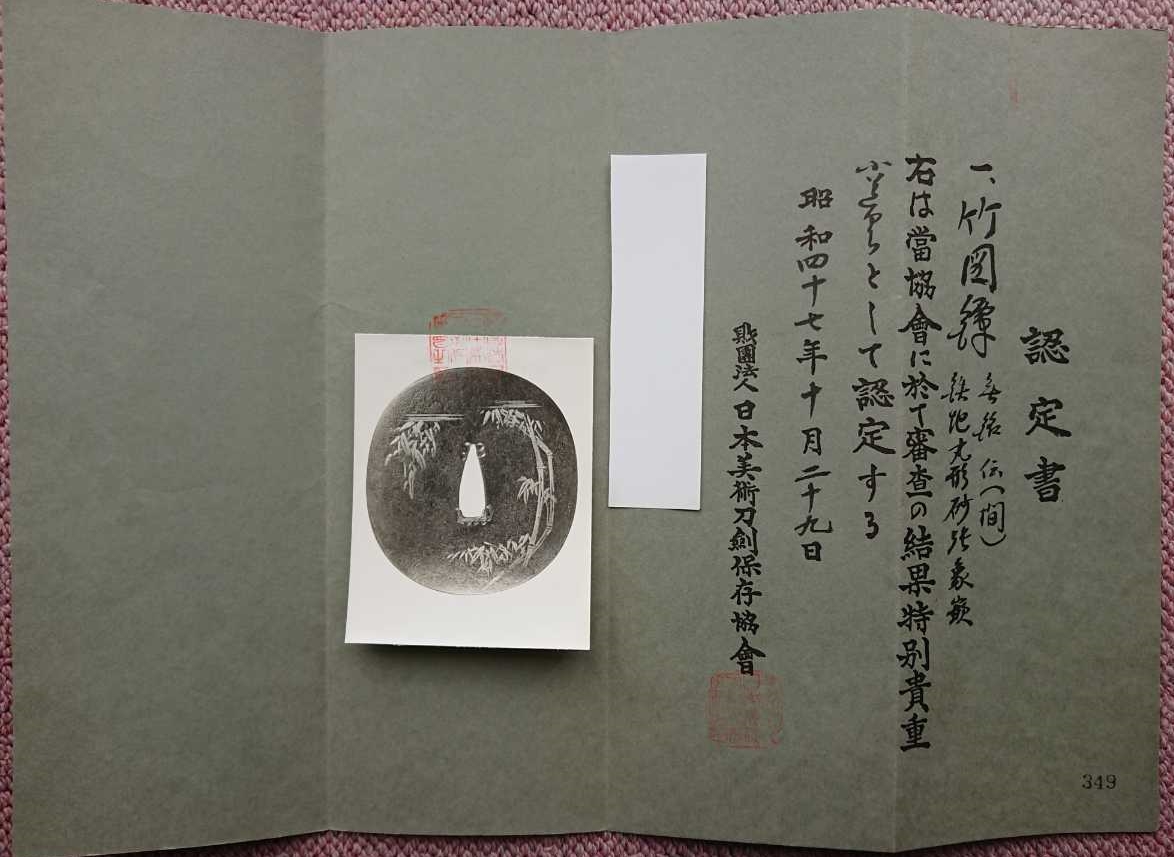 |
HAZAMA |
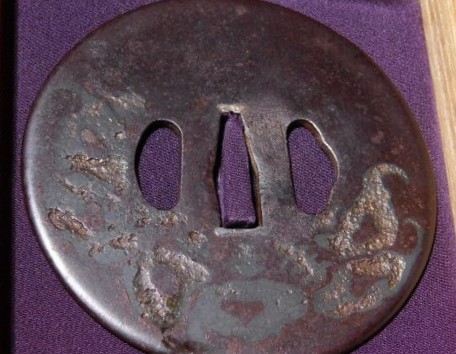 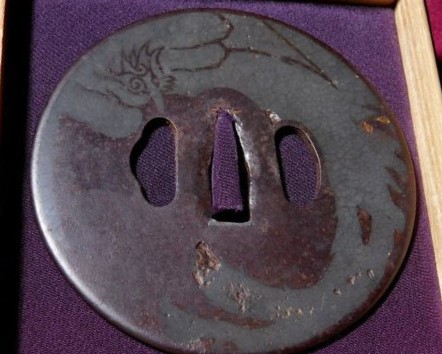 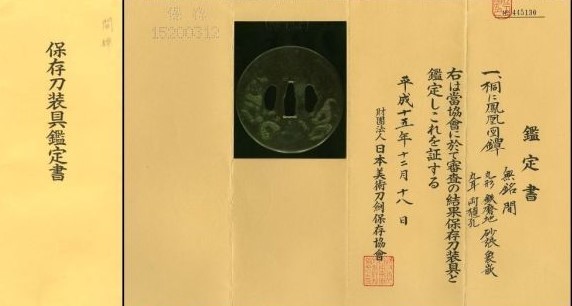 |
HAZAMA |
  |
'NAGATSUGU' |
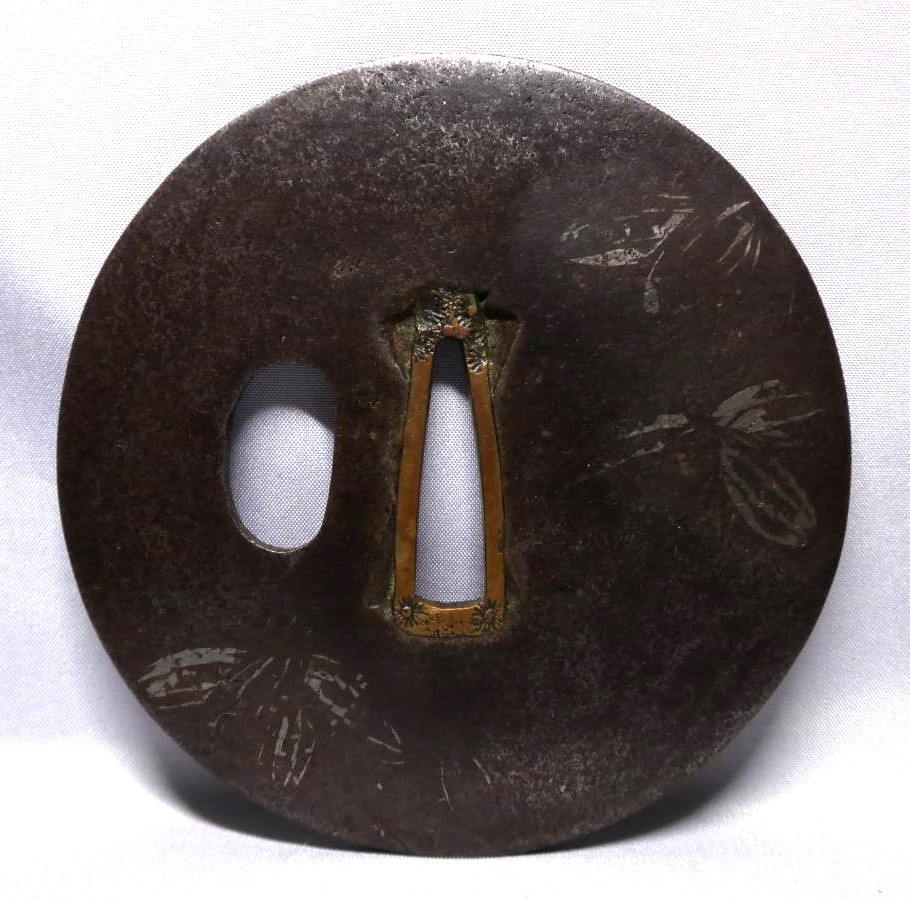 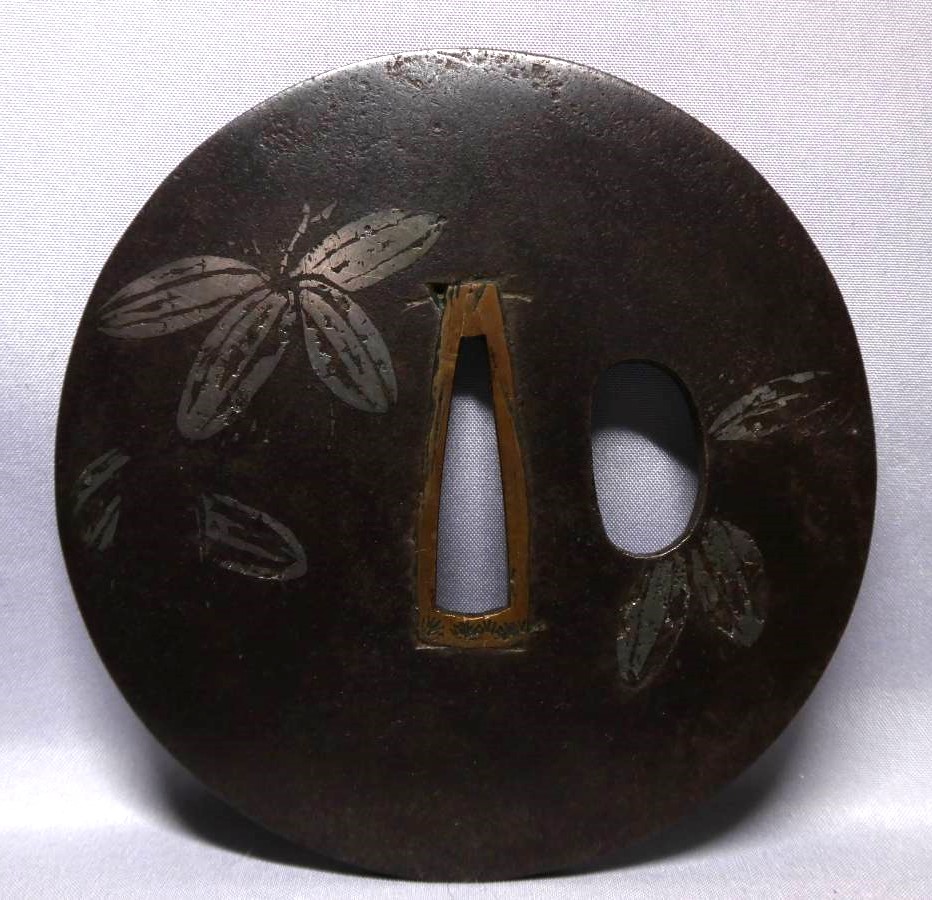 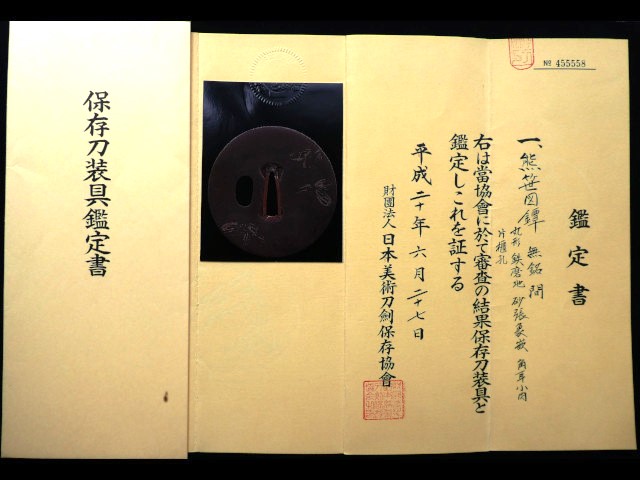 |
HAZAMA |
 |
HAZAMA |
 NFS |
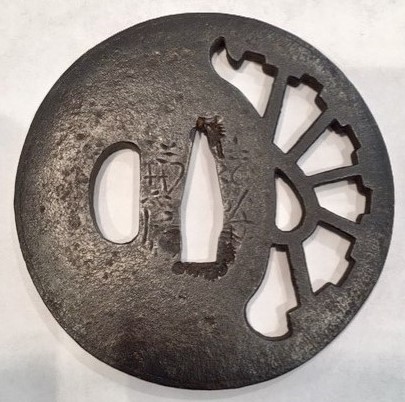 NFS |
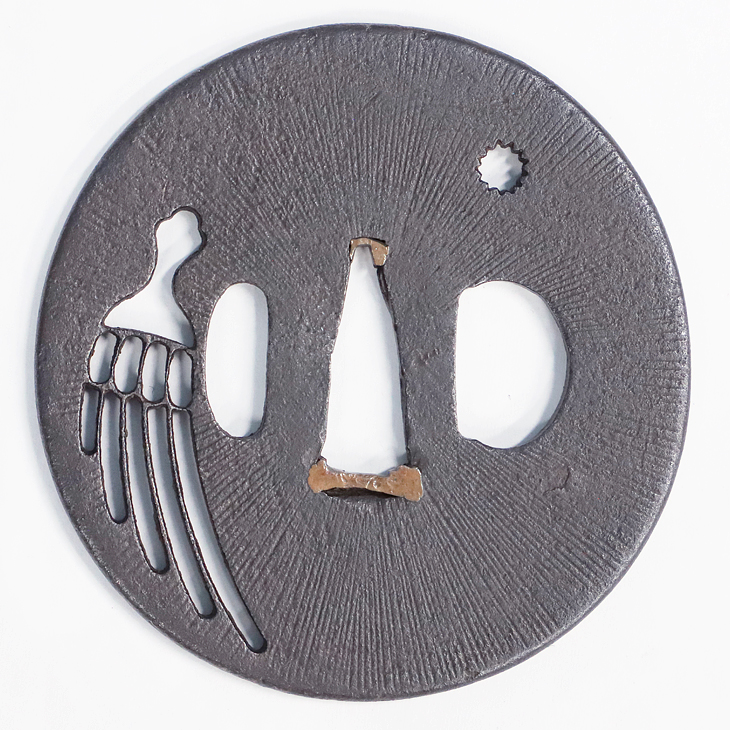 NFS |
 NFS |
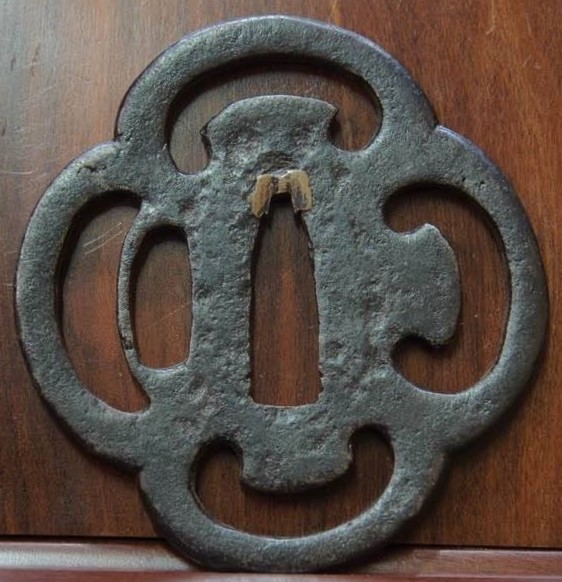 NFS |
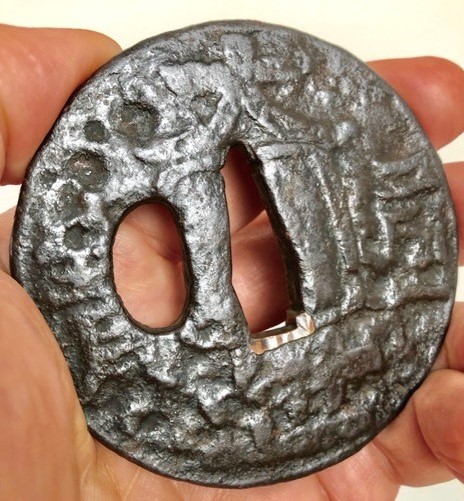 NFS |
 NFS |
 NFS |
The Kinai style originally came from the Shoami school, in all probability, but it also was to borrow from the Choshu style as well. This combination of the Shoami-Choshu styles is the basic feeling of all Kinai tsuba. In considering the work of the Kinai school it is also necessary to mention the Akao school, for the fortunes of both are integrally entwined.
The tsuba of the Akao school for the most part, whether made in Echizen of iron plate, or in Edo of kawarigane plate, are better than the late work of the Shoami school and the kinko. The early work of this school shows the superior ability above that of the majority of the contemporary workers of their period. The number of pieces made by this school was few, for they worked exclusively for daimyo families. The general public very rarely had a chance to see the work of these artists.
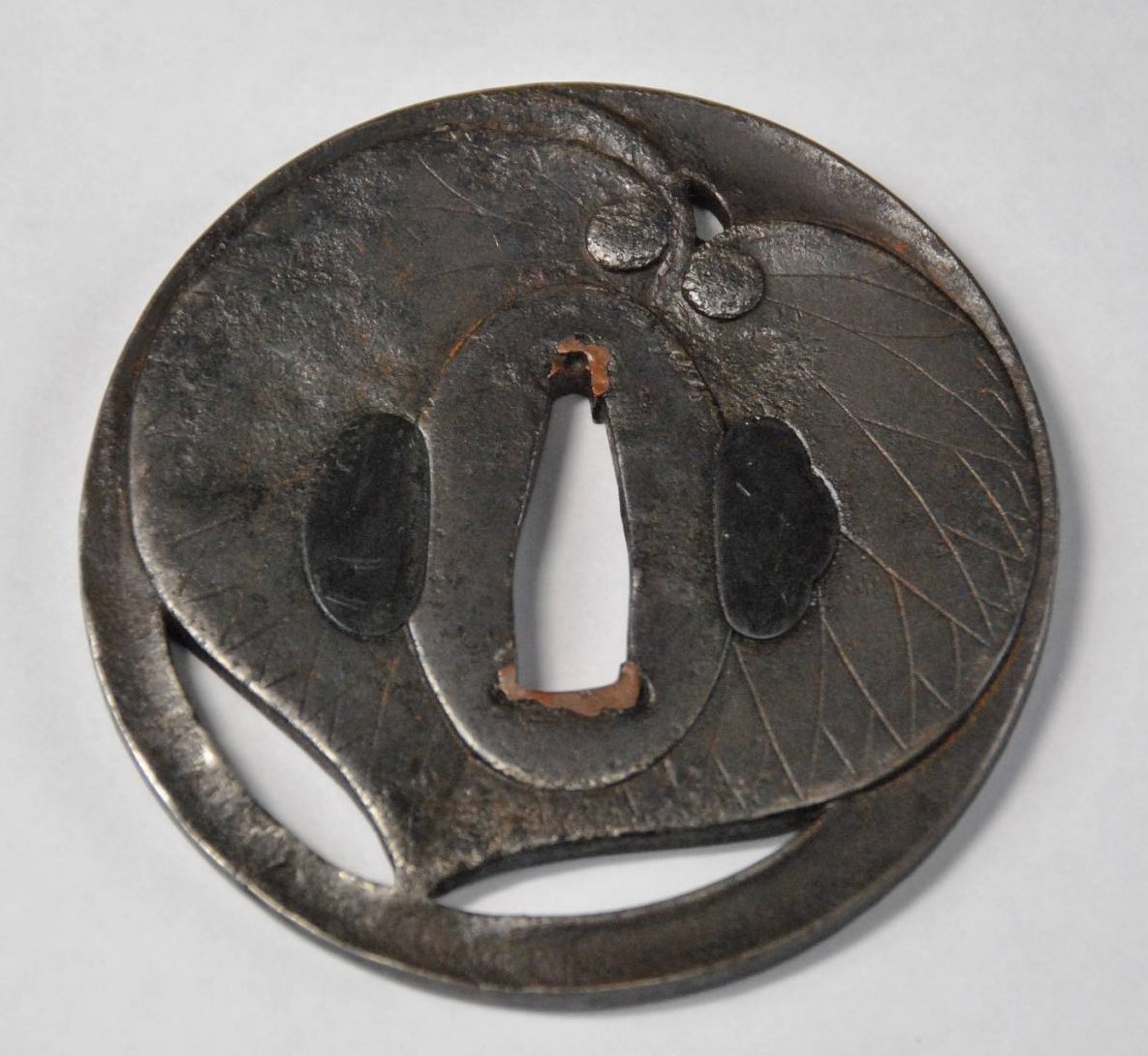 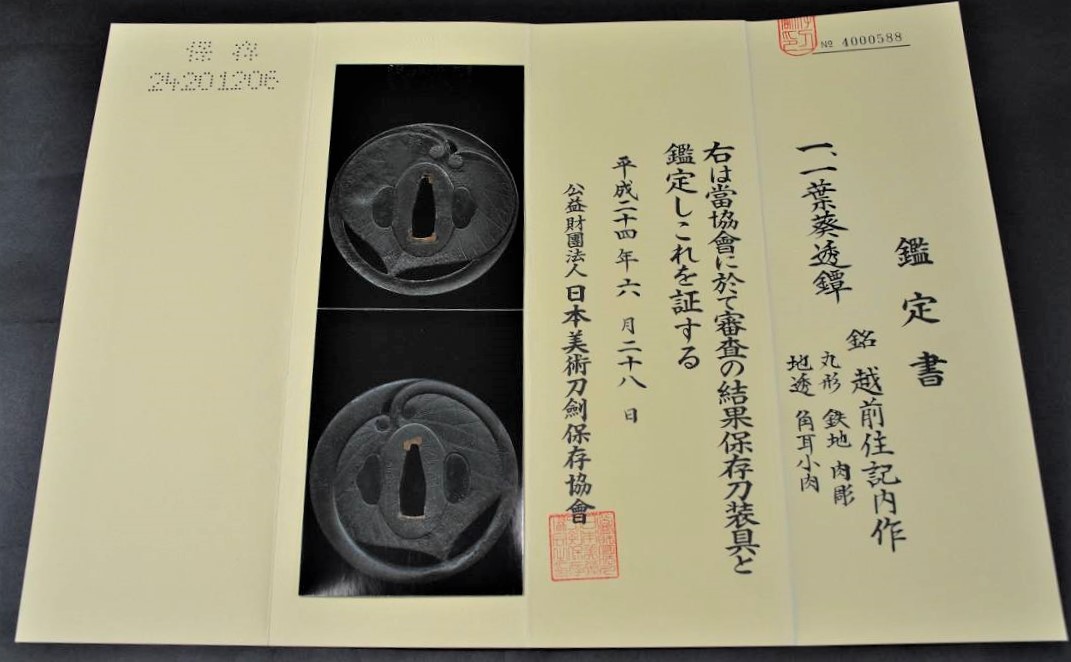 |
'ECHIZEN JU KINAI SAKU' $1500.00
7.65cm x 7.64cm x 0.54cm (seppa) "Kinai tsuba for wakizashi, maru gata, dote mimi, kozuka and kogai ana are filled. Katachi bori sukashi design of a single aoi leaf shaped to be rounded, convex on ura and concave on omote. Ura mei “Echizen no Ju” “Kinai Saku”, probably Yondai Takahashi, late 1700’s."(Long) |
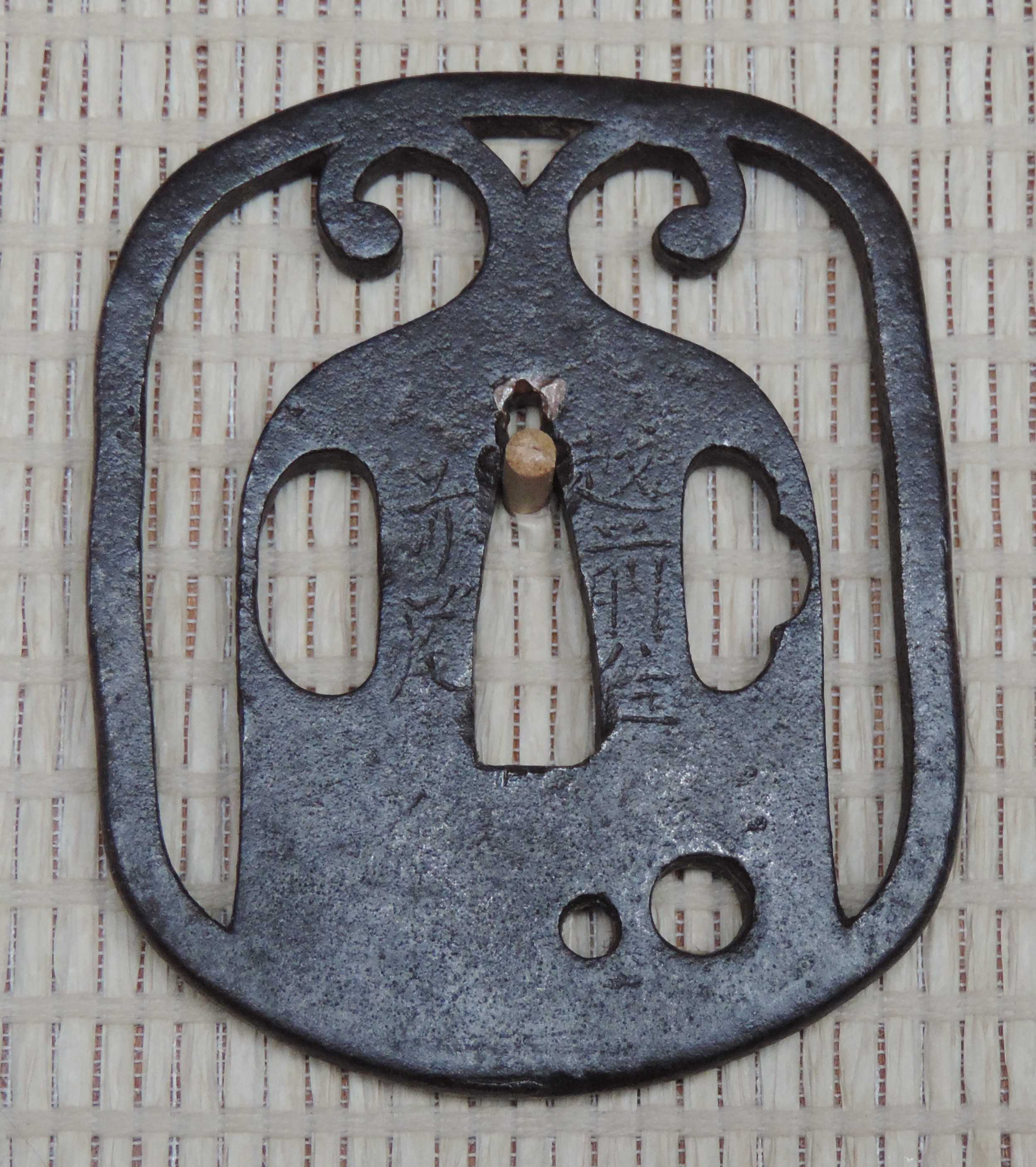 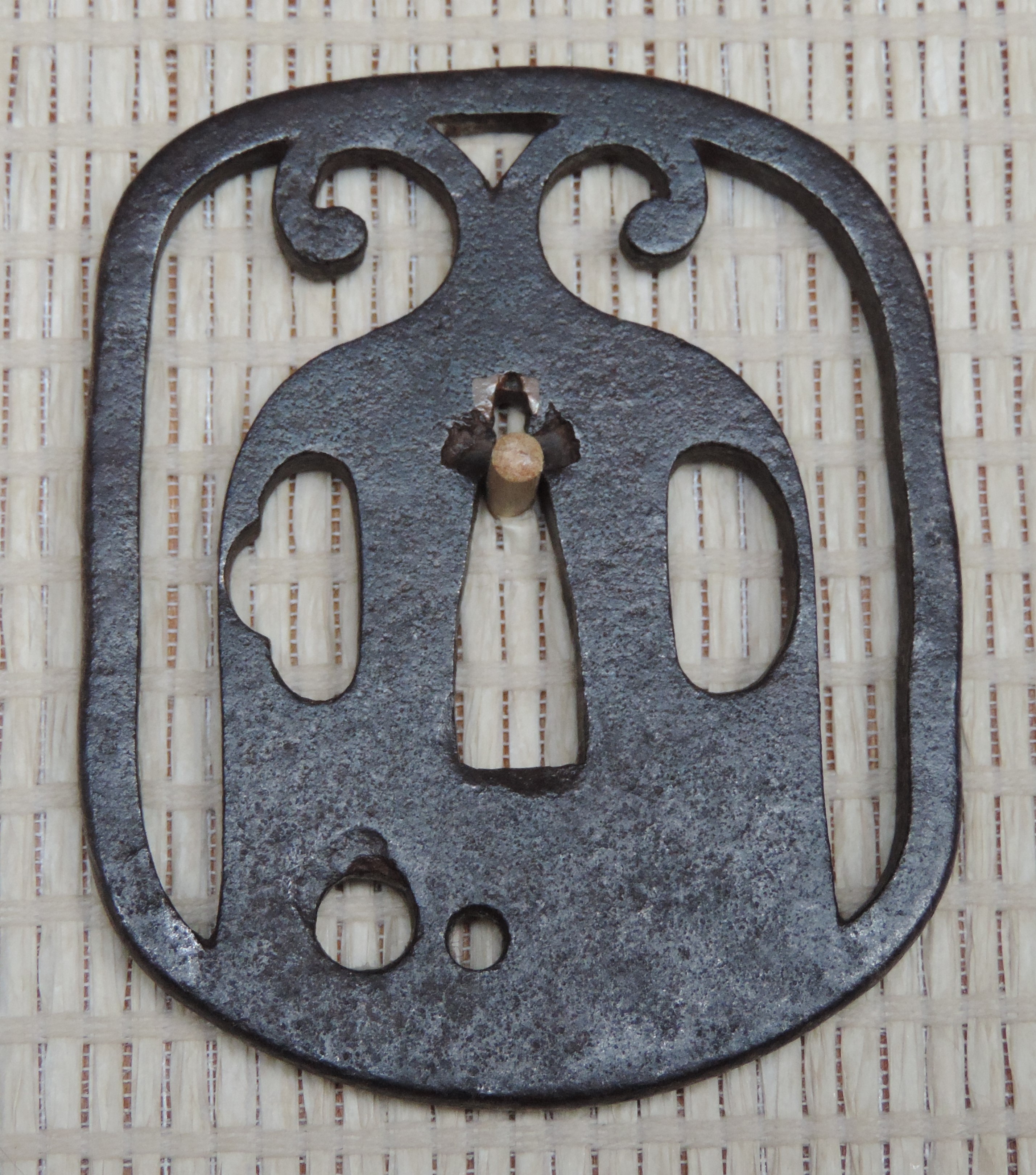 |
'ECHIZEN ju AKAO' |
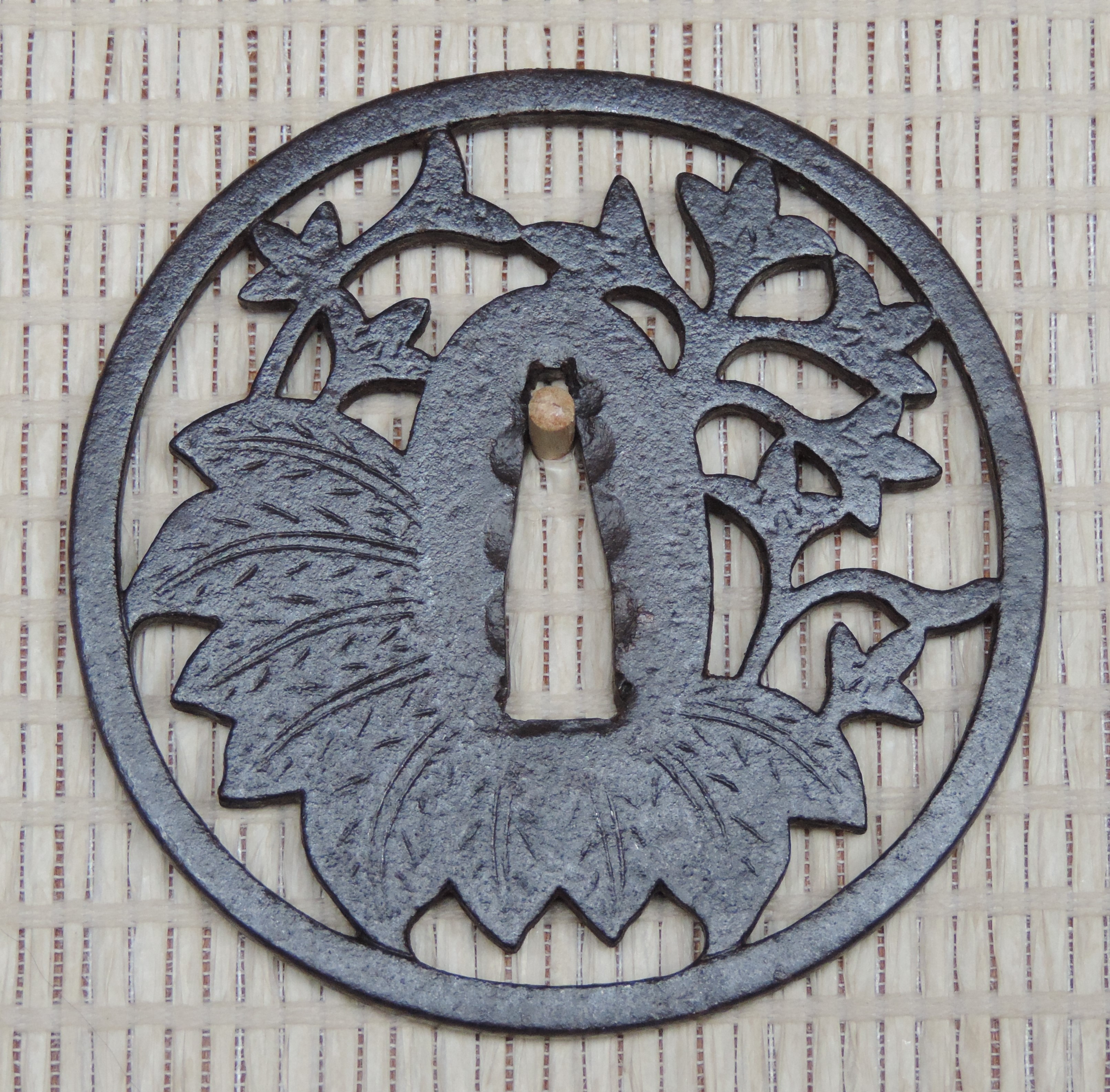 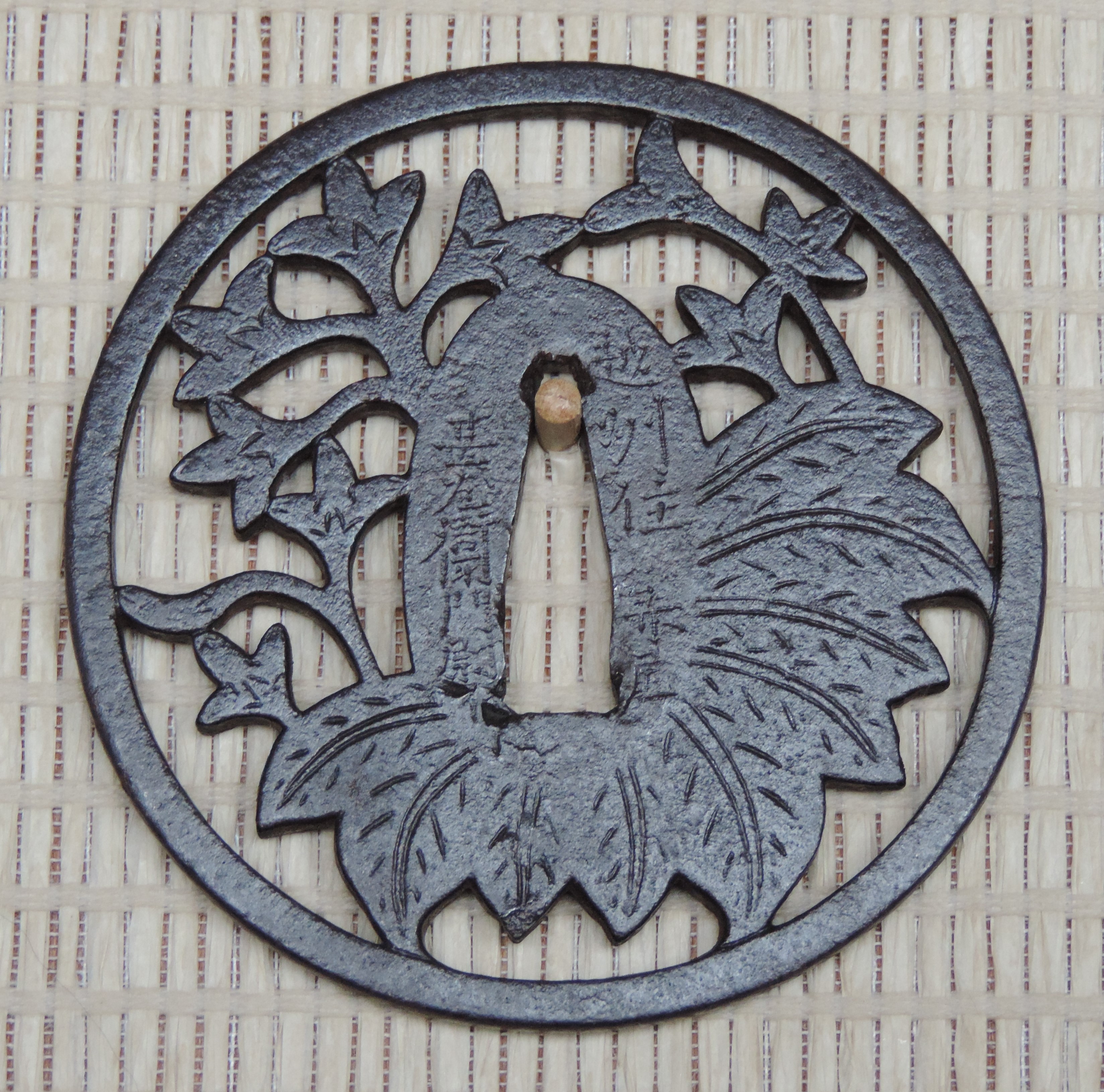 |
'ECHIZEN ju AKAO' |
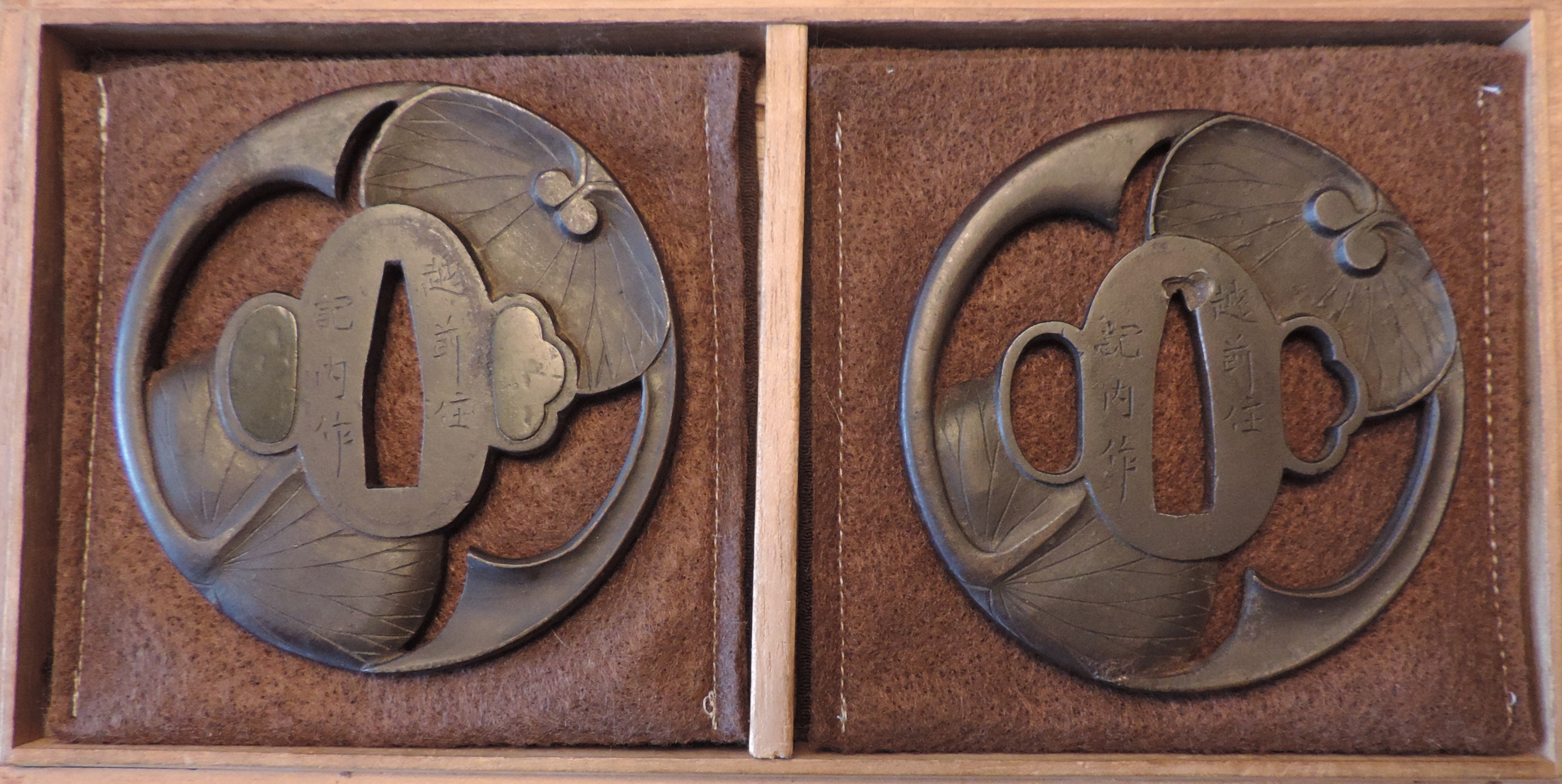 |
"ECHIZEN JU" "KINAI SAKU" |
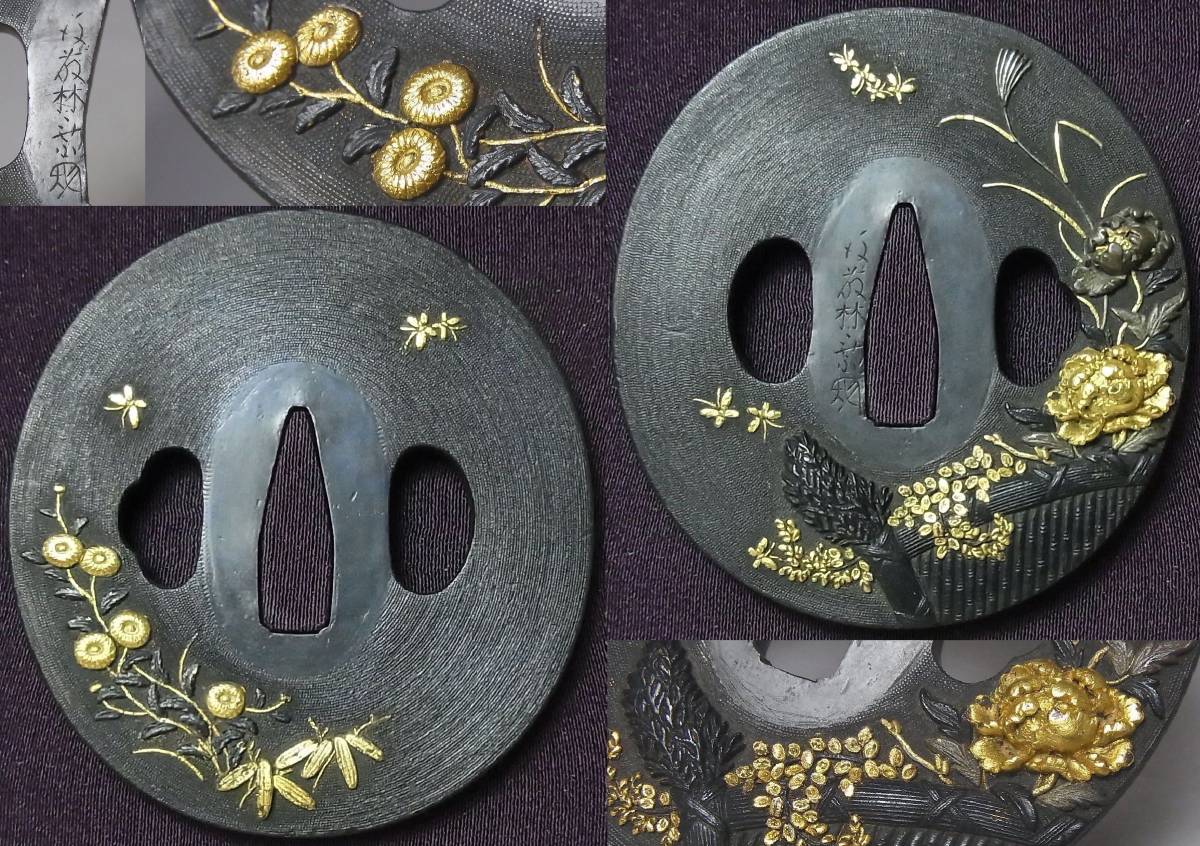 |
'GOTO RINJO' Please Contact Us For Price
7.15cm x 7.70cm x 0.40cm plate "A shakudo plate with the finest and most delicate nanako surface. This decoration appears on both faces and the rim. The size of the dots and the regularity of the work is marvelous as the dots must be placed entirely by touch. On the omote we find peonies and butterflies along with other foliage inlaid with gold and shakudo. On the ura are more butterflies and chrysanthemums inlaid with gold and shakudo. The mei reads: GOTO RINJO with Kao. (H 07553.0) This is the only known and rare example of his signature. He is considered the founder of the Goto Hanzaemon family line and the third son of Goto Kyujo (H 03741.0)."(Long) |
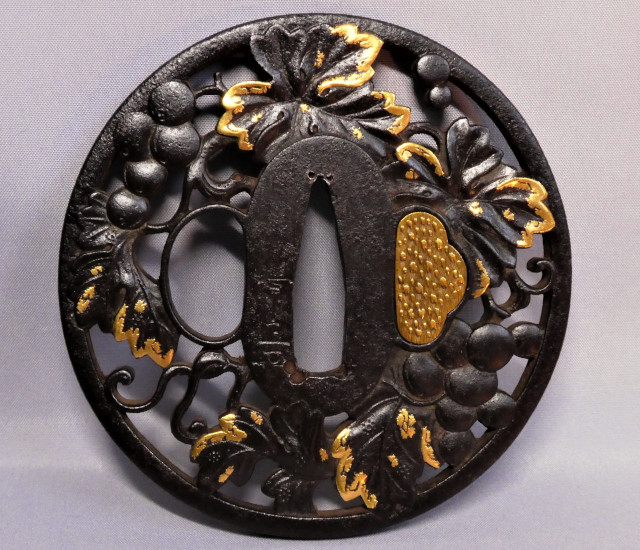 |
'GOTO TSUNEMASA' Please Contact Us For Price |
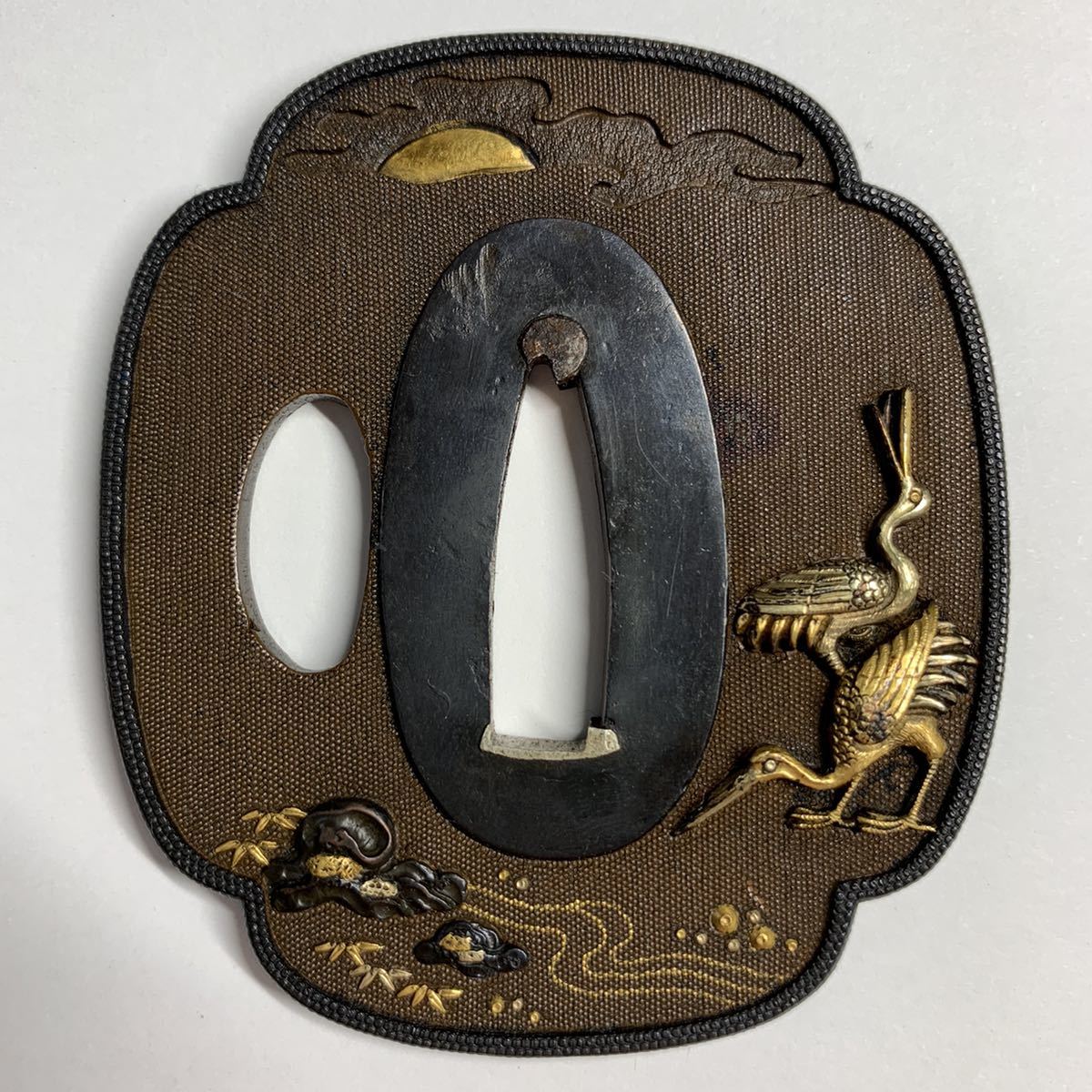 |
GOTO Den $4000.00
6.25cm x 5.55cm x 0.70cm (seppa) "It is the Hinode Tsuru figure tsuba that was identified as Goto Den, though it was unnamed. The workmanship is classified as mokko shape shakudo with fine nanako ground and takabori with iroe ornamentations resembling that of Goto Jujo. The carvings as the iroe are very delicate and result in a finely detailed and elegant style."(Long) |
 |
'GOTO SAKU' Please Contact Us For Price "This is a rare work by "Goto", with delicate and firm openwork on the finest iron base with outstanding iron taste. I have handled many sword fittings so far, but I have never come across the "Goto" inscription, so I believe it is a very rare item. It is a work by a rare artist." (Haynes) |
The artists of the Kaga school followed the designs of the Kano painters and the style of the Goto school of metal carvers. The earliest artists, Yoshishige, who was also a painter, and his brother Kuninaga, were connected with the house of the Daimyo of Kaga province about the middle of the 17th century. Yoshinori, Yoshikuni, and Yoshitsugu were noted pupils of this school. Morisada, a distinguished inlay worker of Toyama, a town in the same daimyate, is also classed with them. Ujiiye,a pupil of Goto-Kenjo of the Goto school, came to Kaga from Fushimi about 1650 and joined the ranks of the Kaga artists. As a school they are famed for their great skill in inlay work (hira-zogan, also known as 'true zogan').
In former times at Edo, Shinchu-zogan tsuba were called Yoshiro tsuba. In Edo this name applied to all brass inlaid tsuba with floral designs. Yoshiro tsuba originate from the Heianjo-zogan school and are not of independent origin. They represent one derivative style of the later Heianjo-zogan tsuba. The term 'Yoshiro' is part of the name of
Koike Yoshiro Naomasa. The Kaga inlay style, native to the province, was far different from that used by Koike Yoshiro, and it would seem that after his period his style was no longer practiced in Kaga. The native Kaga inlay style was in parallel production to that of Yoshiro. Although the iron quality is good in the Yoshiro work the most admirable quality is the fine brass inlay.
The contrast of the color of the iron with that of the brass is very fine in the Kaga Yoshiro work. This is not to be found in other brass inlay.
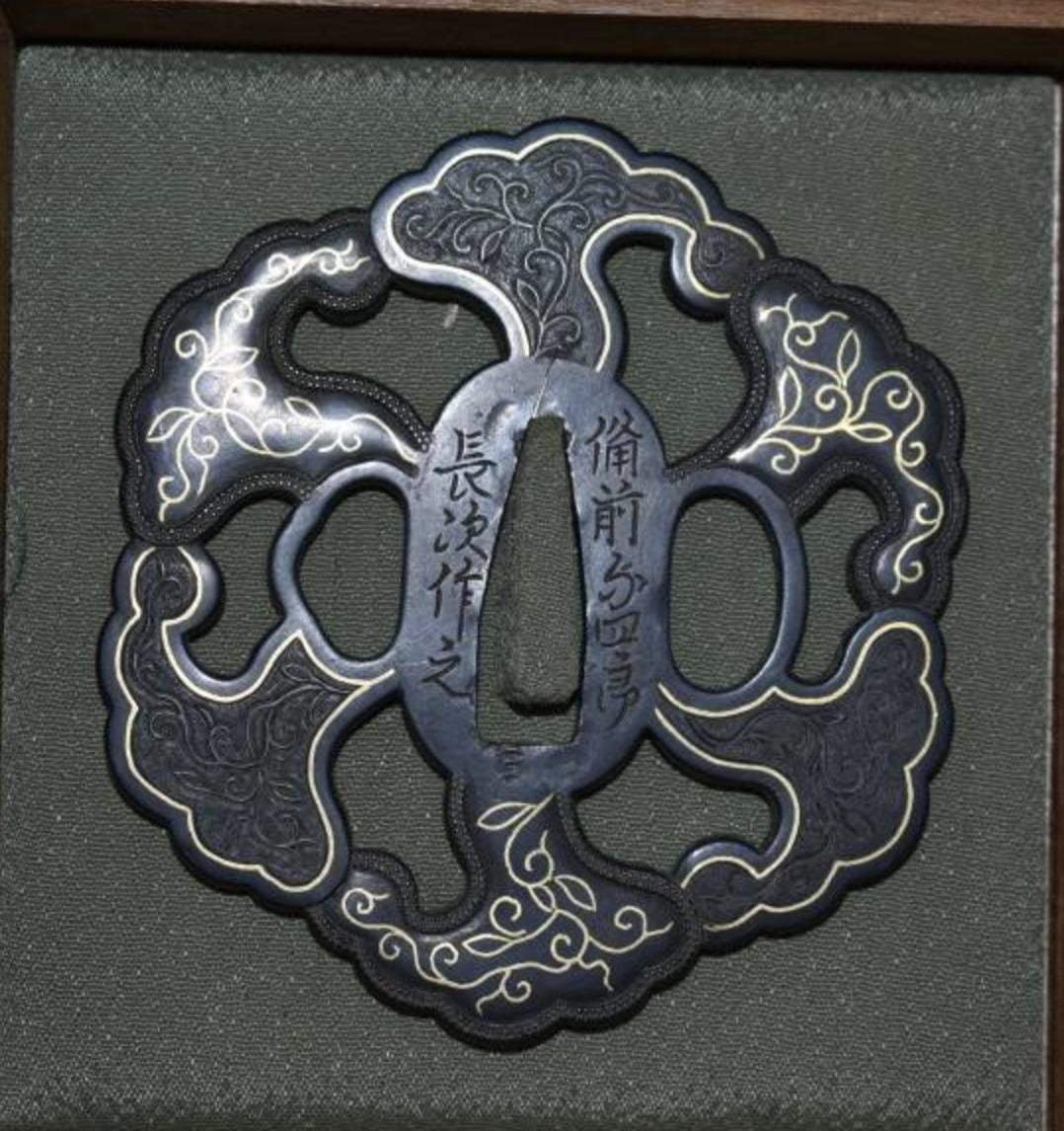 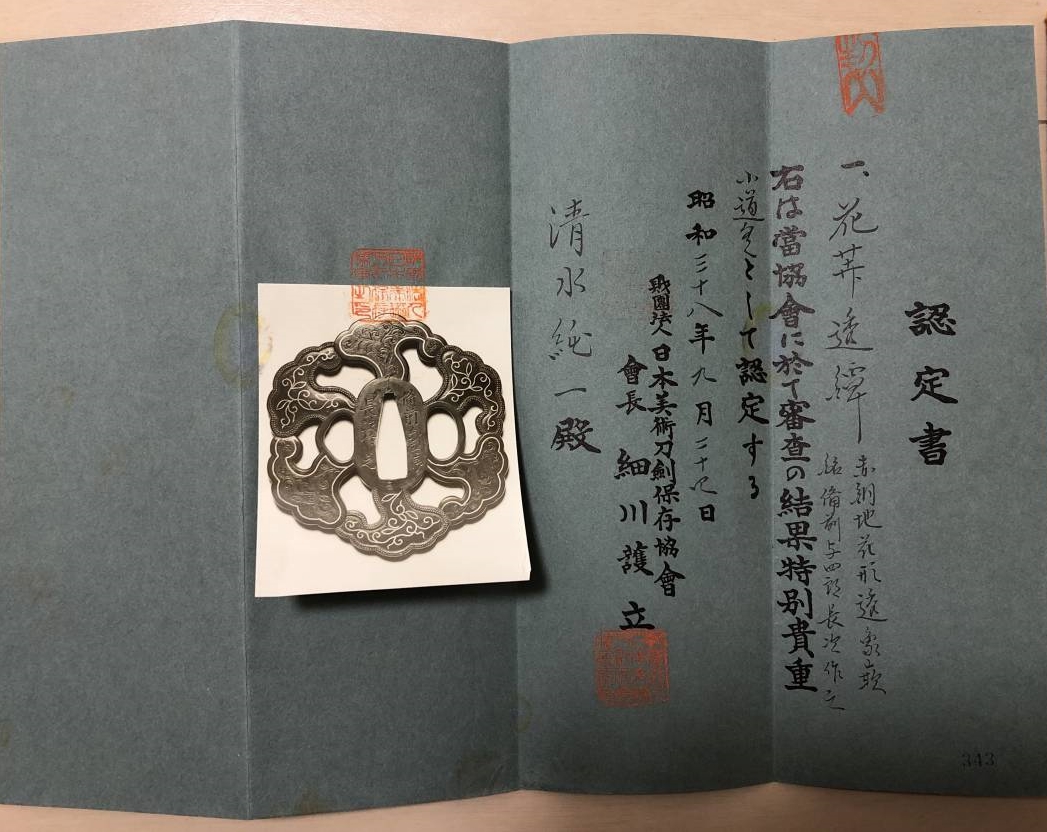 |
'BIZEN YOSHIRO NAGATSUGU SAKUKORE' Please Contact Us For Price "This is a masterpiece made by 'NAGATSUGU', H 06536.0 in the Haynes Index. A fine shakudo plate with the finest of gold inlay. See the 'Tsuba Kanshoki' II on pg. 66 for an iron example of his work." (Haynes & Long) 7.70cm x 8.30cm x 0.50cm |
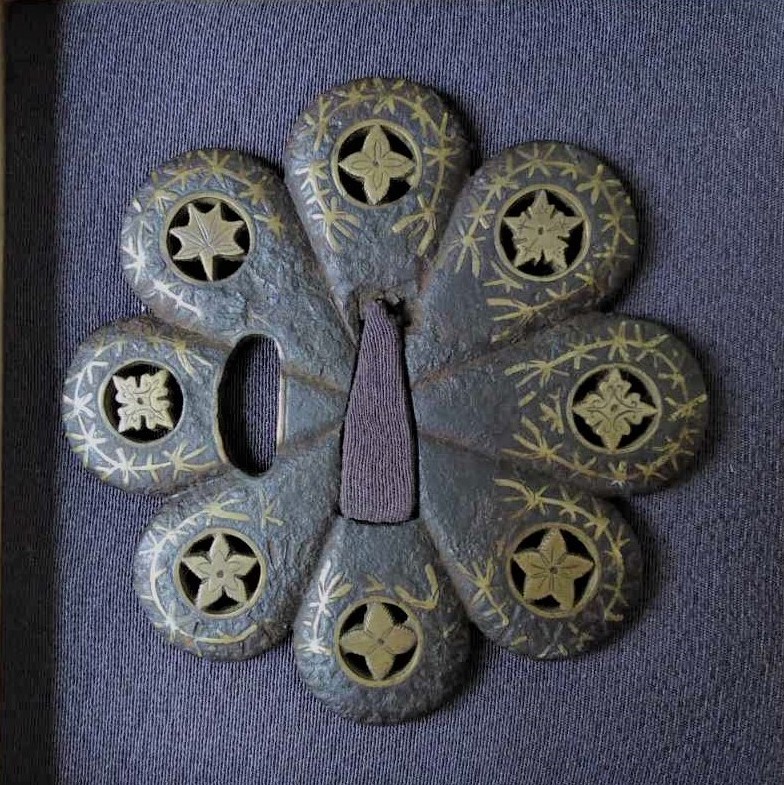 |
BIZEN YOSHIRO Tsuba $3000.00 "An excellant example of a unsigned Bizen Yoshiro tsuba. The inlay is excellant and even extends over the edge of the eight-petal chrysanthemum area. The design between the mon are bamboo stems. Dates to the Muromachi period, ca. 1400." (Haynes & Long) 7.90cm x 7.90cm x 0.40cm |
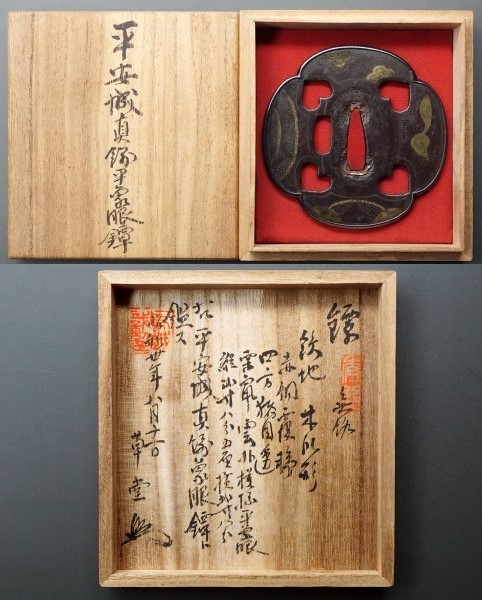 |
KAGA Province Please Contact Us For Price |
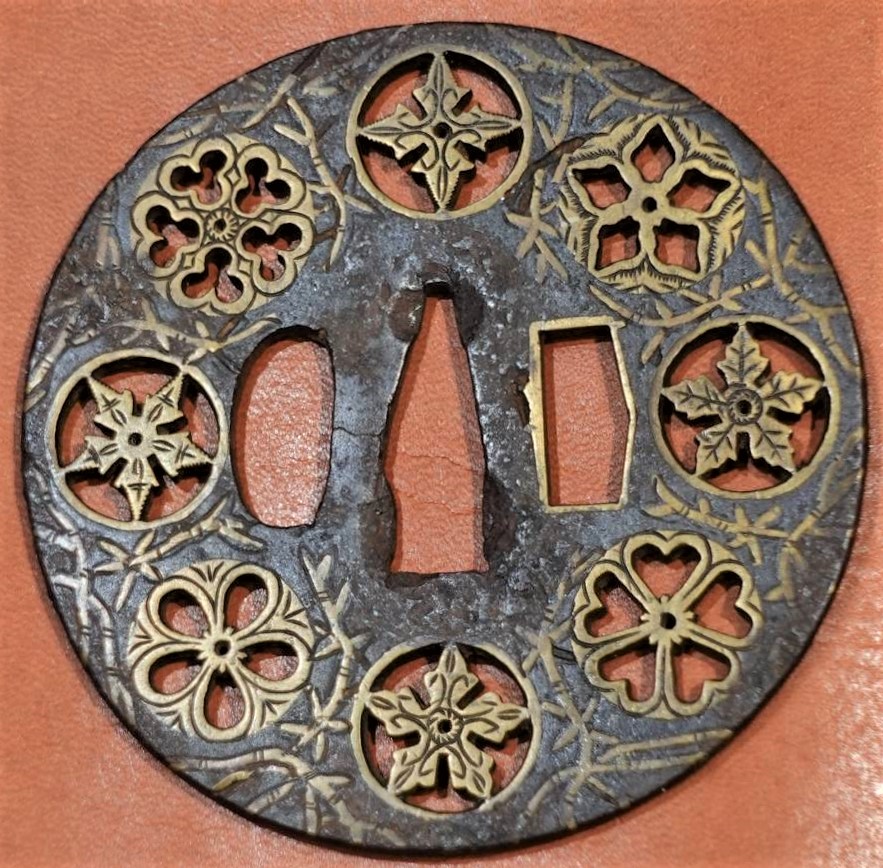 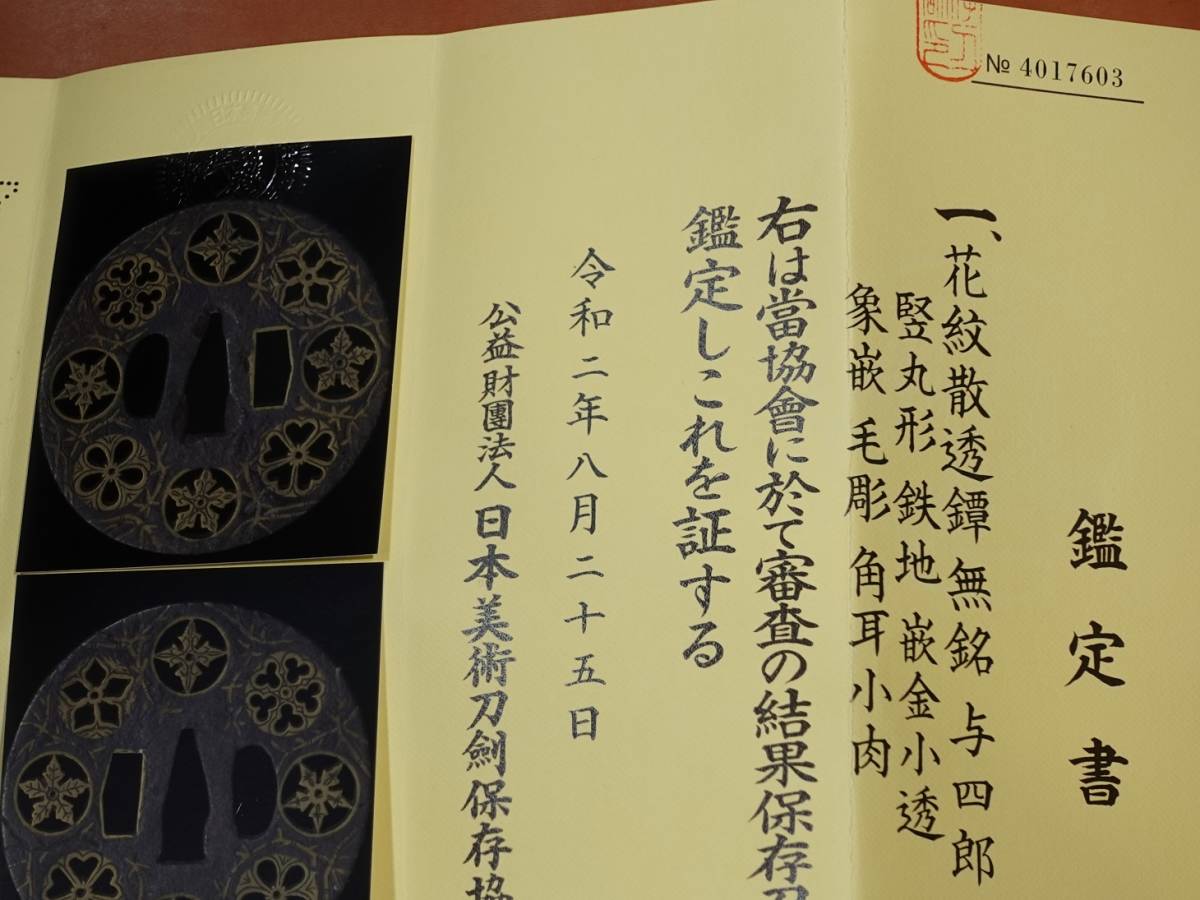 |
KAGA YOSHIRO Tsuba Please Contact Us For Price "A well forged iron plate with eight roundels - circular emblems of family crests (mon) made of cast brass, pierced and chiseled in kebori, and with flat brass inlay (hira-zogan) of bamboo stems between each pair of mon. There are eight different kamon in sukashi, which are obviously visible on both sides. These sukashi sections that are inlaid into the plate are refered to as ranma-bori because they have the appearance of the ranma (transom panels with openwork carving) that are seen in Japanese temples and other important buildings above walls and doorways. Dates to ca. 1450." (Haynes & Long) 7.95cm x 8.01cm x 0.30cm |
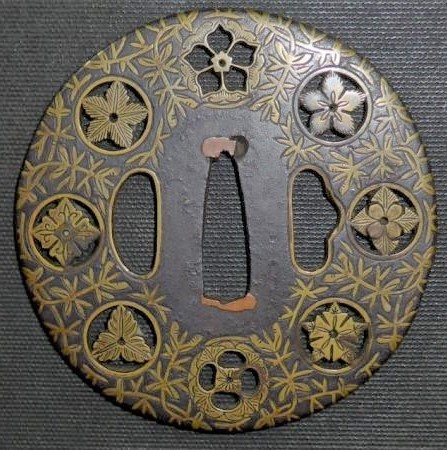 |
YOSHIRO Tsuba Please Contact Us For Price "A maru-gata and maru mimi tsuba of well forged iron plate with eight roundels - circular emblems of flowers and/or family crests (mon) made of cast brass, pierced and chiseled in kebori, and with flat brass inlay (hira-zogan) of floral stems. This inlay style is Kaga Yoshiro zogan where the brass is inlaid into channels and then filed back to be flush with the surface of the iron plate. All inlay is present. The hitsu-ana are original and outlined in brass. There are eight different kamon in all on both sides. All kamon are in sukashi, which are obviously visible on both sides, are of various daimyo families. These sukashi sections that are inlaid into the plate are refered to as ranma-bori because they have the appearance of the ranma (transom panels with openwork carving) that are seen in Japanese temples and other important buildings above walls and doorways. Traditionally the Yoshiro school (Kaga-Yoshiro) produced tsuba decorated in silver, brass, and shakudo hira-zogan. This very fine example dates to ca. 1500." (Long) |
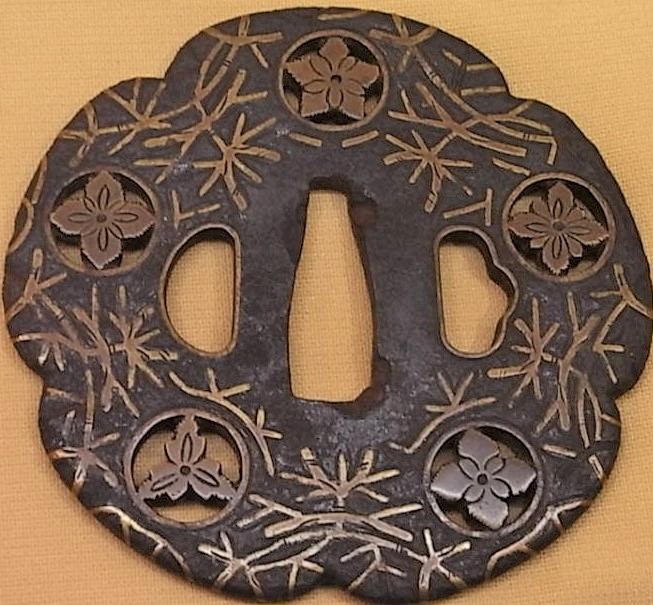 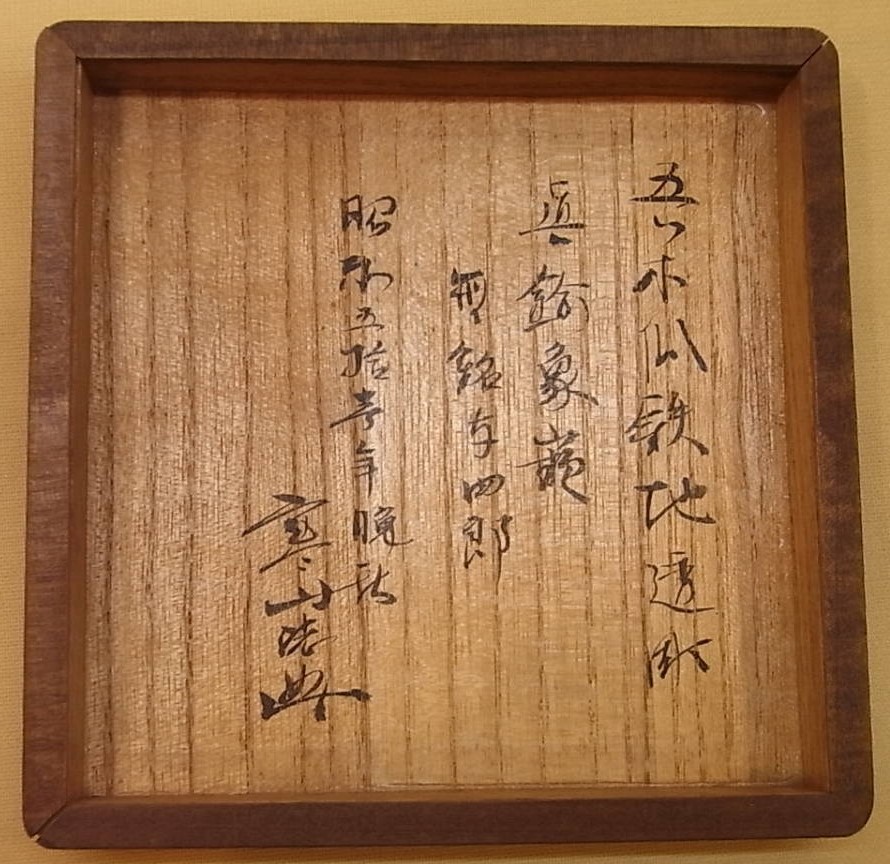 |
KAGA YOSHIRO Tsuba Please Contact Us For Price "A well forged iron plate with five roundels - circular emblems of flowers and/or family crests (mon) made of cast brass, pierced and chiseled in kebori, and with flat brass inlay (hira-zogan) of stems. This inlay style is Kaga Yoshiro zogan where the brass is inlaid into channels and then filed back to be flush with the surface of the iron plate. The hitsu-ana are outlined in brass. There are five different kamon in all on both sides. All kamon are in sukashi, which are obviously visible on both sides, are of various daimyo families. These sukashi sections that are inlaid into the plate are refered to as ranma-bori because they have the appearance of the ranma (transom panels with openwork carving) that are seen in Japanese temples and other important buildings above walls and doorways. Dates to the end of the Muromachi period, ca. 1500. Accompanied with a Hakogaki by Sato Kanzan" (Long) 8.15cm x 7.85cm x 0.35cm |
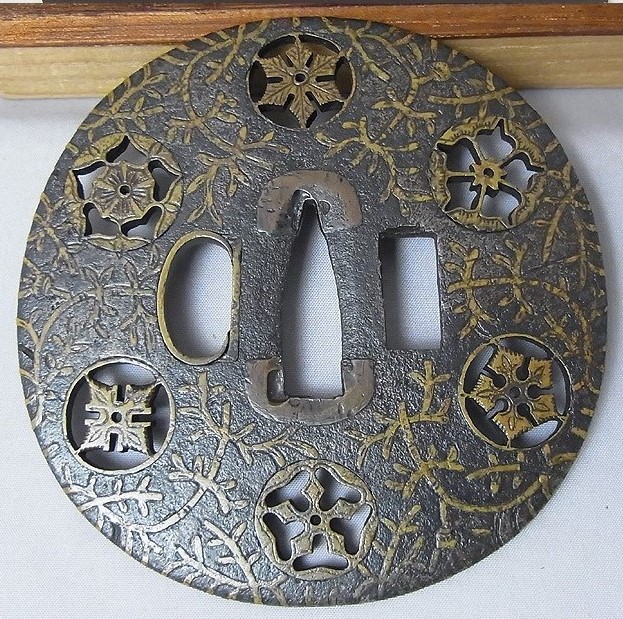 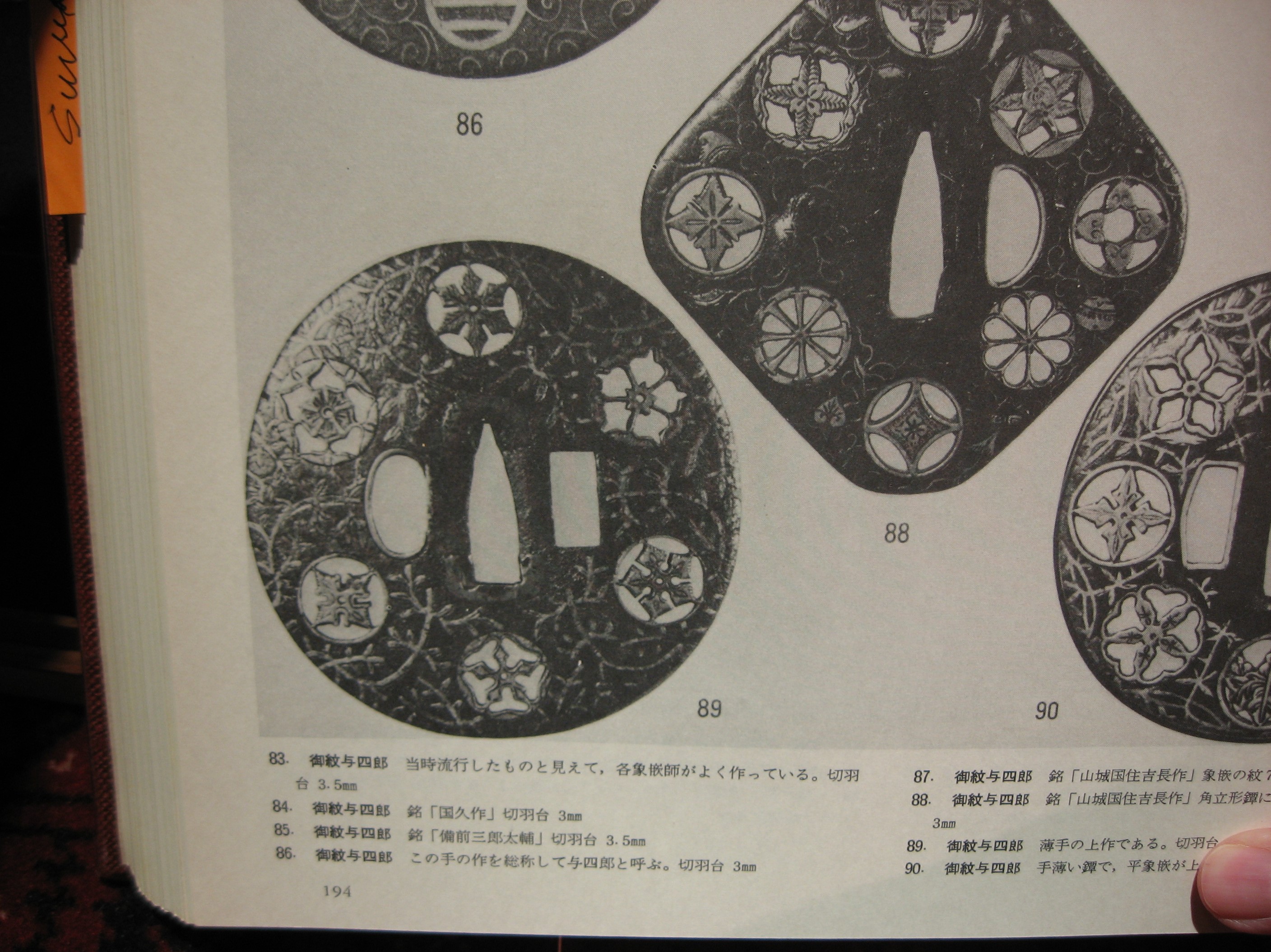 |
BIZEN YOSHIRO Tsuba $3600.00 "A maru-gata and maru mimi tsuba of well forged iron plate with six roundels - circular emblems of flowers and/or family crests (mon) made of cast brass, pierced and chiseled in kebori, and with flat brass inlay (hira-zogan) of vines with flower buds. This inlay style is Yoshiro zogan where the brass is inlaid into channels and then filed back to be flush with the surface of the iron plate. All inlay is present with the exception of four very small pieces. The rectangular hitsu-ana is original as is the kozuka-ana that is outlined in brass. Note the thickness of the sekegane in nakago-ana. There are six different kamon in all on both sides. All kamon are in sukashi, which are obviously visible on both sides, are of various daimyo families. These sukashi sections that are inlaid into the plate are refered to as ranma-bori because they have the appearance of the ranma (transom panels with openwork carving) that are seen in Japanese temples and other important buildings above walls and doorways. Appears to be Mumei but if close study under good light there are vestiges of a mei belonging to SABURO DAIYU. Dates to ca. 1500-1550. This is 100 years earlier than Naomasa." (Long) 8.10cm x 8.30cm x 0.30cm |
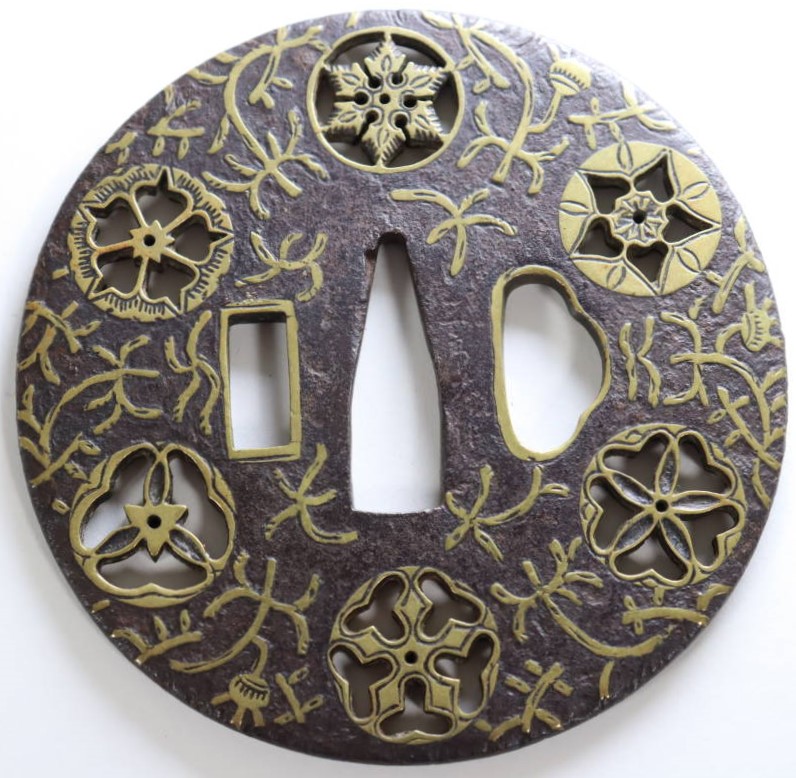 |
'SABURODAIYU' $8000.00 "This is the flush brass inlay artist often with designs of brass sukashi family mon with vines and tendrils with flower buds on the iron plate. Dates to Momoyama period, ca. 1500-1550. A very fine 1st class example of 'SABURODAIYU' of the Koike family. Worked in Okayama in Bizen Province. Refer to H 07660.0 in Haynes Index. Close relationship with Koike Yoshiro (H 06677.0) group. |
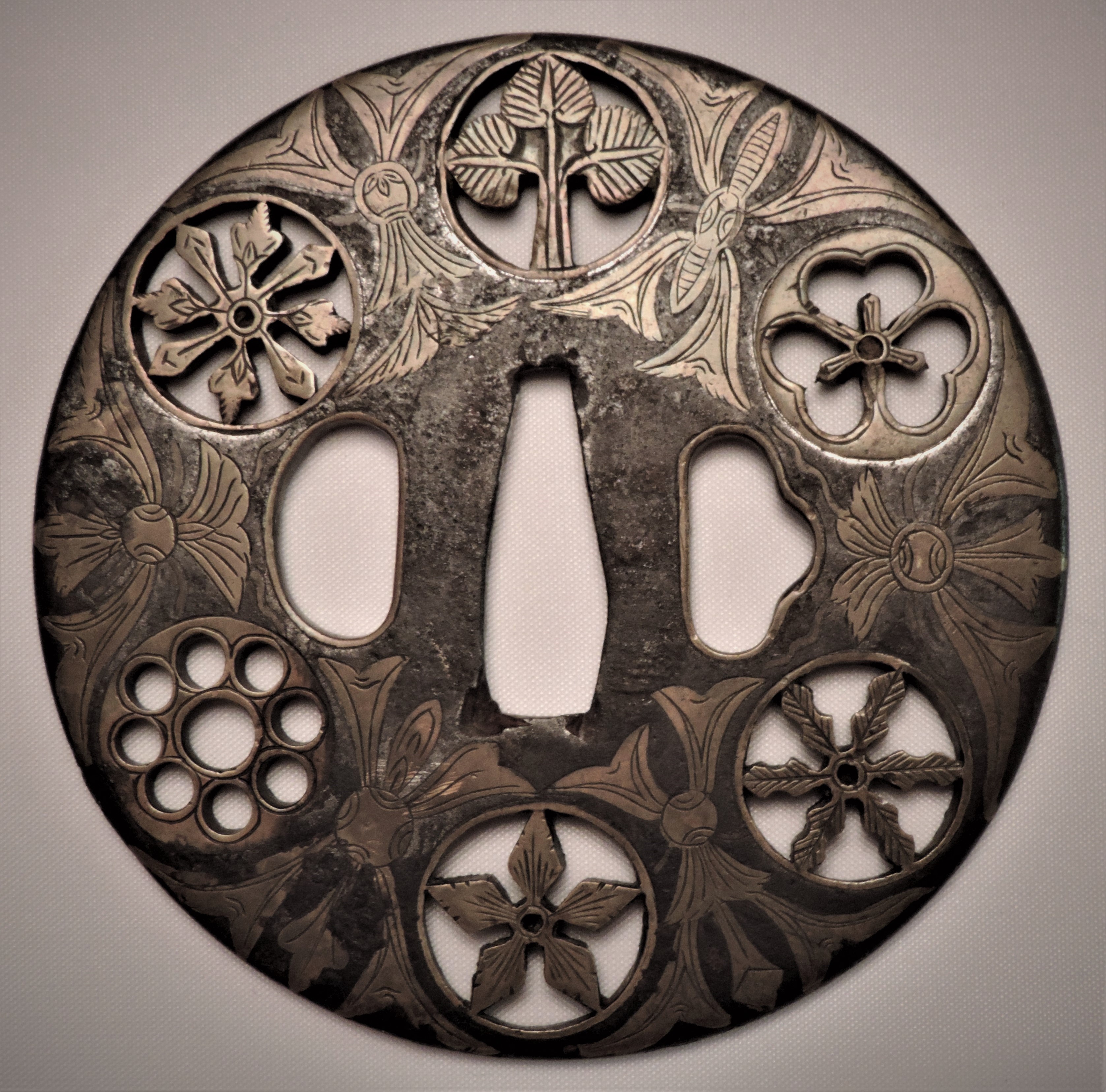 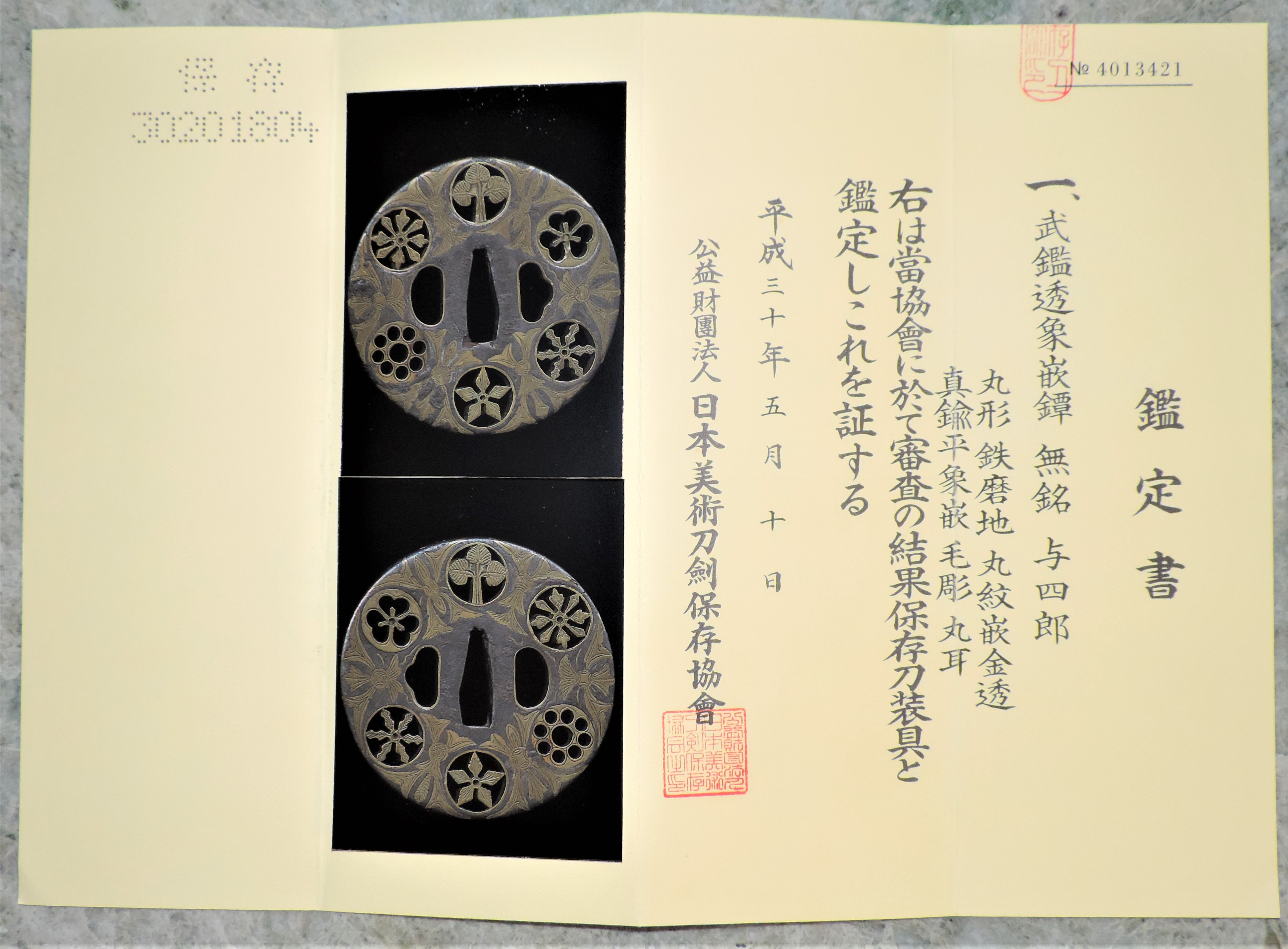 |
KOIKE YOSHIRO Tsuba $6000.00 "A well forged iron plate with six roundels - circular emblems of family crests (mon) made of cast brass, pierced and chiseled in kebori, and with flat brass inlay (hira-zogan) of tied bundles of plants separating each mon. There are six different kamon in sukashi, which are obviously visible on both sides. These sukashi sections that are inlaid into the plate are refered to as ranma-bori because they have the appearance of the ranma (transom panels with openwork carving) that are seen in Japanese temples and other important buildings above walls and doorways. It should be noted that these MON represent familys living in the Northern area of Japan. Dates Momoyama period, ca. 1600-1650." (Haynes & Long) |
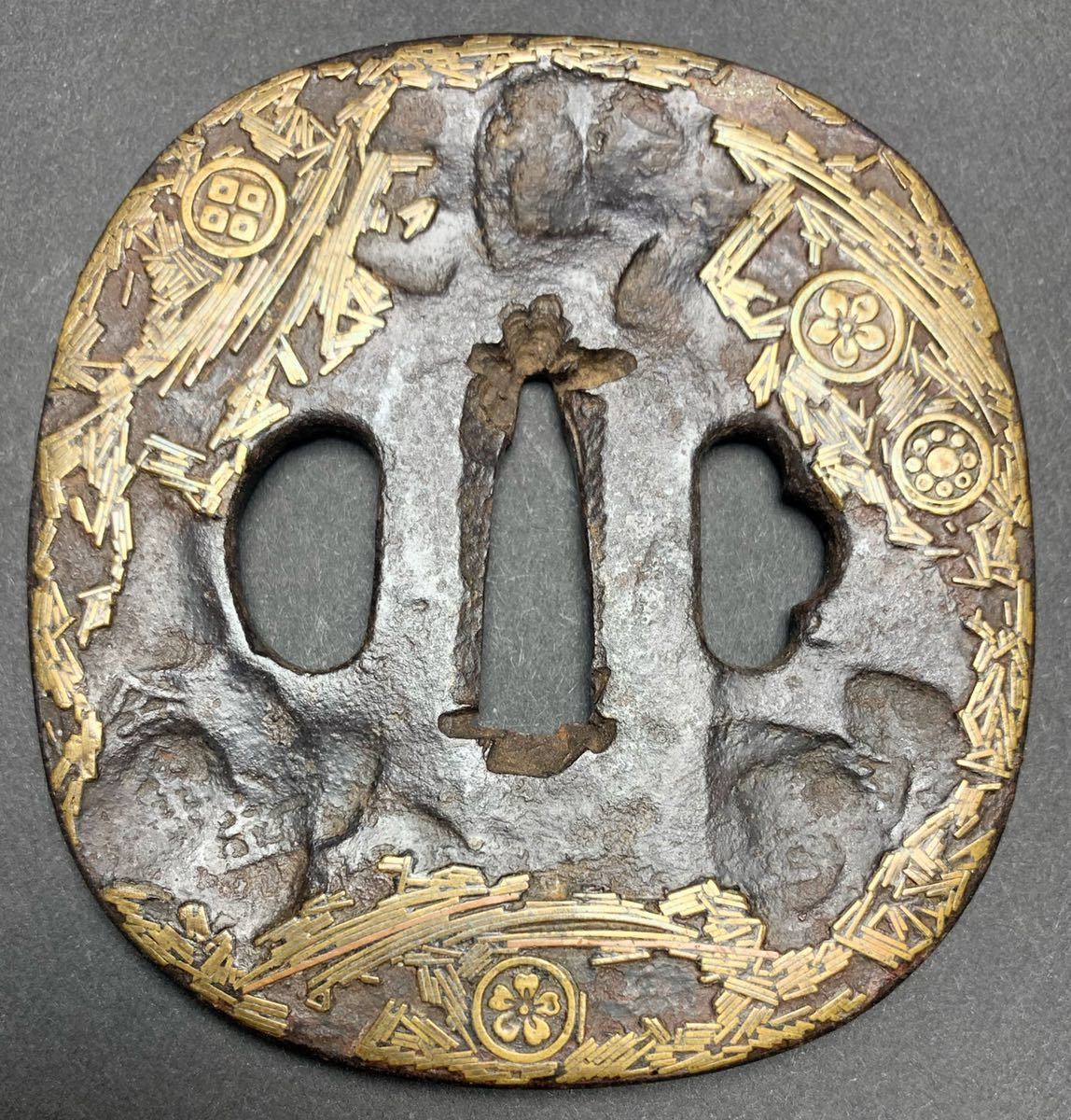 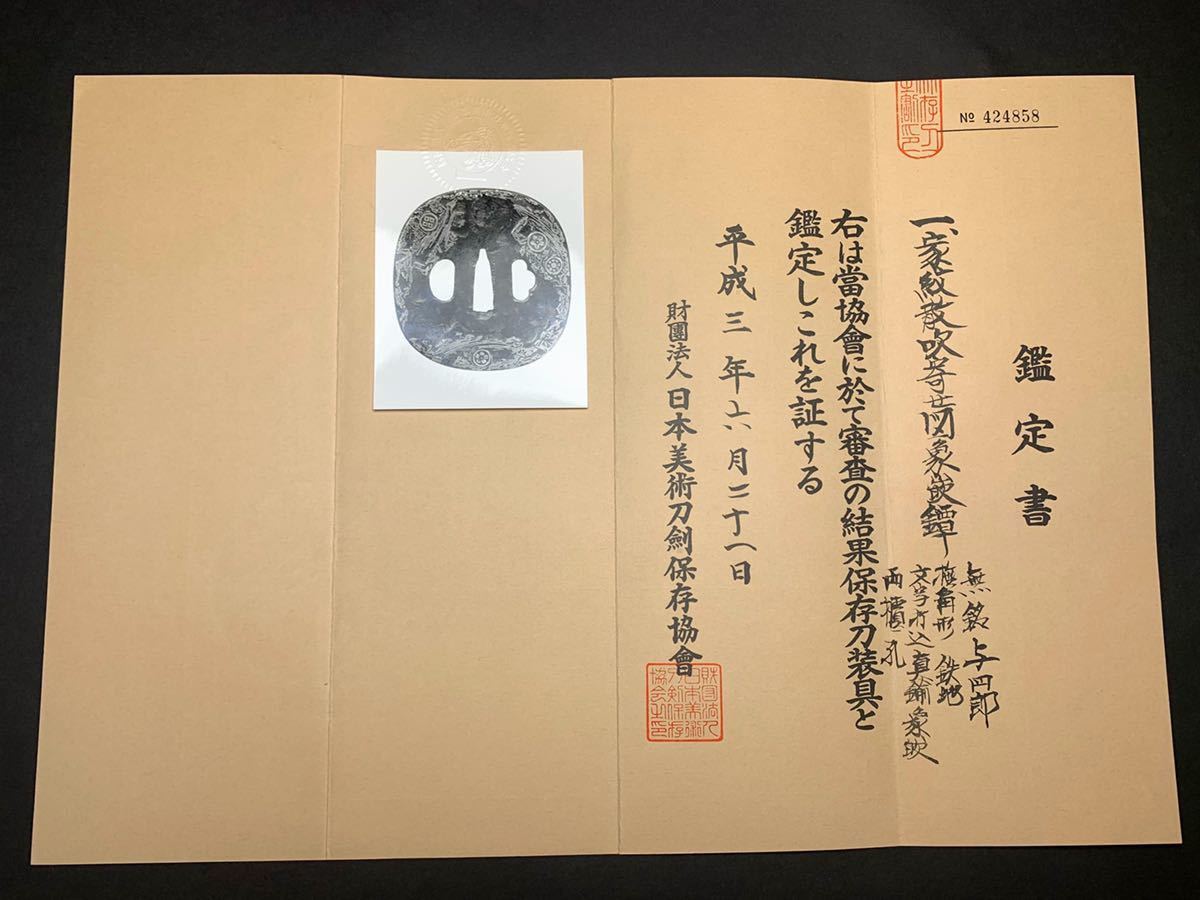 |
HOKORU YOSHIRO $4000.00 "A large rounded square iron plate with gold inlay defined as 'Hokori Yoshiro.' Dr. Torigoye labeled this type of inlay as 'gomoku zogan' or trash inlay. There appears on both omote and ura three or four family mon, one being the Hosokawa Mon. A 1st Class example of this very rare style of zogan inlay and design. Dates to ca, 1600. A great deal more study is needed."(Haynes & Long) 8.00cm x 7.50cm x 0.45cm |
  |
KO YOSHIRO Please Contact Us For Price "Presented here is a tsuba of iron in chrysanthemum flower shape. With brass and copper flat inlay blossoms and fine hair carving. A single hitsu of kotzuka shape. In perfect condition with no missing inlay."(Long) |
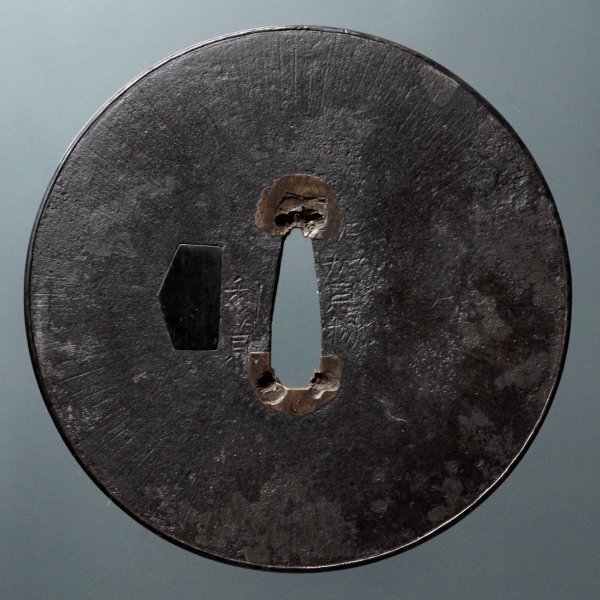 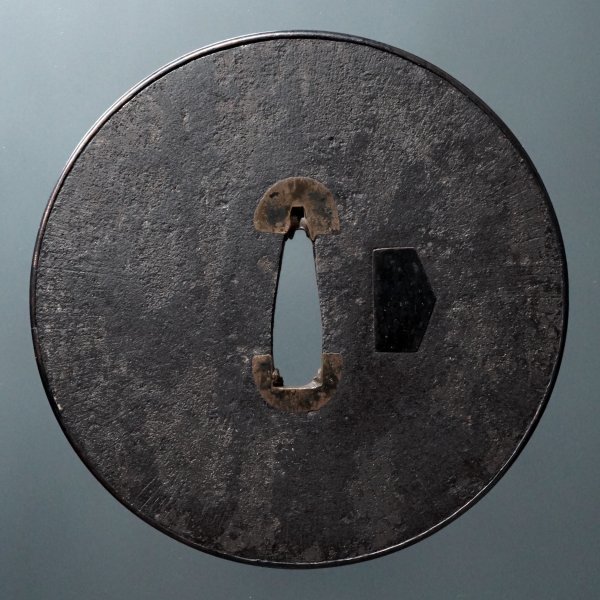 |
'KAGA JO FUJIWARA TOSHISADA' Please Contact Us For Price "Early Edo period Kaga iron work with shakudo fukurin. There is a residue of black lacquer. There is the presence of very fine amida yasurime which one could speculate whether this finish was originally intended to have a particular religious meaning."(Long) 8.48cm x 8.50cm x 0.40cm |
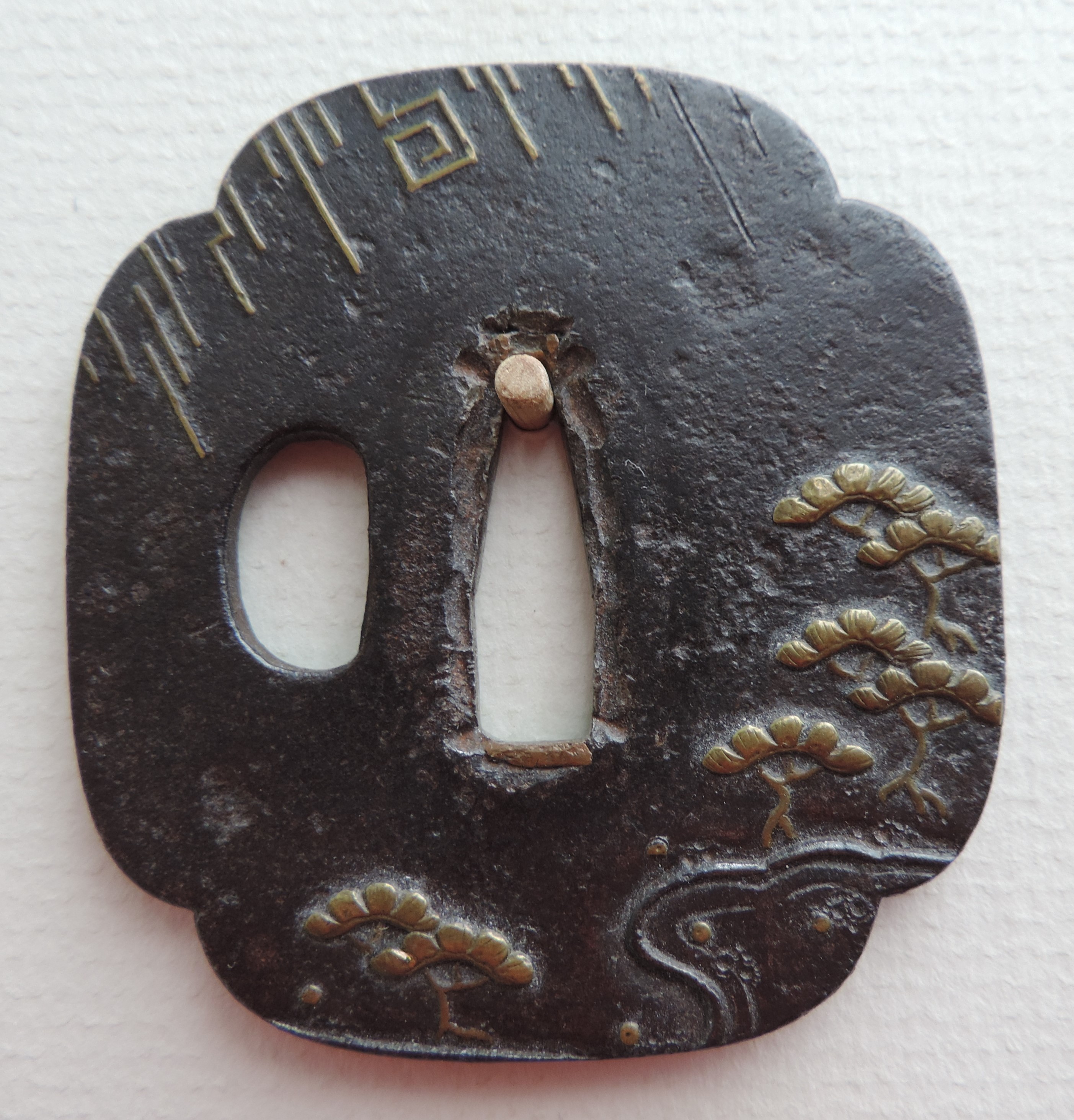 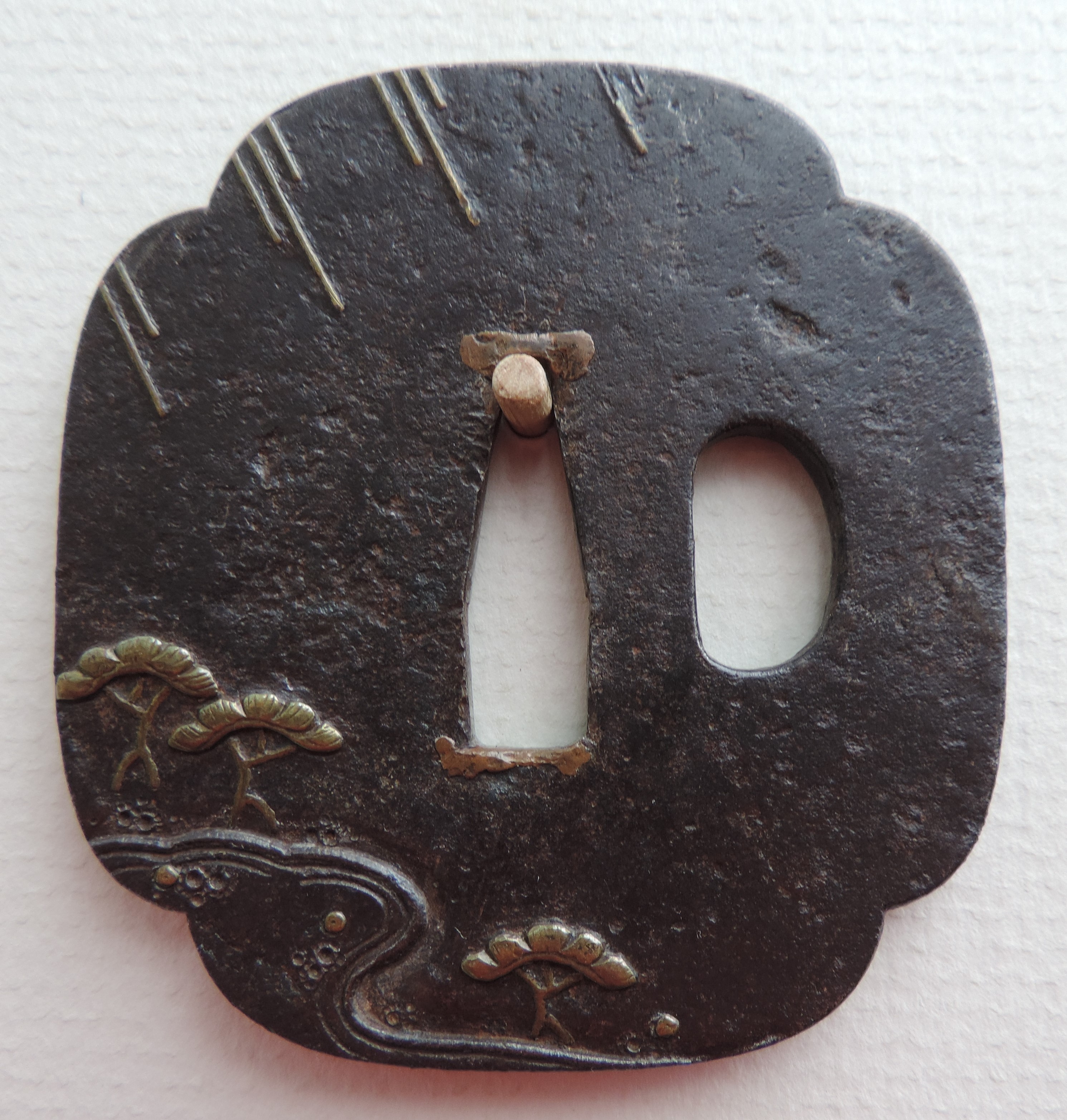 |
FUSHIMI YOSHIRO $800.00 "The school and style is of the Fushimi Yoshiro group. They were living at Fushimi at the same time Kaneiye was there. They did brass inlay but not of the Kyoto style and worked in a style all their own. Landscape and human figures were used in their designs. A well forged iron plate with a design of rain falling amongst the landscape. The plate in mokkogata shape with kozuka-ana. Dates to ca. 1550."(Long) 7.00cm x 7.50cm x 0.40cm |
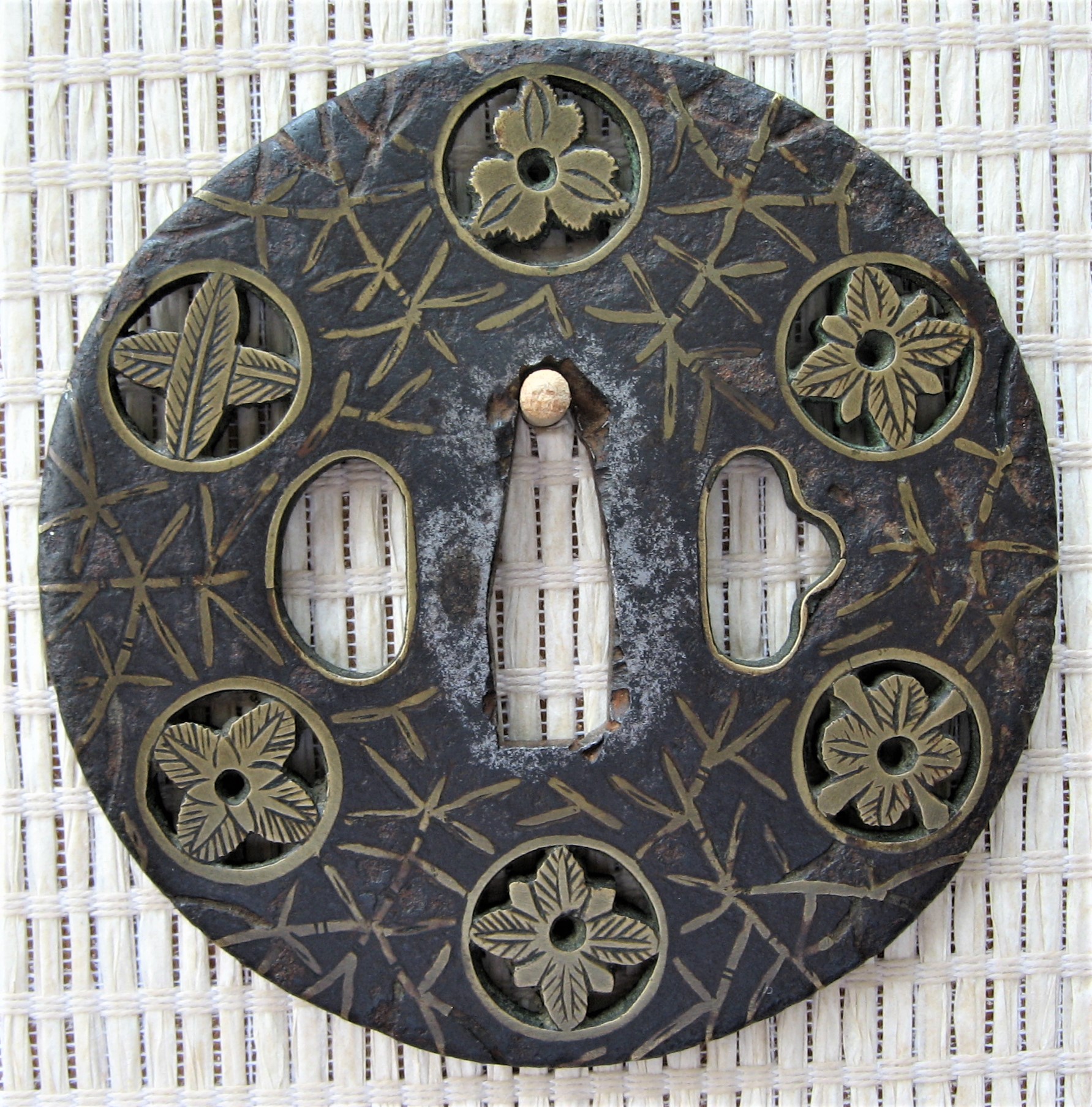 |
YOSHIRO MON-SUKASHI Tsuba $600.00 "A well forged iron plate with six roundels - circular emblems of flowers and/or family crests (mon) made of cast brass, pierced and chiseled in kebori, and with flat brass inlay (hira-zogan) of stems. This inlay style is Kaga Yoshiro zogan where the brass is inlaid into channels and then filed back to be flush with the surface of the iron plate. The channels are visible in places where the brass is no longer present. The hitsu-ana are outlined in brass. The bamboo motif separates the mon. There are six different kamon in all on both sides. All kamon are in sukashi, which are obviously visible on both sides, are of various daimyo families. These sukashi sections that are inlaid into the plate are refered to as ranma-bori because they have the appearance of the ranma (transom panels with openwork carving) that are seen in Japanese temples and other important buildings above walls and doorways. The un-refined design and style confirm the date of ca. 1450-1500."(Long) 8.00cm x 8.10cm x 0.30cm |
AKASAKA HA
|
The name for this school comes from the district of Akasaka in Edo where the artists of this school resided. It is thought that the school came into being when Kariganeya Hikobe moved from Kyoto to Edo along with the first Tadamasa and his brother, the second Tadamasa. It would appear that this group commenced the production of Akasaka tsuba. At the time of the formation of the Akasaka school the two powerful openwork schools of Kyo-sukashi and Owari were exerting great influence upon each other. It could be said that from this clash, in the form of Kariganeya, these two schools were merged. The rare examples of the tsuba made by Kariganeya Hikobei show his clever blending of the Kyo- and Owari styles. From these designs, and the shape of the tsuba, they suggested the style of the original Akasaka tsuba. The reason for the spread of the name of this school throughout the country was its fresh approach and attractive openwork patterns that were far beyond the conventional tsuba of the day. |
 AKASAKA TADAMASA |
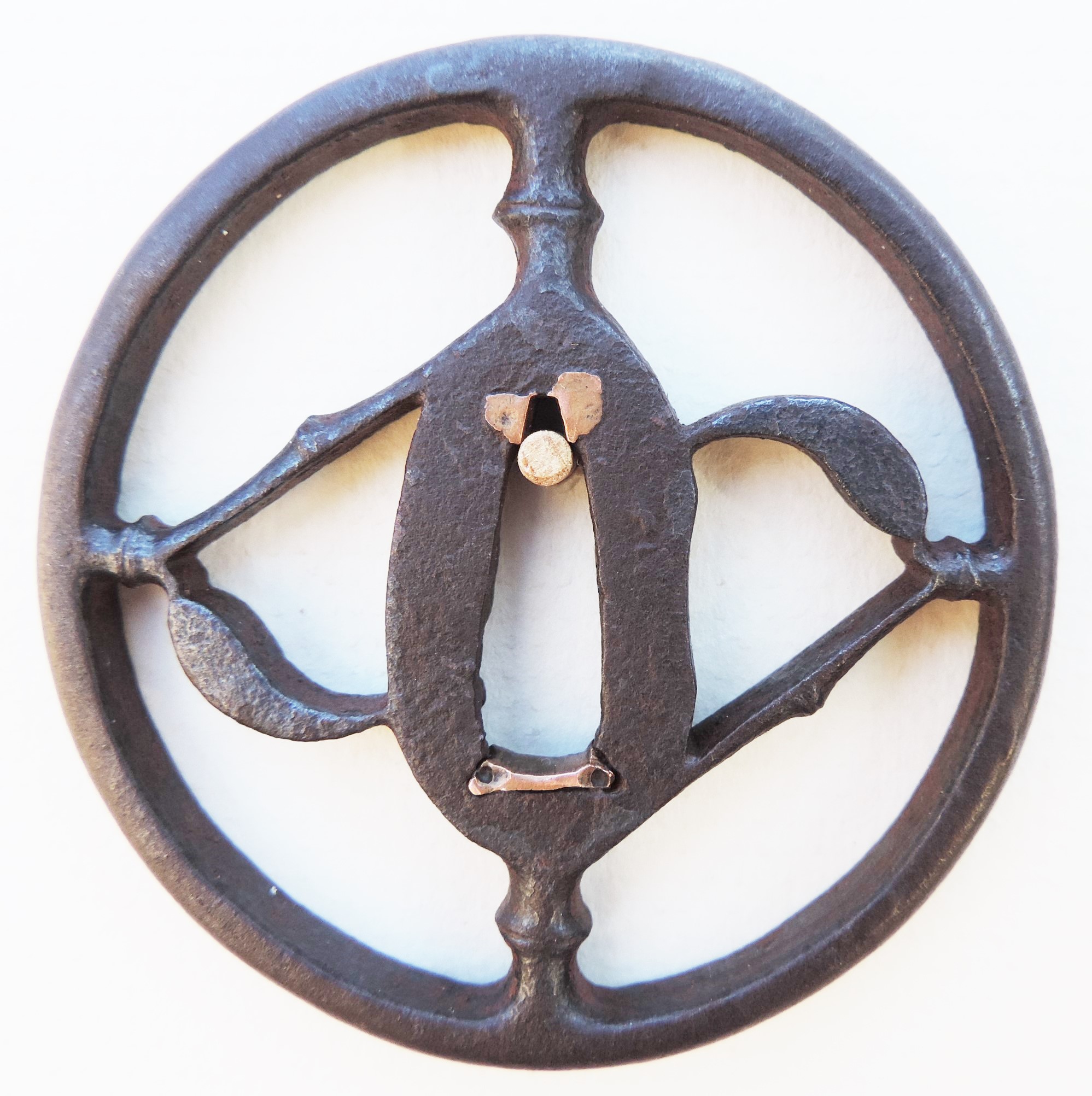 PROTO-AKASAKA $6000.00 |
 'AKASAKA YOSHISUMI SAKU' |
 AKASAKA |
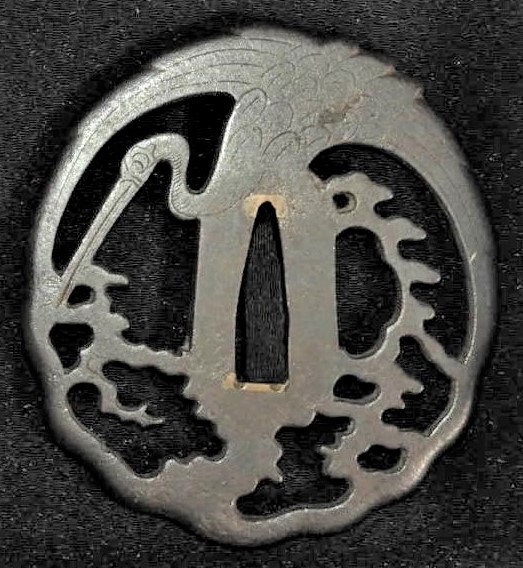 AKASAKA $1800.00 |
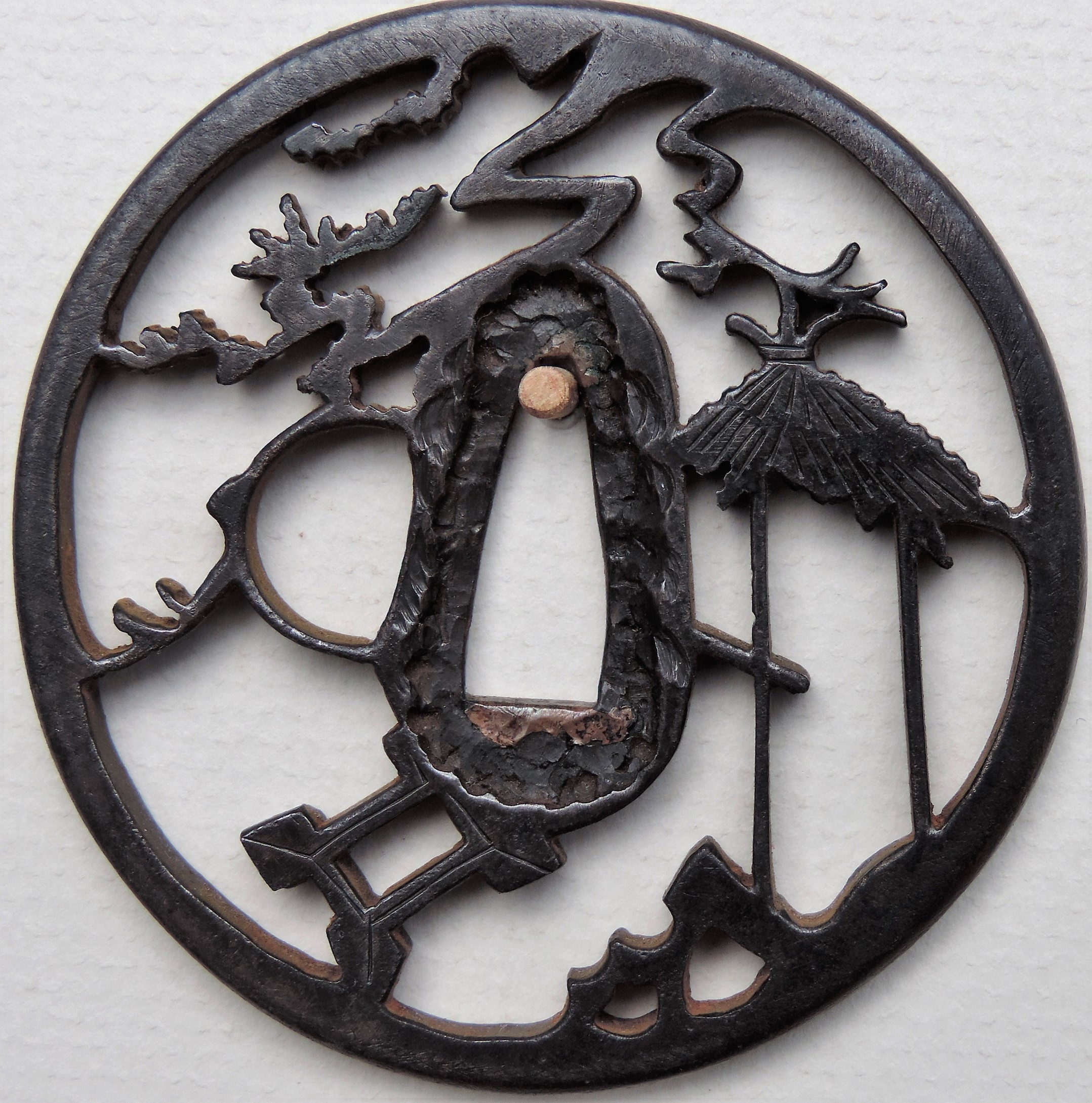 AKASAKA $1800.00 |
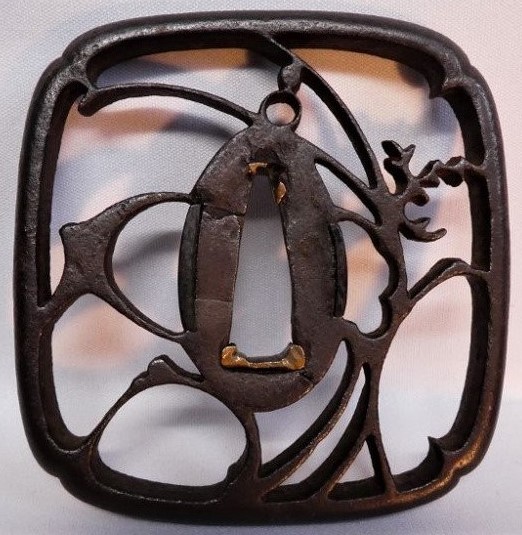 1st TADAMASA AKASAKA MUSHASHINO |
 1st TADAMASA AKASAKA |
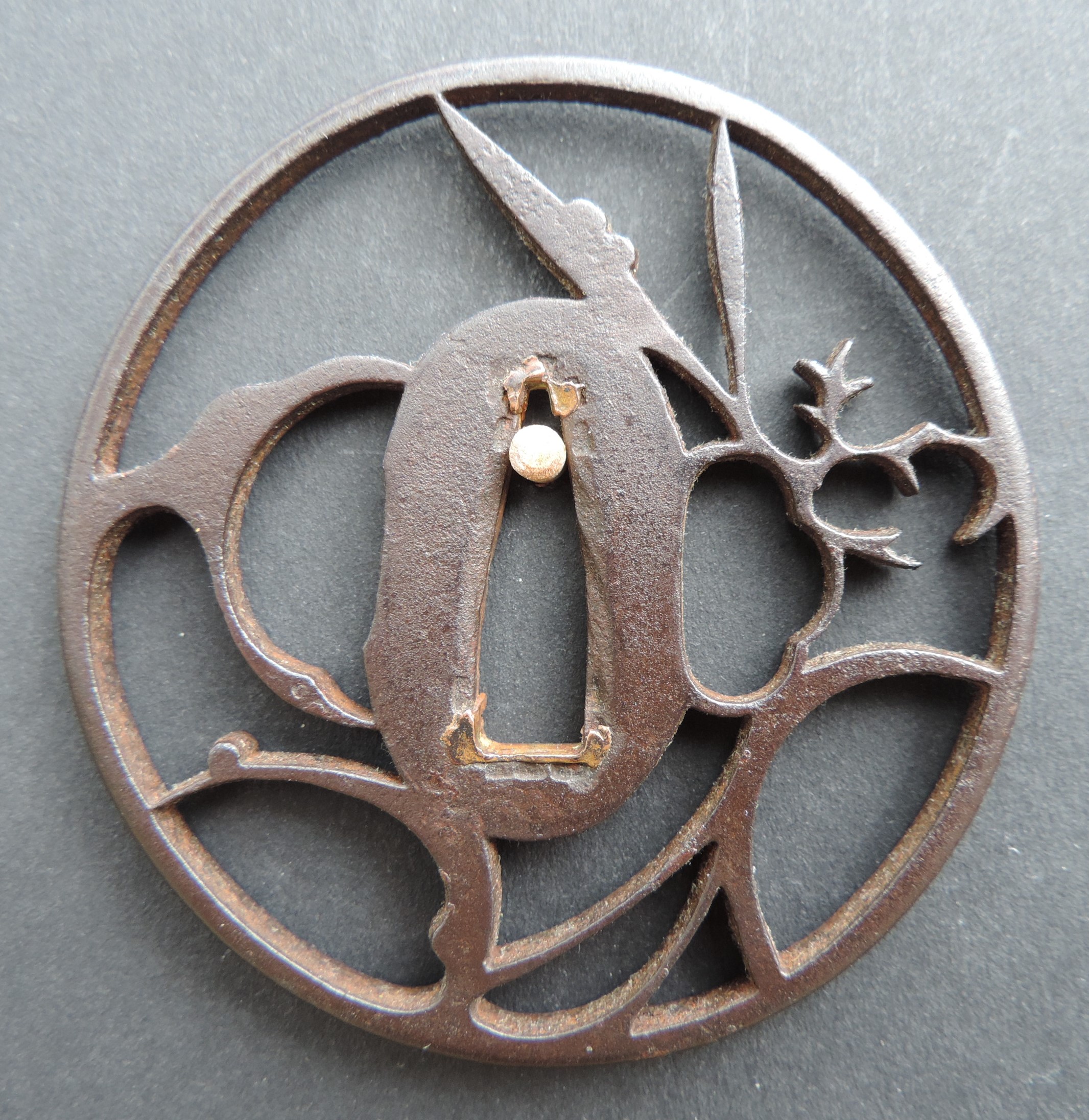 2nd TADAMASA AKASAKA |
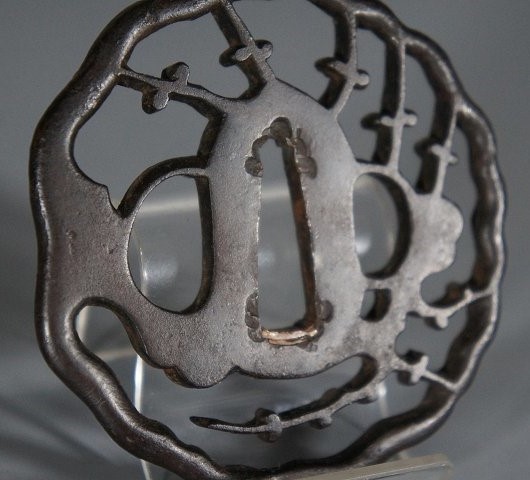 AKASAKA Attribution by 'TOEN SHA' |
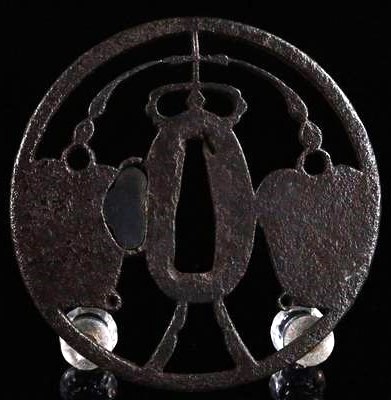 KO-AKASAKA Hakogaki by Kanzan |
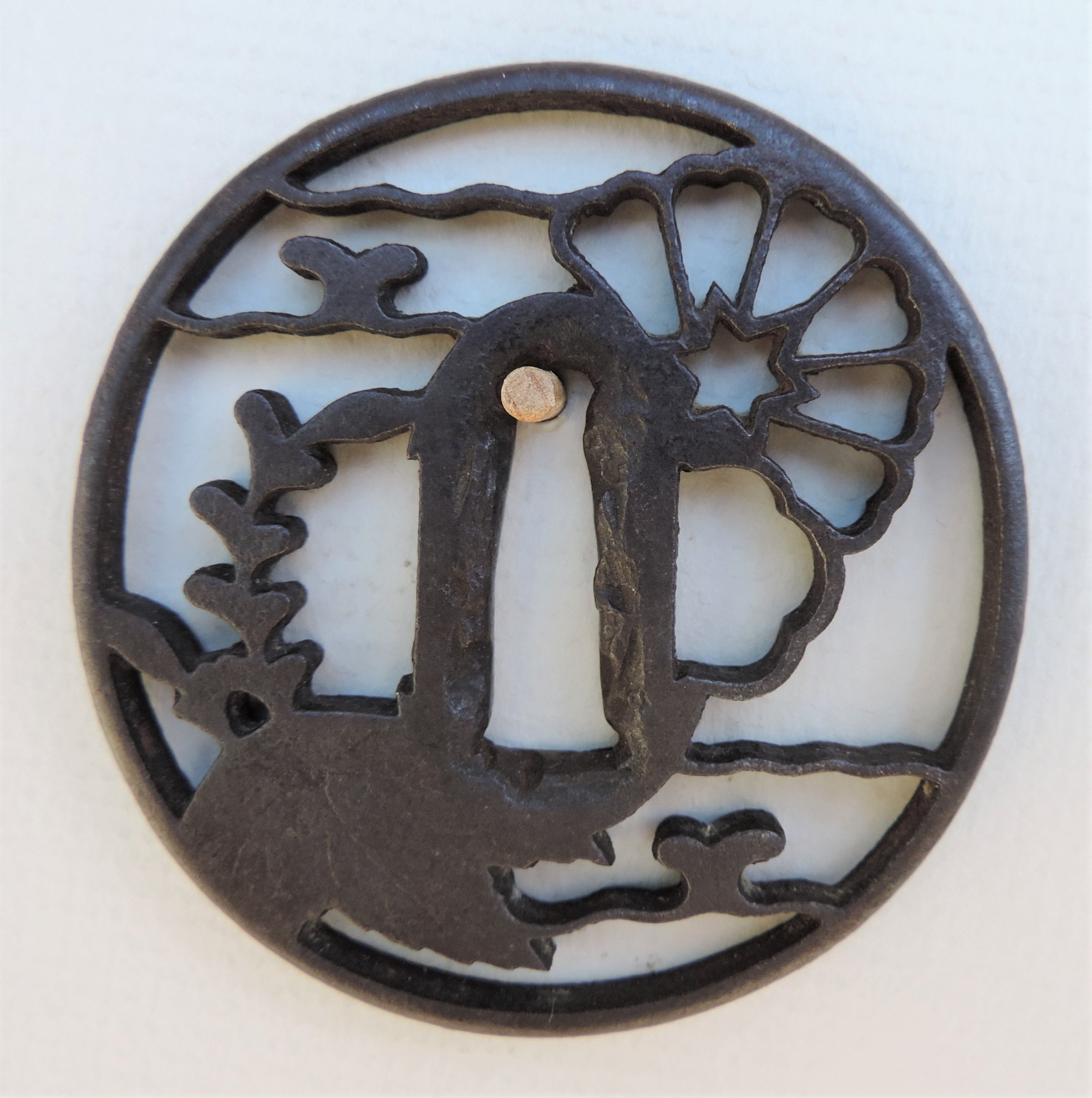 PROTO-AKASAKA NBTHK |
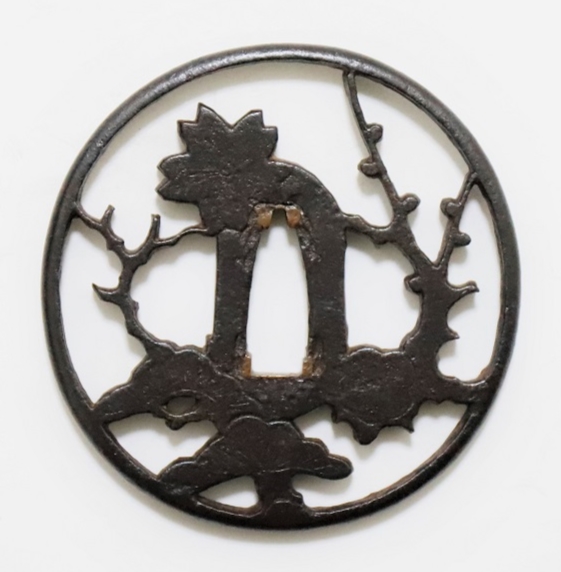 AKASAKA NBTHK |
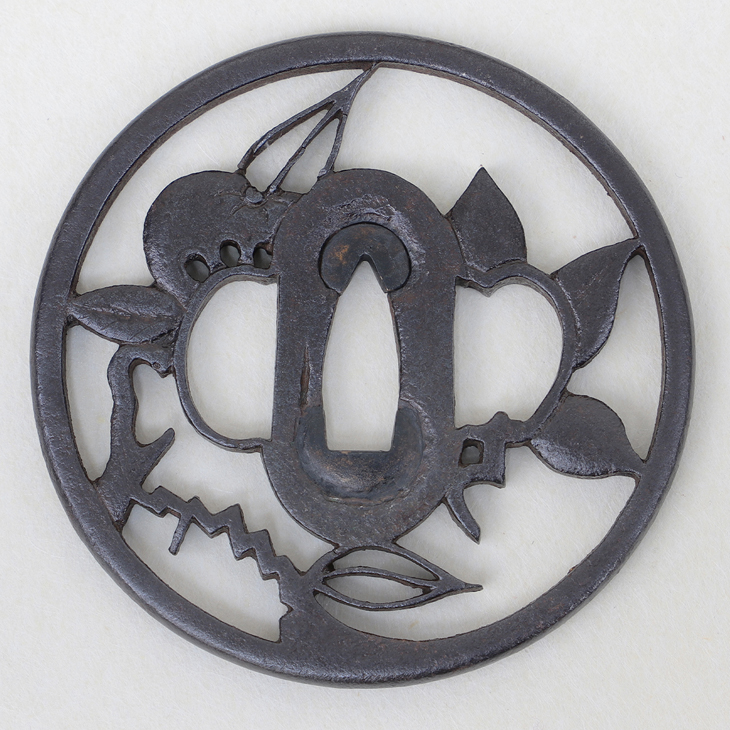 3rd AKASAKA TADASHIGE |
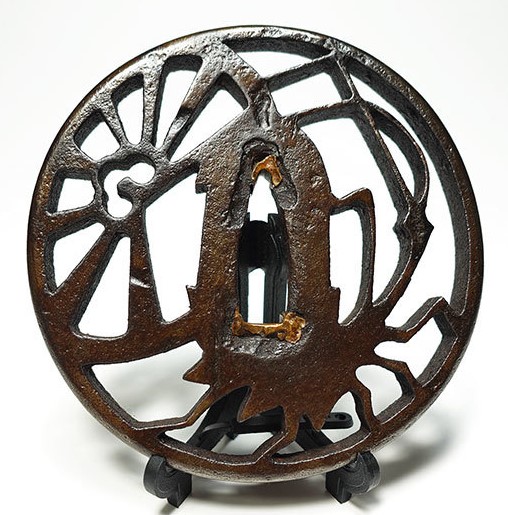 3rd AKASAKA MASATORA (H 04577.0) |
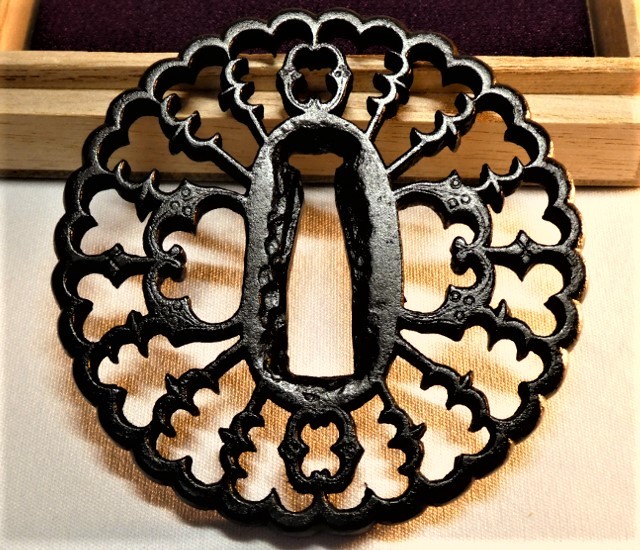 AKASAKA Myoga-Gan Kintoru NBTHK |
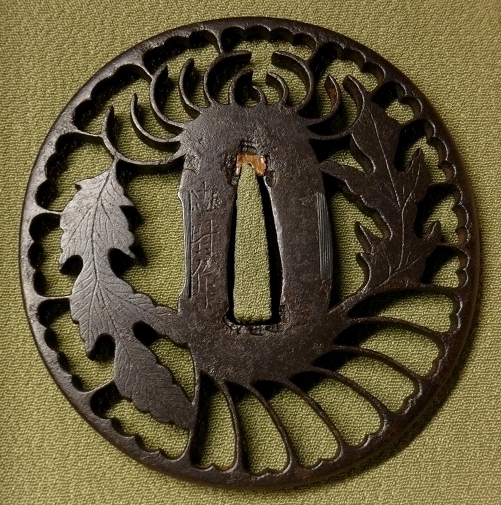 1st TADATOKI (4th Akasaka) NBTHK |
The Saotome were a well known school of armor makers (katchushi). The first master of the Saotome school was Nobuyasu of Shimotsuke. Nobuyasu moved to Odawara in Sagami were the Saotome school itself was founded. Some of the early Saotome makers were Nobuyasu, Iyenori, Iyetsugu, Iyetada and Iyesada although there is some disagreement on the lineage of the school. There were many other generations working well into the late Edo period. Many of the Saotome tsuba are of the kiku and kiku sukashi styles. They also did sukashi tsuba with various designs including mushrooms, clouds and those with somewhat abstract sukashi. Their plates are well forged, mostly folded plates in katchushi style commonly with sukinokoshi or uchikaeshi mimi (raised and/or folded rims). Ten zogan (brass or silver dot inlays) are also seen as are acid relief designs of fans, dragons and Buddhist symbols similar to the technique used by the Hoan School. In the later work of the Saotome school there is a combination of rough hammered surface and kokuin (hot stamped design). On occasion the Nara school or other Kinko used the Saotome plate as a base for their decoration. The Saotome kiku sukashi plate was used as the starting point for weaving brass and copper wire to form the Shingen style tsuba. The Saotome School gave rise to the Tembo school of tsubako.
The Tembo school (also spelled Tempo, Tenpo or Tenbo) originated in the late Muromachi Period and worked well into the late Edo Period. They are most noted for the use of kokuin (hot stamps) on their plates, although not all Tembo School tsuba are of the hot stamped style. In the later work of the Tembo school we find such signatures as Tempo, Yamashiro Ju Tempo, Sanada Tempo and Sanoda Tempo (see 'Sanoda'). Those Tembo tsuba having signatures are usually of better workmanship than the unsigned.
In summation, there are three periods of kokuin tsuba. First, the original Saotome work and the slightly later Tembo, plus a few of undetermined origin. Second, the work of the Hoan-Heianjo and the first period imitations of the Saotome-Tembo style. Third, are the common late Edo period imitations which are, in turn, copies of the imitations of the second period.
  |
PROTO SAOTOME Please Contact Us For Price |
  |
SAOTOME Please Contact Us For Price |
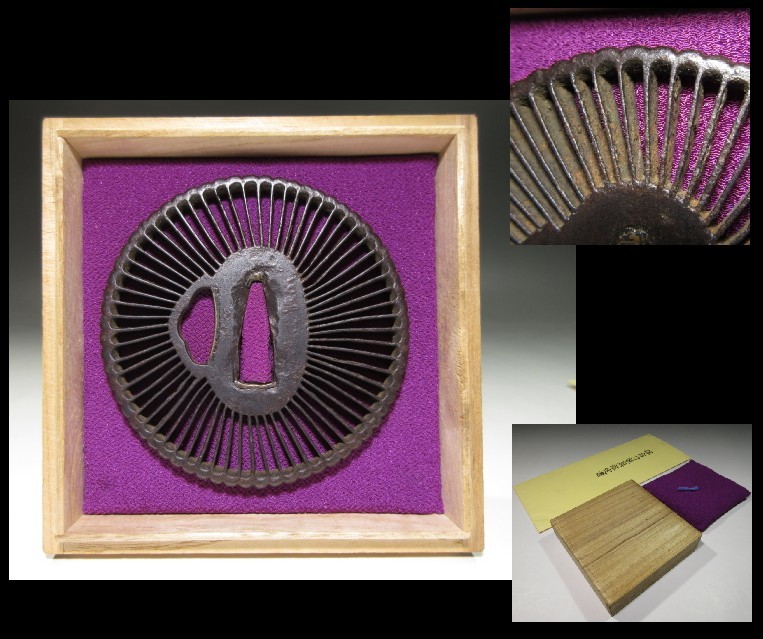 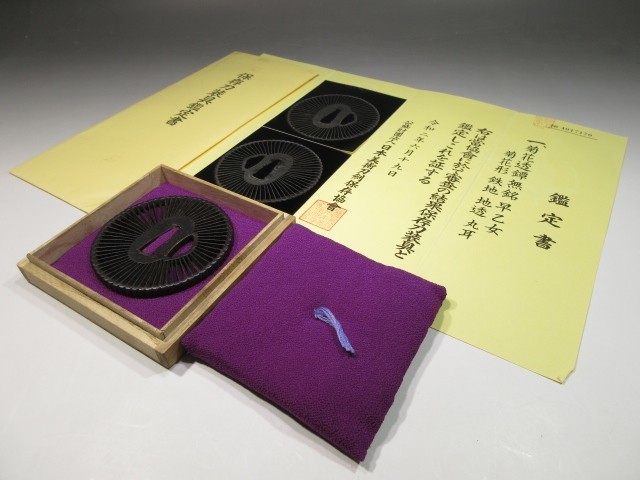 |
DAI SAOTOME Please Contact Us For Price |
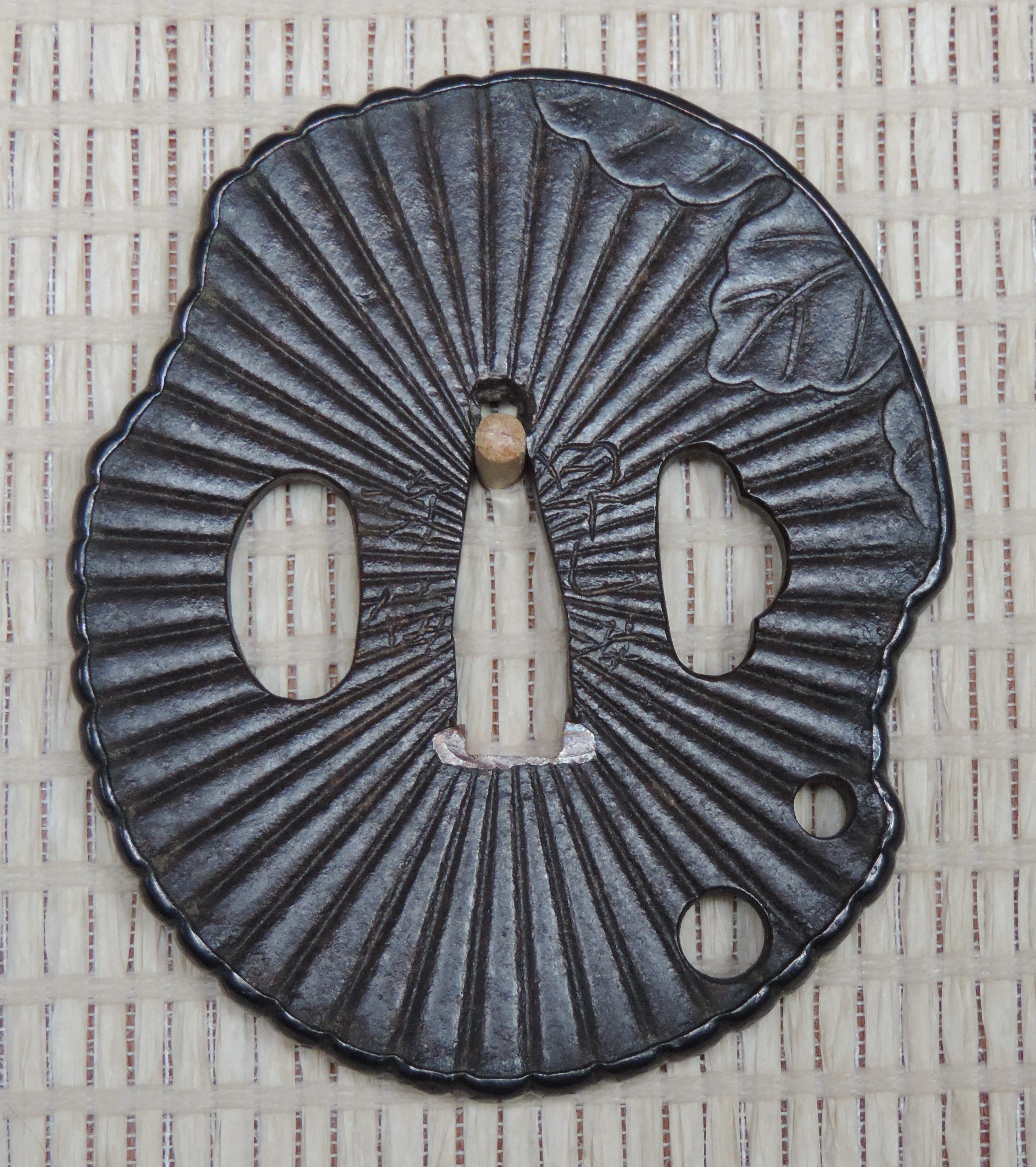 |
'SAOTOME IETOSHI' Please Contact Us For Price
"Saotome work of a design of Kiku bloom and leaves. A very original version of this classical Saotome and Umetada design. Signed: 'SAOTOME IETOSHI', H01819.0. Seems to have worked at Hitachi about 1700. Since Wakayama does not list this name we do not know his relationship to other Saotome of his period. We do know that this style of design was used by other Saotome of his period and he was as fine of artist as other members of the Saotome school. A very rare Saotome example and very important for the signature." (Haynes) |
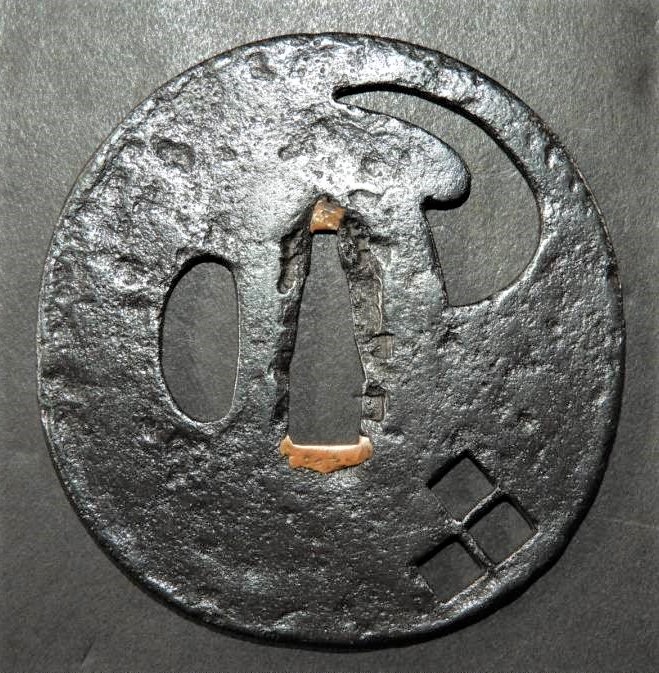 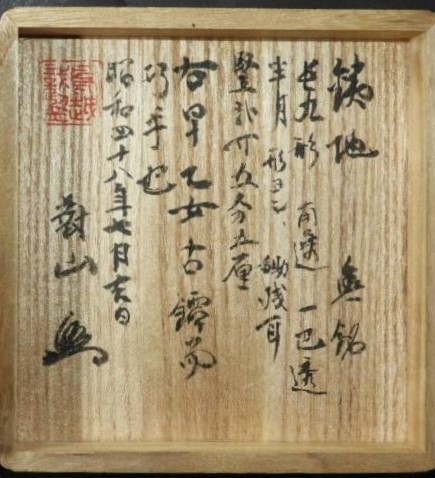 |
SAOTOME KO SAKU $3300.00
"An excellant, strongly forged iron ground Saotome tsuba with sukashi of two family mon design. Probably the prized tsuba of a very skilled samurai. The Saotome school originates from the Myochin school, and were very skilled at producing superior iron and iron tsuba." (Haynes) 7.85cm x 7.52cm x 0.28cm |
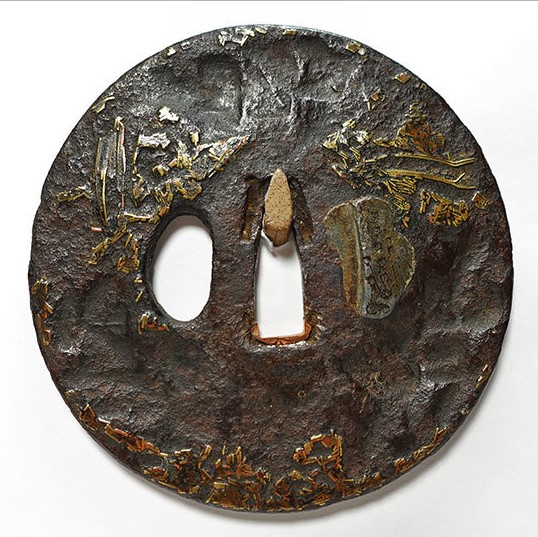 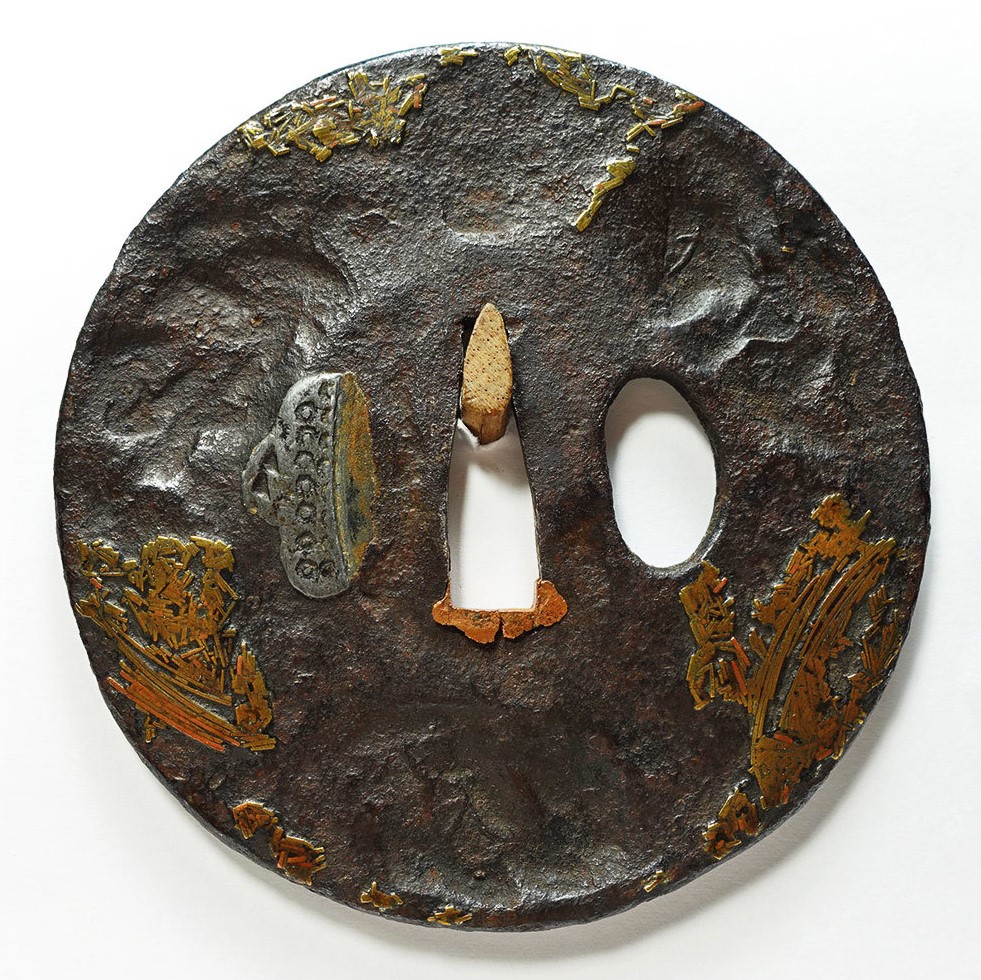 |
SANADA TEMBO $1000.00
"Scattered tsuba with iron mallet joint round inlay, unsigned, one hitsu filled. It is a blunt and artistic fukiyose brass inlaid tsuba. I think it's Sanada Tembo because it's made in a different place and has letters stamped on it. There is an explanation on page 15 of "The Beauty of Japanese Tsuba" by Arthur H. Church. Although there are stains, and rust over time, it is a gem with an old-fashioned taste." (Haynes) 8.39cm x 8.24cm x 0.45cm |
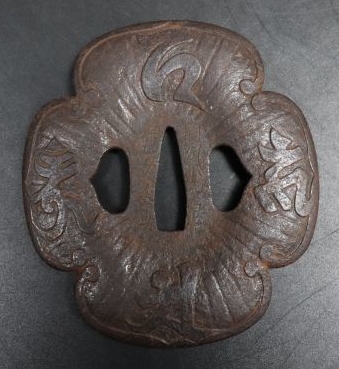 |
'ODAWARA SUMI SAOTOME IESADA' $7500.00
"Iron mokko form plate with well hammered surface. Fine iron bones appear on the rim edge. This Saotome school work shows the very best of this important school with the quality of the iron plate, the very fine hammer work, plus the excellant design. More of this write-up to follow. This example was made about ca 1450-1500." (Long) 8.60cm x 9.50cm |
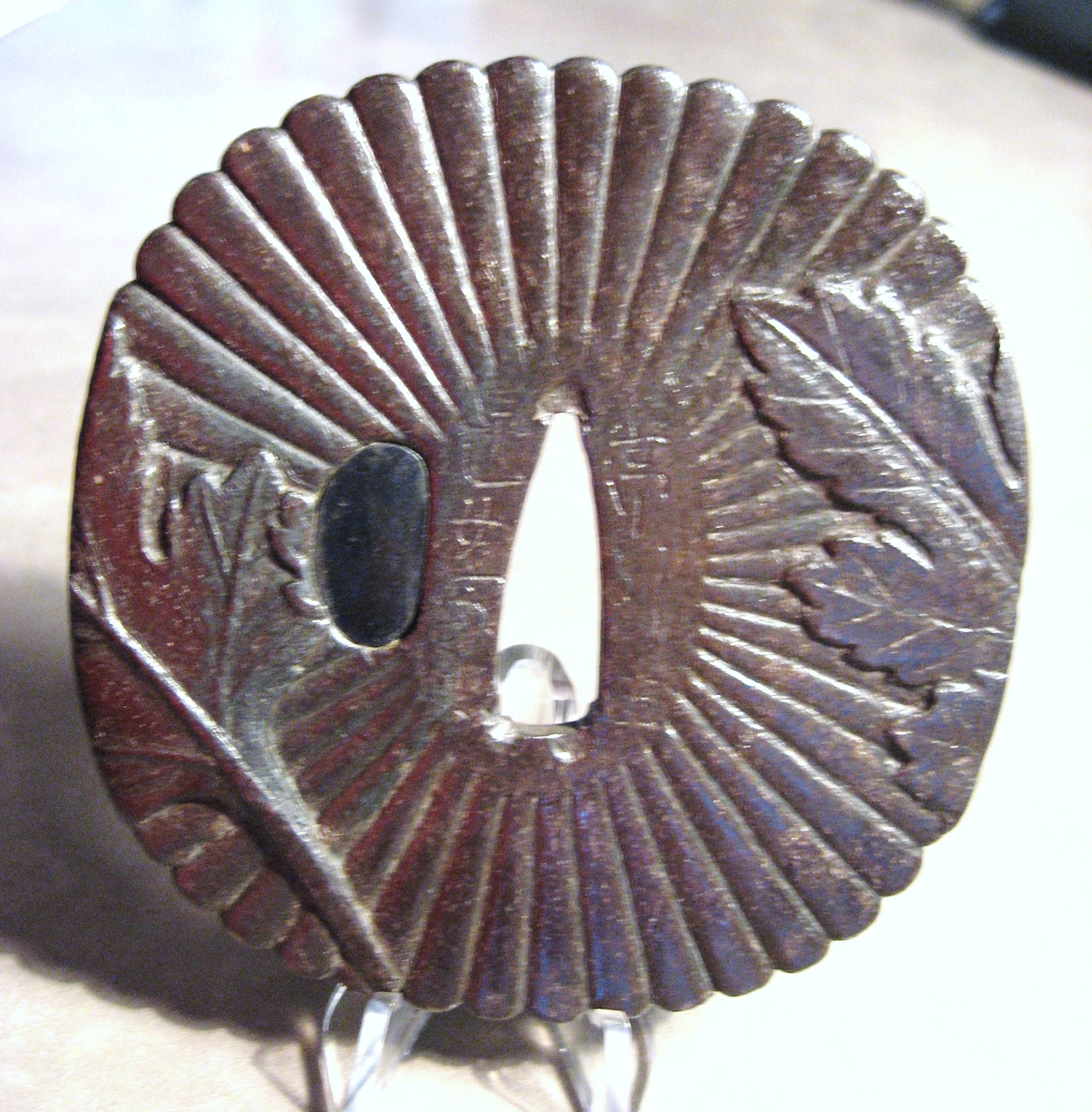 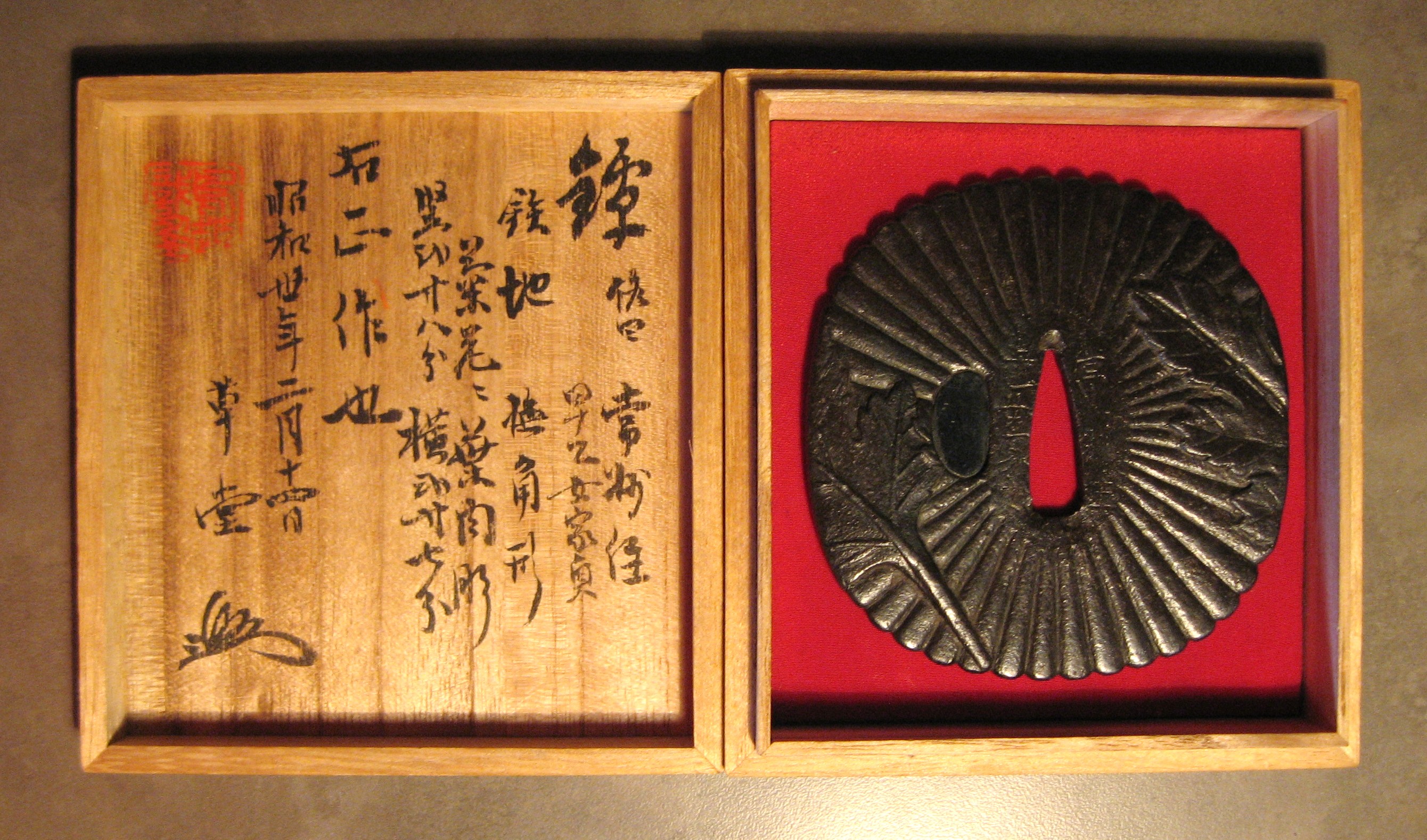 |
'JOSHU JU SAOTOME IESADA' Please Contact Us For Price |
HIGO TSUBA
The quality of this school has appealed to all tsuba connoisseurs for hundreds of years. The finest Higo tsuba are faultless in every area of their craftsmanship, aesthetic taste, and fundamental art. Their wide variety of styles and techniques embrace nearly every aspect of the art of the tsuba.
The four great Higo masters were under the patronage and protection of Lord Hosokawa Tadaoki, Daimyo of Higo Province. Hirata Hikozo, Hayashi Matashichi, Shimizu Jingo, and Nishigaki Kanshiro were four of the greatest artists in the entire history of the tsuba and of the early Edo age.
In soft metal tsuba and those of ita plate the ability of the first Hirata Hikozo stands supreme. In sukashi tsuba Hayashi Matashichi is incomparable. For shinchu zogan no one can equal the power and beauty of the first Shimizu Jingo. The beauty of the sukashi plate of Matashichi and the powerful treatment of the soft metal plate of Hikozo are combined in the work of the first Nishigaki Kanshiro.
A few generalities may be made about Higo tsuba that are applicable to all master works produced by this group. The quality of their iron plate is excellant. The temper is fine and the surface shows rich variation proving their superior ability in hammering. The color of the iron is usually dark with a fine luster and rich color of great depth. The designs of the tsuba, made by these artists, are unequaled in originality and conception in any other school. These designs greatly influenced many of the schools working in the Edo age.
The inlay work of this group has a very pleasing color contrast with the iron plate. The style of the sukashi is always menwo toru, meaning the edges of the perforation have been slightly rounded. The chiseling is powerful but not rough. The shape of the hitsu ana are tasteful but not well designed. In general, the feeling of the Higo tsuba is comfortable, round, smooth, very rich and appealing in appearance, never weak or decadent. The Higo tsuba is a perfect blend of the first aesthetic beauty with the utilitarian aspects that all true tsuba must have.
HIRATA HIKOZO TSUBA
The history of this school begins with Sasaki shi who resided in the province of Omi. His family was destroyed in the war, and his relative Matsumoto Inaba no Kami was forced to flee. He found sanctuary as the retainer of Lord Hosokawa in Tango Province. His son was Hikozo. They followed their lord to Higo Province when he was made Daimyo of that area. When Hikozo was grown he chose Hirata as his family name.
The most splendid point of the Hikozo tsuba is the control and treatment of the plate metal and the aesthetic combinations used to achieve harmony of the plate and fukurin. The combinations of plate and fukurin blend metal color, textures and values, to derive the most from their aesthetic beauty.
It must be remembered that Hikozo chose kawarigane plate for aesthetic as well as utilitarian beauty and his tsuba served both areas admirably. Even though the origins of his designs and techniques will be found in the tachikanagu-shi tsuba of the Muromachi age, he carried these techniques to a perfection never again to be equaled in the kawarigane tsuba.
 Price On Request |
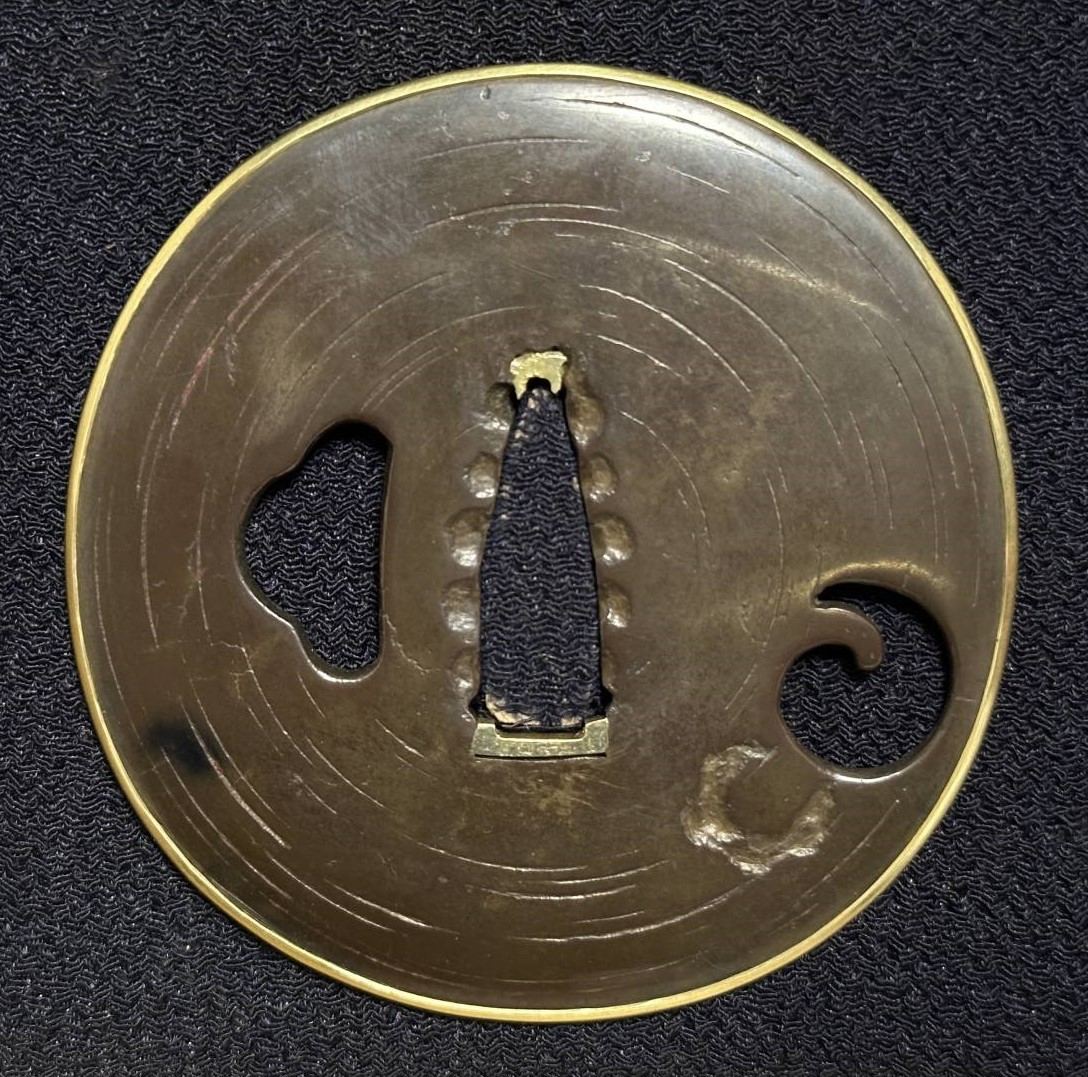 Price On Request |
 Price On Request |
 Price On Request |
 Price On Request |
 $10,000.00 |
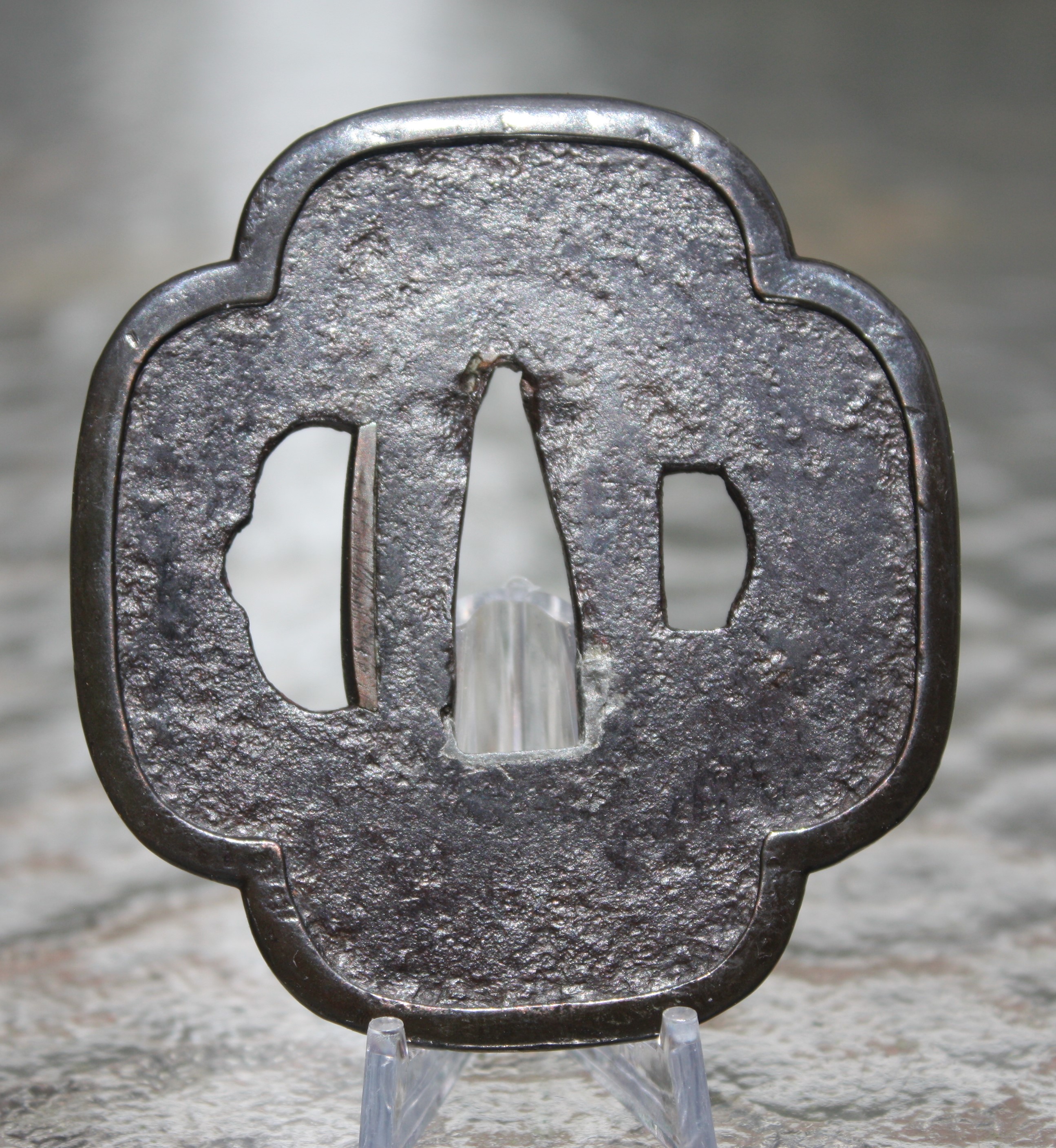 $800.00 |
 Under Study |
 Price On Request |
 Price On Request |
 Price On Request |
HAYASHI MATASHICHI TSUBA |
The Hayashi school lived in Kasuga Village, Akita County, so they are also called the Kasuga school, and together with the Hirata, Nishigaki, and Shimizu schools, they formed the four major schools of Higo metalwork. The Hayashi family lineage began with Matashichi, and was succeeded by the second Fujihira (Shigemitsu), the third Fujiyaefusa, the fourth Heizo Shigetsugu, the fifth Matahira Katsuie (Iehisa), the sixth Matahachi, and the seventh Fujihira, and flourished until the end of the Edo period. The first Hayashi family Matashichi, commonly known as Seizaburo, was born in 1605 (Keicho 10) as the second son of the gunsmith Seibei. There is also a theory that he was born in 1613 (Keicho 13). He was employed by Hosokawa Tadatoshi, the lord of the Higo Kumamoto domain, and turned to tsuba craftsmanship, perfecting the Higo tsuba. The Hayashi family was the mainstream, and Matashichi in particular is said to be the father of Higo metalwork. Matashichi's style is specialized in the production of iron tsuba, and is characterized by outstanding iron forging, excellent iron rust, skillful gold inlay, and elaborate openwork. His works include the Important Cultural Property "Hasen Sakura Inlaid Tsuba" and "Sakura Kuyomon Openwork Inlaid Tsuba", as well as the Tomi Matsu Openwork, Nagegiri Openwork, and Gomon Openwork. |
  |
MATASHICHI (SEIZABURO) Price On Request "Matashichi was born in the same year as Nishigaki Kanshiro, one of the four principal masters of Higo kinko. Although Matashichi's period of activity, from the late Kanei years (1635), when the spirit of the Momoyama period still lingered, overlaps closely with Kanshiro's. However, their artistic styles differ markedly." (Haynes) |
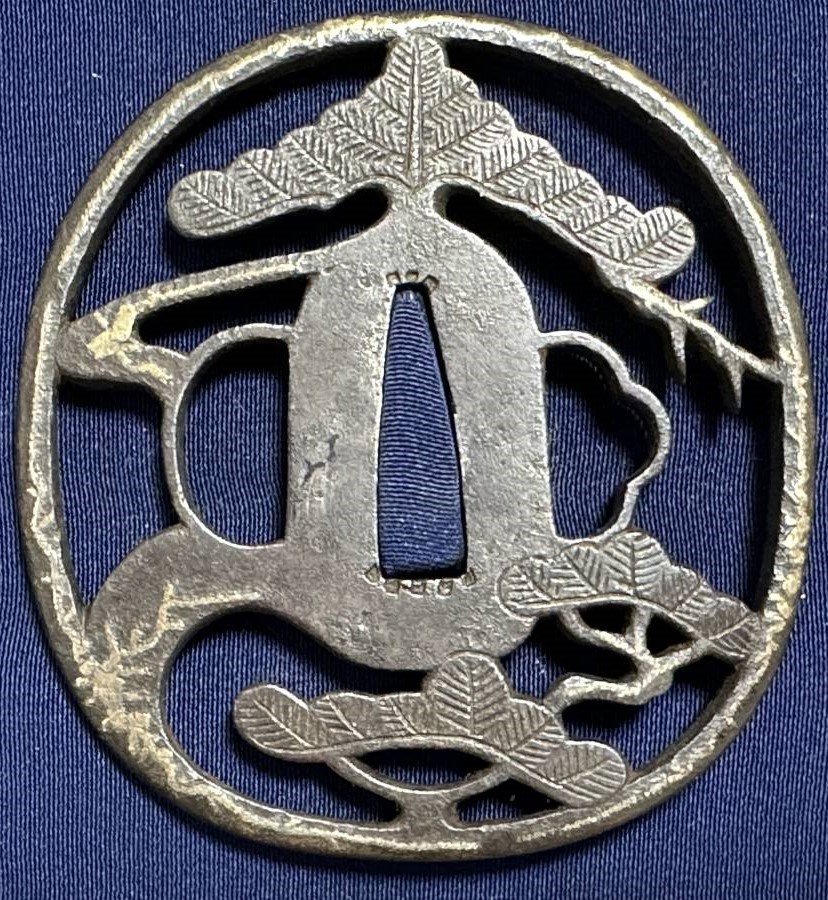 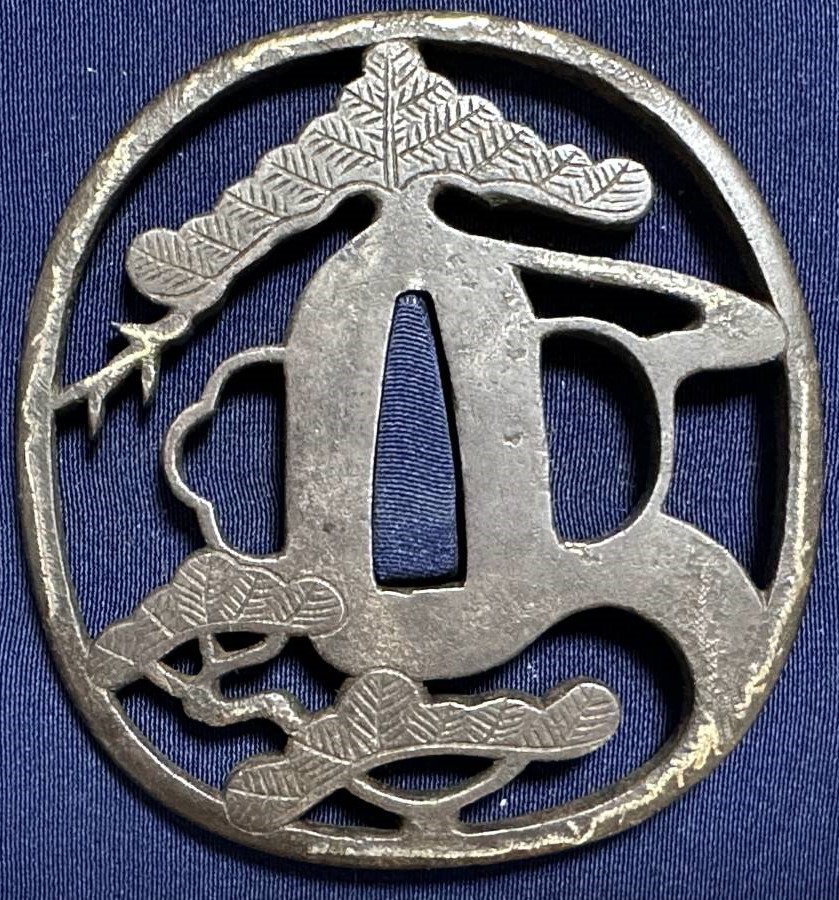 |
Hayashi Matashichi Price On Request "Matashichi Hayashi (first generation of the Hayashi family), made by
Kusado Shiki, iron base, oblong shape, three-covered pine, inlaid with silver dead wood. One of the famous families of Higo, a work by Matahira Hayashi, fifth generation of the Hayashi family, with a popular composition of three-covered pine (three-story tree) This piece has many interesting features, such as the silver inlay of dead wood (Japanese pine) on the rim, detailed carvings of leaves, and the dynamic curve of the trunk in the upper right corner of the piece." (Haynes) |
  |
HIGO Nesting Crane |
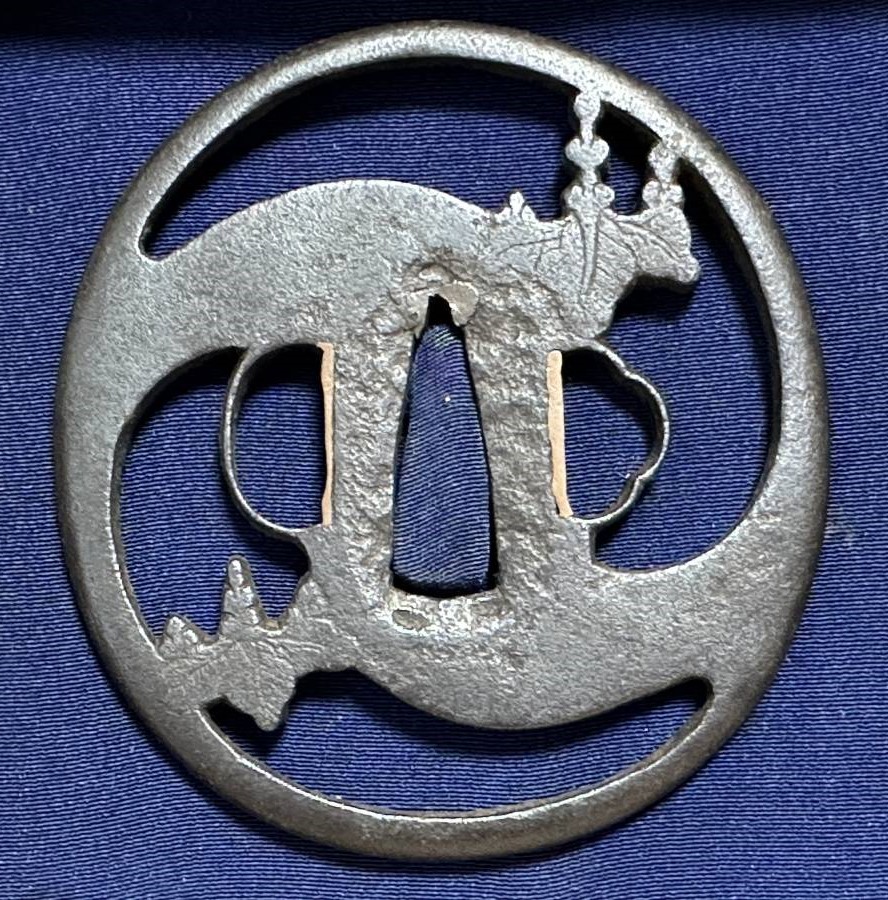 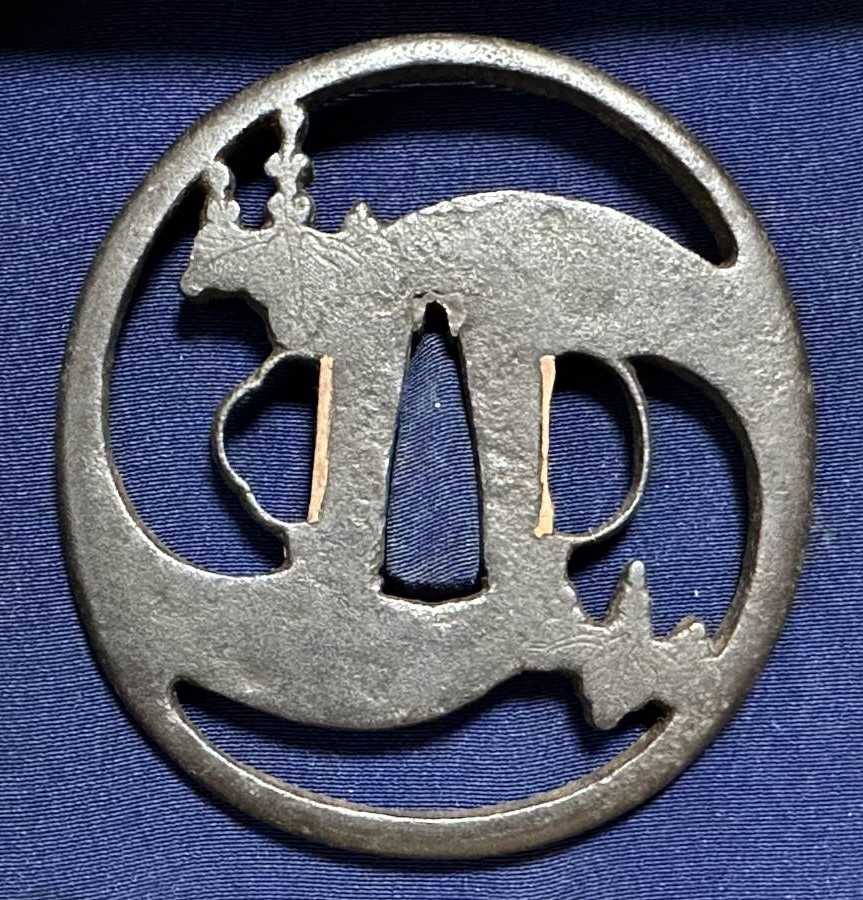 |
Hayashi Tohei Price On Request "Tohei Hayashi (Shigemitsu), iron base, round shape, Tomoe paulownia,
ground transparent. A beautiful piece with paulownia leaves arranged symmetrically." (Haynes) |
  |
HIGO HAYASHI Price On Request "The well-forged jigane shows forging lines at the edge of the tsumi. It features a cross-shaped openwork pattern reminiscent of a Satsuma tsuba, with shadow-like openwork featuring the nine-star and cherry blossom crests, and inlay near the edge of the tsumi. There are some areas of missing inlay and slight rust, but overall there are no noticeable scratches.Dates to ca. 1700-1750." (Haynes) |
  |
WARABI-TE GAN-TSUNAGI "This tsuba (sword guard) is a neat, round shape with proper openwork, and at a glance, it is clearly a superior work of the Hayashi family. The meticulous and understated, deep color of the iron, and the vertical, unburdened edges of the openwork, are reminiscent of Matashichi. However, the uneven shape of the bracken-shaped ornaments, the slight movement in the flat areas, and the visible iron frame at the rim suggest that the maker was Shigemitsu, who succeeded Matashichi. It is large, well-crafted, and first-class in its composition and iron color, making it possibly one of Shigemitsu's outstanding works." (Haynes) |
SHIMIZU TSUBA |
The first generation of this family was Nibei, he was the nephew of the first Hirata Hikozo. The second Shimizu was called Jingoro. It is from a shortening of this name to Jingo that the name Jingo school is derived. Even though the first Shimizu was a student of the first Hikozo we do not find the Hikozo style in the Shimizu tsuba. A number of samurai of Lord Hosokawa tried their hand at making tsuba. One of note is Chisokutei Jingo of Oshima. He lived in the late Edo age. He had no particular style but followed that of his contemporary workers. |
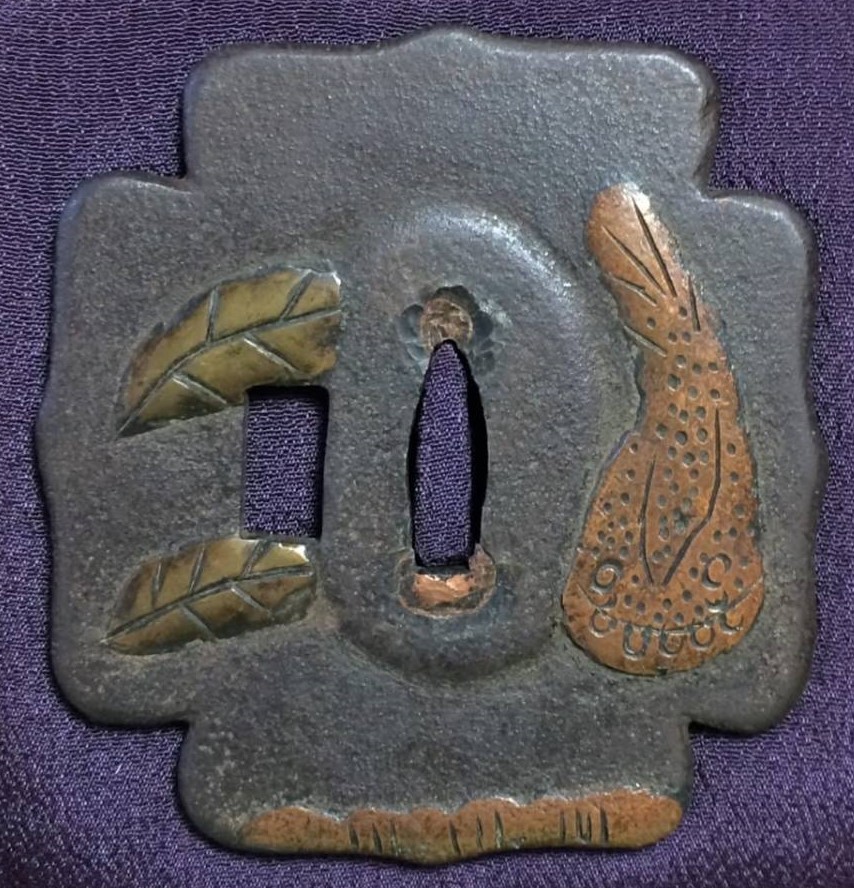 |
JINGO 1st Generation Tsuba Price On Request "A large iron plate tsuba in aoi-jujigata mokko shape, displaying a strong and distinctive individuality. The single hitsu-ana is rectangular in shape. Extending outward from the hitsu-ana are leaves, inlayed of brass suemon. On the opposite side is a 'Thunderfish' inlayed of copper suemon. All known works are unsigned. Under study at this time." (Long & Haynes) 8.50cm x 7.80cm x 0.30cm |
  |
SHIMIZU Price On Request "Higo Jingo-made tsuba (sword guard) with signature "Bamboo Leaf and Dewdrop Design,"
Iron, Hammered Finish, Rounded Angular Shape, Thin Relief Carving, Silver Inlay, Dewdrop Inlay. The iron has a well-forged, lustrous surface and a good feel. There is some peeling in the silver inlay, but overall there are no noticeable scratches or stains." (Long & Haynes) Approx. 77mm (height) x 72.4mm (width), Approx. 3-4mm (edge thickness), Approx. 3.5mm (seppa-dai thickness) |
  |
'YATSUSHIRO JINGO SAKU' Price On Request "A masterpiece by the third generation Jingo. A round-rimmed tsuba (sword guard) with rounded corners, made of iron with a Takasago design, carved in relief, inlaid with a raised pattern, and colored enamel, with a box inscription by Mr. Torikoshi Kyodo. He was a Higo school sword fittings metalworker who was active in Yatsushiro, Higo Province (present-day Yatsushiro City, Kumamoto Prefecture) in the early Edo period. The Higo school was a school of sword fittings metalwork that flourished under the patronage of the Higo Hosokawa family, and the four schools that represent the Higo school are Hayashi Matashichi, Hirata Hikozo, Nishigaki Kanshiro, and Shimizu Jinbei, each with their own first generation, with Shimizu Jinbei being the first generation to be active. Higo metalworkers handled all kinds of metalwork for sword fittings, such as tsuba, fuchi kashira, and menuki, and the first generation Shimizu Jingo is considered unique even among Higo metalworkers, and his works are characterized by their luxurious brass inlay." (Long & Haynes) Approx. 7.60cm x 7.28cm x 0.40cm |
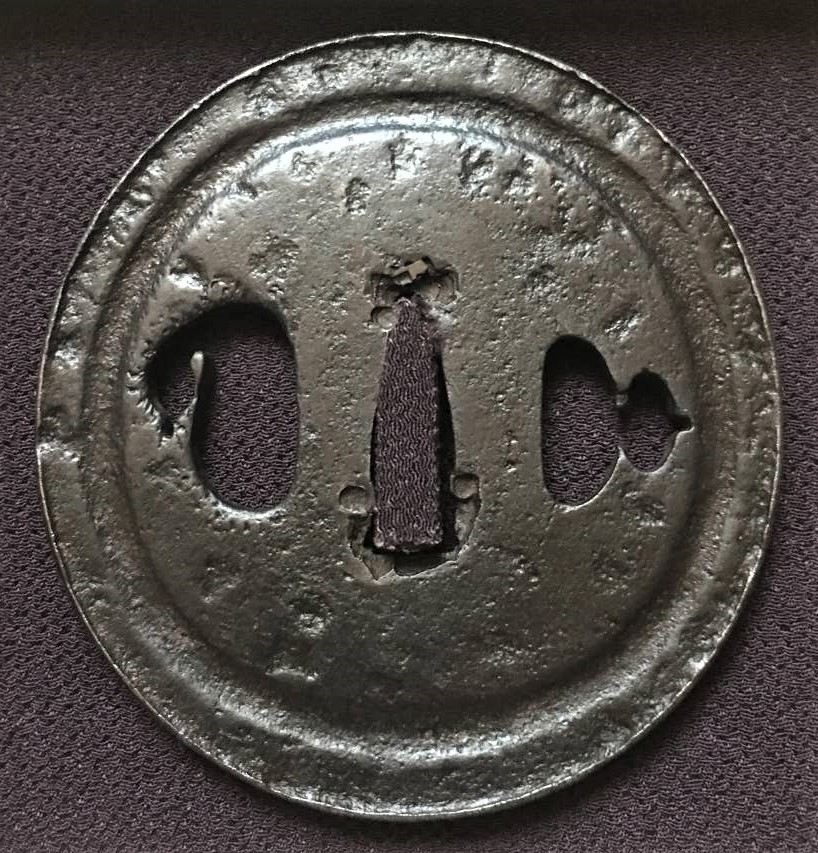  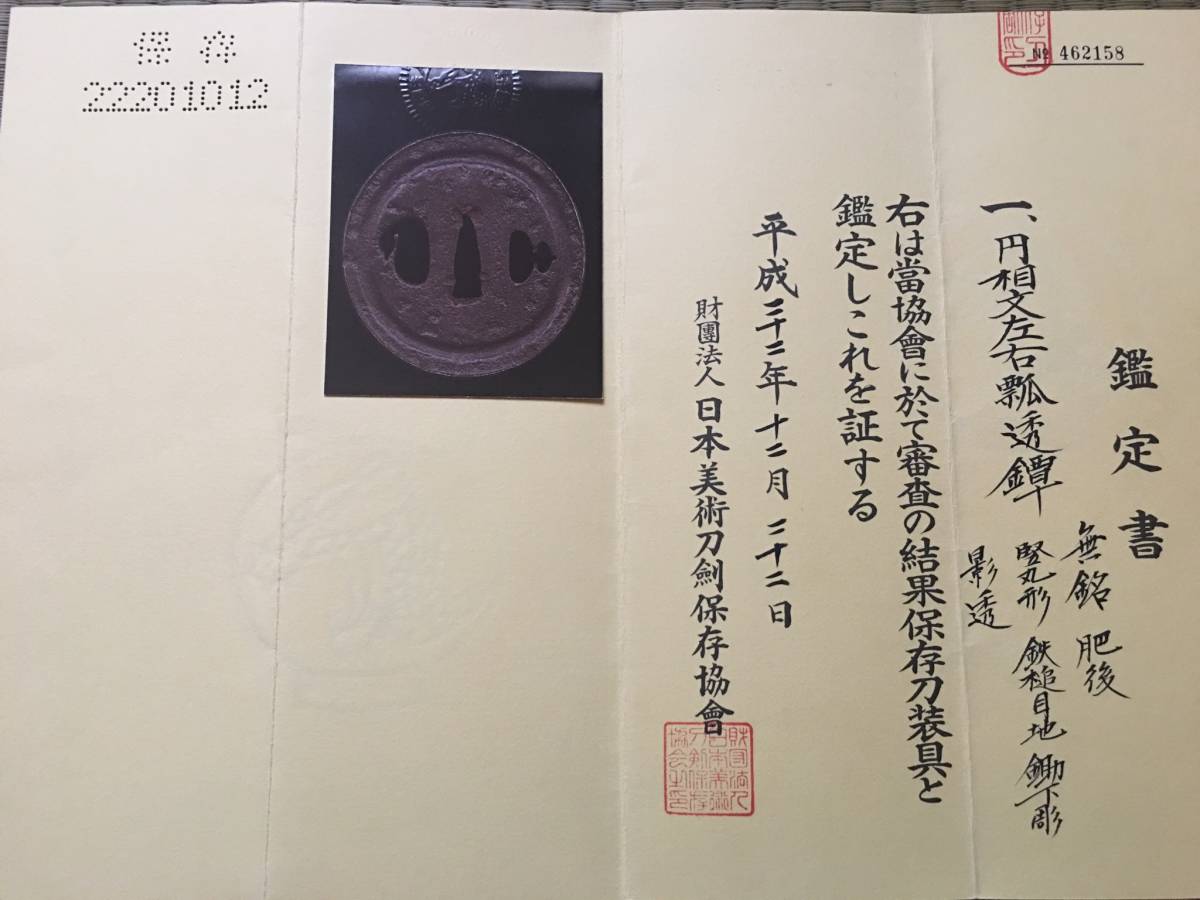 |
JINGO 2nd Generation Shimizu Jingo family. $4500.00 "A very noble iron plate tsuba belonging to the JINGO family. The iron is radiant, appearing wet in hand. The hitsu-ana are designs of gourds, being different shape and size. Because of the highly refined simplicity of the design and high quality of the iron surface, this is a 'classic' Jingo tsuba. Seems to date to the early Edo period." (Long) 7.55cm x 7.12cm x 0.45cm |
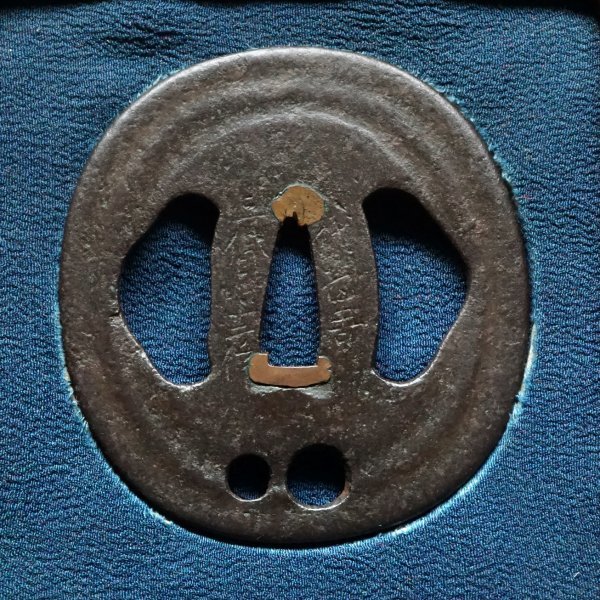 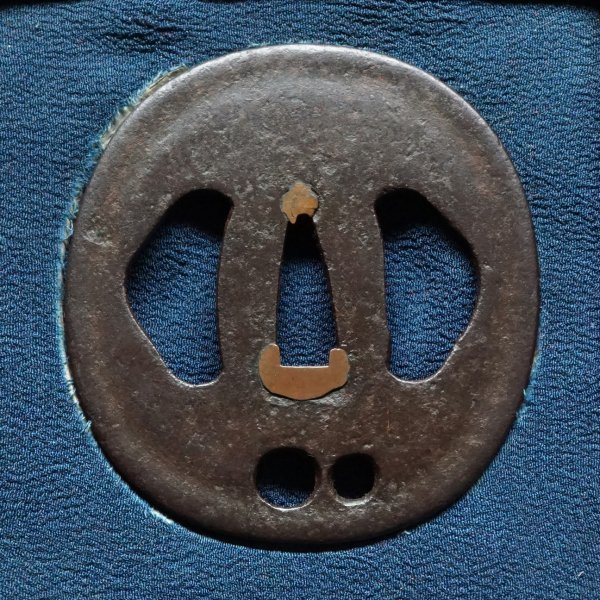 |
'SAN DAI MEI' 'AGE 72' (Yatsushiro) $5000.00 "Presented here is a fine example of the work of the 3rd YATSUSHIRO of the Shimizu Jingo family. His work shows the style and quality of his period and not that of the first or second Jingo. He was a retainer of the Hosokawa Daimyo from the age of 15, and it is said, became head of the family in 1710, at the age of 20." (Haynes) |
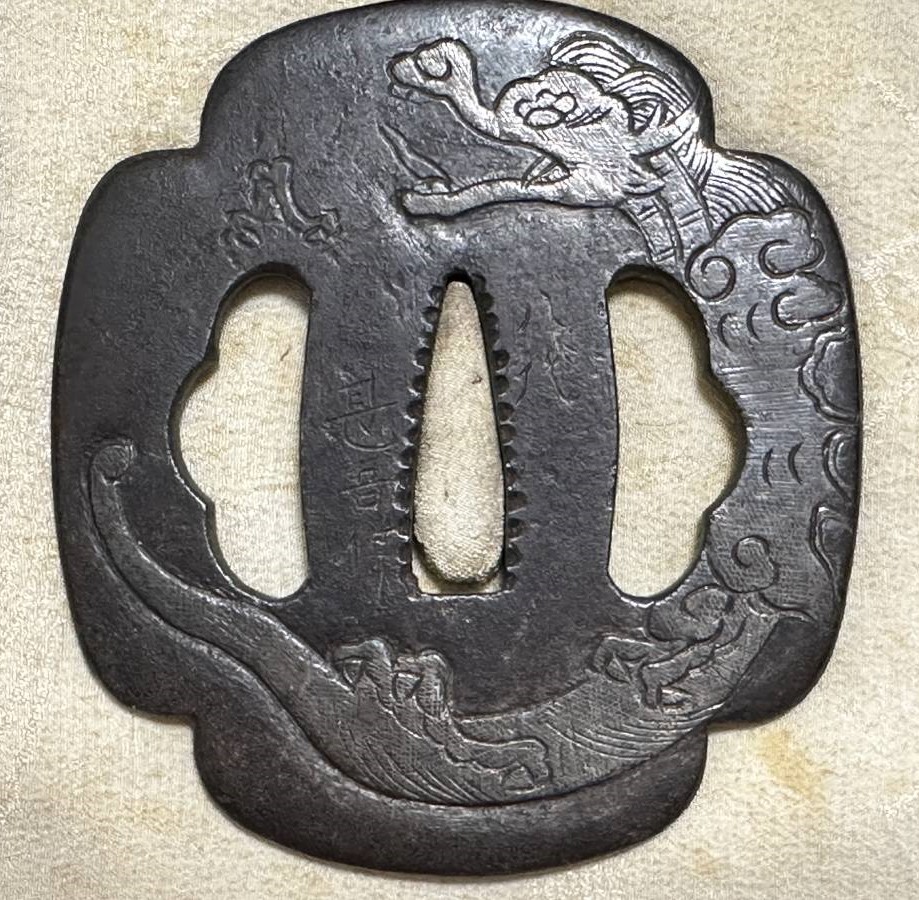 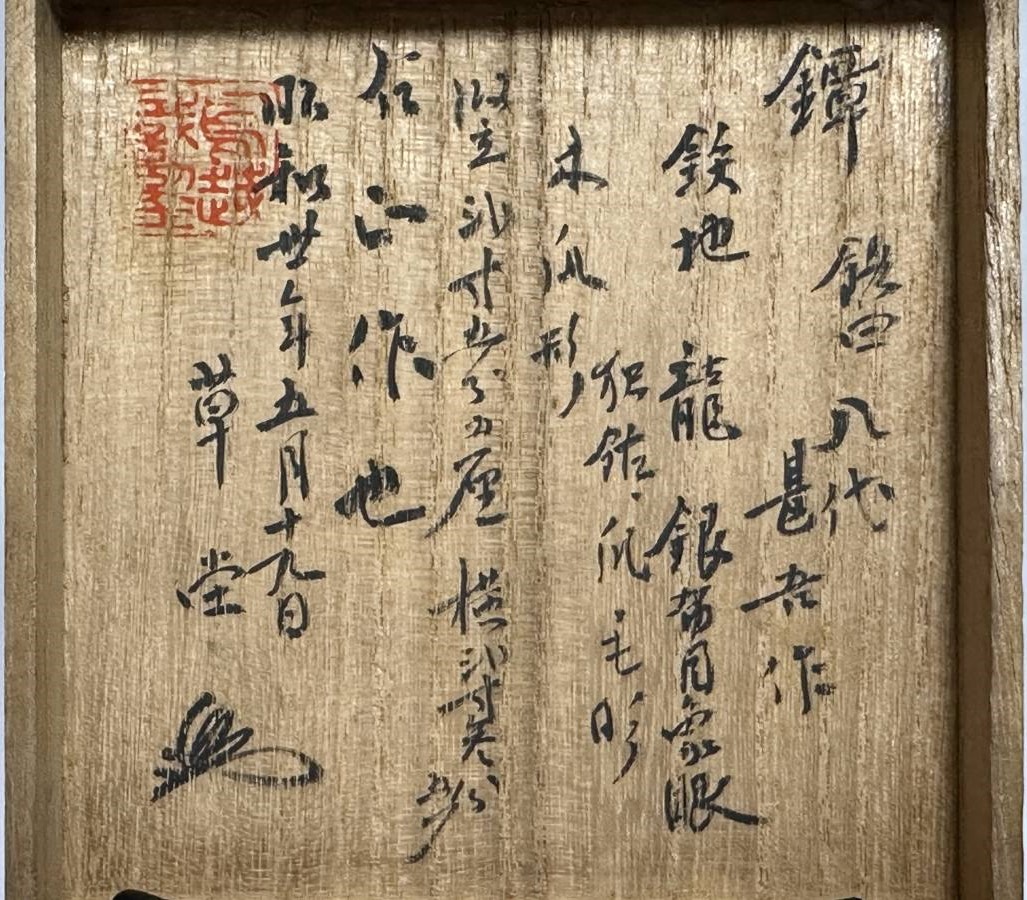 |
'YATSUSHIRO JINGO SAKU' $1500.00 "Presented here is a fine example of the work of the 5th generation of the Shimizu Jingo family. The inlay of the dragon is complete and very well done. On the reverse is a Buddhist Vagra. Dr. Torigoye Hakogake dated 1956, designates this tsuba as 2nd Class." (Haynes) |
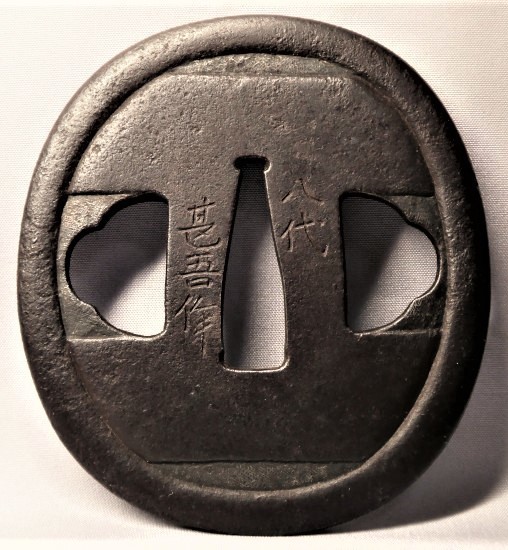 |
'YATSUSHIRO JINGO SAKU' $1200.00 "Worked in Yatsushiro in Higo Province. This is work of the 5th generation of the Shimizu Jinjo family." (Long & Haynes) 6.50cm x 7.20cm x 0.40cm. |
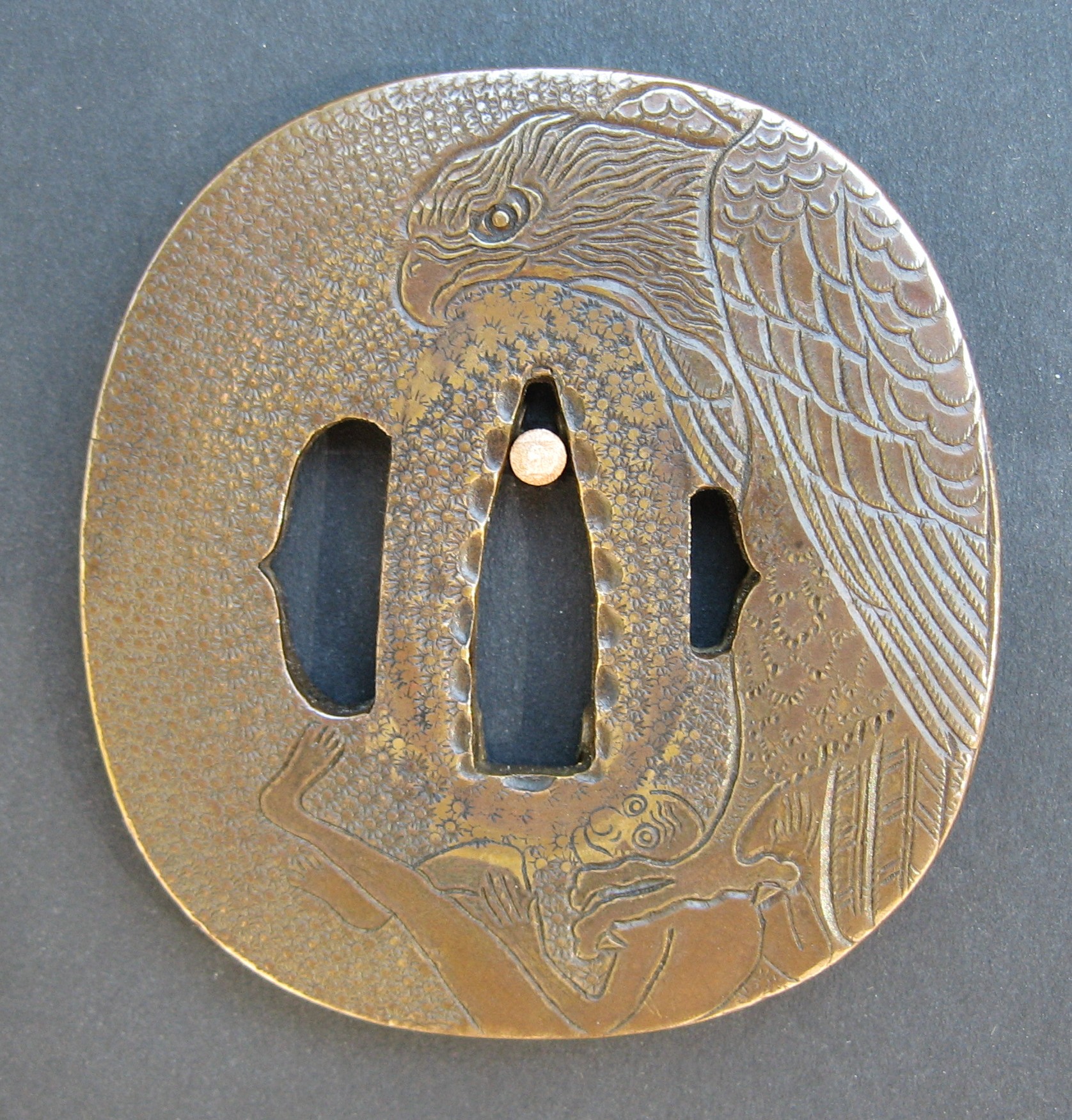 |
CHISOKUTEI JINGO $1500.00 "An oval form tsuba, bearing a ground of stamped kokuin of flowerheads and engraved with a hawk and captured monkey. This design is of the JINGO family of the Shimizu school. It dates ca. 1700. This appears to be the work of CHISOKUTEI H 00315.0. He is of the Shimizu family and worked in Yatsushiro in Higo Province. He worked in the style of classic early Shimizu Jingo school. His relationship to the other members of the school is not known for sure. His work is equal to his contemporaries." (Haynes) See Wakayama Takeshi; Toso Kinko Jiten, pg. 500 & Toso Kodogu Meiji Taikei, vol. III pg. 313. 6.5cm x 6.95cm x 0.5cm |
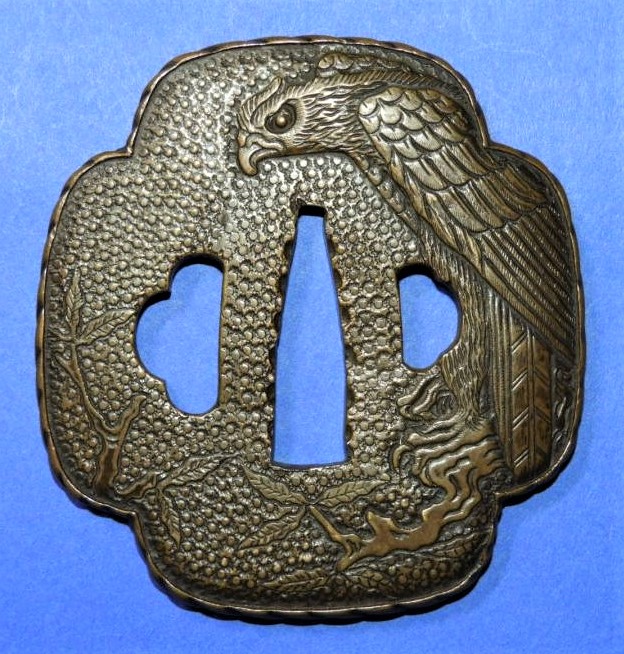 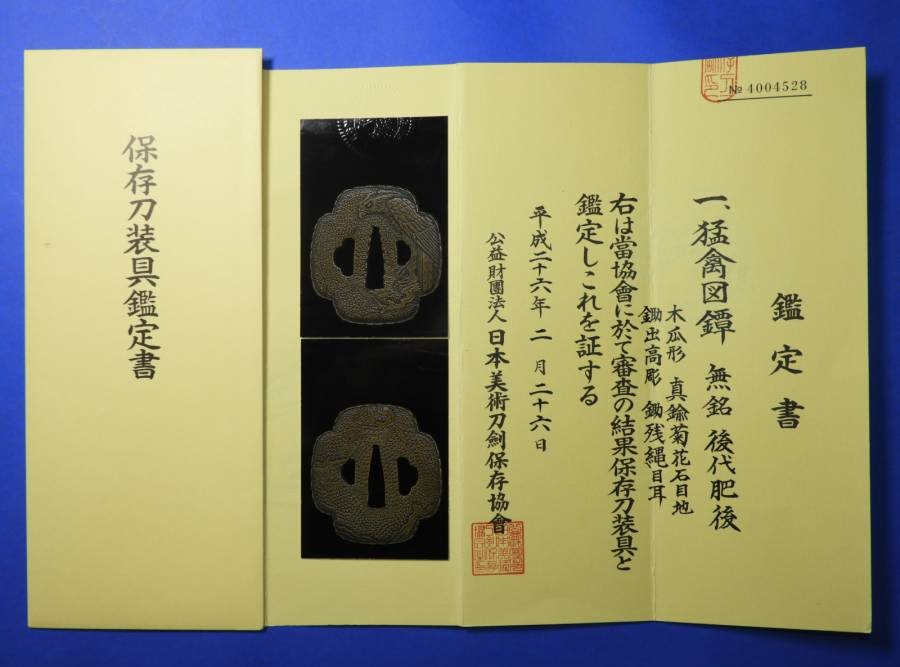 |
CHISOKUTEI JINGO Please Contact Us For Price "Write-up to follow" (Long & Haynes) |
  |
JINGO III Please Contact Us For Price "It is a design of a scenic butterfly that is often seen in Jingo Sandai." (Haynes) |
KAMIYOSHI TSUBA |
The Kamiyoshi family served the Hosokawa clan from its Kokura period. The first Kamiyoshi was Juhei, also called Masatada. He was a student of Tohachi, the third Hayashi. There are a few facts that separate his work from that of his teacher. His plate has a fluid feeling, more refined than any of the early Hayashi. Also the color of his plate is browner in color than the early masters. In design, treatment, and carving he followed his teacher closely. In many cases the tsuba of the first Kamiyoshi Juhei will be misjudged as the work of Tohachi. |
  |
Fukanobu Kamiyoshi Price On Request "Presented here is a very elegant iron tsuba of the Higo school. Tsuba of this style by the Higo school have always been sought after by knowledgeable collectors. Their simple yet artistic patterns were produced by some of the most famous tsubaco of this era. This tsuba is no exception." (Long) |
  |
Fukanobu Kamiyoshi Price On Request "Iron base chrysanthemum flower shape with rounded rim. It is a beautiful design reminiscent of the flower haze when the cherry blossoms are dancing. Very elaborate and ornate work. This seems to be a work of a student around the 4th to 5th generation. It is of good composition and a serious work of great skill and sense. Large tsuba of this size are rare and of this design." (Long) |
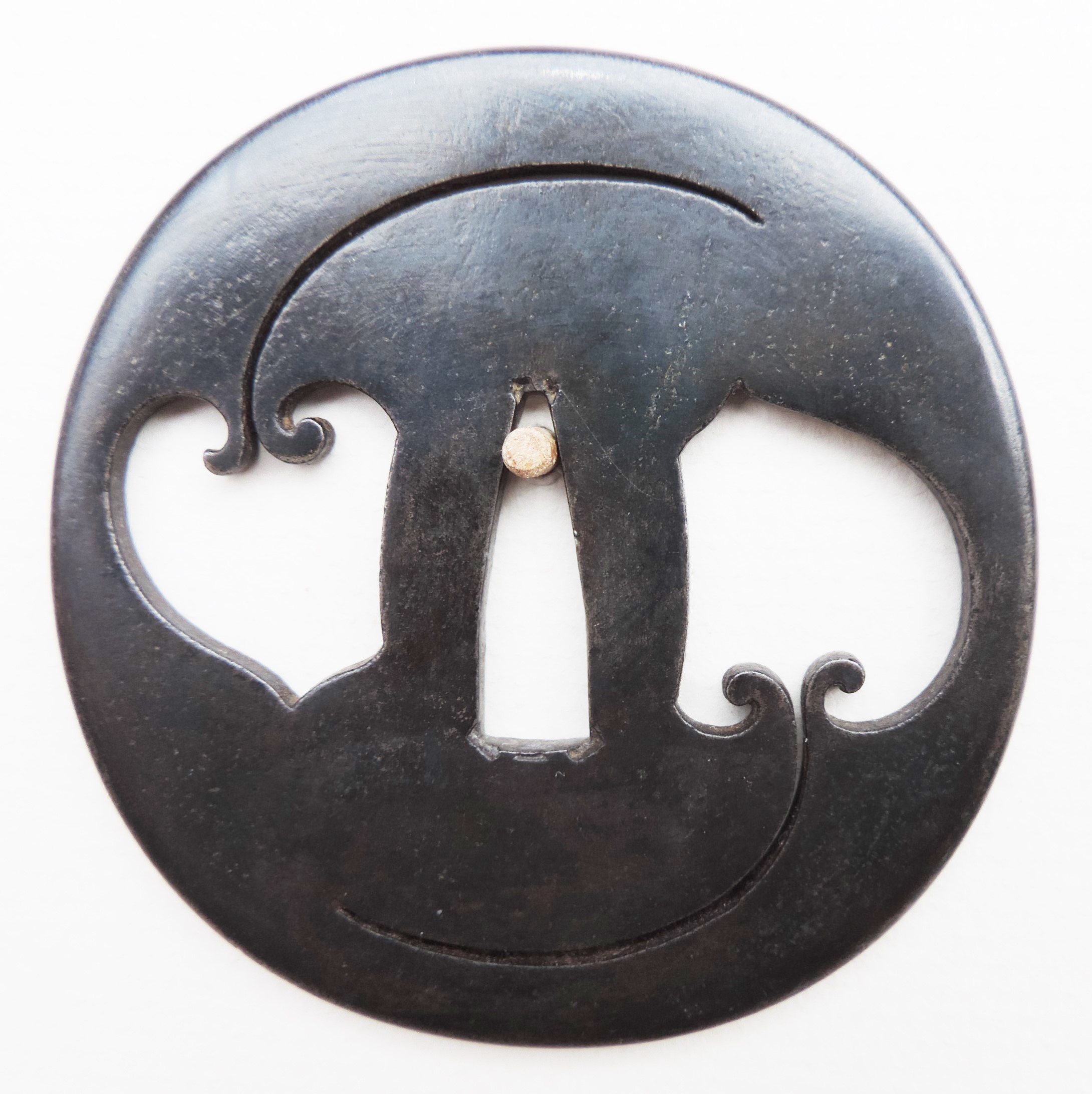 |
RAKUJU Not For Sale "Circular iron plate with two negative-silhouette sukashi design of two sweeping aoi (hollyhock) leaf's. The open work is elegant and exquisite. Both facets appear polished. Though unsigned, has the noted punch marks of two at the top and three at the bottom of the nakago-ana, belonging to RAKUJU. Certified by the NTHK (05/09/1993) as the work of Kamiyoshi Rakuju. Jinsaemon Rakuju (1817-1884), eldest son of Fukanobu, was the third master of the Kamiyoshi family school of Kumamoto city in Higo Province. The school worked in the classic Higo style of fine sukashi with modeling and engraving." (Long) 8.10cm x 8.20cm x 0.30cm |
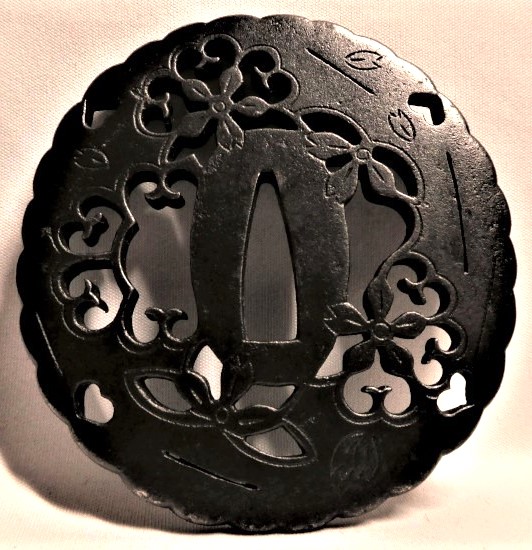 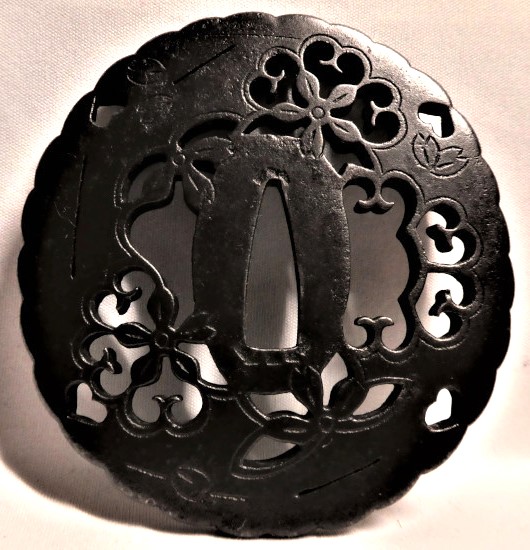 |
Masatoshi Kamiyoshi Price On Request "Presented here is another elegant iron tsuba in chrysanthemum flower shape with rounded rim. Again the signature using small punch marks at the top and bottom of the nakago-ana." (Long) |
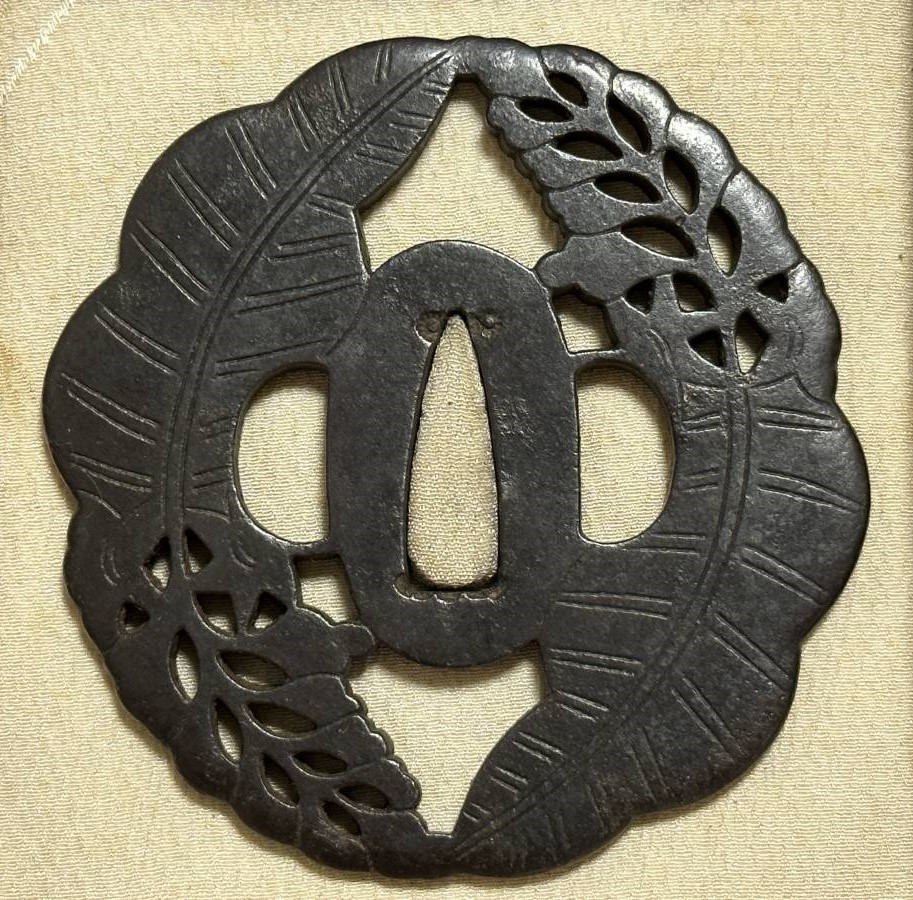 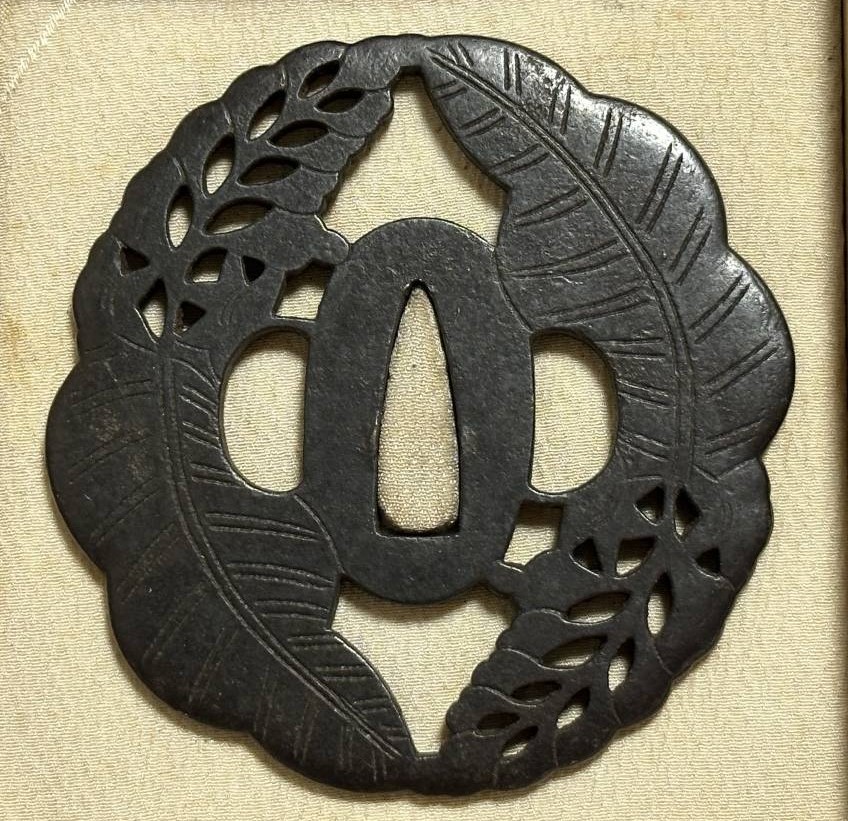 |
MASATOSHI $2000.00 "Presented here is a perfect example of the work created by MASATOSHI, the younger brother of KAMIYOSHI RAKUJU. It is a beautiful iron masterpiece with very finely carved fronds creating the shape of the tsuba. He worked mostly in the style of RAKUJU but never signed his work." (Haynes) |
  |
KAMIYOSHI HIGO Price On Request "The hawk-feather crest was favored by samurai families as a symbol of martial valor, as the hawk’s fierceness in hunting and keen intelligence were associated with the qualities of an ideal warrior. This tsuba features an openwork design of five interconnected hawk feathers. The rim is further embellished with the Kuyo-mon (Nine Stars crest) and cherry blossoms rendered in in-yo with gold nunome-zogan, adding a decorative elegance to the piece. Judging from the workmanship and the sekigane fitted to the hitsu-ana, this tsuba is considered to be a work of the Higo school. The chiseling around the nakago-ana strongly supports an attribution to the Kamiyoshi family, based on characteristic tool marks unique to the work of small punch marks of 4 at the top and 8 at the bottom of the nakago-ana. Who this family member is is under study." (Haynes) |
NISHIGAKI KANSHIRO TSUBA |
The first Nishigaki, whose imina (a posthumous or canonical name) was Yoshihiro, is known as Kanshiro, as are all the later generations of this family. He is said to have been a shrine priest in the province of Tamba. Later he became a retainer of the Hosokawa in Higo. He became a student of Hirata Hikozo, learning the methods of kawarigane tsuba. He lived at Yatsushiro. In general it may be said that the style of this school is a combination of the two great schools of Hayashi and Hirata. To this was added a feeling of Kyo-sukashi and Kyo-Shoami. |
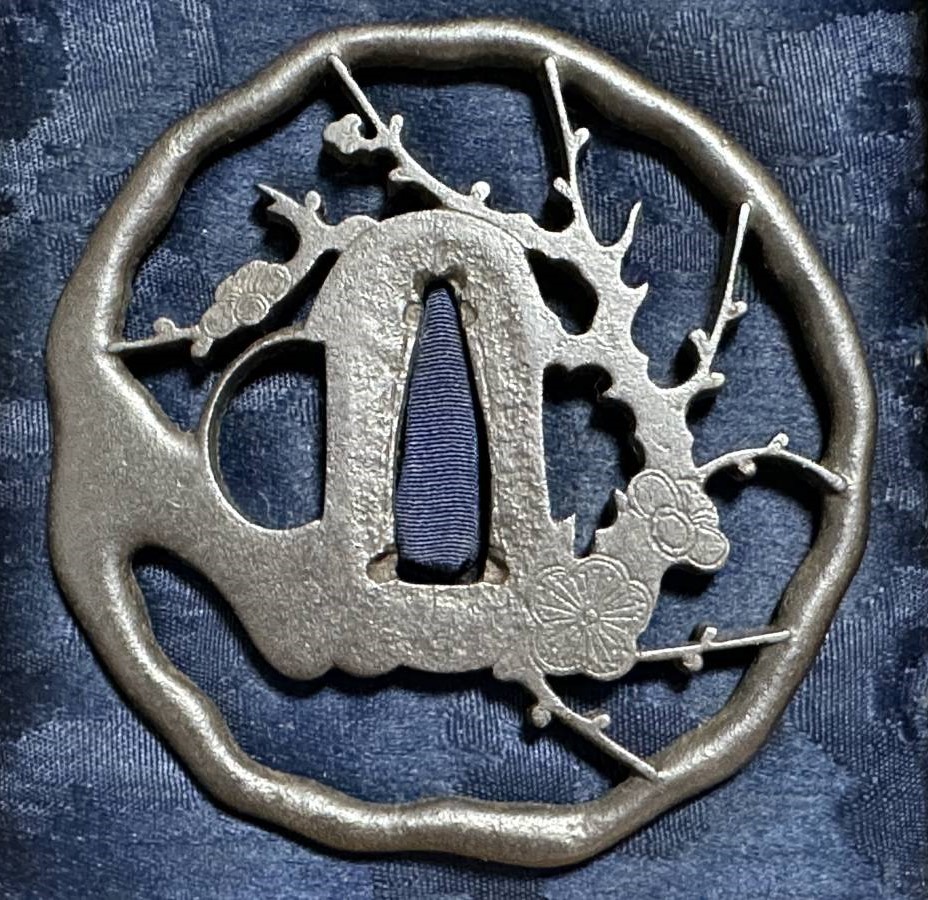 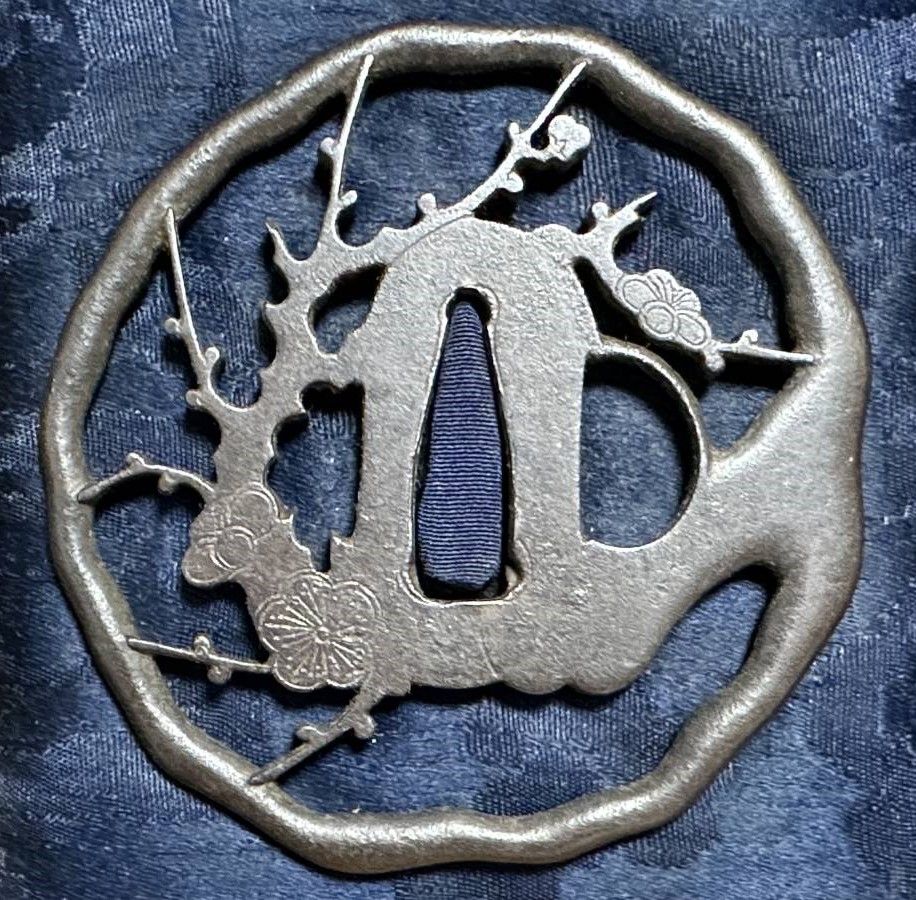 |
Nishigaki Kanshiro $3000.00 "A classic design by 2nd. generation Nishigaki Kanshiro. See Haynes Index H 02673.0.
Accompanied with a Dr. Torigoye Hakogaki dated 1957." (Long) |
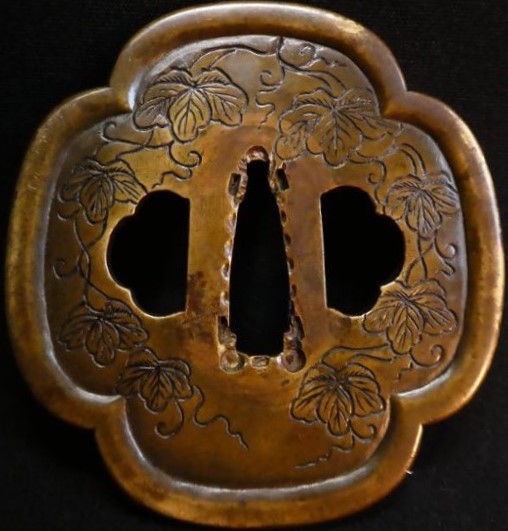 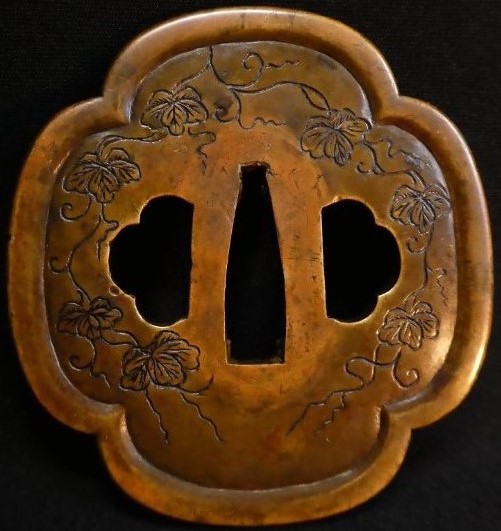 |
Nishigaki Kanshiro Price On Request "The first Kanshiro is said to have been a shrine priest in the province of Tamba. Later he became a retainer of the Hosokawa in Higo. He became a student of Hirata Hikozo, learning the methods of kawarigane tsuba. He lived at Yatsushiro and received a stipend from the Hosokawa. Presented here is a mokko shape copper work with kebori carving of kiri plant on both faces. Note the small chiseled indentations used by the Nishigaki school and more in number than those used by Hikozo. It should also be noted that the first Kanshiro did not sign his work." (Long) |
  |
Nishigaki Kanshiro II Price On Request "Presented here is a excellent sukashi tsuba displaying the highest quality iron. The surface area has been finely burnished and the edges pleasingly rounded and sloped. All in all a deep purpleish black patina that is luscious. This is named "tomi-matsu sukashi" (distant-view pine openwork), where the outlines of the pine appear soft and indistinct. The motif is a two storied pine tree by the 2nd generation (nidai) Nishigaki master, Kanshiro. The auspicious motif is executed in positive silhouette or yo-sukashi (??). The branches and veining of the leaves are delicately carved in kebori, and as typical of nidai works, some of the carving encrouches into the seppadai, and the hitsuana are asymmetric. In concert with the sukashi motif, the outer rim evokes the old gnarled character of a mature, large branch of the pine tree. The entire piece symbolizes longevity, righteousness, and spiritual order, quietly embodying the ideals and self-discipline valued by the samurai class." (Long) |
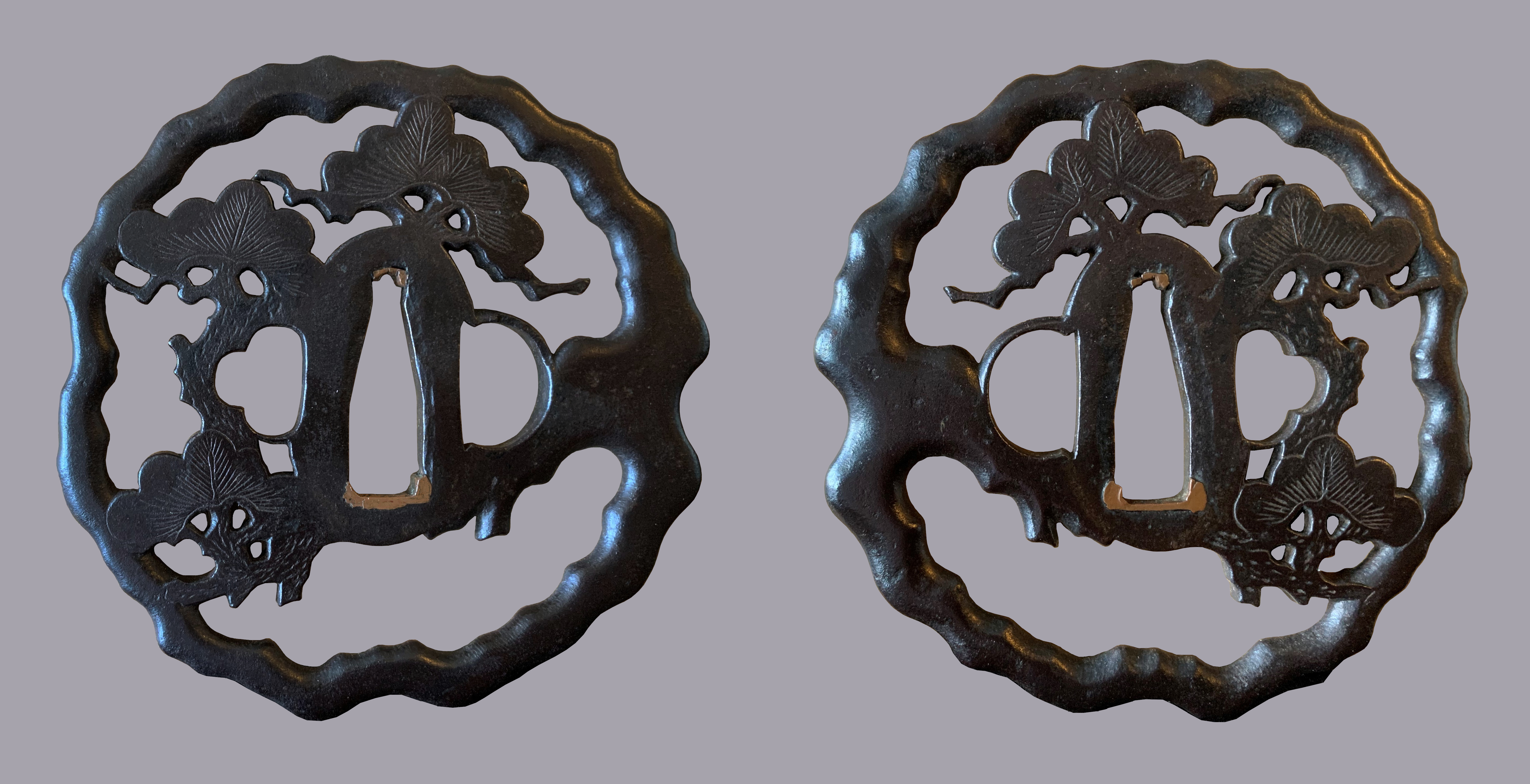 |
Nishigaki Kanshiro II Price On Request "Presented here is a excellent sukashi tsuba displaying the highest quality iron with clear, fine horizontal laminations on the plate and on the reverse side in the uppermost pine. The surface area has been finely burnished and the edges pleasingly rounded and sloped. All in all a deep purpleish black patina that is luscious. This is the same high quality iron that was also used on contemporaneous armors. The motif is a three storied pine tree by the 2nd generation (nidai) Nishigaki master, Kanshiro. The motif is executed in positive silhouette or yo-sukashi. The branches and veining of the leaves are delicately carved in kebori, and as typical of nidai works, some of the carving encrouches into the seppadai, and the hitsuana are asymmetric. In concert with the sukashi motif, the outer rim evokes the old gnarled character of a mature, large branch of the pine tree." (Long) |
  |
HIGO HACHINOKI Price On Request "The theme of this tsuba is Hachinoki; Pine Tree, Plum Tree, Cherry Blossom. These three trees in combination refer to a Noh Play. Though unsigned, this tsuba has been attributed to the Higo Tradition. The craftsmanship shows a likeness to the Nishigaki school. NBTHK Certification dated October 10, 2023. Hozon Tosogu." (Long) |
  |
HIGO SUMIYOSHI Price On Request "Sumiyoshi Taisha Shrine is located in the southern part of Osaka City, facing west in the direction of Osaka Bay at the western end of the base of Uemachi Plateau. It enshrines the three gods of the sea, Tsutsuo Sanjin, and Empress Jingu, and has been associated with Sumiyoshitsu and Naniwatsu, important ports for diplomacy since the Kofun period. In ancient times, it was worshiped by the Imperial Court and aristocrats as a god of waka poems as a national voyage guardian deity enshrined on ships envoys to the Tang Dynasty, and as a deity of purification from the Heian period. Presented here is a very elegant iron tsuba of the Higo school. Tsuba of this style by the Higo school have always been sought after by knowledgeable collectors. Their simple yet artistic patterns were produced by some of the most famous tsubaco of this era. This tsuba is no exception." (Long) 7.10cm x 6.80cm x 0.50cm |
  |
Higo Nishigaki II Price On Request "The second Kanshiro has individual characteristics that will easily separate his work from that of the first. He was not an imitator of the first, only rarely working in his style. His designs and conceptions show original ideas of merit and ability. His iron plate is delicate and quite pretty, but stronger than that of the first." (Long) |
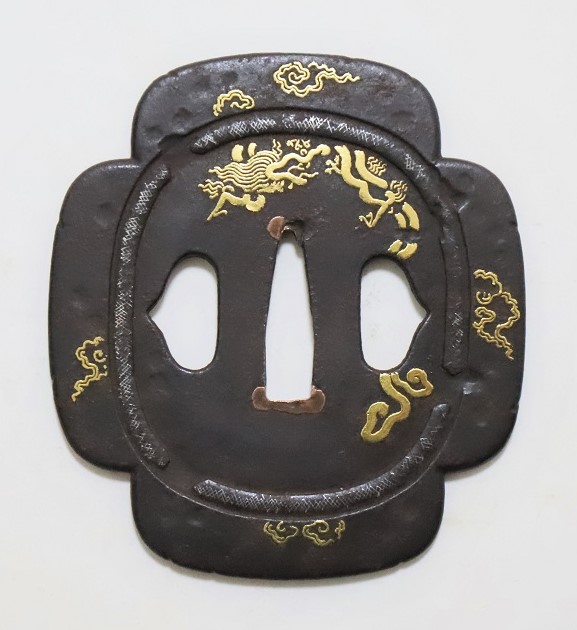 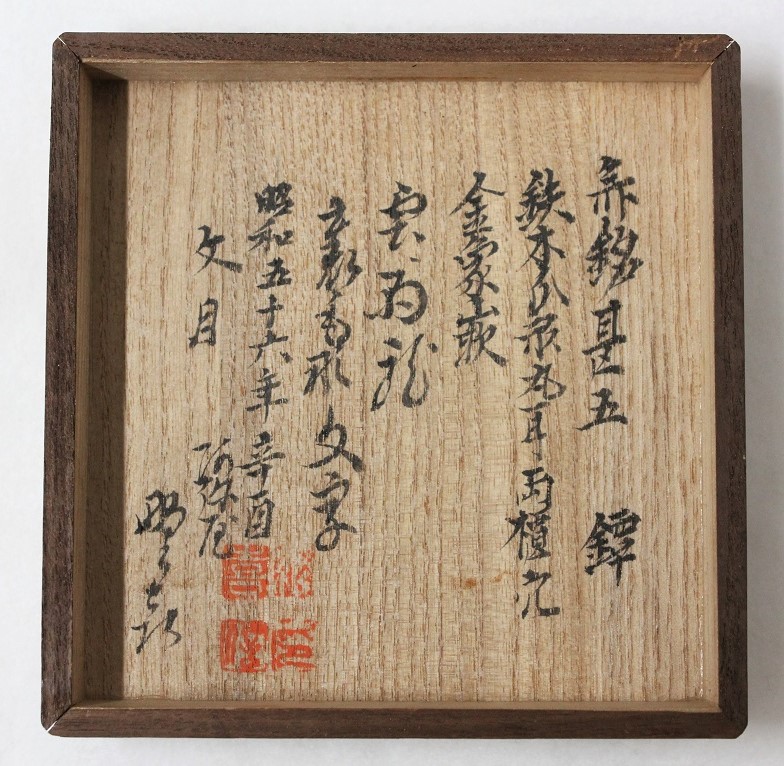 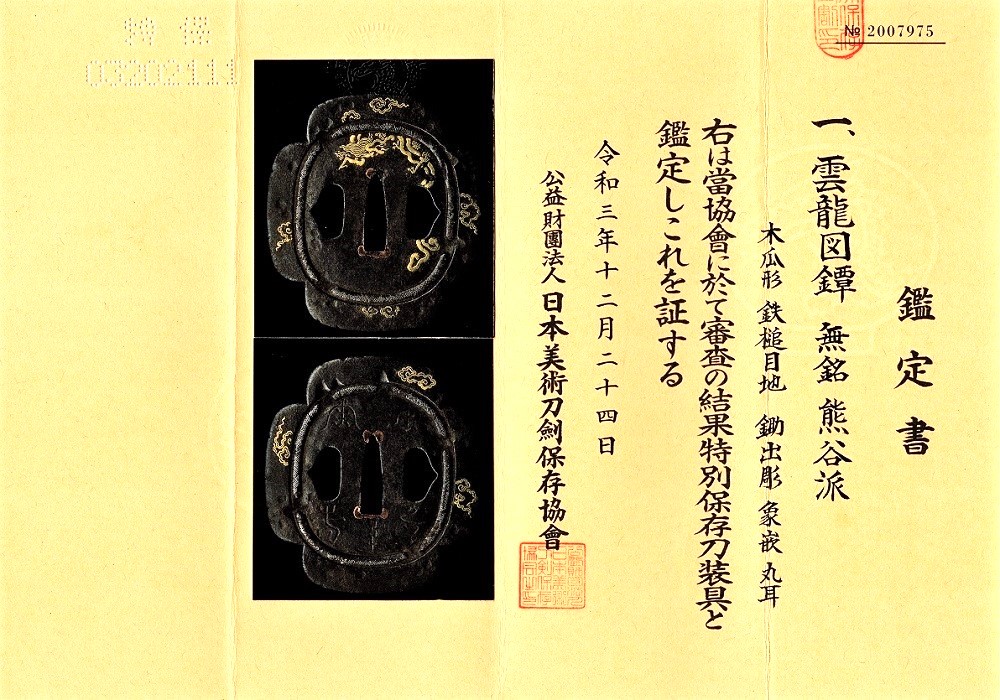 |
KUMAGAI $4000.00 "The theme of this tsuba is Dragon and Clouds. An iron plate in mokko shape with details in gold. Dates to Mid Edo period. The Kumagai tradition was founded by Kumagai Yoshiyuki and worked as the official craftsmen for the Higo Clan in Edo. This tradition became popular and flourished based on the Higo Tradition and the use of their own techniques." (Long) 8.70cm x 7.90cm x 0.40cm |
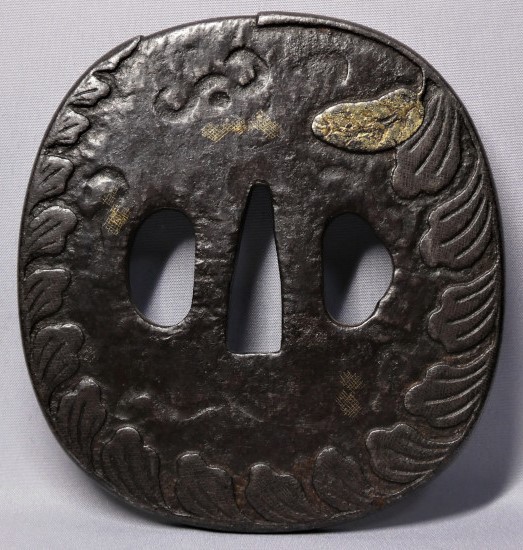 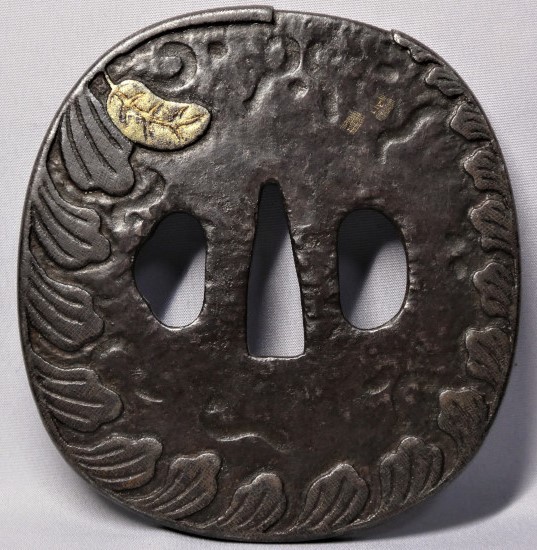 |
KUMAGAI FUJIEDA $1500.00 "Write up to follow." (Haynes) |
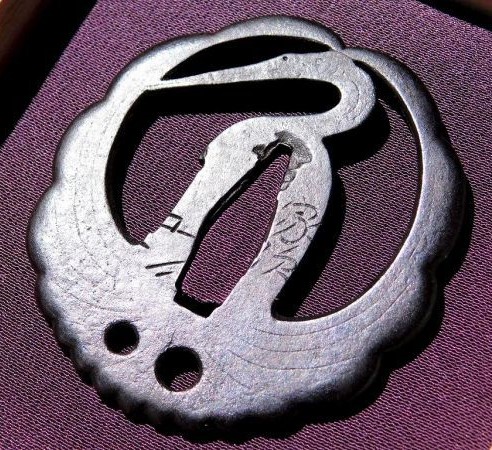 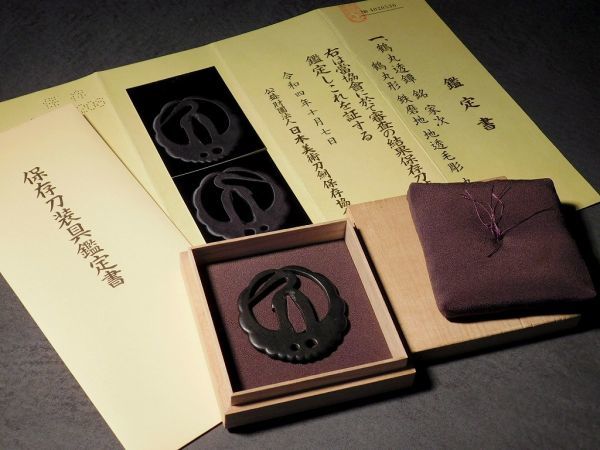 |
HIGO Please Contact Us For Price "Iron sukashi Higo tsuba, with a classic Tsuru or crane motif, carved 'in the round', with outspread wings enclosing over its head. Details of the head, feathers and cross-hatching on the seppadai, are finely carved into the plate. Two large udenuki-ana holes detail the bottom of the tsuba. Currently under study but believed to be Higo work." (Long) |
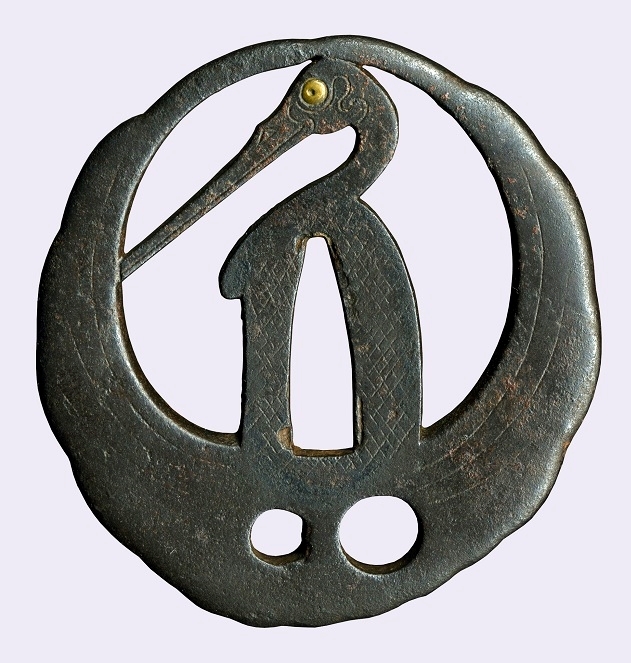 |
HIGO Tsuba $2000.00 "Iron sukashi Higo tsuba, with a classic Tsuru or crane motif, carved 'in the round', with outspread wings enclosing over its head. Details of the head, feathers and cross-hatching on the seppadai, are finely carved into the plate, and prominent eyes are inlaid with brass. Two large udenuki-ana holes detail the bottom of the tsuba." (Long) 7.72cm x 7.39cm x 0.50cm |
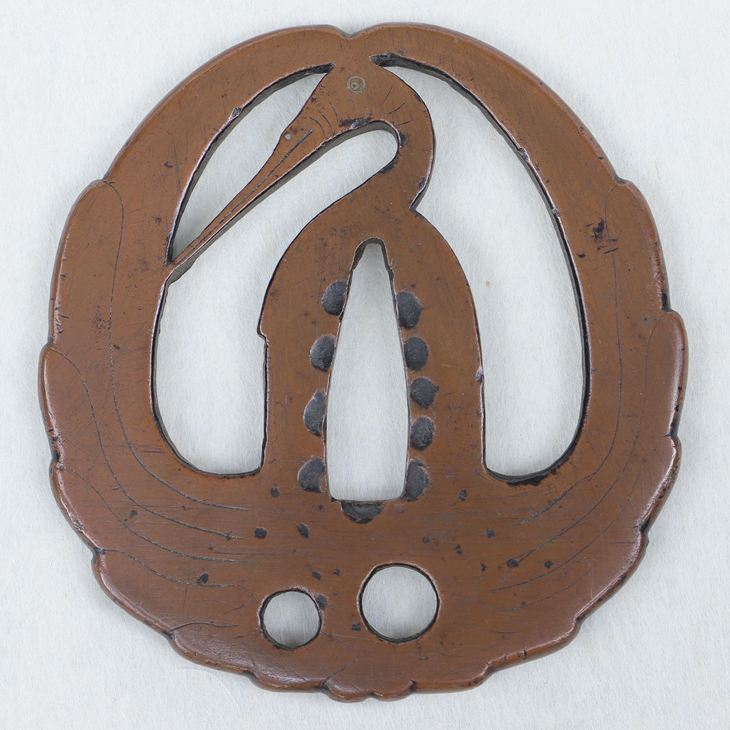 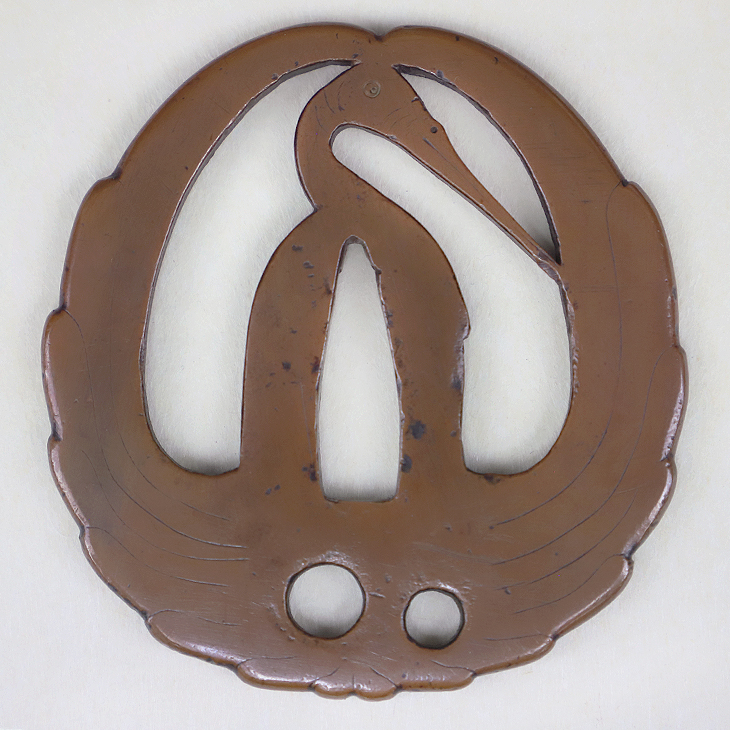 |
HIGO Please Contact Us For Price "Copper polished ground of a crane that Higo specialized in. Dates Momoyama to Early Edo period. Hakogaki by Kanzan dated Showa 37." (Haynes) |
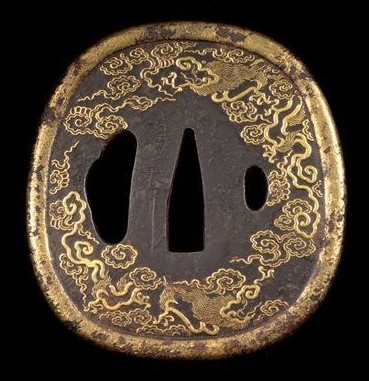 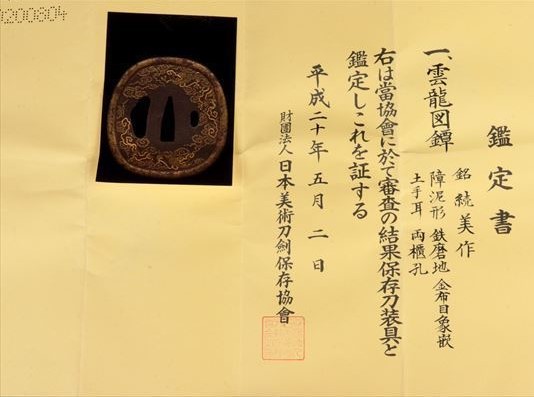 |
'TSUGUYOSHI SAKU' $2000.00 "An iron plate in aorigata shape with dote mimi. The theme of the entire piece is 'Dragons in the Clouds'. It was believed that the Dragon was the bringer of rain and good opportunity. It usually lives in the water, but when the time has come, it makes the sky cloudy, causing it to rain as it rises high into the sky. This motif made the Dragon a symbol of a successful leap and it was sometime used as the symbol of an Emperor. The entire piece covered in gold nunome inlay. The dote mimi at one time completely covered. Signed: 'TSUGUYOSHI SAKU'. Haynes Index H 10770.0. A member of the Tani family school of Higo." (Long) 7.10cm x 7.70cm x 0.40cm |
  |
KUMAGAI Please Contact Us For Price "The Kumagai school was commonly known as Edo Higo or Yotsuya Higo, as they lived in Yotsuya and became the craftsmen employed by the Hosokawa family of Higo. The Kumagai tradition was founded by Yoshiyuki, Yoshitsugu, and Yoshinobu and their works are an improvement on the Jingo-style carving technique of their home town of Higo. This tradition became popular and flourished based on the Higo Tradition and the use of their own techniques." (Haynes) |
UMETADA HA
The Umetada school first appears in the Tensho era (1573). Nothing is known of the Umetada as a group or as individuals before the time
of Myoju, first known and greatest master of the school. This artist showed the genius of the Momoyama age. Not only was he a great tsuba maker but he was a great
swordsmith and a renowned judge of swords as well. It is unfortunate that the foundation and origin of the talent of Myoju is one of the great mysteries in the history
of tsuba. The following genealogy is taken from the Shinto Bengi, Shinto Mei Shuroku, and from the actual work of the artists by Dr. Torigoye and Robert E. Haynes.
KYO-UMETADA school (Kyoto main branch): 1st. Myoju, 2nd. Myoshin, 3rd. Shigenaga, 4th. Muneyuki, 5th. Muneshige, 6th. Shigeyuki, 7th. Shigehide, 8th. Yoshihisa, 9th. Gichin(Yoshiharu), 10th. Muneaki(Shichizaemon), 11th. Munetoki.
EDO branch school: In Edo, a branch school of the Umetada developed that was both prolific and popular. These artists were the ones who often signed their work with the plum rebus instead of the kanji ume (plum).
BANSHU (Harima) branch school: Working here are Muneyoshi, Shigeyoshi, Yoshihisa, Yoshitsugu, and Yoshitada. Some are related to the Kyoto artists of the same name.
CHOSHU OKADA school: A pupil of Myoju emigrated to Choshu and started this branch.
HIZEN UMETADA: This school worked in a style which combined Higo, Hizen, Umetada, and Shoami with many variations. Workers were Munetake, Akinaga, Yoshinaga, and others.
HITACHI Province: Umetada worker Tomotsune was a known artist. In UNSHU and TSUGARU Provinces, Umetada Munetake was a most capable artist.
These later branch workers, at first, had a style that mixed the Umetada and Shoami techniques. To this mixture they added the native style of the provinces where they had settled. So each branch school will have at least three styles combined in its work. In later periods the work of the branch schools tends to have more of the provincial style and less of the Umetada and Shoami styles. Unfortunately, the great talent of Myoju became so dissipated by the later generations that not a vestage of his talent and ability descended to them.
The early Umetada workers almost always used iron plate and nearly all forms of edge style were used. Nobility is the key word to describe the designs used byMyoju and his school. The designs are aesthetically satisfying in every detail. The quality of the carving shows a precision and power lacking in the later kinko. The designs are wide and varied, but the ones seen more than once are karakusa, raimon, rinza (arabesque, yamanashi (wild pear), grapes and swallow tails. Inlays used were gold, silver, shakudo, shibuichi, and copper.
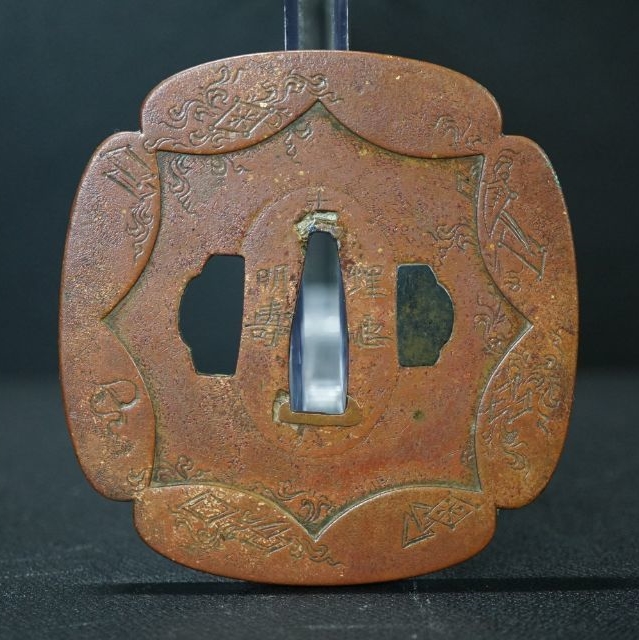 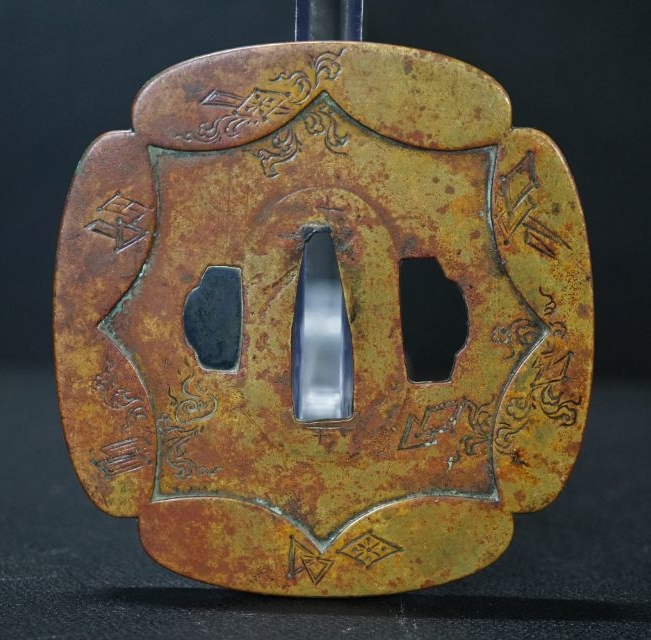 |
'MYOJU UMETADA' Please Contact Us For Price "Under study.....Could be H 06409.0 Haynes Index." (Haynes & Long) |
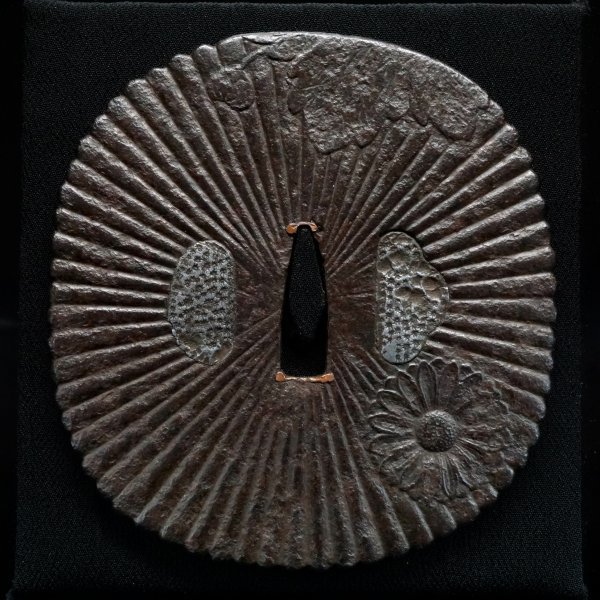 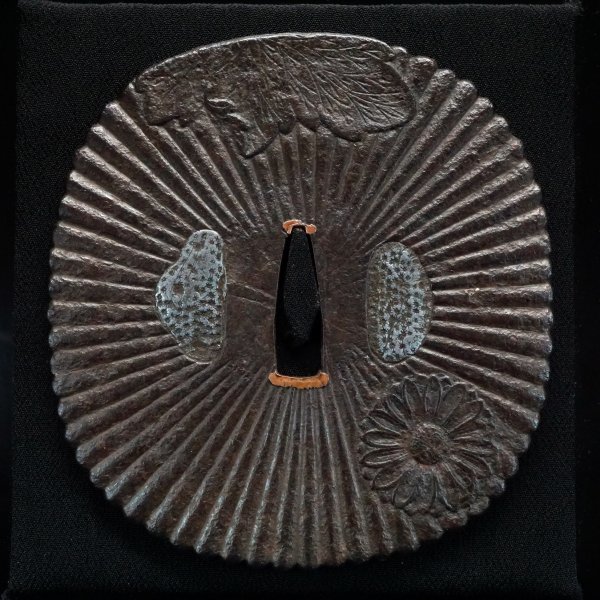 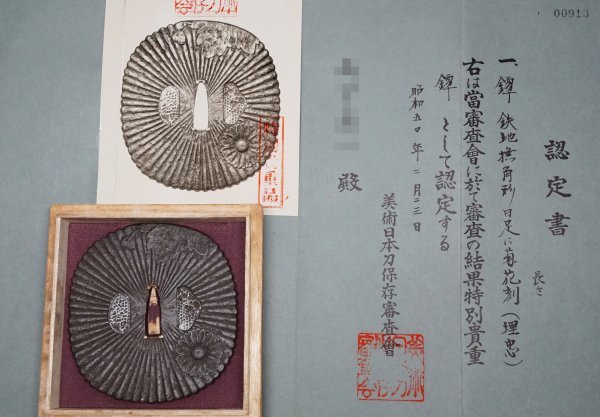 |
UMETADA Please Contact Us For Price "Large rounded square iron plate nicely forged and carved with excellent patina and color. Further study and description coming soon." (Haynes & Long) |
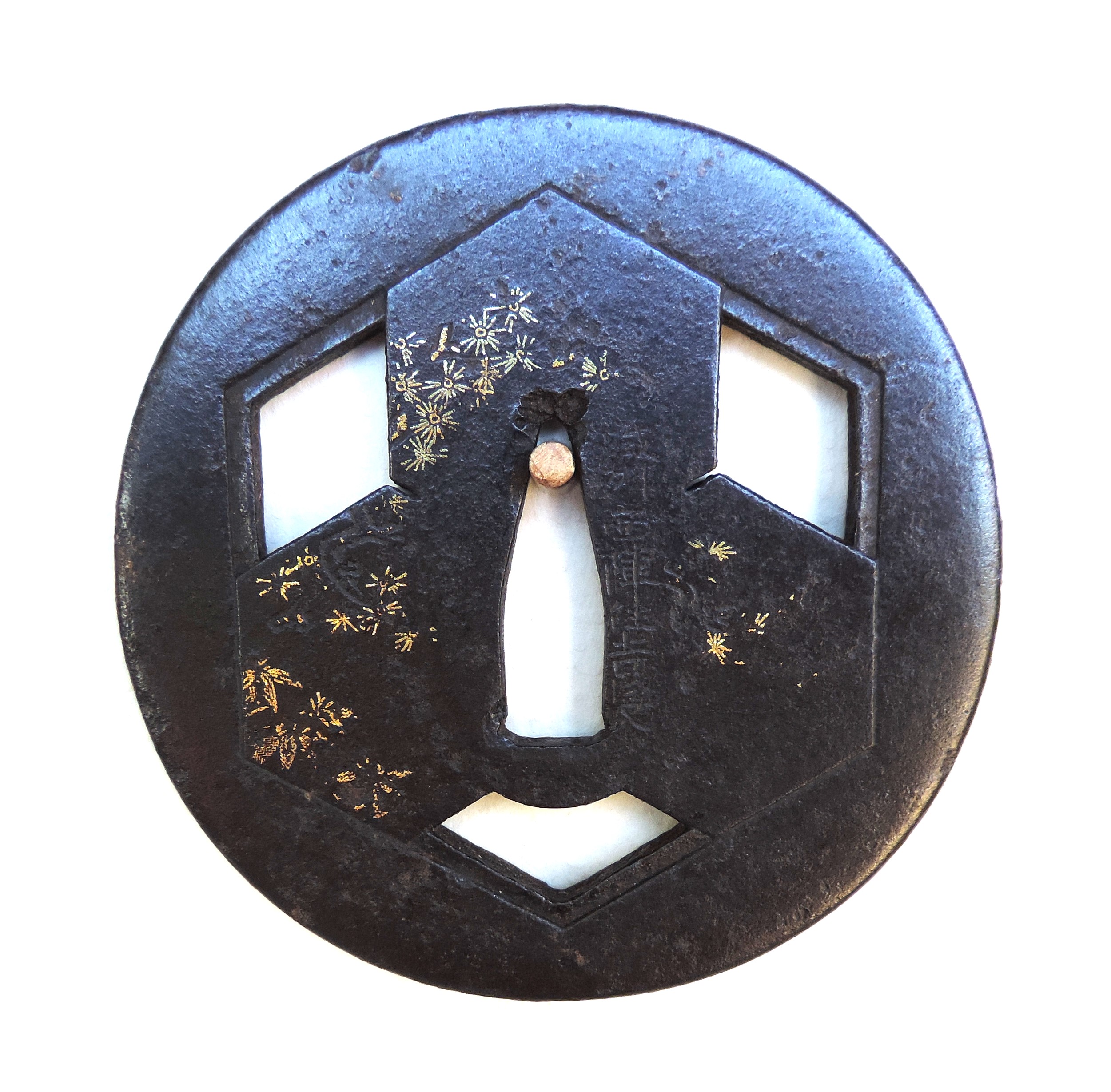 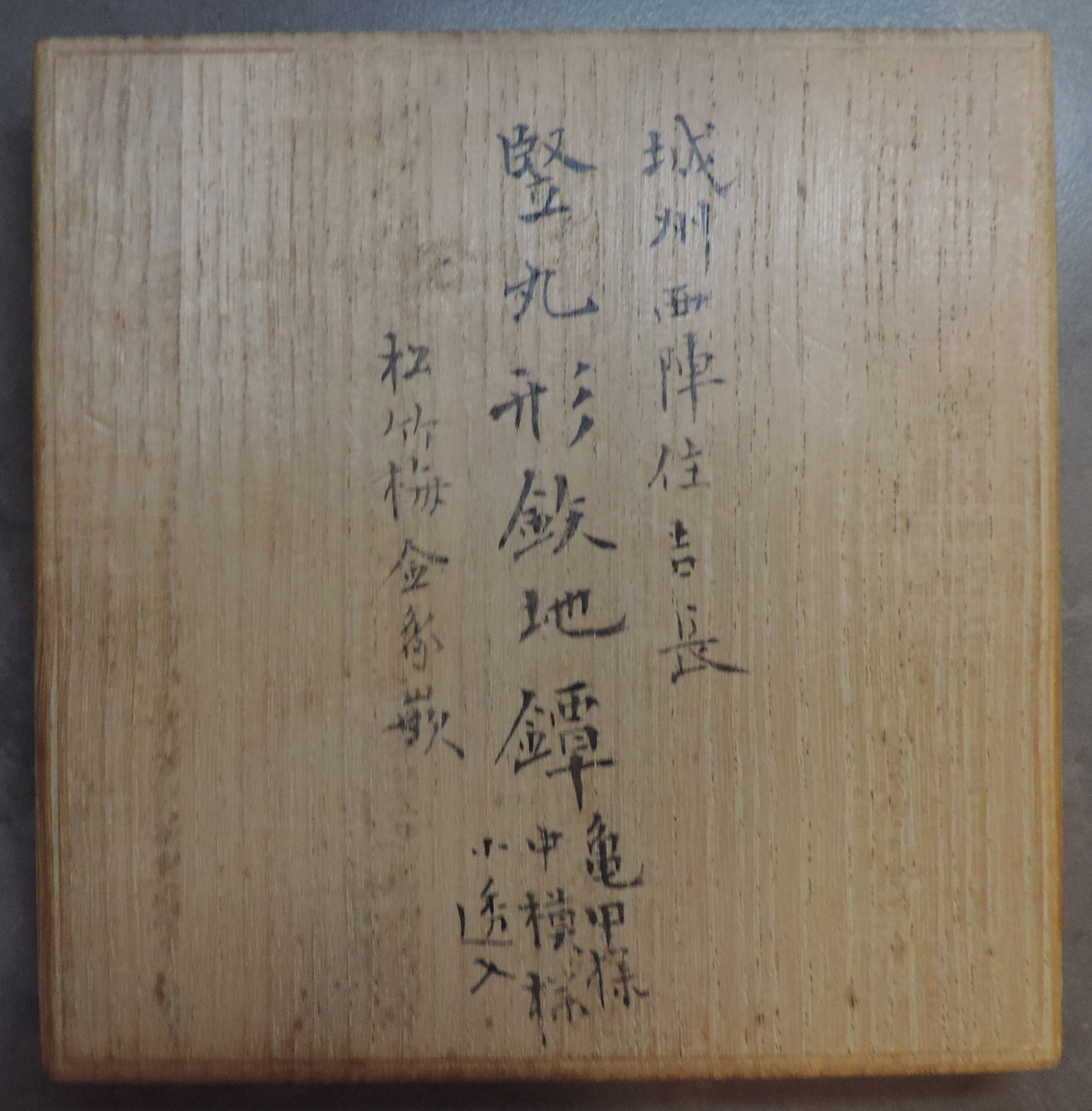 |
'JOSHU NISHIJIN JU YOSHINAGA' Please Contact Us For Price "Presented here is a round shape iron ground tsuba of tortoise shell design. Intricate gold inlay of foliage in a scattered pattern. Signed: 'JOSHU NISHIJIN JU YOSHINAGA' a master craftsman of the Umetada family ca.1700. Illustrated in ZABO TANZEN, pg. 269, no. 319. Haynes Index H 11916.0." (Long) |
  |
'UMETADA'
Please Contact Us For Price "The Umetada school first appears in the Tensho era (1573), its pre-existence unexplained.It is necessary to begin the study of the Umetada with the first known, and greatest master, MYOJU. One would expect that such a great artist would have a well defined genealogy and a brilliant family history, but just the opposite is the case. It is unfortunate thatn the foundation and origin of the talent of MYOJU is one of the great mysteries in the history of tsuba." (Long) |
  |
'TADATSUGU' $4800.00 "Iron plate in marugata shape, one hitsu-ana in suhama-gata filled with lead with sekigane. The sukashi design in positive silhouette of Daruma 'sitting in front of a wall'. The meaning of the upper left kanji is 'faith' (men) and the lower left kanji is 'wall' (heki). This depicts the Daruma as he sat silently wasting away in meditation. Signed: 'TADATSUGU'. H 09190.0. The delicate subject, careful finish and refined iron establishes this tsuba as a work of perfection." (Long) |
  |
'UMETADA TACHIBANA SHIGEYOSHI' $4200.00 "A maru gata iron sukashi guard of five kiku flowers that are very well carved. Appearing on the rim is a scroll design done in very fine gold nunome. MEI: 'UMETADA TACHIBANA SHIGEYOSHI'. This was the Shigeyoshi who was said to have taken the Umetada school from Kyoto to Edo. Comes with hakogaki by Dr. Kazutaro Torigoye." (Long) |
  |
'JOSHU NISHIJIN JU UMETADA SHIGEYOSHI' Please Inquire For Price "Titled "Tatsuta River with beautiful golden autumn leaves." Polished iron, tilt-shaped with sukidashi carving, inlaid with colored inlay and suki-zan-mimi. The edge features a flowing river carved with sukidashi, with scattered autumn leaves. See bottom tsuba, pg. 135, Tsuba Kanshoki." (Long) |
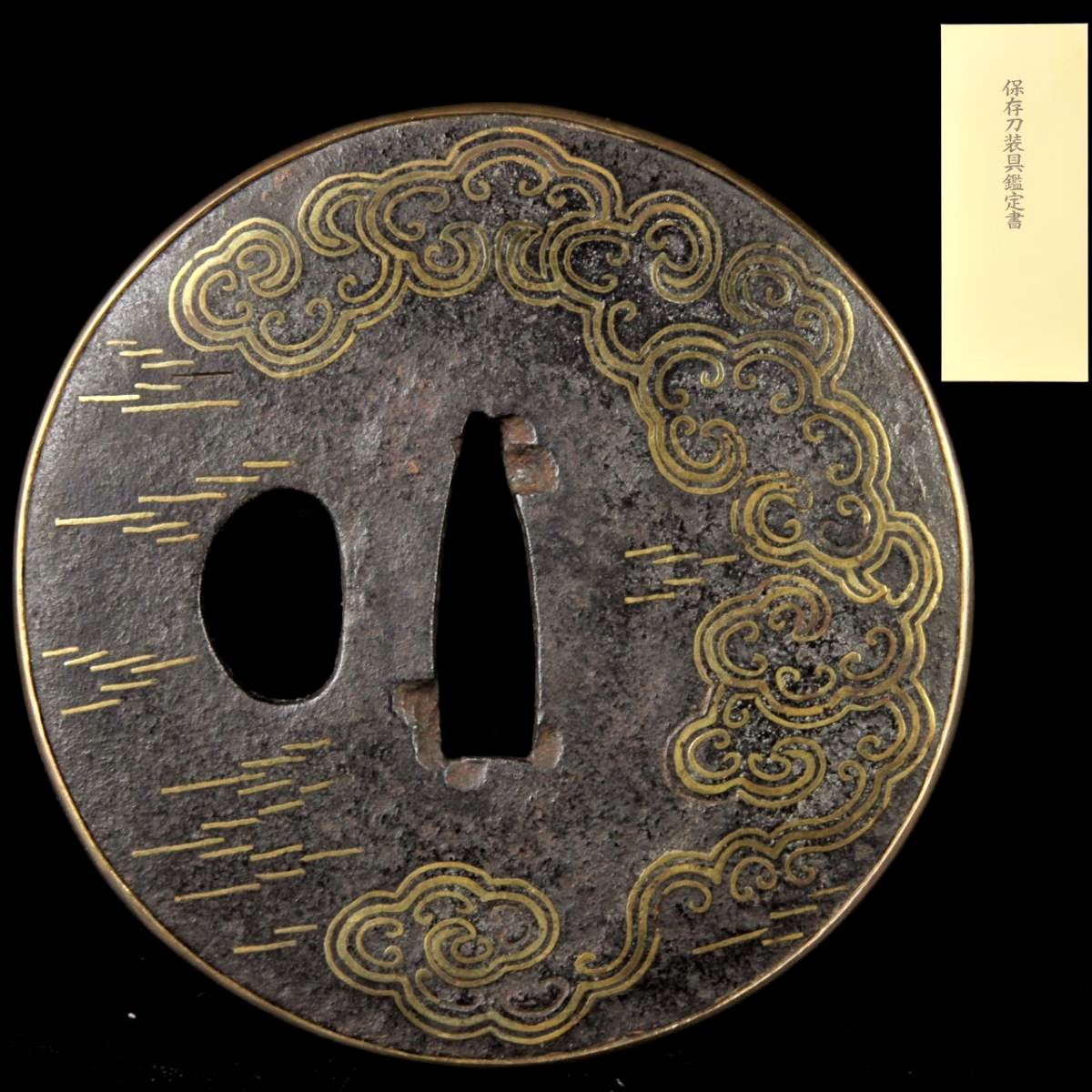 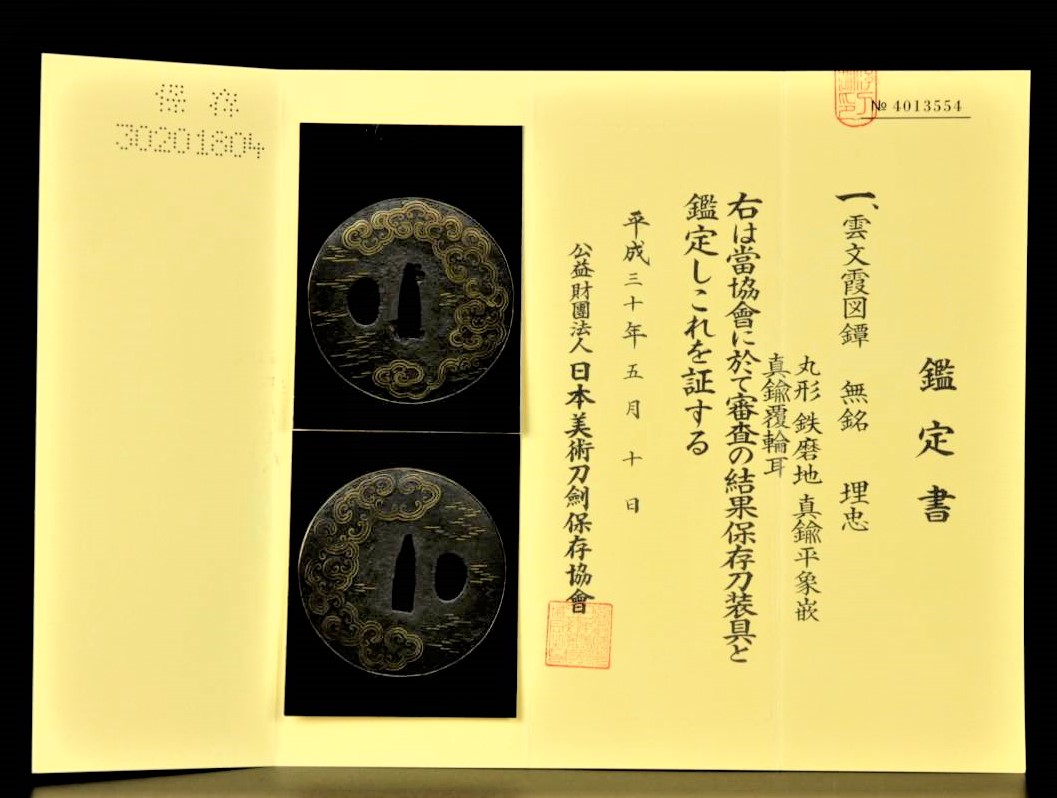 |
UMETADA $1300.00 "Iron tsuba with brass fukurin, design motif of clouds and mist inlaid with brass." (Long) NBTHK Hozon origami. |
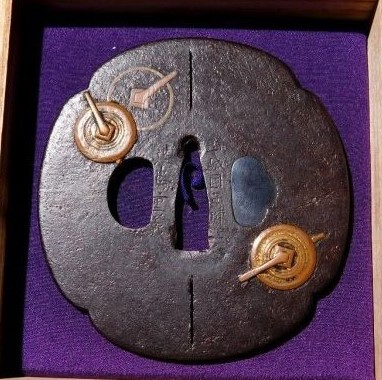 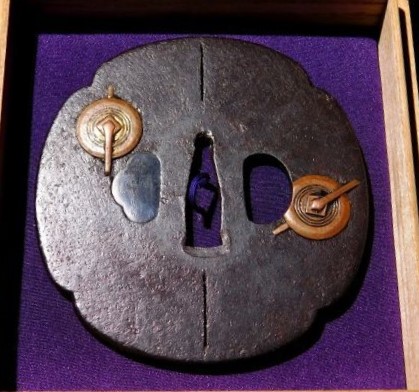 |
'YAMASHIRO KUNI NISHIGEN JU SHIGEYOSHI' Please Contact Us For Price "A very old fashioned work by Shigeyoshi, a master craftsman who plays a part in the famous family represented by Umetada Nishigen. A rare Yagen design with vertical thread watermarks on top and bottom." (Long) |
  |
'MASAYOSHI UMETADA' Please Contact Us For Price "This is a rare piece by 'Masayoshi Umetada' featuring a well-forged iron base inlaid with gold and silver inlay 'Mushikui Choshi Arabesque Print.' We have handled numerous sword fittings so far, but we have never handled any of the "Umechu Masakichi" names, making them extremely rare pieces. Well-forged iron. [???????? ??? Era: Edo period. Material: Iron with paulownia box Signature: ?????." (Long) |
  |
'SHIGENARI' Please Contact Us For Price "Rare item with box inscription by Shibata Kazuo, dated 1970, and a certificate of preservation and fittings. Excellent tsuba "Nine Years of Mother" by Umeda Tada Shigenari, no hole-inscribed tsuba. Early to mid-Edo period, Shichizaemon-dojin, copy of Akiju . Iron base, vertically rounded, square edge, small edge, single edge carving, gold cloth inlay, and shadow-like pattern. This tsuba is the work of Shibata Kazuo, author of Towa (Japanese Sword Shibata) and numerous books on swords. His box inscription is rare, and this is the first time I have seen it. As the box inscription commentary states, this is a fine tsuba, a copy of Umetada Akiju's famous tsuba "Nine Years of Mother." Umetada Shigenari was a metalworker from Yamashiro, but he was also a skilled craftsman who served the Edo Shogunate and was stationed in Edo. Although the gold cloth inlay has some wear, this is a well-forged, well-crafted tsuba." (Long) |
  |
KO UMETADA Please Contact Us For Price "The metal parts of the four-petal flower design are full-bodied, the design has movement, and the metal is of fine quality and has a deep color. These traits and the aged look of the seppa-dai and the hitsu-ana indicate that this is a work of some antiquity. The elegance of the design is distinctively Umetada. Dates to Muromachi period, ca. 1500." (Long) |
| |
KO UMETADA or Ko Shoami Please Contact Us For Price |
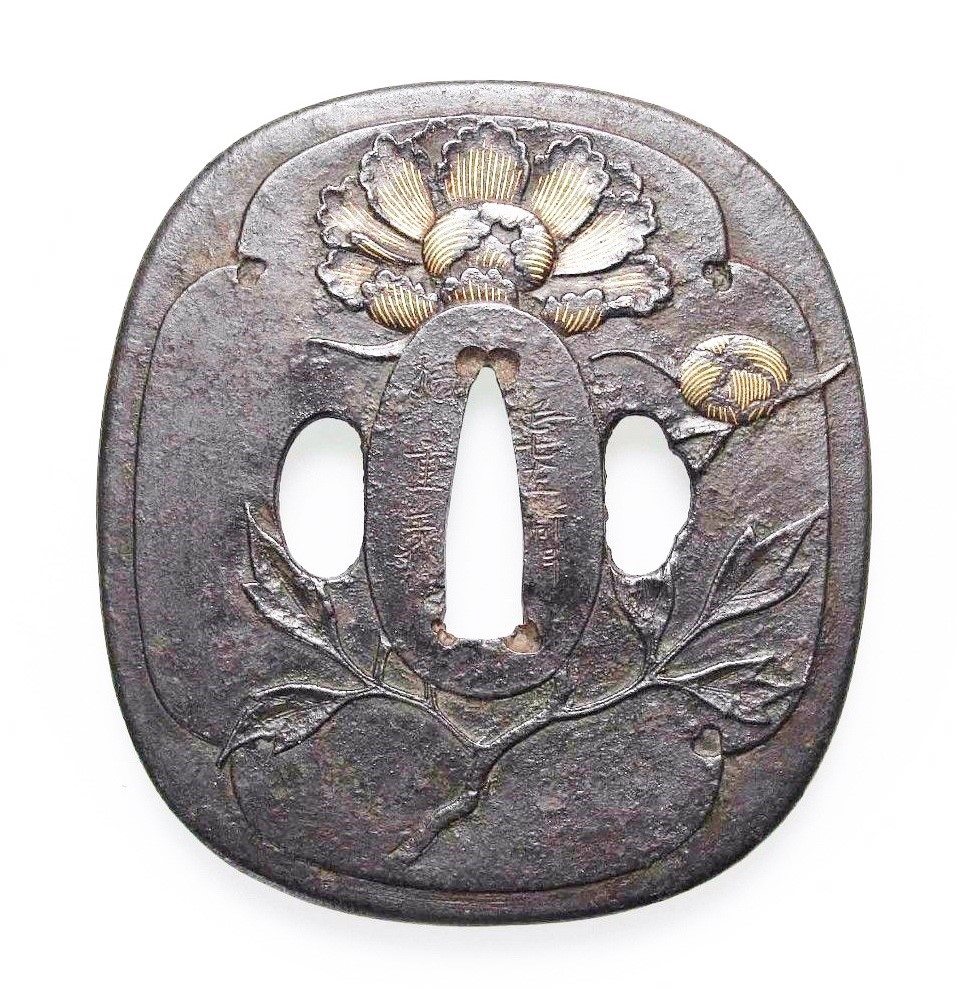 |
'UMETADA SHICHIZAEMON TACHIBANA SHIGEYOSHI' $1600.00 "Large squared circular (okaku maru) iron plate with design of peony flower and bud. Signed: 'Umetada Shichizaemon Tachibana Shigeyoshi'. Ref. Haynes H 08573.0. Took the Umetada school from Kyoto to Edo." (Long) |
  |
'JOSHU NISHIJIN JU SHIGEYOSHI TACHIBANA' Please Contact Us For Price "This work is Shigeyoshi Shichizaemon from the inscription "Joshu Nishijin ju Buried Tadada Shigeyoshi". There are also those that call the Tachibana surname from Kanei to Genroku and have the inscription Edo Sumi. He prefers to carve chrysanthemum flowers with the technique of inlay cloth. This work is a chrysanthemum drawing with chrysanthemum flowers floating in the flow of water. The chrysanthemum crest is a combination of flower and water, and is famous as the family crest of Kusunoki Masanari." |
  |
|
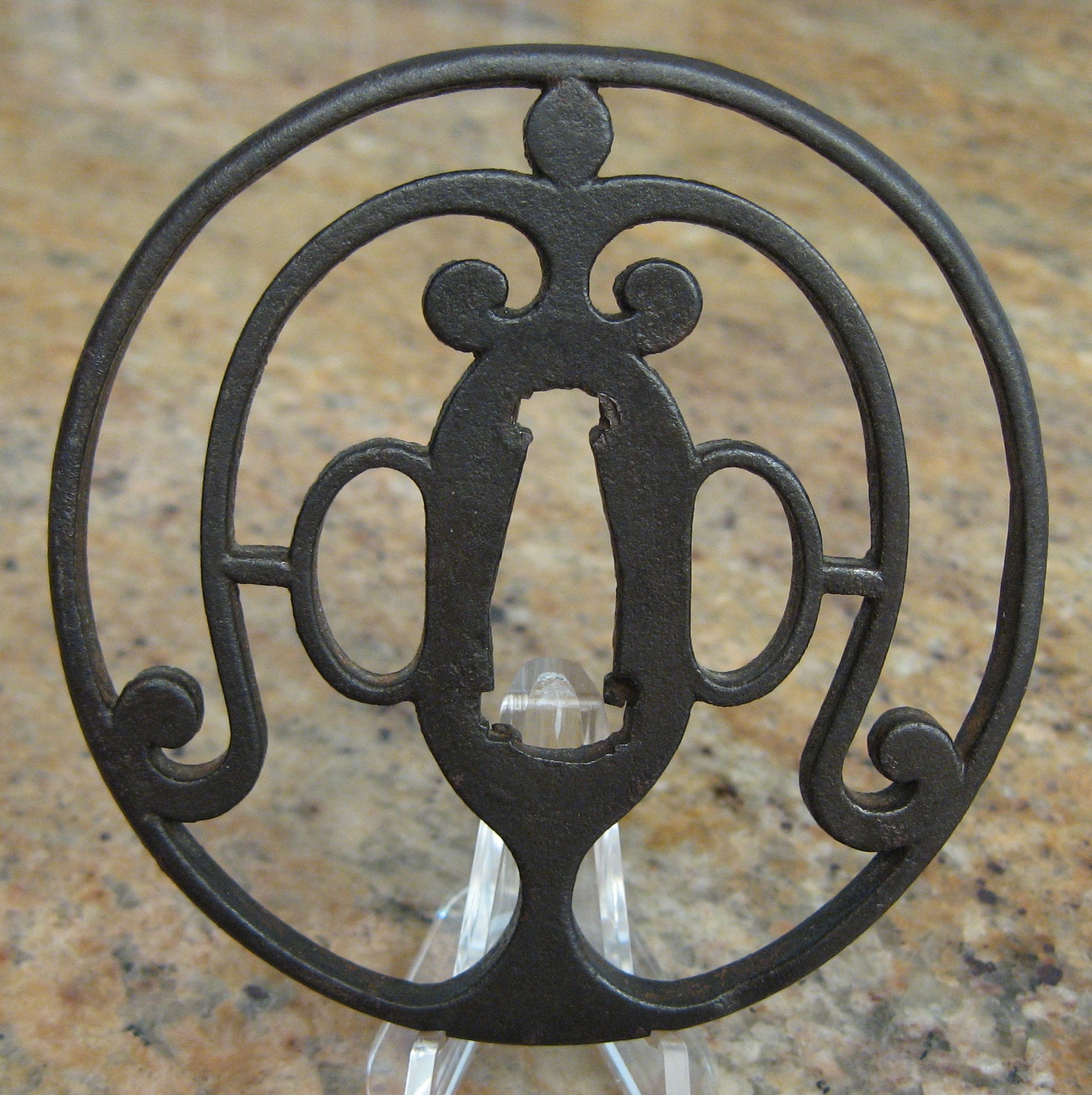 |
KO - UMETADA Please Contact Us For Price "Iron ji-sukashi tsuba with a design of a bridge for Koto. 'Nobility' is the keyword to describe this design. It is aesthetically satisfying in every detail. The surface of the plate is splendid and appears to be a little wet. The luster of the patina is in tune with the softly structured surface. Wonderful tekkotsu is to been seen in the rim.Dates ca. 1500-1550." (Long) |
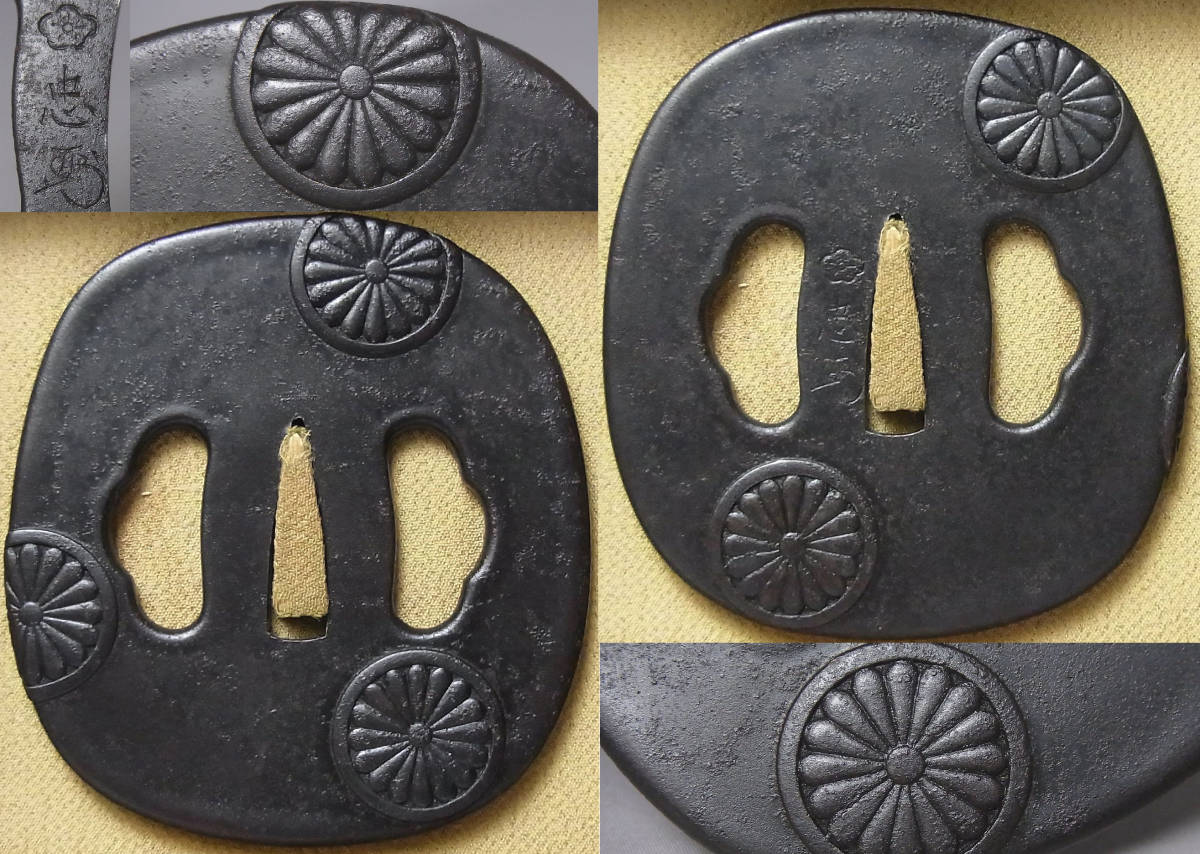 |
Chrysanthemum Mei Please Contact Us For Price "" (Long) |
KAGAMISHI TSUBA:
The Kagamishi were mirror makers in the period before the Edo age who also made tsuba. A study of the mirrors of the Kamakura and Muromachi ages may throw some light on these workers. The Kagamishi tsuba are of a cast metal usually the same as would be used in the making of a mirror. The plate metal in most cases is bronze. Sometimes a tempered plate is found, with such fine hammer work that the connecting layers of the plate are undetectable. The designs in most cases are very similiar to those used on the old mirrors. The subjects are bold in feeling and strong in arrangement. Some pieces have stamped designs or surface carving. There are two distinct styles of Kagamishi tsuba. One are designs common to old mirrors, the other has representational designs of landscapes with flowers, birds, animals, and human figures. These designs have a classical feeling that is both naive and noble in concept. In the best kagamishi tsuba the shape, ground, thickness, and quality of metal are very good and show remarkable skill. The base plate in many cases is of superior quality despite its being made of cast metal. The combination of the base metal and the design is very pleasing, showing the same qualities found in the Kamakura tsuba as applied to work in soft metal.
TACHI-KANAGUSHI TSUBA:
The word tachi-kanagushi means a maker of tachi fittings. These workers were also called sokenshi, which has the same meaning. The tachi-kanagushi tsuba is made through the collaboration of two tachi fittings makers. The preparatory worker, called the tachi-shi, collects the material for the base plate, forms the rough shape and does the basic hammer work. The tachi-kanagushi does the finishing of the surface and the decoration. The work of the tachi fittings maker dates from very ancient times. In this broad meaning the shitogi, aoi, nerikawa, and other early soft metal tsuba might be called tachi-kanagushi tsuba. However, it is best to apply the term to those pieces made in the Muromachi and Momoyama ages.
SANMAI TSUBA:
Sanmai tsuba are constructed of three
sandwiched plates; a top and bottom plate of shakudo, shibuichi, or nigurome
with a center core normally of yamagane(copper). They are bound by a fukurin
(rim) which holds the three plates together. This construction can be seen on
the interior of the nakago and/or hitsu-ana. The plate decoration is done by a
repousse technique, working the design from the back of the plate,
sometimes hammered into a pattern mold. Some sanmai tsuba will have the exact
same design on both sides; others will have different designs on each side of
the tsuba. The plates are normally of floral, scenic, dragons or mon design. Some Sanmai tsuba have Goto style designs. Commonly the plates will have some type of gold wash/inlay on areas of the
design. Each tsuba must be judged individually based on the quality of the
plate, core and workmanship. Care must be taken with sanmai tsuba as the plates
are relatively soft and the designs easily crushed.
The dating and
attribution of this type of tsuba has been a subject of some debate among
collectors. Some believe these tsuba are a type of tachi-kanaguchi tsuba. Others
feel they are Ko-Kinko (early soft metal) tsuba (see Ko-Kinko above). They have
also been attributed as Ko-Mino (early Mino School) tsuba. Sanmai tsuba have had
attributed dates from the Momoyama period to late Edo period. Sanmai tsuba have
received origami from the NBTHK, NTHK, and NTB generally attributing them to
Ko-Kinko (see above) or Ko-Mino and dating Momoyama to early Edo periods. However, this should not be taken to mean that all sanmai tsuba are of this age; some are most certainly late Edo shiiremono. Each tsuba must be judged individually based on the quality of the plate, core and workmanship. Care must be taken with sanmai tsuba as the plates are relatively soft and the designs easily crushed.
It is common to note the age of many fittings by the wear to their surfaces imparted during use and handling. These tsuba show the foil worn away exposing the foundation in the very place the samurai would have rested his left hand on the sword while wearing it. Therefore, these tsuba were proudly worn for many years and the compromise of the foil on the rim is historic, and not due to abuse or neglect.
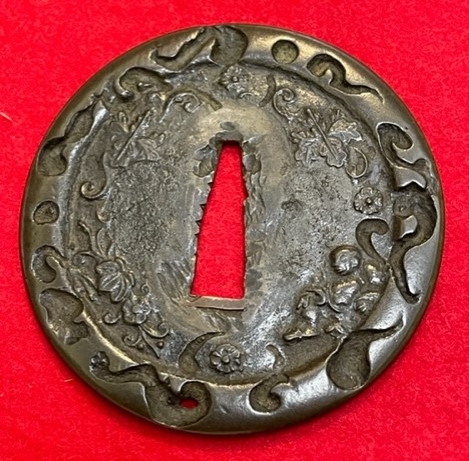 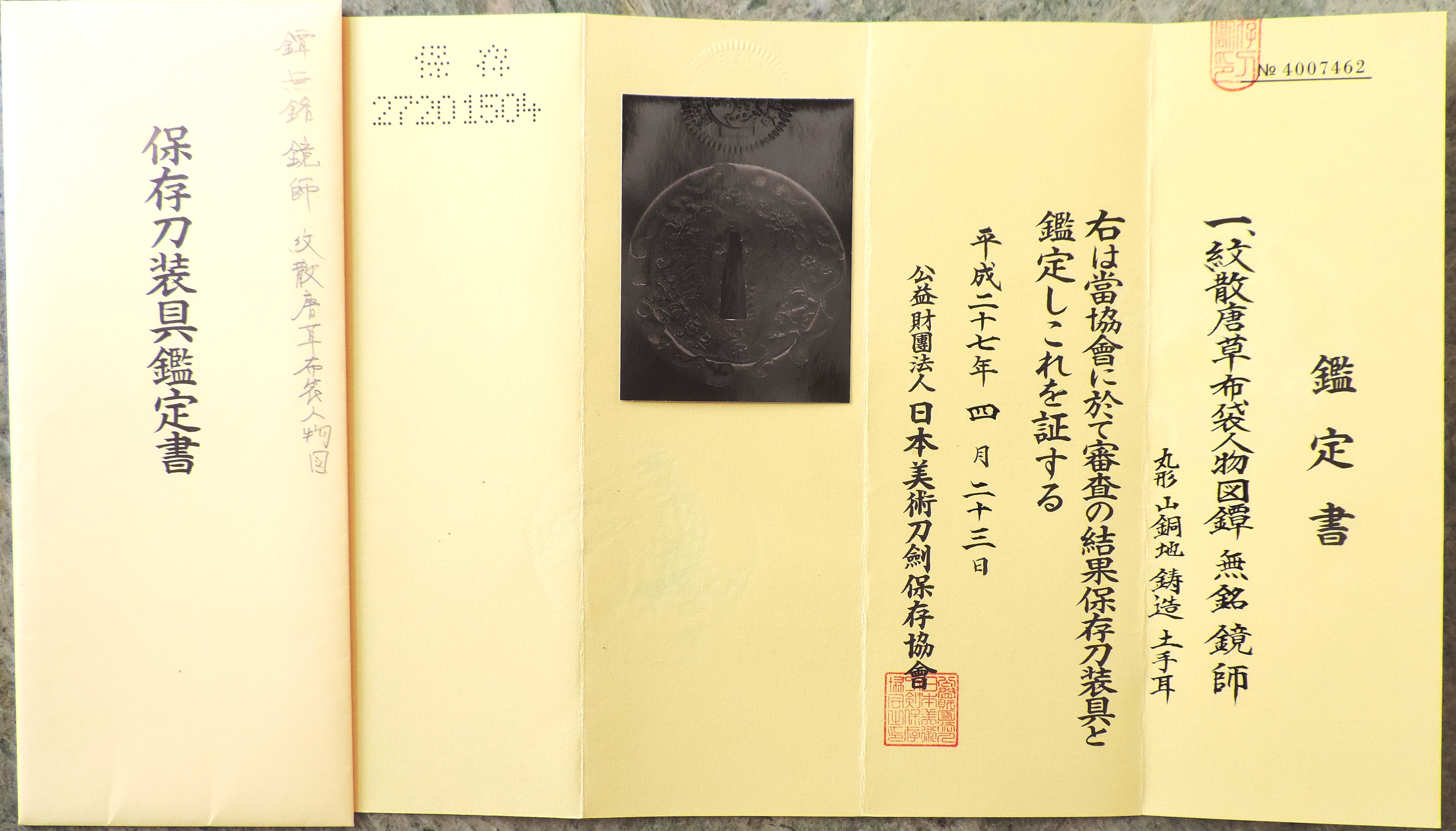 |
KAGAMI-SHI Please Contact Us For Price |
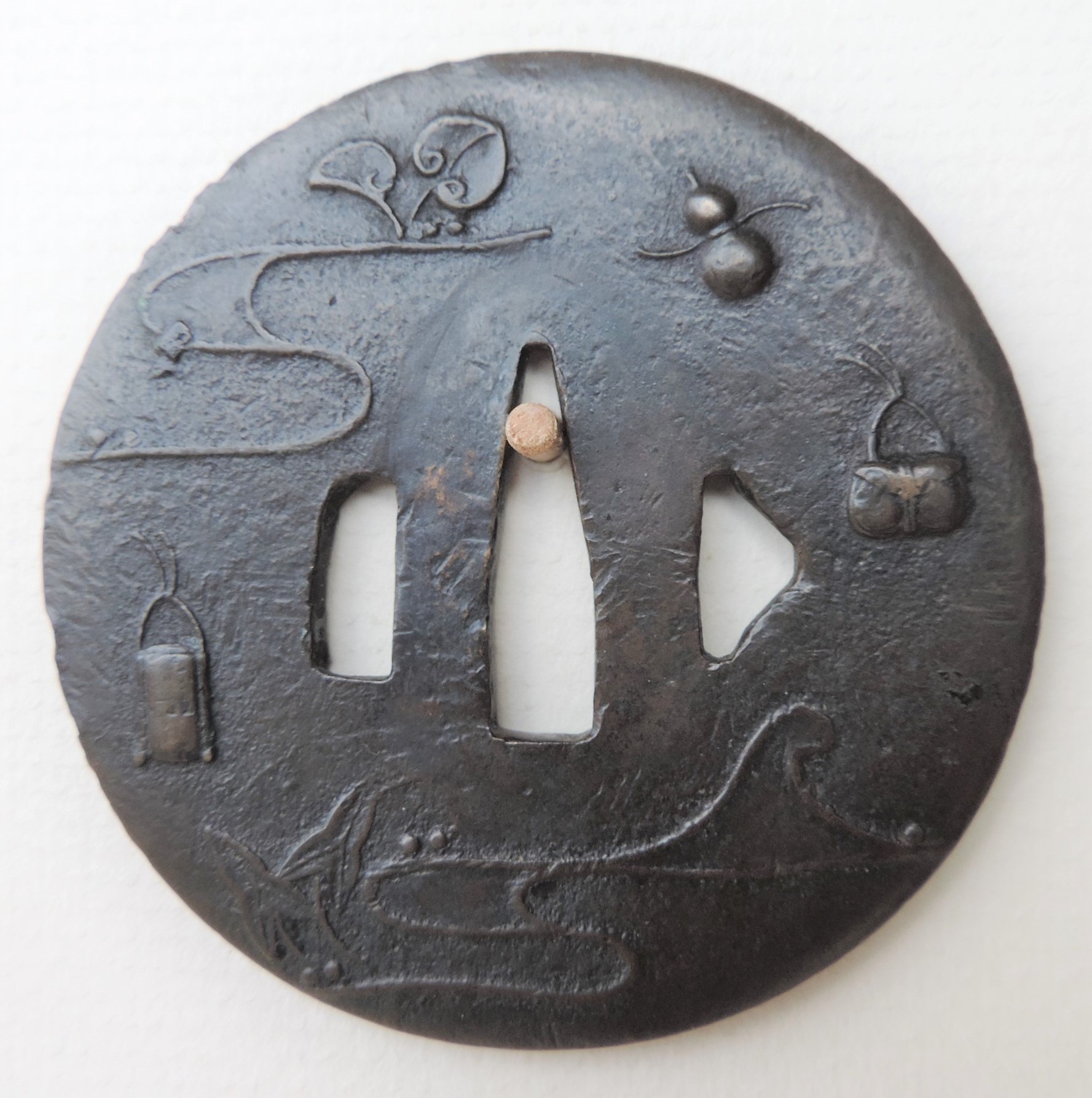 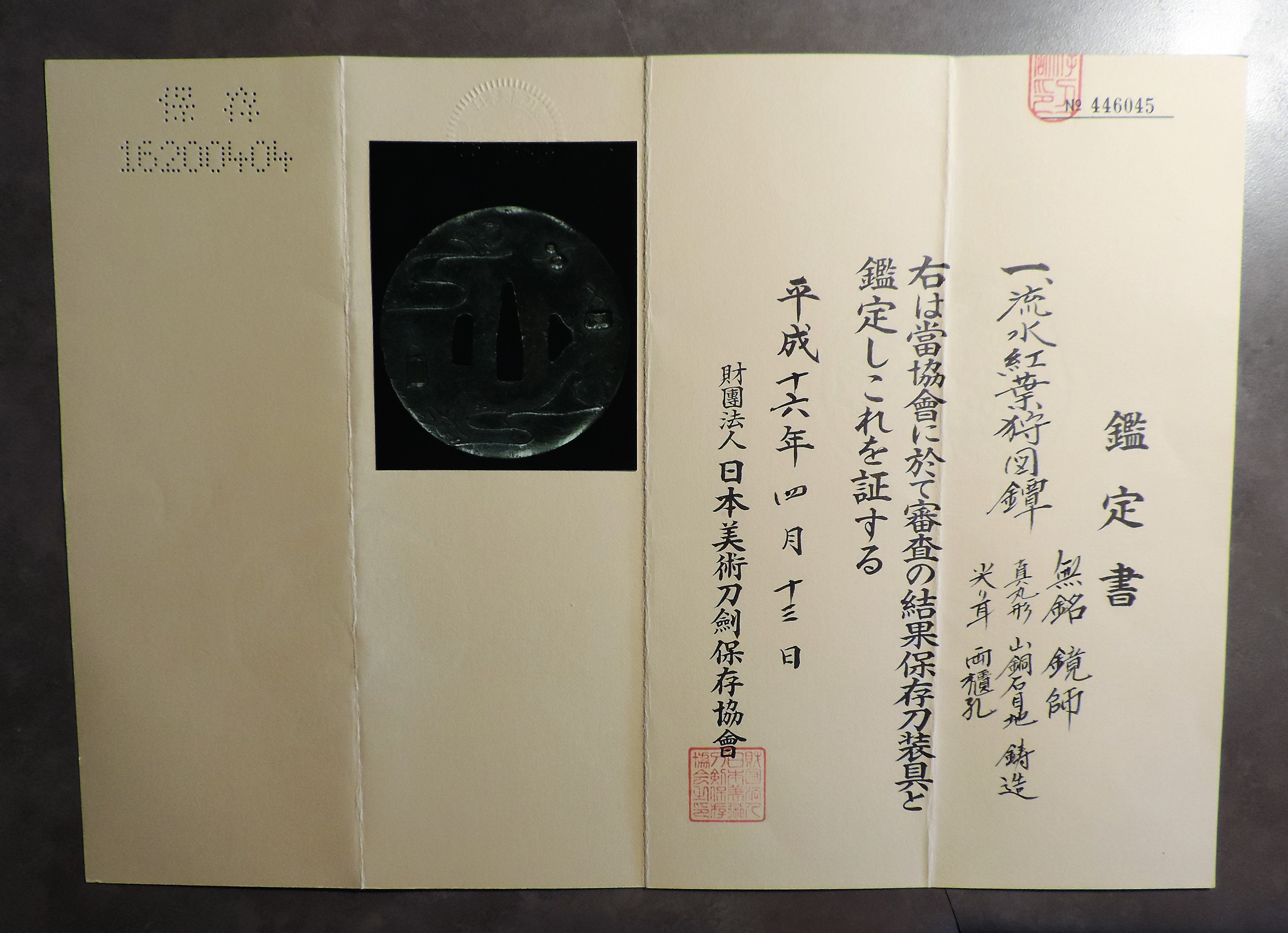 |
KAGAMI-SHI Please Contact Us For Price |
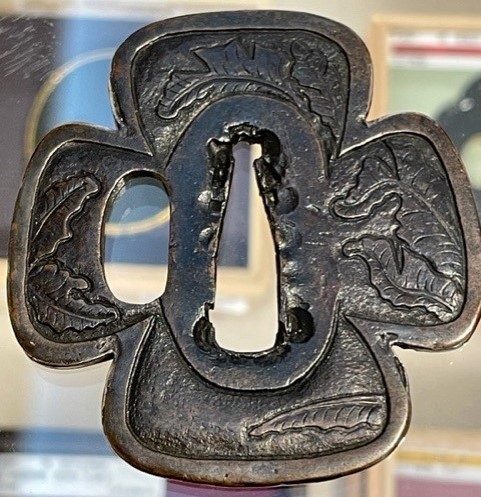 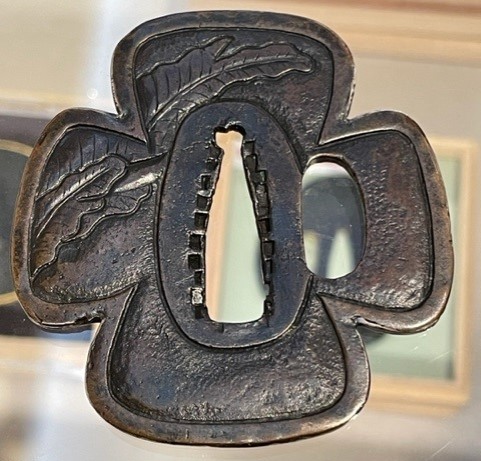 |
KAGAMI-SHI $5000.00 ""Mountain copper mokko shape carved of white radish leaves, one of the seven herbs of spring. Much of the black lacquer still remains. At first glance, it looks like the work of an old metalworker, but it is thought that it expresses the aesthetic sense of the third of the seven philosophers of Rikyu. Having gone through numerous battles, the state of 'wabisabi' has deepend more and more." (Haynes & Long) |
  |
KAGAMI-SHI $3000.00 "A rare ko-kinko tsuba known as a KAGAMI-SHI (Mirror Craftsman) in hexagonal bronze shape with a traditional dragon pattern set against a wave background, reminiscent of bronzeware. The mote-mimi features carved arabesque patterns. It is completely un-altered or ubu. Realize that while in classic mirror maker style, it was made with original hitsuana and intended for use on katana. This style was popular among high ranking samurai who required uchigatana or katana on the battlefield and maintained traditional style and workmanship. This tsuba is made of solid bronze and cast as a solid piece of metal, with a large amount of high-relief carving of the original plate. This carving technique is termed fukabori, a variant of sukidashi-bori. Overall, this tsuba is an extremely well-preserved, rare and valuable early soft-metal work dating to Early Muromachi period, ca. 1400." (Haynes & Long) |
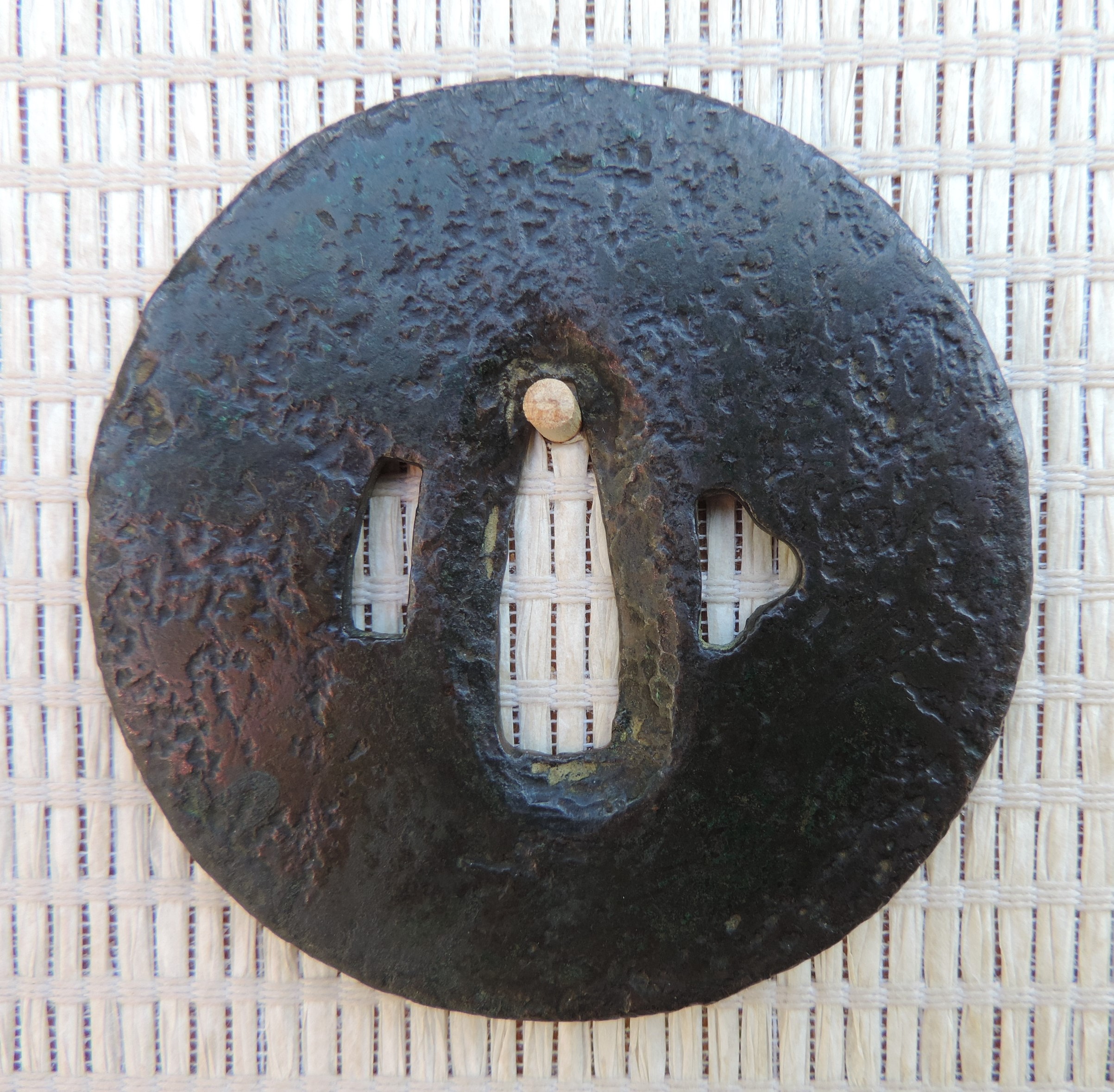 |
KAGAMI-SHI $2000.00 |
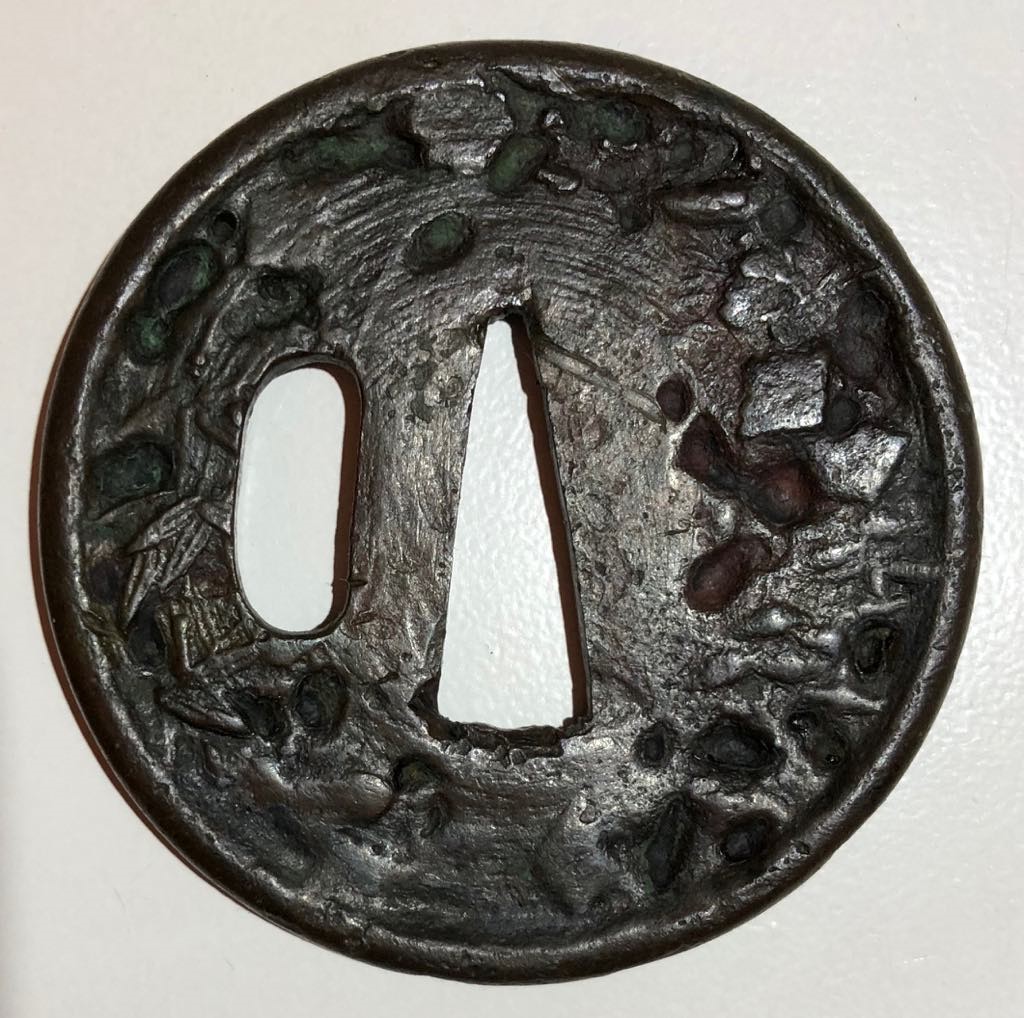 |
KAGAMI-SHI $2000.00 |
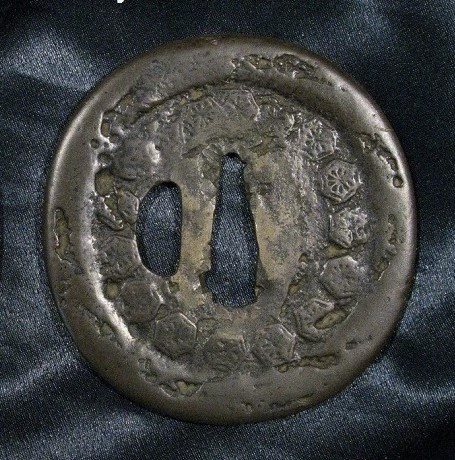 |
KAGAMI-SHI $3000.00 |
"Kokinko" refers to the works of metalworkers who did not belong to the "Goto" or "Mino" schools, such as those who made "tsuba," "kogai," "kozuka," "menuki," and other sword fittings before the Momoyama period. Old "kagami-shi" (mirror makers) also belong to the category of "Kokinko," with those from the Edo period being classified as "kagami-shi." The works of "Kokinko" and "Tachi-shi" have been used for a long time, exuding a unique atmosphere, and without any pretense, they are full of "ancient elegance and antique charm," possessing a "presence" and a subtle, timeless appeal."
  |
KO KINKO Please Contact Us For Price "Arabesque is one of the patterns that has existed all over the world since ancient times, although it looks slightly different. It was probably preferred because the way it stretched and grew on the vines suggested eternal life. This carving, which is accompanied by a flower of imagination, is a horizontal round shape that is also a feature that can be seen from time to time in the rising of the age. The plate is a mountain copper (yamagane) base with a deep color, and the surface is struck with fine stone joints, highlighting the arabesques and flowers that express a simple muscle carving with changes in intensity." (Haynes & Long) |
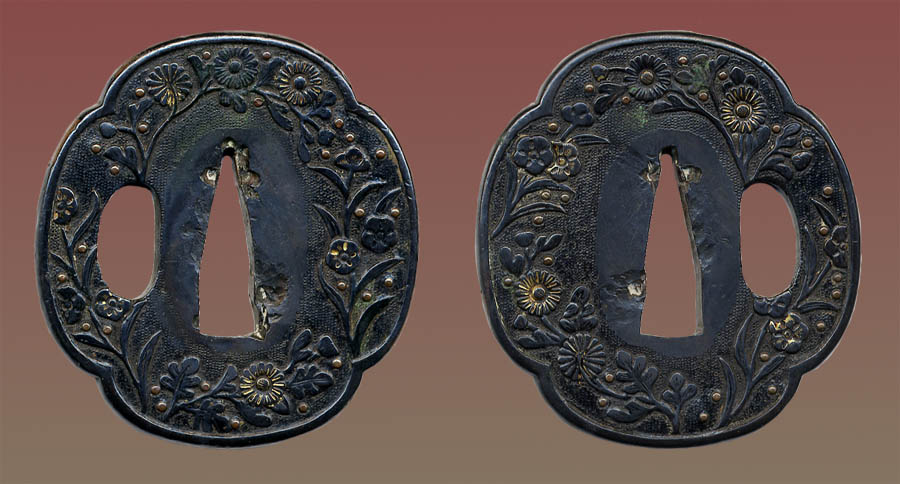 |
KO - KINKO $1500.00
"Accompanied by a Hozon certificate number 433796, issued by the N.B.T.H.K. "Mumei and attributed to Ko-Kinko. Momoyama period, ca.1450-1500. A Mokko-gata tsuba with thin shakudo plates covering both surfaces. Autumn flowering plants are represented with ten-zogan and iroe. The rim is covered with Shakudo-yakitsuke fukurin." (Long) 6.46cm x 5.94cm |
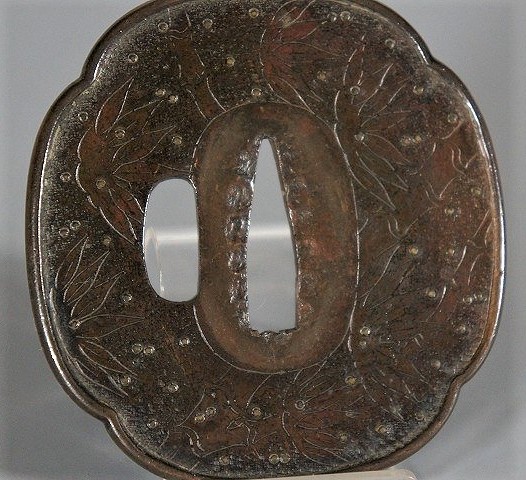 |
KO-KINKO $3000.00 "Dates to mid Muromachi period. Write-up to follow." (Haynes) 7.25cm x 8.15cm x 0.25cm |
  |
KO KINKO Please Contact Us For Price "Unsigned bronze tsuba (sword tsuba) with a certificate of special value, featuring a vine design and a paulownia wood box. Bronze base, quince shape, and indentations. The bronze tsuba has a slightly bluish hue and an elegant design reminiscent of a bronze mirror. The shape features indentations for a small knife, similar to a swordsmith's tsuba. There are some minor scratches and scuffs , though not noticeable." (Haynes & Long) |
  |
KO-KINKO Please Contact Us For Price "A Ko-Kinko tsuba with a En-ou rokkakyo (flower shaped mirror of squirrels and grapes) design. One hitsu is present with nakago-ana lined with copper. Muromachi period (15th-16th C.)" (Haynes & Long) |
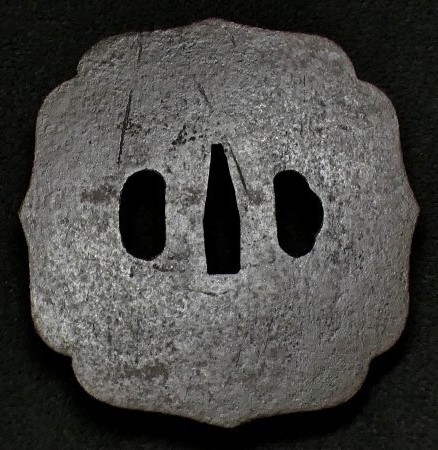 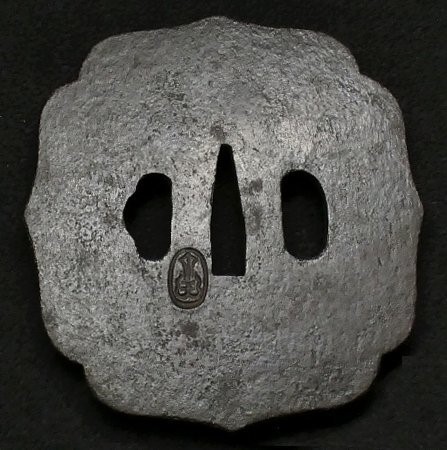 |
MIZUSHINKO MASAHIDE (seal) $500.00 |
"The term "Tachi-shi" is a general term for metalworkers who have been making the metal fittings for "Tachi-koshirae" (long sword mountings) since ancient times. While "Tachi-koshirae" were necessary for ceremonial occasions and were only worn by high-ranking individuals such as court nobles, daimyo, hatamoto, and koke, there was a certain demand for them. However, from the mid-Edo period onward, orders for "Tachi-koshirae" decreased, and they began to make other sword fittings such as tsuba (sword guards) that could also be used for "Hantachi-koshirae" (half-long sword mountings) and "Uchigatana-koshirae" (short sword mountings)."
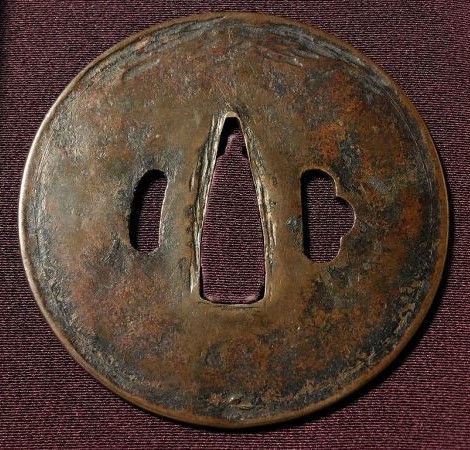 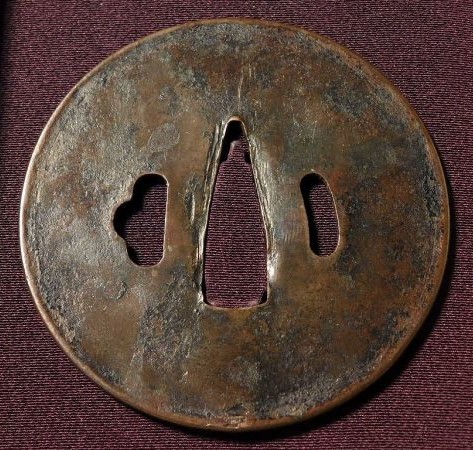 |
KANAGU-SHI $2000.00 |
 |
KYO KANAGU-SHI |
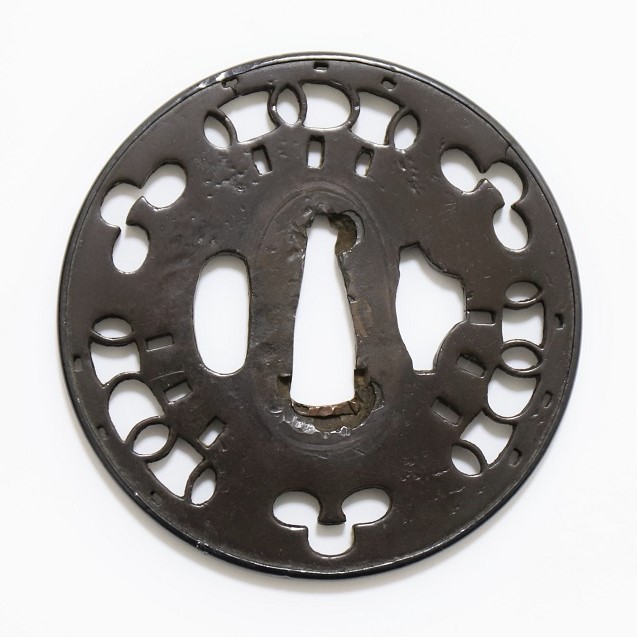 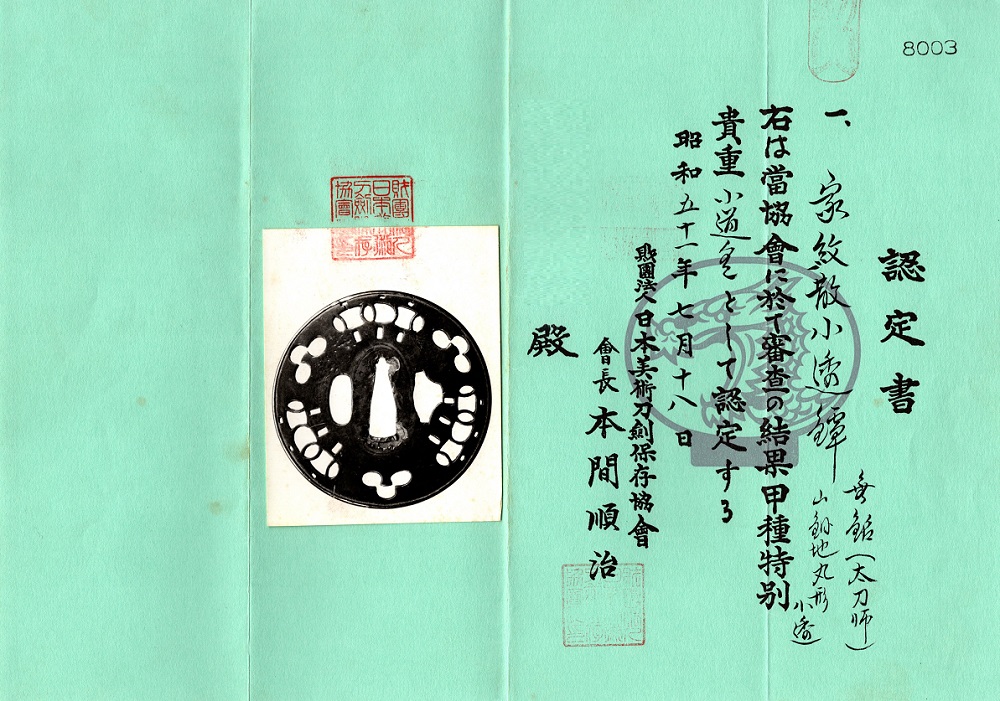 |
TACHI KANAGU-SHI Please Contact Us For Price |
  |
TACHI KANAGU-SHI Please Contact Us For Price |
  |
TACHI-SHI Please Contact Us For Price |
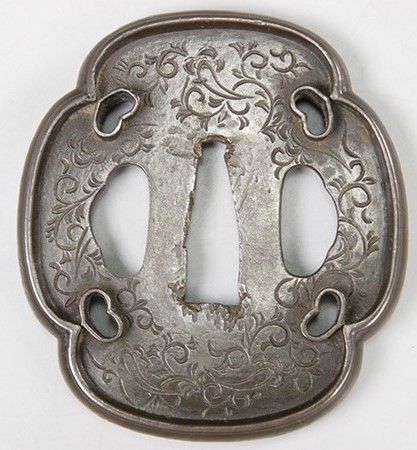 |
TACHI KANEGU-SHI |
  |
TACHI-SHI Please Contact Us For Price |
 |
TACHI-SHI Please Contact Us For Price |
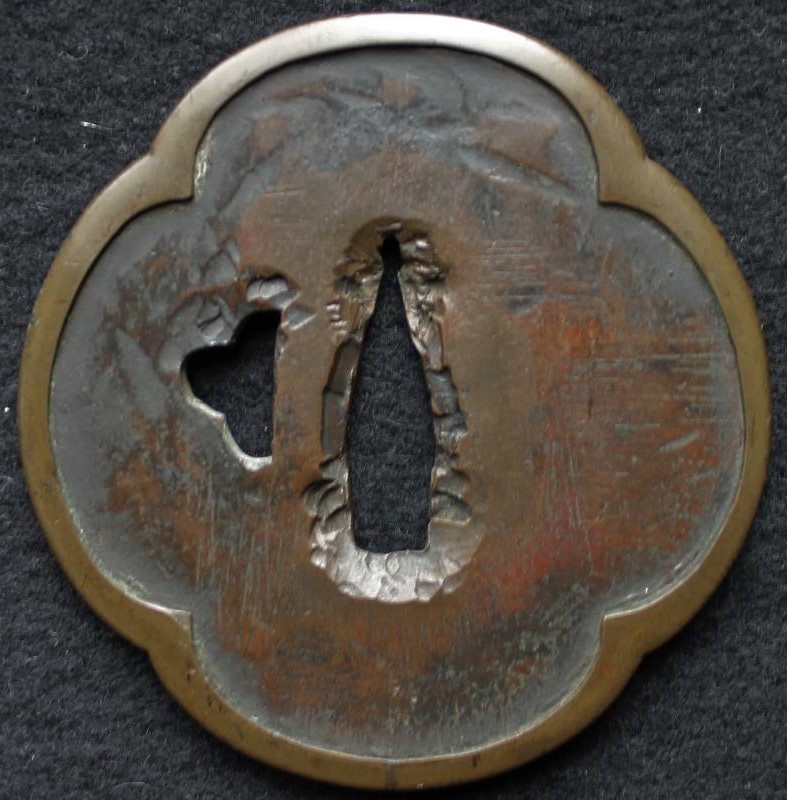 |
Tachi Kanagu-shi Please Contact Us For Price |
BUSHU/CHOSHU TSUBA
BUSHU ITO TSUBA
The term Bushu tsuba means the Ito school. The Ito school was native to Edo, where other schools were branch schools that came to settle. They were the most powerful and largest school in Edo, with influence over all the others who worked around them. The Ito school became so popular that schools as far away as Choshu felt compelled to adopt its style. The Ito school, along with the Shoami and Choshu schools, constituted the three largest and most dominate of the Edo age.
There are a number of problems concerning the origin and the organization of the Ito school. In reality there are two Ito schools: Edo Ito and Odawara Ito. The signatures and style of the tsuba on the Odawara Ito school and those on the Edo Ito school are entirely different. From this fact alone we may see that there was a separation of the school into at least two branches. Others contend that the artists of the two branches are really the same workers and that they merely changed their place of residence, from Edo to Odawara, and did not change their style in the process. The city of Odawara was a metropolitan center when Edo was just a village. During the Muromachi age Odawara was a very important center of power for the government.
It would seem that there is some truth to both of these contentions. In the early development of the school they were probably a single group with a common style, but later members of the school changed their residence and at the same time changed their style. The Edo Ito school was very prosperous and received orders from the Shogunate. The Odawara Ito school was not favored by the Shogun and had to be content with orders from minor provincial officials who lived near Odawara. What was the relationship of the Edo Ito school and the schools of the Choshu Province? The period of greatest influence of the Bushu on the Choshu style does not appear until after the middle of the Edo age. By the end of the Edo age the influence of the Edo Ito school is dominant.
On the whole these schools show good control of their material. The designs, though conventional, are well carved and the details are well handled. The style is gentle and quiet, expressing the peaceful age, and the luxury of the Shogunal court. The Edo Ito tsuba was beloved by the nobility as well as the commoner of Edo. Their best work was produced in the period from 1688 to about 1736.
CHOSHU TSUBA
The term Choshu tsuba means those pieces made at the city of Hagi in the province of Choshu, and includes the tsuba produced in Yamaguchi, Tokuyama, and Iwakuni (areas facing the inland sea). Hagi is cut off from the east, west and south by mountains which isolate it from the rest of the main island. For over two hundred years this area produced tsuba of Hagi style with little variation. The style pleased the samurai of the area, as well as those who occasionally saw this style of tsuba outside of the province. The Choshu tsuba originated at the beginning of the Edo age. The three earliest schools, of the eleven schools of Choshu, were the Kawaji, Nakai, and the Okamoto. They seem to have originated in the period from Kanei to Empo (1624-80). Though they were individual schools they show some Shoami influence and, in some cases, Umetada influence as well at this early stage of development.
There are two distinct styles to Choshu tsuba. One is openwork tsuba with the designs being the same, or virtually the same, on either side. The second style is solid plate with a different design on each side. Though the Umetada came to Choshu in the form of the Okada school, and the Bushu were to influence the designs of this school, the above two styles remained the same to almost the very end of the Edo age. The characteristics of the eleven schools are so similar that there is no need to describe each school in detail. There were separate family motifs and subjects, but they were all treated in either of the above two Choshu styles. For study purposes Choshu tsuba may be divided into two periods. The first is from the early Edo age to near the end of that period; the second period continues to the Meiji era. There were more than two hundred workers in the Choshu area in the Edo age. The tsuba of this large school of Choshu can not be judged as a group, a single family, or any one master. Each tsuba must be judged on its own merits. The inconsistency, and wide latitude in quality, make this essential for an understanding of Choshu tsuba.
 |
'BUSHU JU MASATOYO' Please Contact Us For Price "This is a superbly crafted tsuba by Masatoyo , a master of the Bushu Ito school (H 04679.0). It is beautifully carved in an idyllic rural landscape. The condition is excellant. Comes with a certificate of authenticity for the sword fittings. This is the actual item featured in "Tsuba Craftsman, Bushu Ito School book, pg. 64." (Haynes) |
  |
'CHOSHU JU ITOGA SAKU' Please Contact Us For Price "A stately tsuba with a scroll titled 'Qizheng'. It is built in a Go stone shape with slightly thinner edge than the face, and the surface has a varied expression of the stone style, which is one of the charms of this tsuba. The black iron of the ground has a profound feeling, and the jet-black (shakudo) scrolls that are scattered copper and bronze high carvings with gold and silver paintings, emerges on the stone faces." (Long) 7.97cm x 7.97cm x 0.45cm |
  |
'CHOSHU HAGI KAWAJI GONNOJO TOMOCHIKA' Please Contact Us For Price "Tsuba with snow ring and daffodils, Mid-Edo period, Hagi, Nagato Province. Although some of the inlay has fallen off, it still has an elegant appearance that gives a sense of free movement. Daffodils are also called snow flowers. It blooms dignifiedly even in the snow, giving off a refreshing fragrance. Because it withstands cold weather and produces beautiful flowers, it is also loved as a pattern that gives strength to overcome adversity. This piece use's nunome inlay, which is relatively rare for Choshu tsuba. The rim is also inlaid with nunome, giving it a gorgeous and bright look." (Long) Length: 82.2mm x Width: 82.2mm x Face thickness: 4.5mm x Rim thickness: 4mm |
  |
'MASANAGA' Please Contact Us For Price
"Bushu Ito family. Tsuba Kanshoki, pg. 229. Haynes Index H 04247.0" (Haynes & Long) 8.02cm x 7.68cm x 0.43cm |
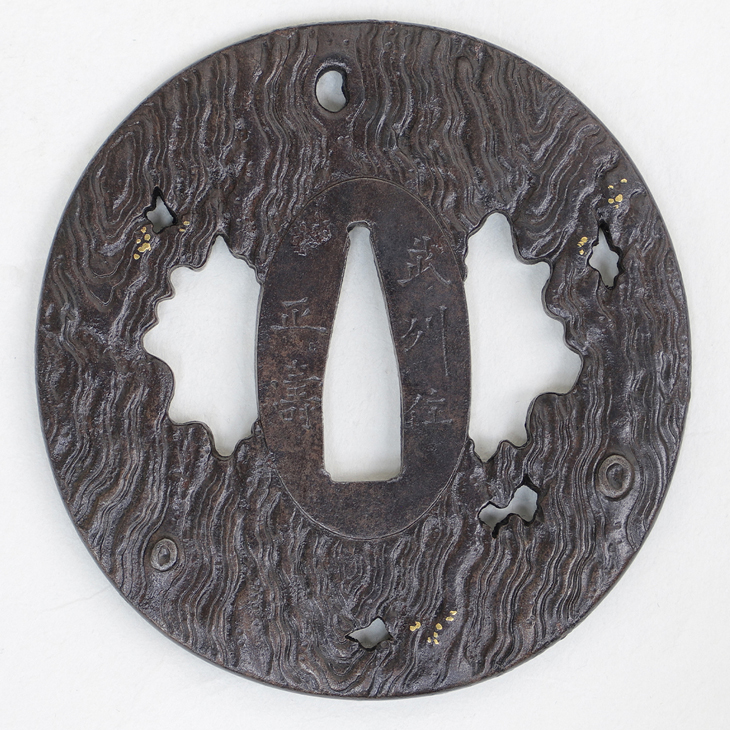 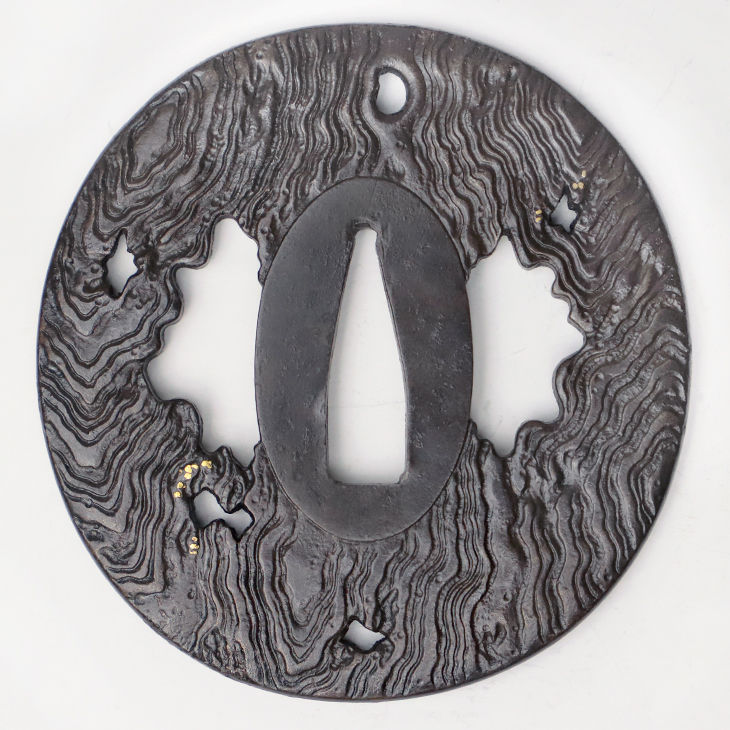 |
'BUSHU JU MASATOSHI' $1500.00
"Iron ground circular plowed hair carving, small openwork slight gold inlay. The shape of both hitsu are also unique and interesting, matching the grain of the cedar." (Haynes & Long) 7.51cm x 7.22cm x 0.55cm |
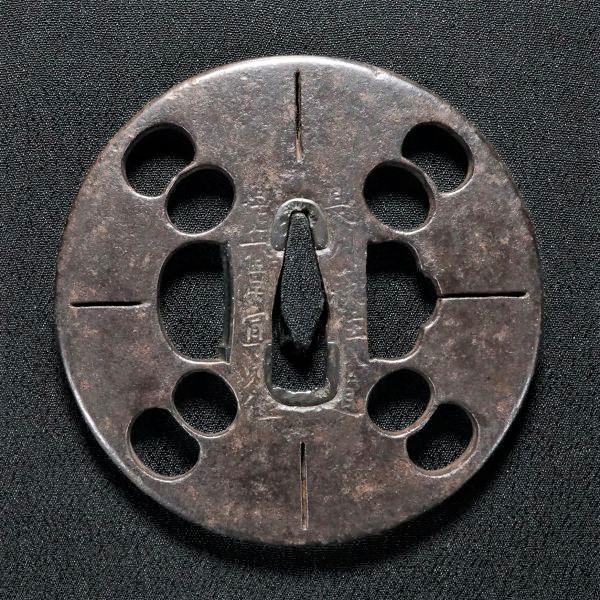 |
'CHOSHU HAGI JU ....?YOSHIKATSU SAKU?? Please Contact Us For Price "Inscription iron tsuba "Cross watermark on layered rice cake" Zenbei Nobumasa (next?) Choshu Hagisumi Hachido Nagato Middle Edo period. Iron ground Round square ear small meat Shadow watermark / Shadow watermark It is a shadow watermark with a unique pattern. The iron ground forging, iron taste, and production are all good, and the bright natural rust color is also beautiful. The last two letters of the inscription are worn, making it difficult to read. Further study on Mei is on going" (Long) 7.40cm x 7.35cm x 0.49cm |
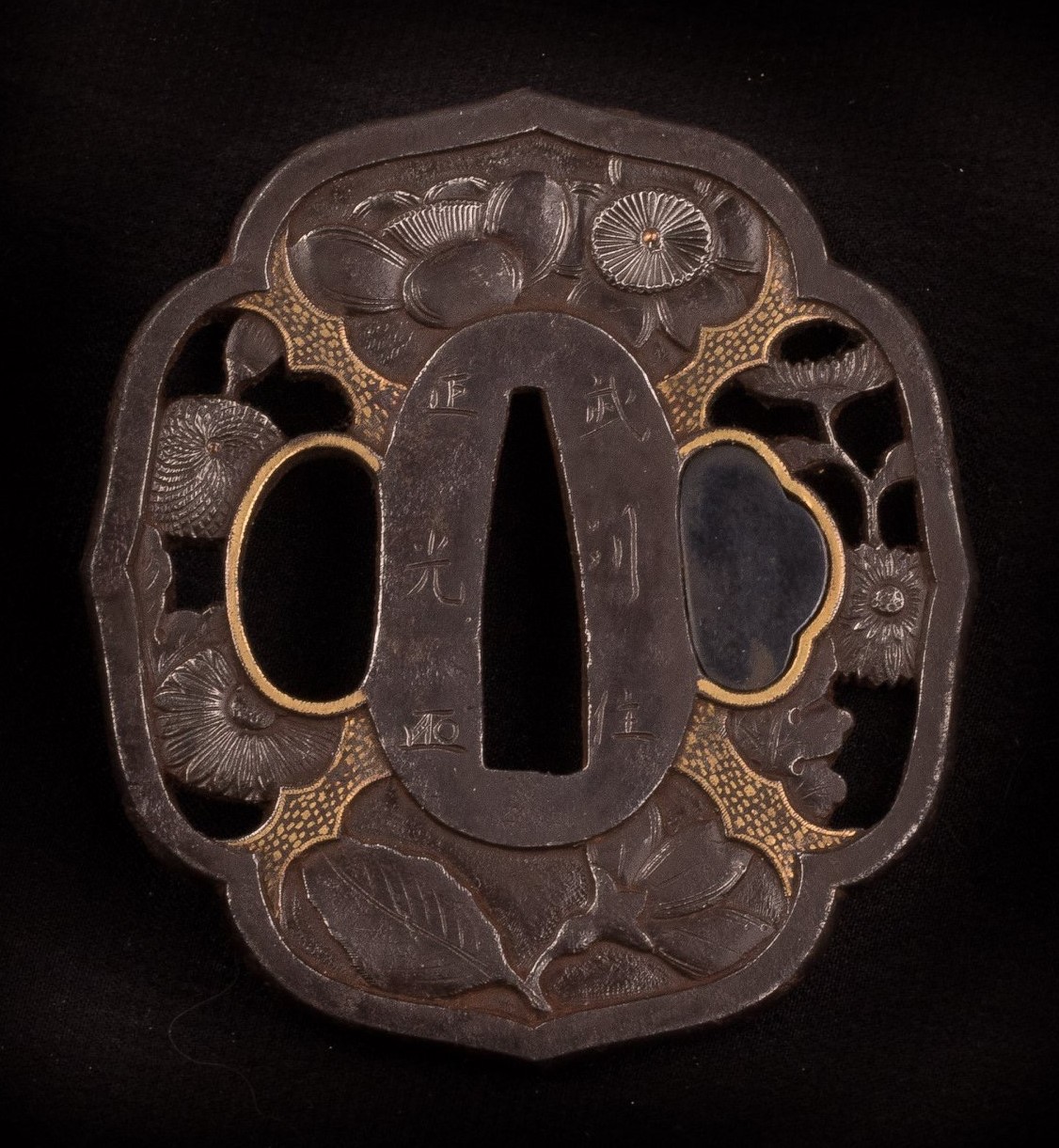 |
BUSHU JU MASAMITSU and Kao $800.00 "A very elegant iron plate tsuba in aoi gata shape. Various plants are finely carved in both positive and negative sukashi. At the four cardinal points are stems with inlay of gold. Both hitsu-ana are outlined in gold also. Mei reads 'BUSHU JU MASAMITSU'. There were a number of Masamitsu artists that worked in Bushu, which one made this is unknown. The Kao is unrecorded." (Long) 6.15cm x 6.80cm x 0.40cm |
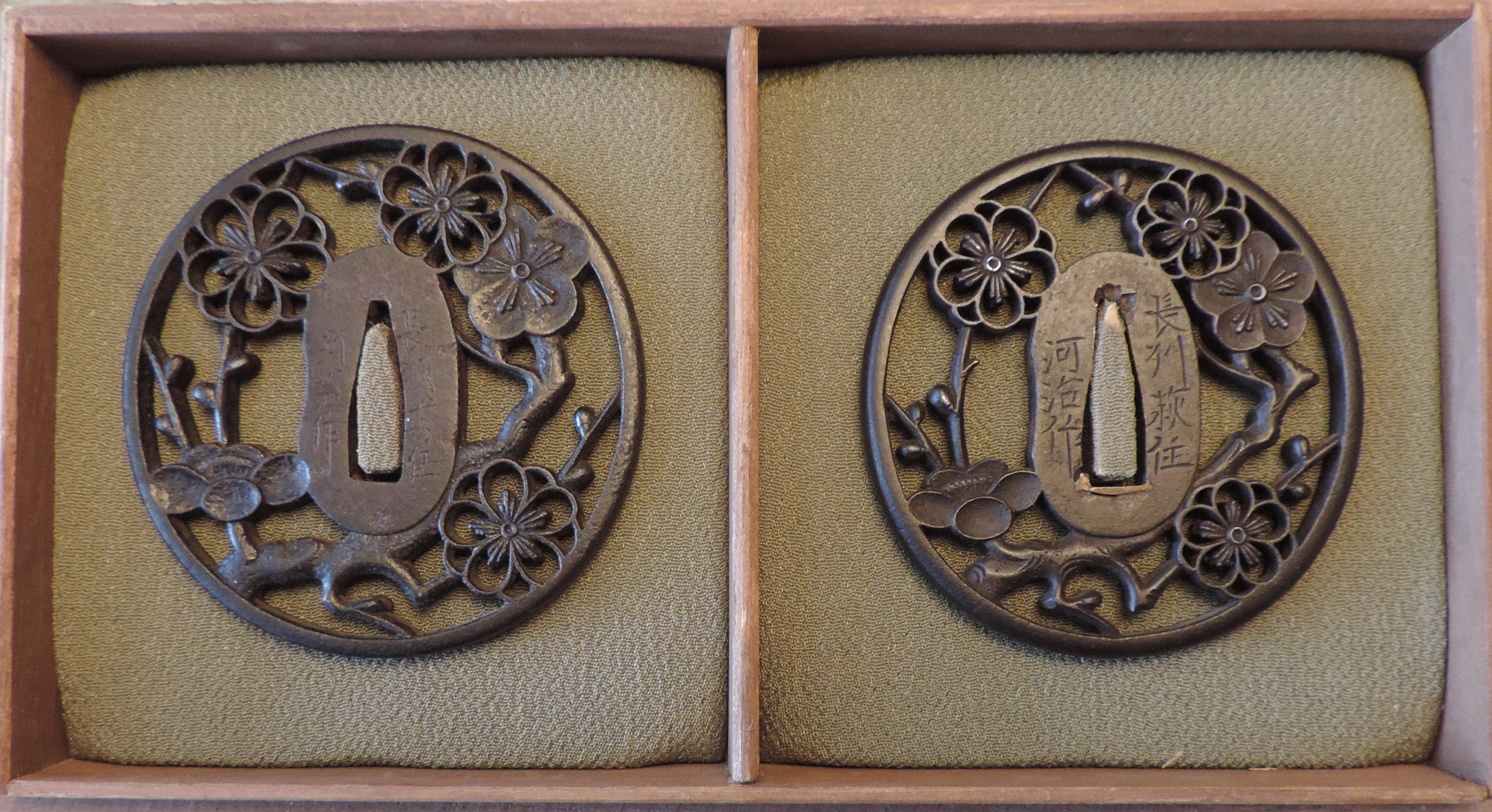 |
"CHOSHU HAGI JU KAWAJI SAKU" $2000.00 "A very elegant iron plate DaiSho set in marugata shape. Various cherry blossoms, both in negative and positive sukashi, are finely carved. Mei reads "CHOSHU HAGI JU" "KAWAJI SAKU". Refer to Haynes H 02969.0. Done by a family member in ca. 1800. Which family member is unknown." (Long) Dai: 7.50cm x 7.60cm x 0.50cm. Sho: 7.00cm x 7.30cm x 0.50cm. |
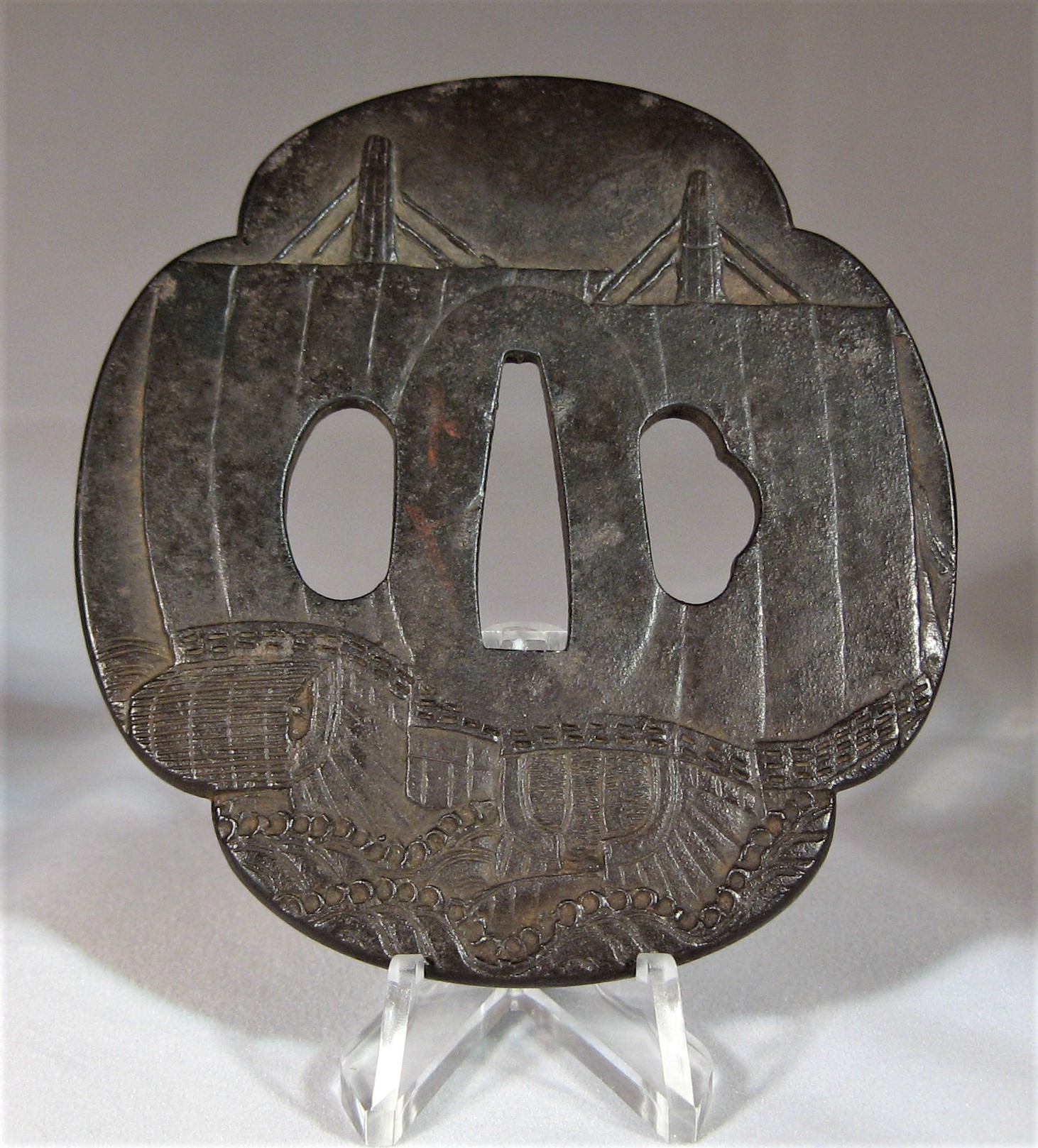 |
CHOSHU TOUSEN Tsuba $700.00 "Iron mokko shape tsuba. The subject is a pair of "Morukoshi-fune", or "Tousen", or Chinese ships. The term was liberally applied to all foreign ships. Under Sakoku edicts most of Japan was cut off of foreign trade. Some Nagasaki carvers, like Onitake Toshiyoshi, were also known to have worked in Hagi, Choshu. They would have seen Chinese ships tied up at the docks, and Dutch vessels riding at anchor in the harbor. Seems likely the image was copied from a print." (Long) 7.70cm x 8.20cm x 0.32cm |
MITO School
Mito is famous for the kinko artists who lived there from the mid Edo age until the Meiji era. Slightly before the Kambun era (1661-72) Akashi Yodayu worked at Mito. In the Hoei era (1704-11), about thirty years later, Gunji Koami Yogoro was working at Mito in the same style as Yodayu. They used iron, copper, or brass plate and worked in the Shoami style of ubu-sukashi and relief inlay work, as well as in line carving. The general tone of their work is quiet and subdued. The most famous student of Yogoro was Yatabe Tsuju (often called Mito Tsuju). He worked in the Kyoho era (1716-36). He made many tsuba of iron in round or oval shape with dragon design in ubu-sukashi with very fine detail and silver hira-zogan geometrical patterns inlaid on the edge. He also made tsuba with high relief inlay in the kinko technique, but these are very rare.
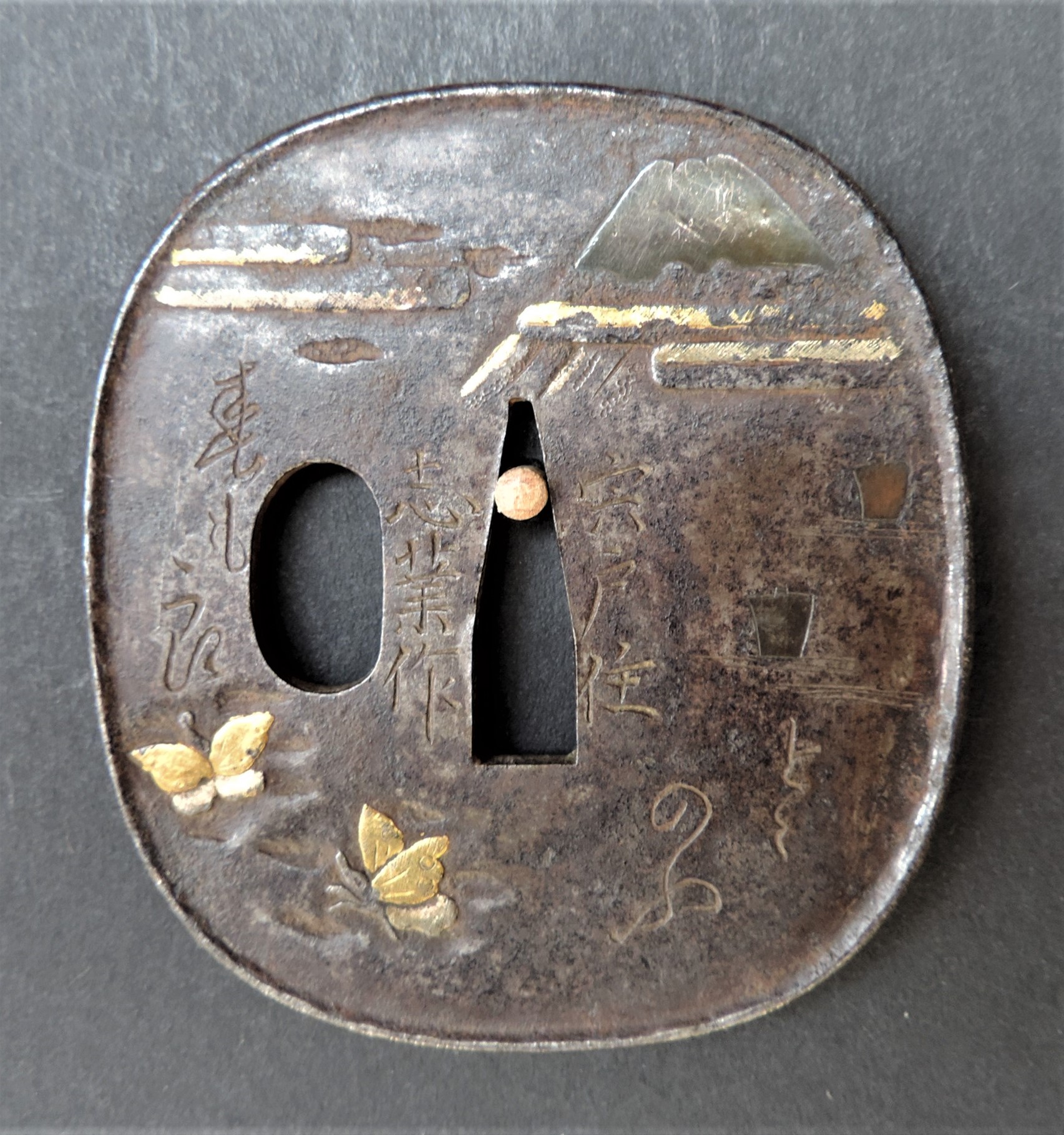 |
'KATSUNOBU' $800.00 "Iron plate of rounded oblong shape with a slight raised rim and hammered mimi. The face with Mt. Fuji and two gold butterflies, and a carved poem. The back with a silver cresent moon and gold cherry flowers. The face is signed: 'Shishido ju' (probably in Mito Prov.) and on the left: 'Shigyo Saku', which would seem to mean "I made this work as a gift." On the back is: 'Oshoku Tadayuki ko' which means, made to the taste of Mr. Oshoku. On the left of the back is: 'Mito ju KATSUNOBU'. An unrecorded artist that now has the number H 02848.B. All of this inscription is very unusual and it would seem that this was a very special order work and probably between friends." (Haynes) 6.80cm x 7.45cm x 0.45cm (rim) |
  |
'JOGETSUSAI HIROYOSHI' Please Contact Us For Price "This is a large tsuba with a frog design on a quince-shaped lotus tsuba, signed Jogetsusai Hiroyoshi (H 01449.0), with double hitsu-ana, high-pitched carving, hair carving, gold and silver grain inlay. This is a masterpiece with a cute frog peeking through the openwork on a large tsuba with a vertical width of over 8.5 cm. Jogetsusai Hiroyoshi is a disciple of Ichijosai Uchikoshi Hirotoshi (H 01416.0), a master of Mito metalwork. An explanation is included in the "Tatakara Kinkojiten"." (Haynes) 8.61cm x 7.87cm x 0.43cm |
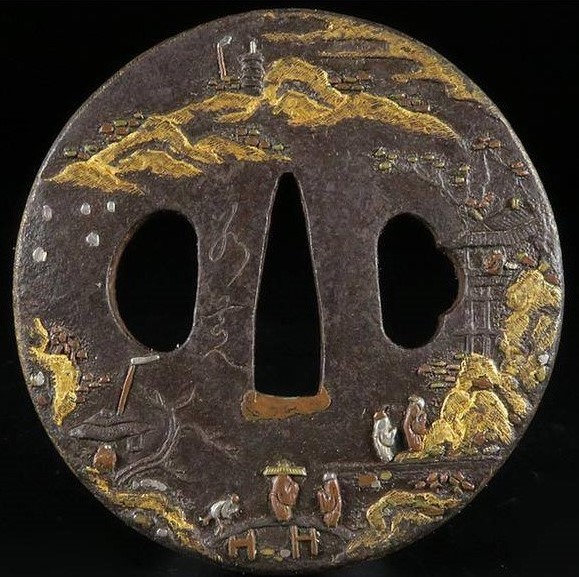 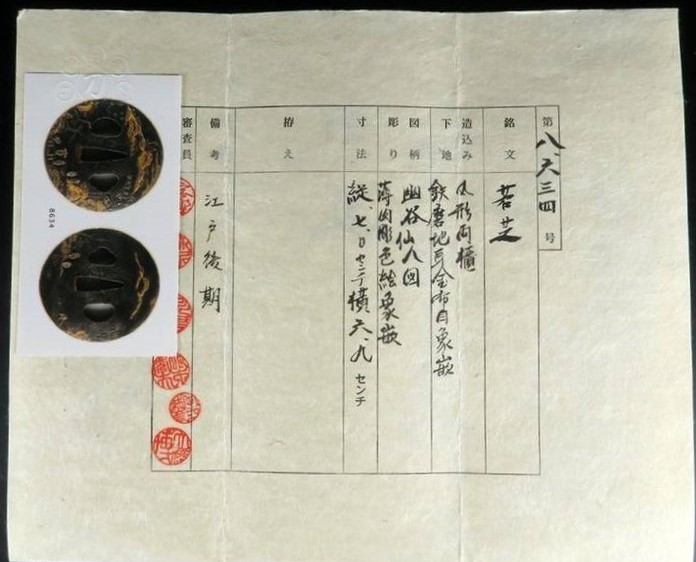 |
'JAKUSHI' $1800.00 "This piece illustrates the powerful influence of contemporary Chinese Nanga Literati painting. The use of soft metal (copper, gold, silver, shakudo) inlays to portray foliage, mountains, architecture, and human figures is consistant with the best workmanship of the Jakushi masters, Koreyuki and Koremitsu. The entire piece displays a high level of artistic refinement and sophistication. Exemplary Jakushi school tsuba, signed with two characters. One of the many examples of the sosho signature of the Jakushi family school. They lived and worked in Nagasaki of Hizen Province. Accompanied with NTHK origami." (Long) 6.85cm x 7.10cm x 0.55cm |
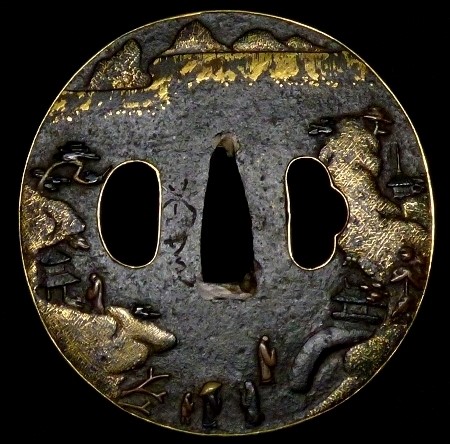 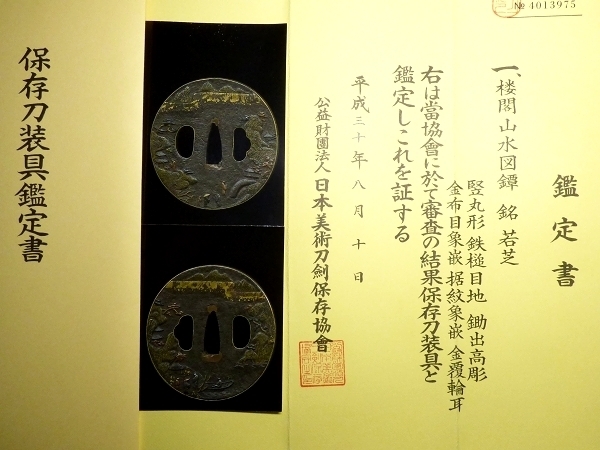 |
'JAKUSHI' $2500.00 "This piece exemplifies the powerful influence of contemporary Chinese Nanga Literati painting. The use of soft metal (copper, gold, silver, shakudo) inlays to portray mountains, architecture, and human figures is consistant with the best workmanship of the Jakushi masters, Koreyuki and Koremitsu. The entire piece displays a high level of artistic refinement and sophistication. Accompanied with NBTHK origami."(Long) 6.95cm x 7.25cm x 0.41cm |
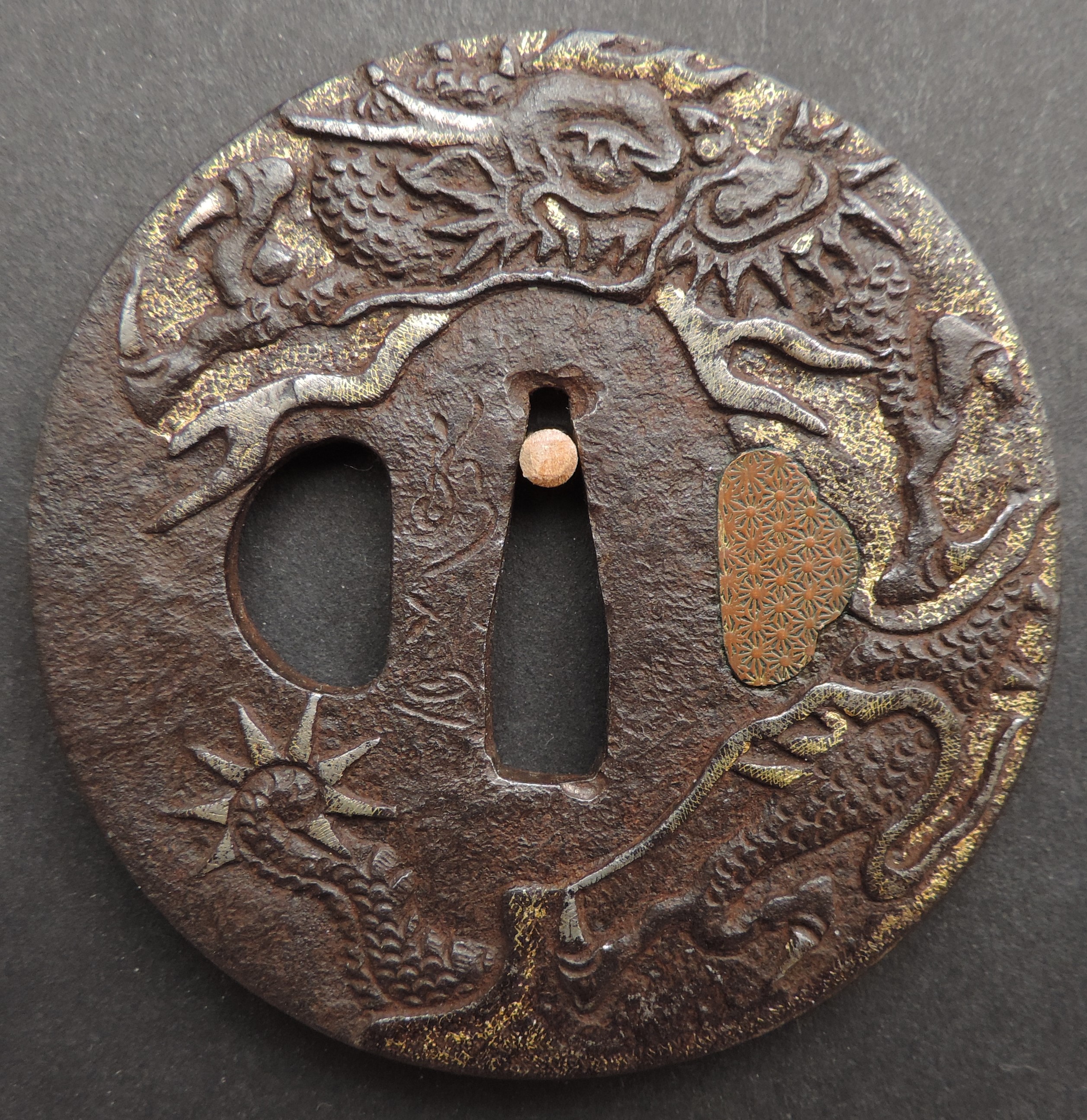 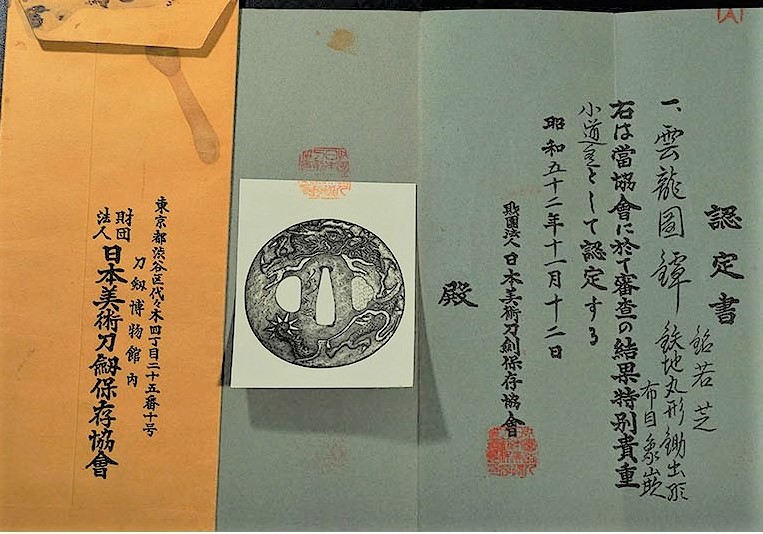 |
'JAKUSHI' $1300.00 One of the many examples of the sosho signature of the Jakushi family school. They lived and worked in Nagasaki of Hizen Province. Accompanied with NBTHK 'Green' origami. 7.00cm x 7.20cm x 0.50cm |
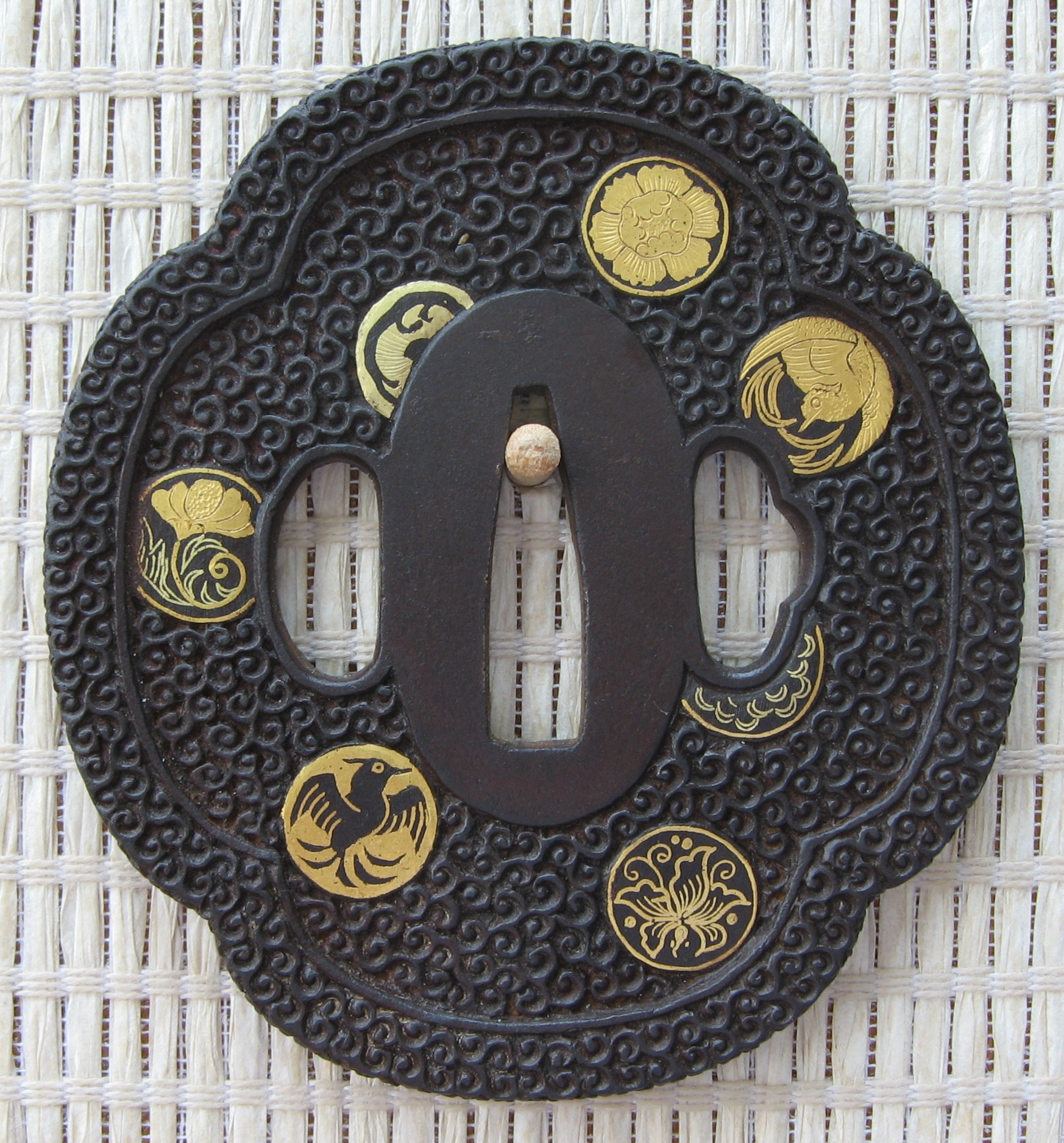 |
HIZEN $1000.00 A presentation tsuba of mokko shaped iron plate covered with fine karakusa carving on both faces and the rim. There is an internal border just inside the rim of the same mokko shape, both sides. Also appearing are seven mon on the omote and three mon on the ura. 7.10cm x 7.73cm x 0.49cm |
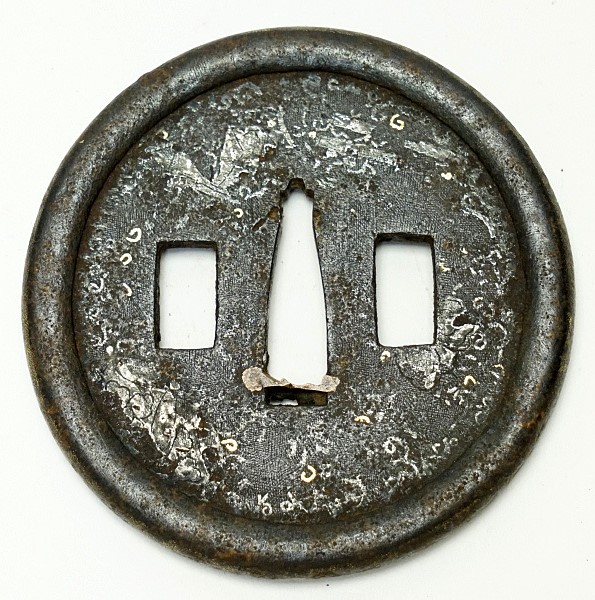 |
HIZEN/KIRIFUMI work $800.00 A very nice example of Hizen work dating about ca. 1500. The design is of 'Chinese Good Luck Objects' which is seen often from this area. The Katchushi-style plate is of this same period, ca. 1500. The rectangular hitsu are typical of Hizen work. 7.51cm x 7.38cm x 0.55cm at seppa-dai. |
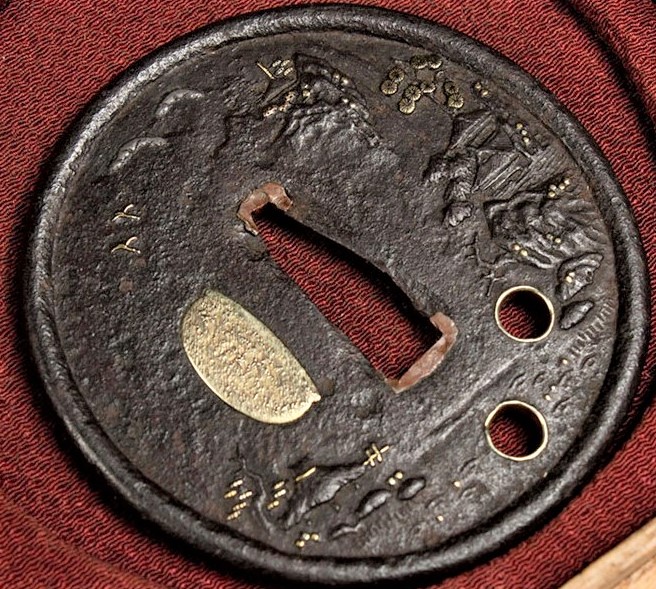 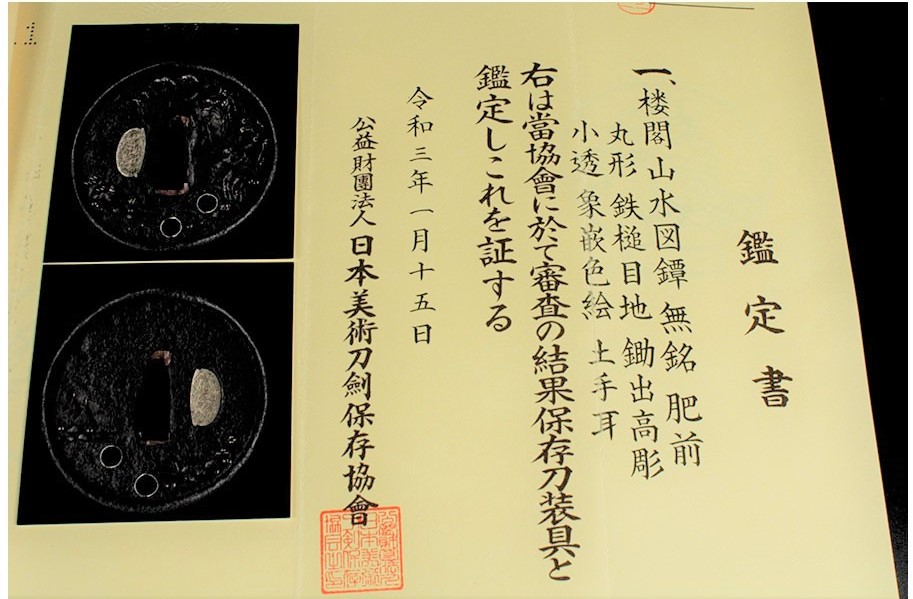 |
HIZEN/SAGA KANEIYE work $1400.00 "This fine iron tsuba for a Japanese sword has a maru gata circular form, with sekigane in the nakago ana, a look of great strength and a well patined surface. It has a filled kotzuka-ana. The well patined surface is carved in a delicate manner in katakiri bori on both faces. The subject depicts a peaceful landscape, with two Tsuru alighting above, and mountains rising in the distance. The design looks like a painting, it is in the tradition of Chinese Sung dynasty landscape painting, and of the ink drawings of the Japanese painter Sesshuu. 7.45cm x 7.65cm x 0.49cm (rim) |
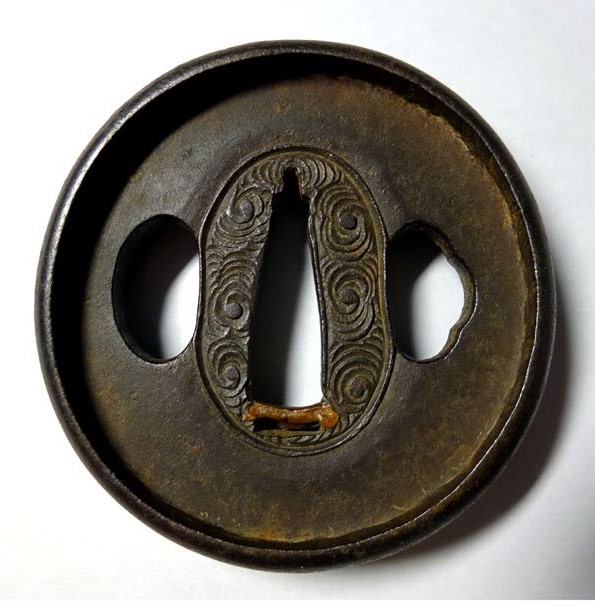 |
HIZEN/NAGASAKI work $500.00 Edo era iron plate with carved wave design on both seppa-dai. A very large uchikaeshi rim. The plate is well-hammered to an almost polished finish. The finished plate was then placed inside the large rim. The piece is crafted very well. 6.63cm x 6.45cm x 0.40cm at seppa-dai, 1.40cm rim width. |
MINO School
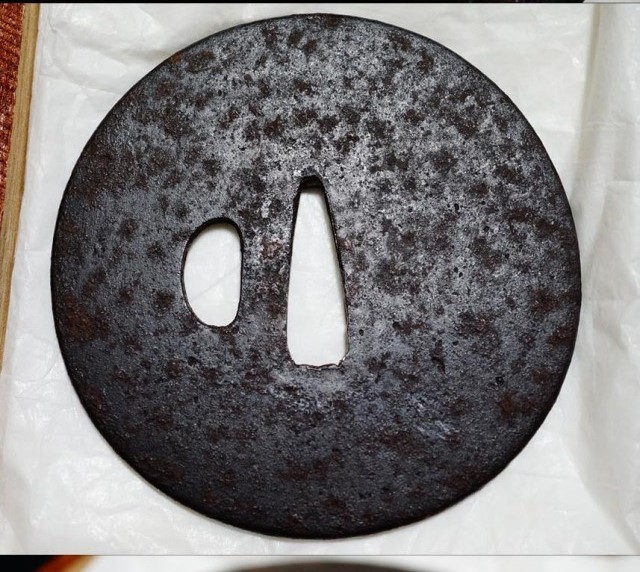 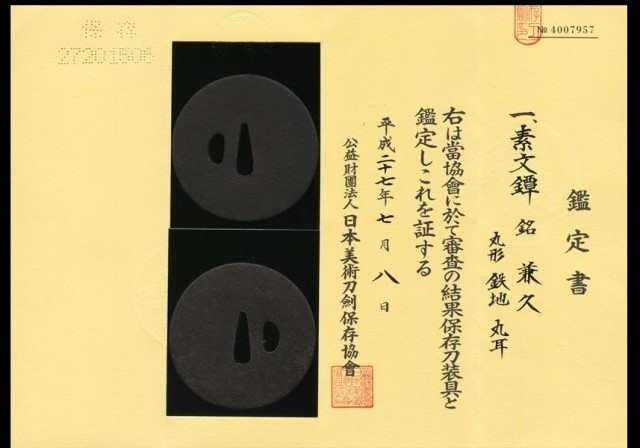 |
'KANEHISA' $1000.00 "Iron maru-gata shape tsuba with maru-kaku mimi. A very rare Mino swordsmith tsuba by Kanehisa who was the son of Nao Shizu Kanetoshi during the period of the Northern and Southern Courts. Certificate of Authenticity from NBTHK. Hozon Tosogu." (Long) 8.60cm x 8.50cm x 0.40cm |
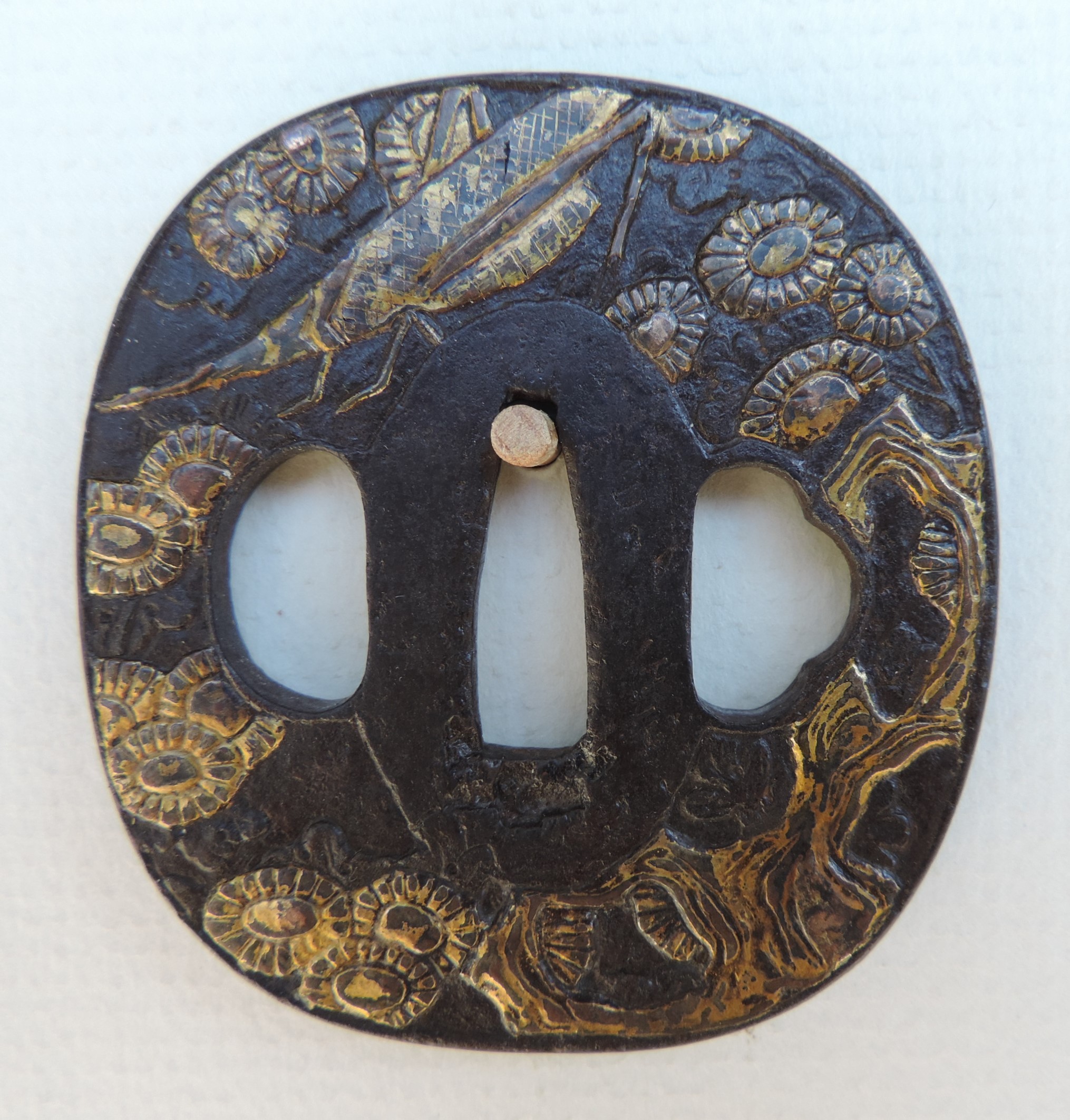 |
MINO BORI or EZO UNDER STUDY "Early Mino work often depicts gardens and insects, in deep relief, bringing to mind that the world is beautiful, yet risk is ever present. A rare Mino Bori tsuba with design of cricket and chrysanthemums on both omote and ura. An iron plate of rounded square shape with gold gilded copper overlays. The fire gilding attaches very well to copper but not iron. The marks on the right side of seppa-dai have unknown meaning. 6.40cm x 6.80cm x 0.5cm Dates to the Momoyama period." (Long) |
According to the statements of Inaba Tsuryo, and the late Kuwabara Yojiro, Toshinaga was thought to have been a student of the fourth Nara. It is logical to make the division of old, from new, Nara work at the period of Toshinaga. He was the father of the new style of the Nara school and those artists previous to his time worked in a style that better represents the meaning of the term Ko-Nara.
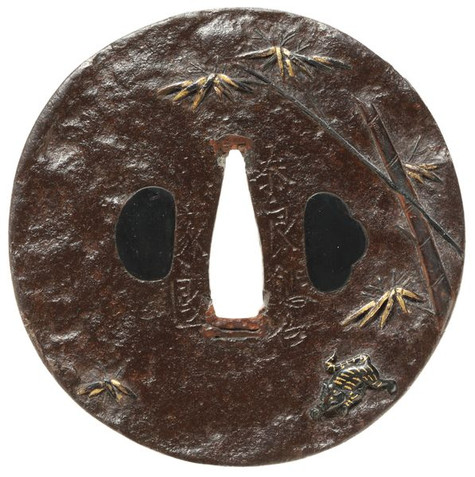 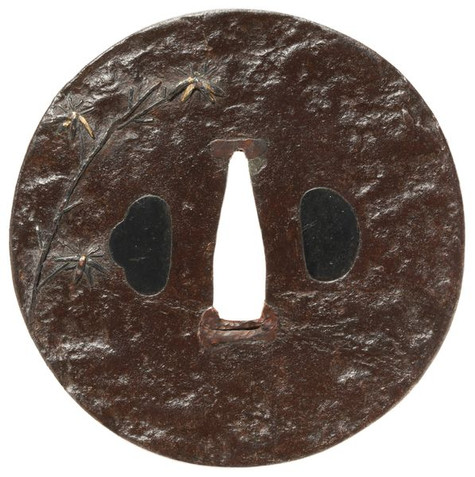 |
'NARA KAJI IEKUNI' Price On Request "The inscription proudly engraved on the kiri-waki: 'NARA KAJI IEKUNI'. H 01778.0. This is early Edo period work from the Yamato Province. Iekuni is the most outstanding craftsman among the Nara kaji school. It is very rare to have soft metal inlay by this artist. This tsuba was in the collection of Kenichi Kokubo. It is illustrated in his book: ZABO TANSEN (1974), page 404." (Long) |
  |
'TOSHIKUNI' Price On Request "Iron ground corner cut square shape. The work of TOSHIKUNI (H 10404.0) of the later generation of the Nara school. It is very heavy and powerful." (Long) |
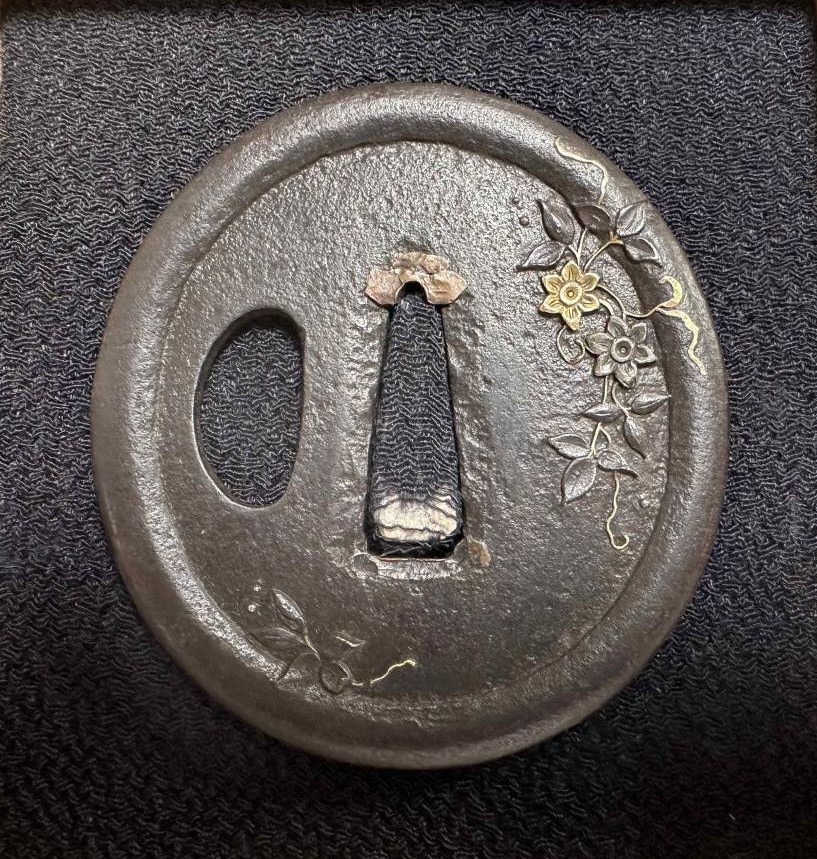  |
KO-NARA Price On Request "A Ko-Nara iron tsuba of slight oval shape. The design of blossoms inlaid with gold, silver, and copper. The composition is artistic and in keeping with the size and shape of the plate. After the time of Toshiteru the other members of the family, and the school felt that they should differentiate their style from that of the Goto. To accomplish this they chose to apply it to iron plate rather than soft metal. In this way they could still display their decorative skill and achieve popularity. This Ko-Nara tsuba is graceful and precise in feeling. Dr. Torigoye (using his full family name) awarded a 1st class Hakogake." (Long) 7.50cm x 7.00cm x 0.40cm |
  |
'SHOZUI' Price On Request "Presented here is a masterpiece tsuba in which the Tang warrior figure is expressed with wonderful workmanship by a splendid carving method in which the periphery of the pattern is carved deeper and the inside is made in thin relief, so that the pattern is not higher than the base. Hamano 'SHOZUI': H 08803.0. Student of the first Nara Toshinaga and considered the founder of the Hamano family school. He is now thought of as the fourth member of the Nara Sansaku. His works, like his masters, are small in stature. In addition to iron, there are also materials such as bare copper, silver, and brass. His style shifted from a gentle and elegant style of the early Nara school style that represented small patterns with thin flesh to a powerful style that represented large patterns with high flesh. Thus his own work was a combination of the Yokoya and Nara school styles. He can be considered as the true founder of the Edo machibori artists." (Long) |
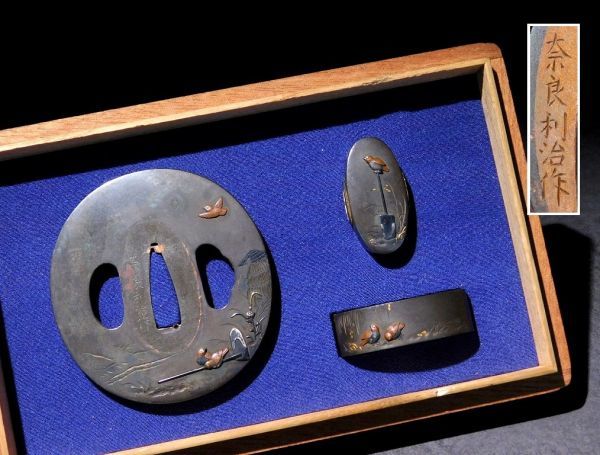 |
'NARA TOSHIHARU SAKU' Price On Request "A masterpiece of preeminent skill that uses a variety of colored metals such as gold, silver, red copper and copper on the soft grayish background that emits a dull shine, and performs very delicate inlays and overglaze representations. Signed: 'NARA TOSHIHARA SAKU' (H 10316.0). A master craftsman who succeeded the Nara family as the second generation, and is highly regarded for his achievements." (Long) |
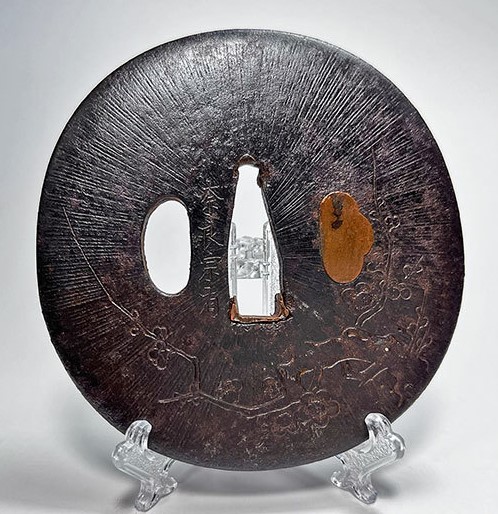 |
'NARA SOYA' (TOSHIHARU H10316.0) Price On Request "Iron plate round shape (maru-gata) with Amida yasurime. The plum and bamboo design done in kebori. In addition to the fine chiseling of the plums and bamboo leaves, the Amidaba file marks, which are elegant like a halo, creates a profound beauty. A very orthodox beautiful iron tsuba of the NARA school. Signed: 'NARA SOYU'. This is TOSHIHARU, son of Toshimune (H 10591), student and preparer to Nara Toshiteru (H 10591) and Toshimune (H 10463). See Haynes Index H 10316.0." (Long) 7.93cm x 7.59cm x 0.45cm |
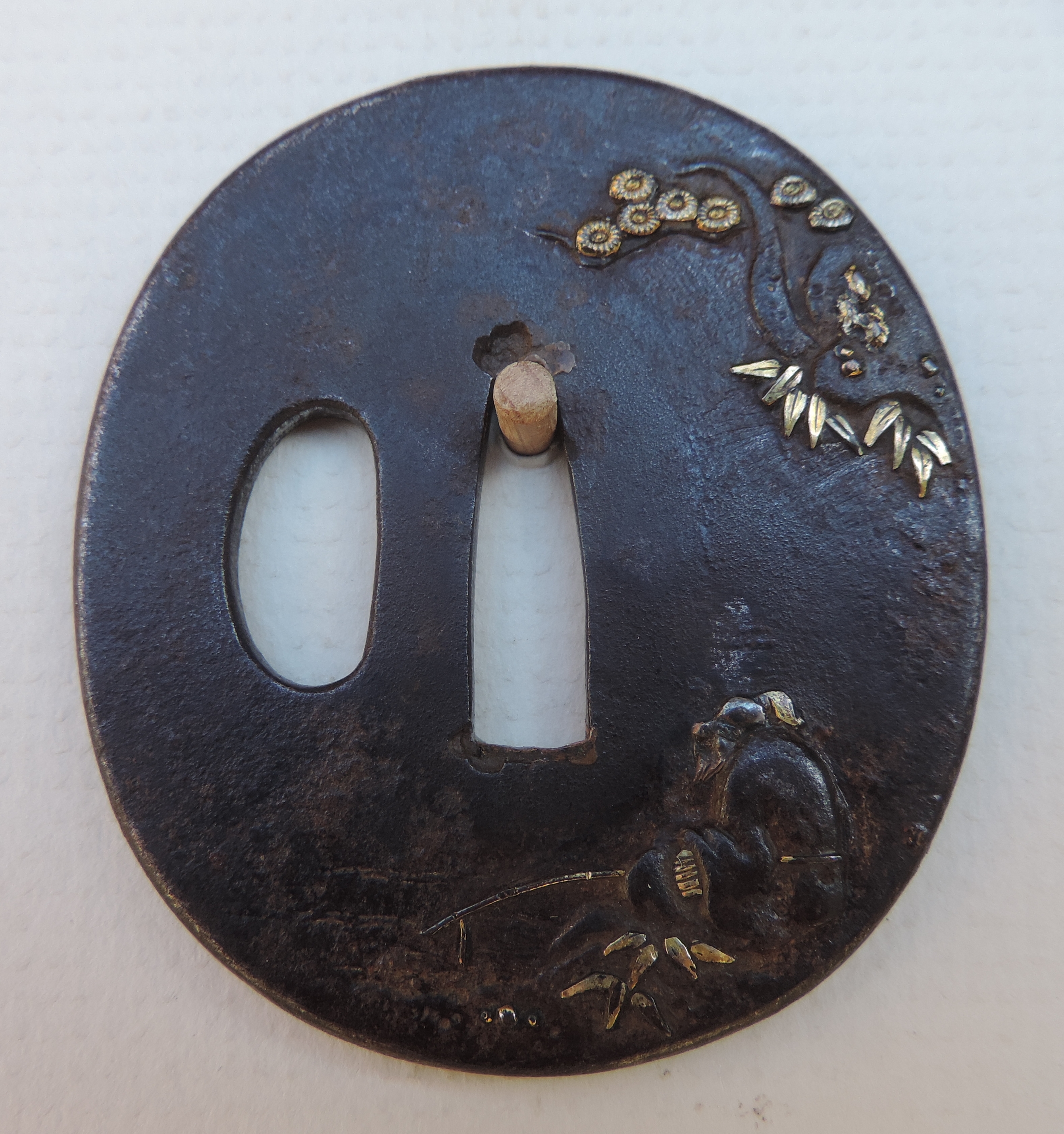 |
NARA $600.00 "A small iron (tetsu-ji) tsuba of an angler ("Tsuri Jinbutsu") with a fishing rod. Possibly along the Uji-gawa river and close to the Ogura-ike lake. This area was known as the best place to enjoy the landscape overlooking the scenic river and lake. There is delicate inlay of the chrysanthemums, foliage, and the fishing pole, all in gold. The intire scene is very serene." (Long) 5.95cm x 6.60cm x 0.35cm |
Smiths working on Sado Island during the middle of the Edo age produced tsuba that have an antique feeling, but do not seem to be of any certain origin, style, or school. They are usually the work of Sado Sanzaemon. His name is first mentioned in the Shimpin Zukan (this is not the Toban Shinpin Zukan). He worked in a mixture of Owari, Akasaka, and Kyo-Sukashi openwork styles. The walls of the openwork tsuba are wider than those made by the schools mentioned above. This gives a slightly heavier feeling to the Sado tsuba. Sanzaemon was a sword ornament maker who worked in the Shotoku to Kyoho period (1711-1735). He was arrested for an unknown indiscretion and sent to Sado Island, a favorite place for exiles, for several years. While there he made tsuba for the magistrate of the Sado gold mine. The name of this man, who became the patron of Sanzaemon, was Fukushima Kunitaka, who was the son-in-law of Ujiyuki. Kunitaka went to Sado Island with Matsumiya Kanzan, author of the Toban Fu (similar to the Toban Shinpin Zukan). They became students of Sanzaemon. Kunitaka enjoyed drawing designs of tsuba that Sanzaemon would make. Many were in the shape of the kanji "kuni". These three artists are justly famous for their work. In later years Sanzaemon was able to return to Edo to finish his days a free man. In the 19th century two descendants of Sanzaemon were working on Sado Island. They were the first Toshisada and his son, the second Toshisada. They made fine openwork, ubuzukashi and a few flat plate tsuba. They had one student, Yoshifuru.
The plate metal of Sanzaemon tsuba is of soft iron, rich and of good temper. The best quality of his plate resembles old Higo tsuba. They have a simple antique feeling, though they are not very old.
 'SANZAIMON' |
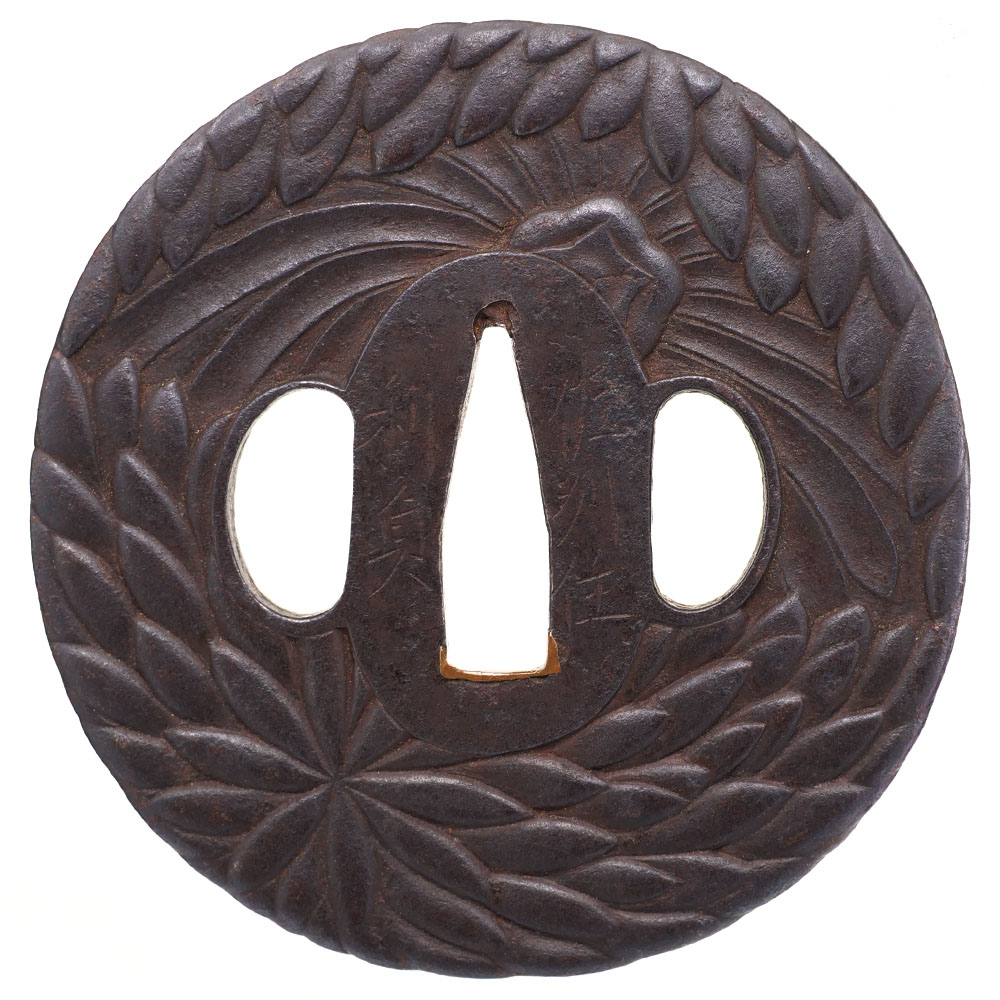 'SASHU JU TOSHISADA' I |
 'SASHU JU TOSHISADA' I |
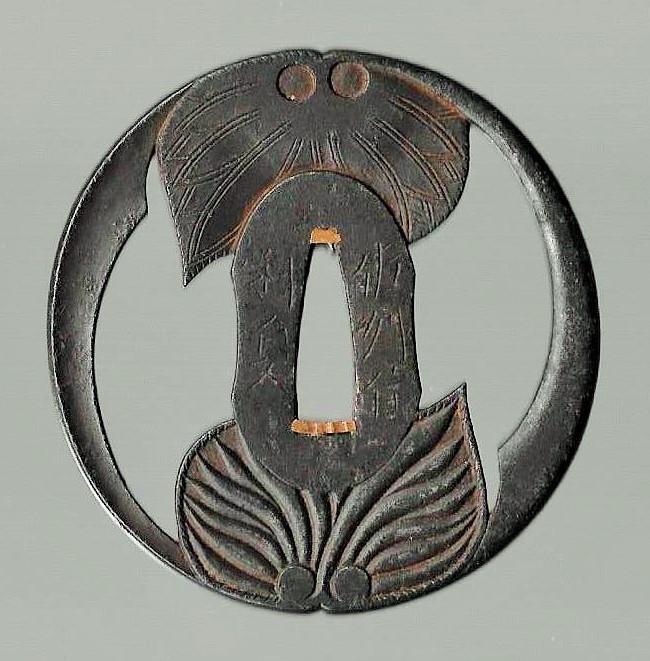 'SASHU JU TOSHISADA' II |
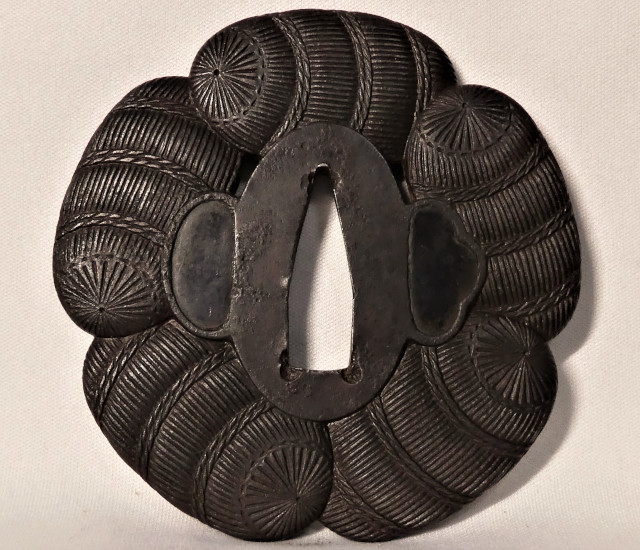 'SASHU JU TOSHIHIDE' |
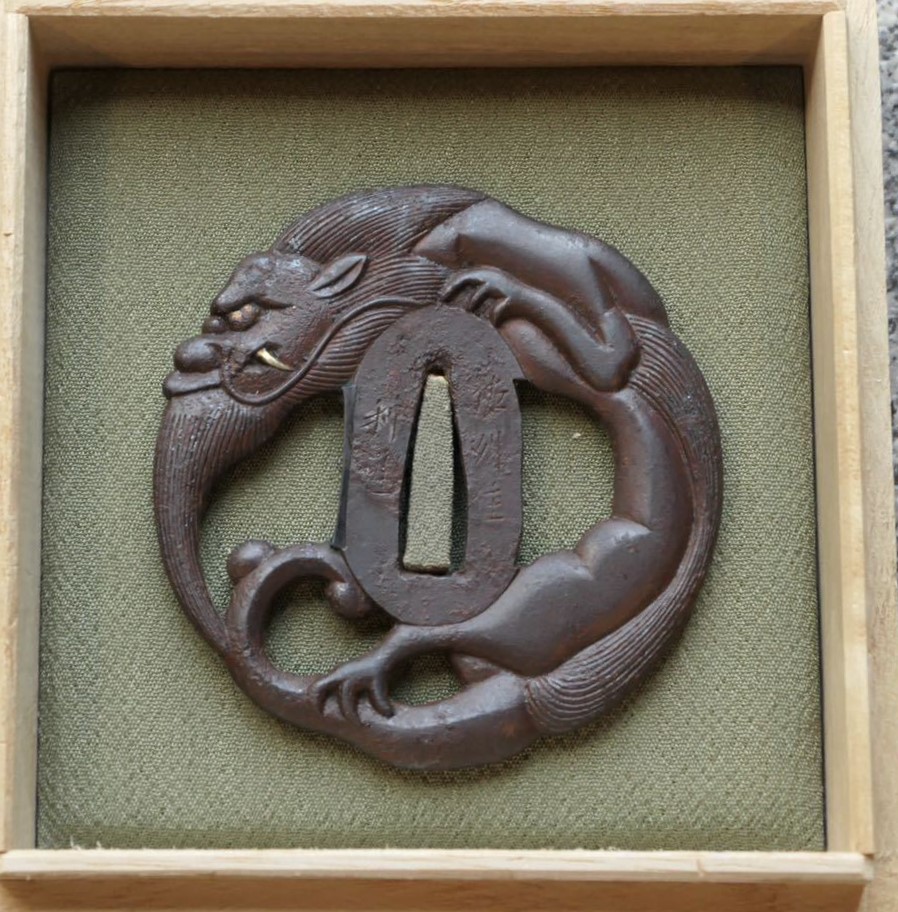 'SASHU JU TOSHIUJI' |
 'SASHU JU TOSHIUJI' |
 'SASHU YOSHITAKA' |
 SADO ISLAND |
'SANKEI'
KAZUTSUNE (H 03052.0)
There is considerable confusion as to how many artists these names belong to. It seems that only one is involved, but because he used so many variations of his various 'art names' on very different styles of work it seems that more than one artist might have been the case. There are a large number of his pieces in the West. Several examples of his work have various types of shippo inlay, often on a mokume plate.
Read the complete write-up on each individual web page. (Click on the image)
Refer to Haynes Index H 03052.0
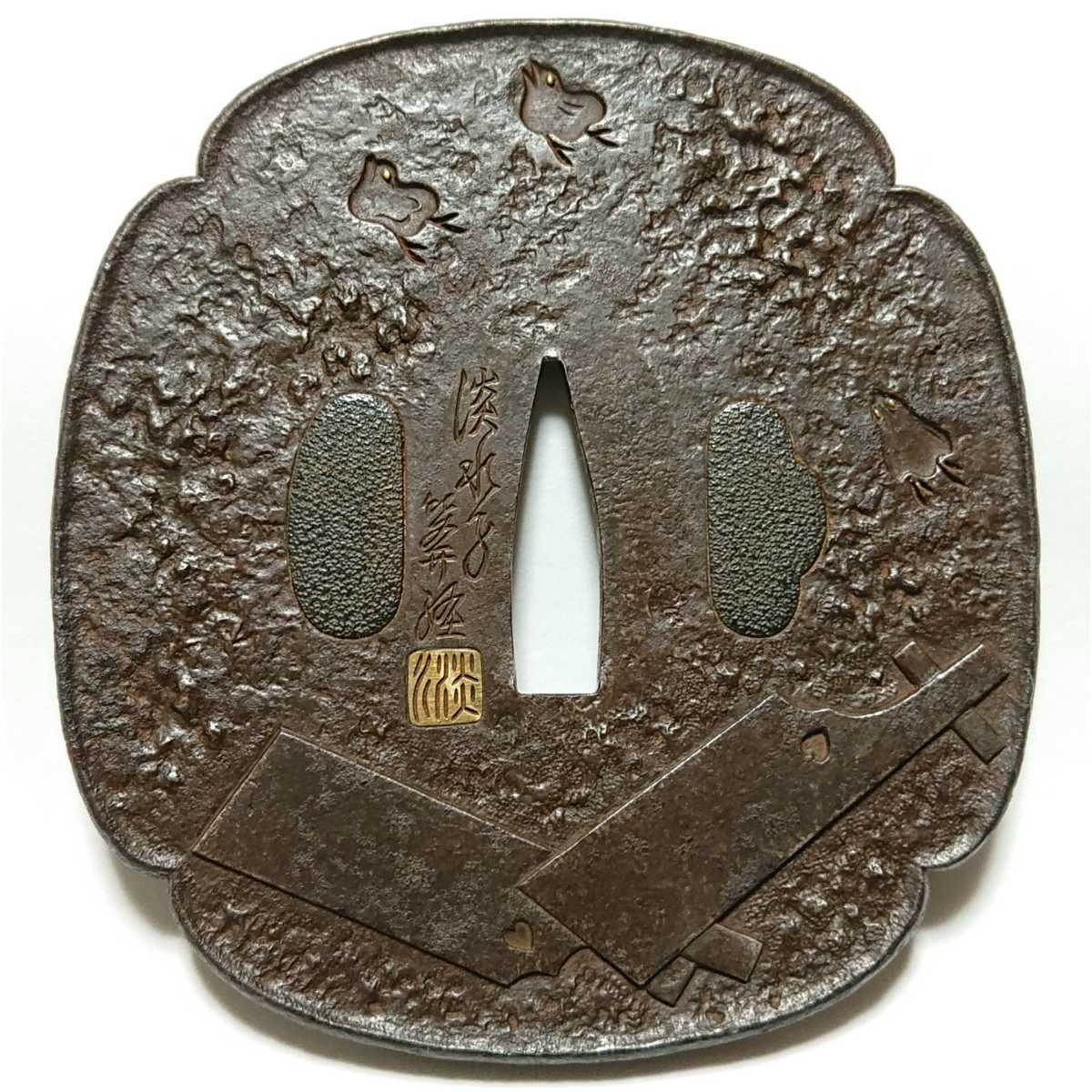 $1200.00 |
Kitagawa Soten, a man of Omi no Kuni Hikone
Nakayaba, skillfully formed a Ha which made items popular for the times, and
there were a great number of members in his Mon. The first Soten had many students who helped him produce Soten style tsuba. In fact, during his lifetime, the demand for his style of tsuba became so great that he and his school could not keep up with the orders. In Kyoto, the Hiragiya school and the Shoami school made Soten style tsuba to help fill the orders for the many requests received from all parts of the country. The previous name of the shodai
Soten is said to have been SHUTEN, and works of his style were a development of
the marubori work in Kyoto.
The second generation used only the name Soten. In addition to these two artists there are at least twenty-five well known students who signed their work with their own names, and innumerable students who signed with the name Soten, or did not sign their work at all. A student of note is Soshu, an above average worker, but the most famous student is Nomura Kanenori: his best work is about equal to that of the second Soten.
There are slight differences between the signatures of the first and second Soten. There are other differences in their work, such as designs of the second being more picturesque and detailed. The surface of his plate is very busy and brilliant; the design covering the major portion of the web area. The first also used small figures in the designs but he did not cover as much of the web area with his decoration. He did not use as much inlay of gold and silver. From the style of carving used mainly by the second Soten this school has become to be called the Hikonebori school (The term Hikonebori means the original style of carving of the Soten school. It is a combination of low relief, line carving, some shishiai, detailed iroye inlay and elaborate openwork. In reality it is but one type of ubuzukashi, and is found rarely in the early work of the first and second Soten.)
The first and second Soten were splendid at their chosen style. The iron is of good quality but the tempering is quite common. The nikubori is inferior. An attempt to cover this fault in the iron quality was by making a good edge and using fine decoration. Although their work is usually on iron plate, the plate is subordinate to the decoration. Their work should be judged on the quality of the carving, inlay and designs. The scenes included people such as Gen-Pei Busha (Warriors of the Minamoto and Taira), and sennin (wizards, or hermits capable of performing
miracles). They are exceedingly complicated engravings, and they are gaudy.
The majority of the work in the later Soten tsuba school is but a poor imitation made by shiiremono makers in the late Edo age at the docks of Yokohama. These imitations account for more than 95% of all Soten tsuba extant. The work of this school was so corrupted that a true idea of the real Soten tsuba is almost impossible to obtain. Had the work of this school been less popular, the true work of the first and second Soten might be regarded with more respect than it now receives.
Read about Soten of Hikone from 'Jaspanese Sword Mounts' by Helen C. Gunsaulus.
This article was written by Robert Haynes.
This article was written by Dr. John Lissenden for the Northern Token Society (UK).
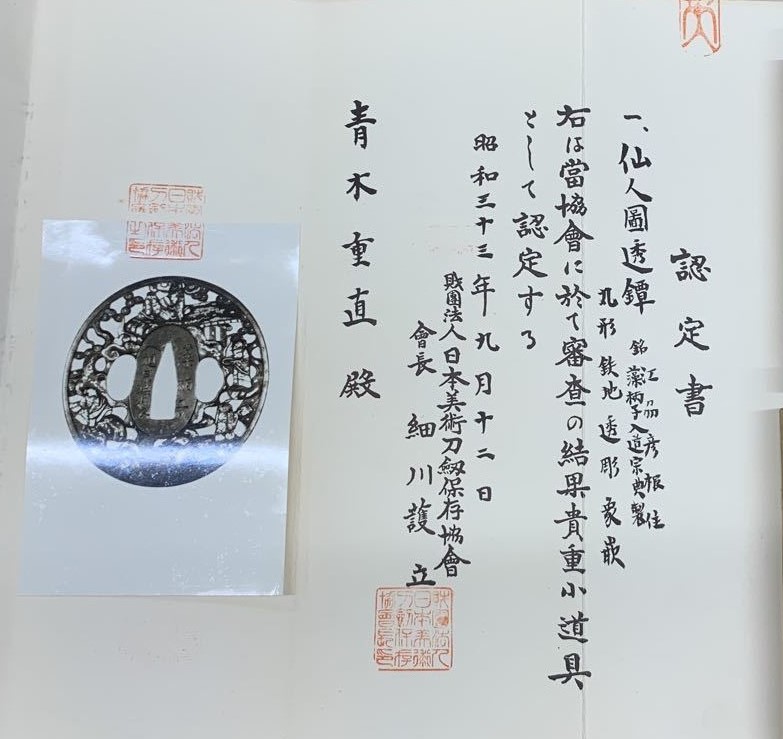 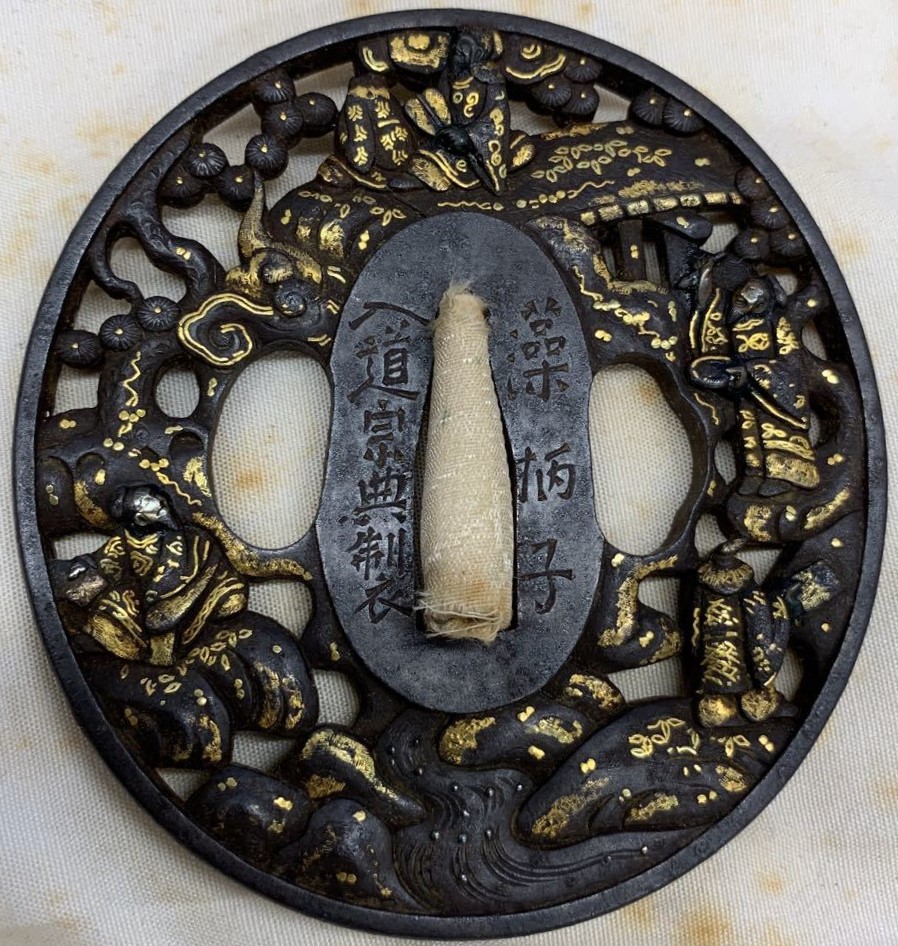  |
'SOHEISHI NYUDO SOTEN SUKEKORE' $8000.00 "The pictoral designs favored by Soten are almost the same as those of his father Shuten. They are pictures of Taoist and Buddhist monks at leisure, or pictures of warriors in combat. This type of Soten tsuba is of very fine iron with two ryohitsu ana. The rich dark plate is deeply pierced and delicately carved in Hikone Bori with accurate details." (Haynes) N.T.B. attribution and Hakogaki. |
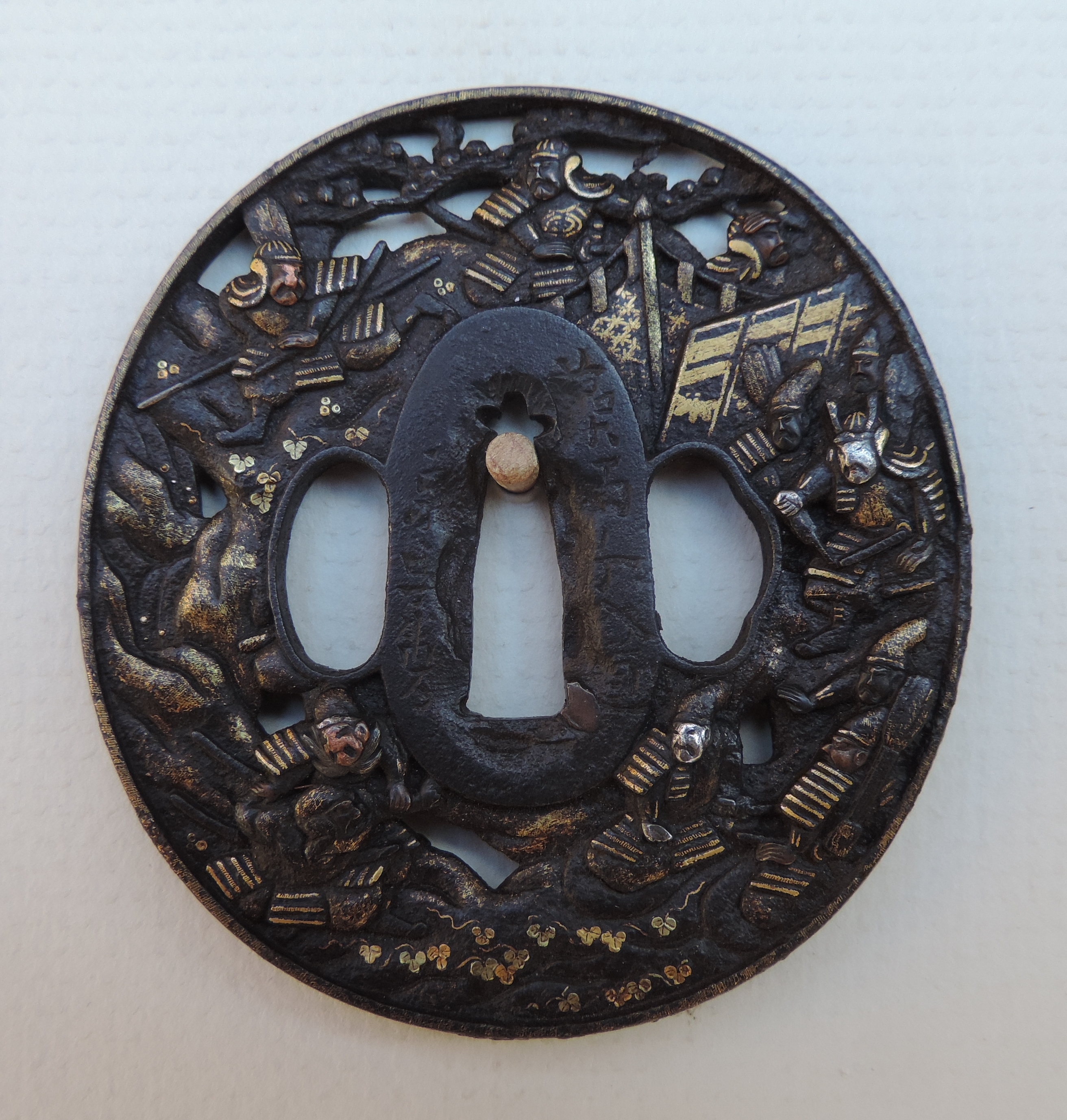 |
'SOHEISHI NYUDO SOTEN TSUKURU' $1800.00 "An oval shape tetsu-ji (iron) tsuba depicting a scene from the Gempei War. As shown here a piece with refined technique and drawing on a legendary episode in Japanese history. The inlay is gold and shakudo nunome zogan. Both sides exhibit high relief and and finely detailed inlays. Mei: 'SOHEISHI NYUDO SOTEN TSUKURU'. This is Haynes Index H 08942.0. This is confirmed due to the lack of openwork sukashi. Dates to ca. 1750." (Haynes) |
 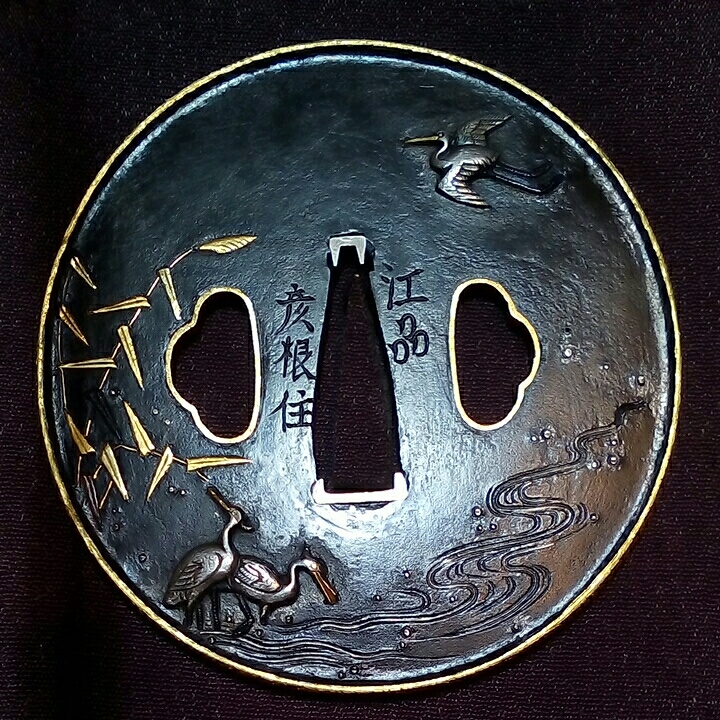  |
SHOKOKU Tsuba
SHOKOKU TSUBA:
This term was used by Dr. Torigoye and his explanation follows.
A direct translation would mean: tsuba of several provinces. Under this title the artists who do not belong directly to one of the foregoing schools have been placed in this single group. The majority of these artists were independant workers who may have existed in proximity to a major school but maintained a style very much their own. The group is composed of both tsuba makers and kinko. The artists included in this section are not necessarily inferior workers to those that have already been discussed. Some, in fact, are fine artists of considerable merit. The work of those independant artists that show creativity and above average ability are very important for study and future research.
  |
'SHOKASHIDO SUNAGAWA MASAYOSHI' Price On Request "Introducing the chrysanthemum-like openwork tsuba. This is a masterpiece tsuba inscribed by Shokashido Sunagawa Masayoshi', which is decorated with a splendid picture of a chrysanthemum in full bloom, and is made with the finest craftsmanship without cutting corners. The material and workmanship are both of the highest quality, and it also comes with a commemorative box written by Dr. Ichitaro Torigoye and Mei Kusado (Hanaoiri). The details of the workmanship are so attractive that I cannot explain them in my shallow writing. Both the workmanship and the materials are of the highest quality. This is the finest chrysanthemum work that can be said to be a model for Choshu Tsuba. Read Haynes Index H 04798.0." (Long) |
  |
'KAWACHI NO KAMI MOTOYUKI' Price On Request "A masterpiece tsuba (sword guard) by Matsuba Honyuki, a descendant of Naoyuki of Bungo Province, with a double box inscribed by Hino Shoan, and a specially important sword craftsman, Wakashiba Kizaemon. This famous sword guard was made by Kawachi-no-kami Motoyuki (Matsuba Motoyuki), a descendant of Bungo-no-kuni Ki-no-daifu Yukiharu, who served the Doi family of Karatsu, Hizen Province. He is a master craftsman whose works are designated as Specially Important Swords. While Honko was a skilled swordsmith, he also produced iron tsuba (sword guards). However, this piece differs from his usual simple works, featuring intricate landscape designs inlaid with gold, silver, and copper. This remarkable craftsmanship, judging from the inlay technique, is clearly the work of the Wakashiba school of tsuba makers from the same province, and furthermore, its quality suggests it was likely done by the first Kizaemon. Since it does not appear to be a later inlay, there was probably a technical exchange with the Wakashiba school from the same Hizen province, and this is likely a valuable collaborative work produced during that time. Comes with a double box inscribed by Professor Hino Shoan. It is in excellent condition and is a highly valuable historical document related to Matsuba Honko." (Long) |
  |
'YOSHIHISA' Price On Request "Presented here is a masterpiece tsuba by the great artist of Shonai who was the first teacher of the first Tsuchiya Yasuchika, the first Watanabe Arichika, and Shoami Kiyonari. He worked in a combination of the early Edo period Nara school, and the Kyoto Shoami style of that same time." (Long) |
  |
'ARICHIKA' Price On Request "There were five generations of artists who signed 'ARICHIKA', H 00109.0 to H 00114.0 in Haynes Index. This tsuba is by the 1st of the family, 1661 to 1742. The work of the later generations became more and more in the Edo period Kinko style. This tsuba is by the first master in the style of the signature, which is well recorded. His teacher was Shoami Yoshihisa ( Chinkyu ) who was also the teacher of the 1st Yasuchika. There are examples signed at the age of 75 and dated 1735." (Long) |
   |
'YOSHICHIKA' & Kao Price On Request "The iron base, which bears rough traces of the hammer that hammered and forged it, is round with some tapering towards the edge. Granular steel that shines particularly black can be seen around the edge and in places on the flat ground. One side of the large openwork opening on either side is filled with quarter-grain ground, and a dragon and a tiger are carved into it. This technique was Yoshichika's forte. The tiger has a thin carving inside its powerful outline, and the round dragon is inlaid with high-pitched carvings on a red copper base." (Long) |
  |
'KISHU JU SADANAGA' Price On Request "A Masterpiece by Sadanaga [Featured in Tsuba Collection] Signed by Sadanaga, Resident of Kishu. Owned by Shizuoka Tsuba Lovers' Association, "Water Plantain Openwork Tsuba," Excellent Iron Quality, Iron Base, Round Shape, Slightly Relief Corner Rim, Openwork Design, Thin Relief Carving. This tsuba is featured in the book "Tsuba Collection" by Nakamura Tetsusei, and the author describes it as a masterpiece by Sadanaga. Of all the Sadamei-signed tsuba I have seen so far, this one has the best iron quality, and the openwork design is elegant, making it likely to be a superior work by Sadanaga." (Long) |
  |
'HARUMICHI' Price On Request "Vivid Gold and Silver Inlay Mokko-Shaped Iron Tsuba. This rare "Harumichi" piece features vibrant gold and silver butterfly and autumn grasses adorning the high-quality iron. The pieces themselves are extremely rare. The level of craftsmanship is exceptional, making this a masterpiece that undoubtedly ranks among the finest " Harumichi " works. It is listed in the " Meikan", which serves as a benchmark for examining inscriptions." (Long) |
 |
'NAOMITSU YANAGAWA' $3000.00 "An iron plate (tetsu-ji) in 'Sumikiri Kaku' shape (square with slightly beveled corners). Motif of chrysanthemums floating on the water appear on both faces. Described in Japan as: Tetsuji Kikusui no Zu Otsuba Sendai. Inscription by Naomitsu Yanagawa, Senfu. This is Haynes H 06717.0. He was the adopted son and student of Yanagawa Naomasa (H 06695.0). He was a silversmith in his youth with the name of Koemon. At age 25 he took the name Sanzaemon. He was a retainer of the Soma Daimyo at Nakamura in Iwaki Province. According to what is written, this tsuba was ordered by Hou Date, the lord of the Sendai domain. "Osenfu" is engraved" (Long) |
 |
'YASAKA EIKAN' Price On Request "Iron tsuba with the inscription Yasaka Eikan Mid-Edo period Bungo Ryokou Four-sided treasure bag crest Iron base, irregular shape, round ears, hair engraving, gold inlay, small transparent. The gold inlay has peeled off over time, but the iron base has not decayed and the rope stitches near the ears remain. This tsuba is listed on page 334, number 17, of the "Tsuba Shusei" by Nakamura. The certificate of NBTHK (Green) special valuable tosogu has been confirmed by the Japan Art Sword Preservation Association." (Long) |
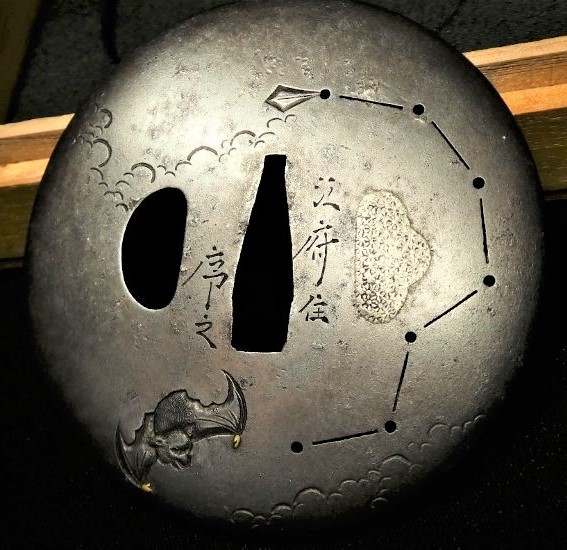   |
"EFU JU TSUNEYUKE" $4000.00 "Oval shape iron plate tsuba with intricately carved clouds, and the constellation of the 'Big Dipper' with a Ken at the end of the handle. On the omote, appears a bat that has gold inlay on the tips of wings and is also very well carved. There are hitsu-ana, the kogai-ana being filled with lead. Signed: 'EFU ju TSUNEYUKI'. This is H 10950.0 in Haynes Index. 7.05cm x 7.35cm x 0.35cm |
  |
MUCADESHU Price On Request "This is a round-shaped iron tsuba with no signature, two hole holes, brass wire combination with brass fittings, brass ring, and a special paulownia box. The Shingen in this tsuba is the Shingen of the Sengoku warlord Takeda Shingen. There are some inlay holes, but it is in very good condition and is a Shingen tsuba of the highest level in terms of size, weight, and workmanship." (Long/Haynes) 8.60cm x 8.55cm x 0.52cm |
|
|
'SHIZUKADO' Price On Request "The swordsmith's tsuba is said to have originated from the tsuba that swordsmiths attached to swords in ancient times when they forged them, hence the name. It was once said that one by Akiyama Kyusaku was 600 years old, but after the war, it was believed to have originated around the mid-Muromachi period. However, in his book "The Origin of Sword Fittings," Sasano Daigyo defined it as dating from the late Heian period, as it was attached to a katana worn by a servant in the "Ban Chunagon Emaki." This tsuba features large and small circles that are openings on both sides of the tsuba. The transparent circles are tastefully shaped and exquisitely arranged. Moreover, the atmosphere is soft and evocative of infinite space. It is truly an abstract expression, like viewing stars or a constilation in the sky. The fairly thin, glossy black rust of the iron exudes a sense of time, sharing the same style and atmosphere as the Kamakura-period tsuba featured in "The Origin of Sword Fittings." It is also desirable that it is somewhat large, making it a rare masterpiece. There is a ridge on the backside and smooth on the front of the rim." (Long/Haynes) 8.78cm x 8.70cm x 0.25cm |
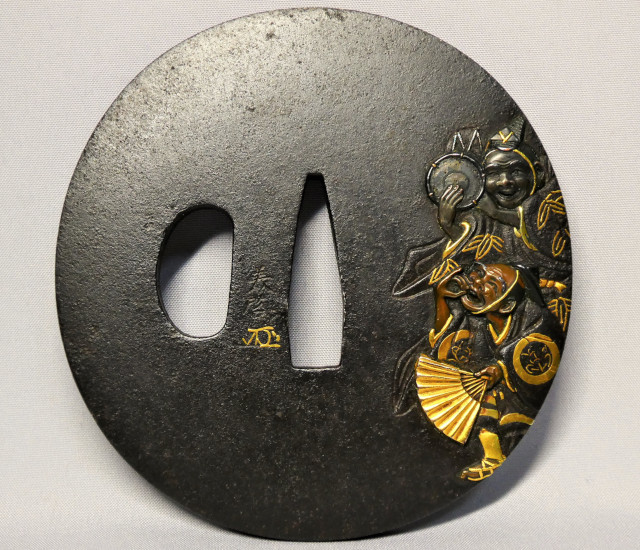 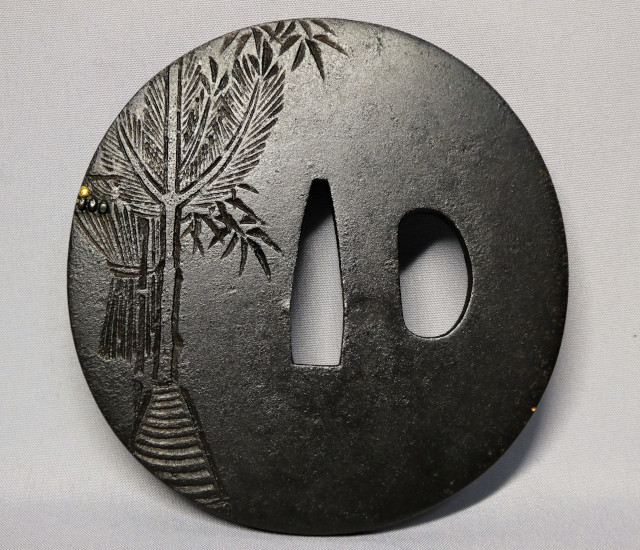 |
'YOSHIHISA' & Seal $5500.00 "A masterpiece by YOSHIHISA. Art names: BUNSUKE, TASHICHI, YOSHINORI. See Haynes Index H11643.0. Unknown writer of Hakogaki. Published in ZABO TANSEN, pg. 212. An iron plate with two dancers inlaid with gold, shakudo, and copper. The lively expression brings out the movement of the dance." (Long/Haynes) 7.40cm x 7.20cm x 0.40cm |
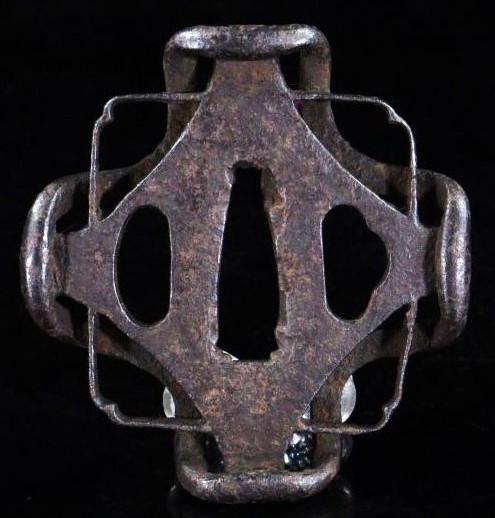  |
KUTSUWA-GATA $2400.00 "Kenkyusha's NEW JAPANESE-ENGLISH DICTIONARY (Copyright, 1954) defines 'kutsuwa-gata', a Greek cross in a circle." (Long/Haynes) 7.61cm x 7.60cm x 0.61cm. |
  |
'MASAIYE' Price On Request "Made of well-forged iron and has a dignified appearance. The characters 'Ten Directions' on the front and 'Sanon' on the back skillfully engraved. There were several famous Shoke swordsmiths from the Koto period, of which this is one. Dates to Tei-wa 1345. Certificate of Preservation by NBTHK." (Long & Haynes) 9.48cm x 8.40cm x (rim) 0.50cm x (plate) 0.30cm |
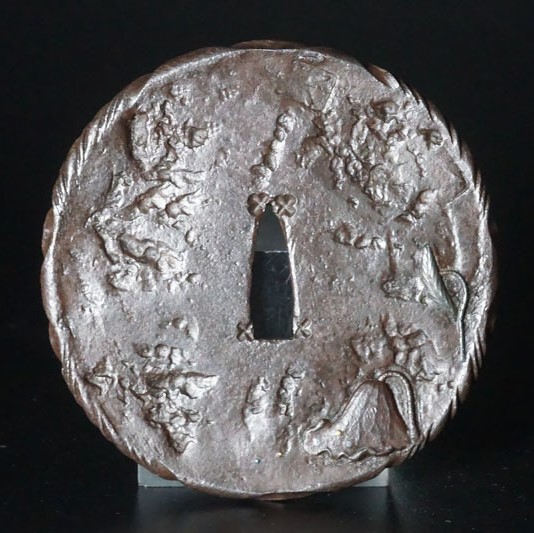 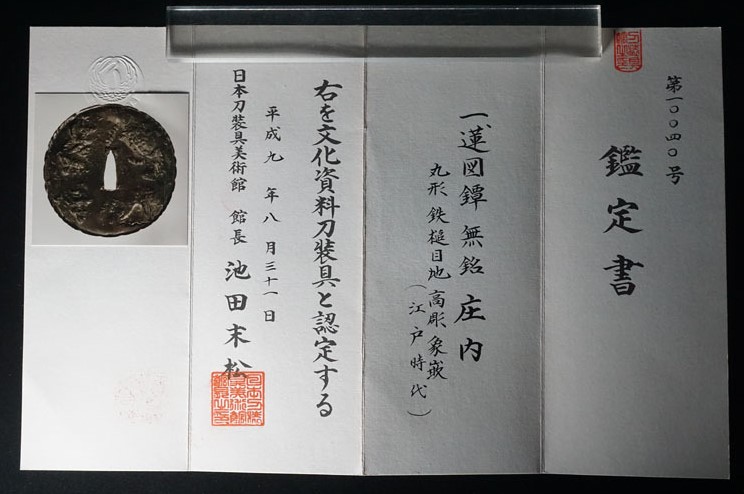 |
|
  |
SHONAI Price On Request "A brillant copper tsuba with silver and shakudo inlay and a shakudo rim. Tatemaru shape. The theme of this tsuba is Kakko, a Japanese hourglass drum, played on both sides with sticks. This is used traditionally in Gagaku. It is Mumei but attributed to the Shonai Tradition. The features of this tradition are items made of copper along with silver and shakudo inlays." (Haynes) 9.20cm x 9.20cm x 0.60cm. |
  |
IKEDA KAZUHIDE Price On Request "Ikeda Kazuhide Shonai swordsmith and tsubako working in ca. 1600. Bold Zen circles. Pg.299 Shonai Kinko Mei Saku Sho. Pg.620 Haynes Index." (Haynes) |
  |
|
 |
Worm-Eaten Peach Price On Request "Iron base with a unique shape, forged with wood grain, and openwork. This openwork tsuba features wood grain forged iron in a peach shape, resembling insect holes. Excellent forging, this is a bold and interesting piece." (Haynes) 7.00cm x 6.80cm x 0.50cm. |
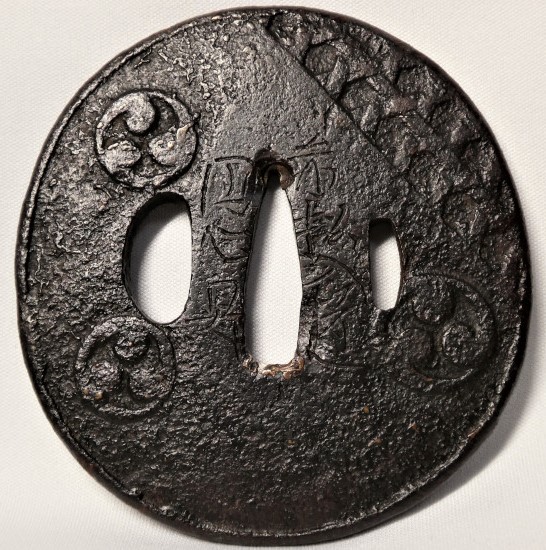 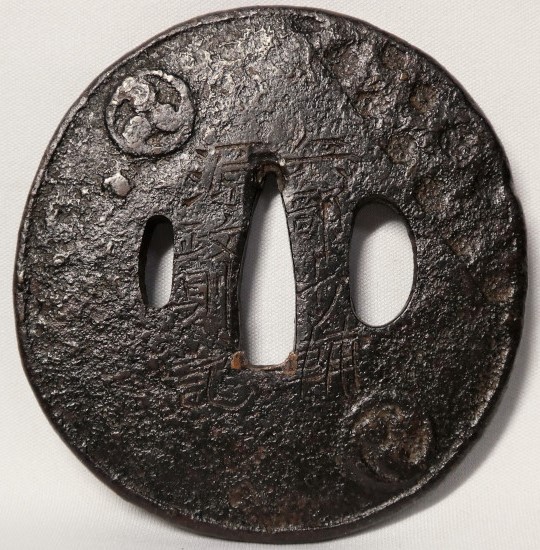 |
|
 |
'NOBUYUKI' Not For Sale
"A masterpiece by Hamano Masanobu, the founder of the Hamano school, one of the three most renowned metalworking schools of Edo. This is a rounded, iron-ground tsuba (sword guard) with a wave design, carved in relief, silver inlay, and enamel, featuring a sukidashi (lofted relief) style. Hamano Masanobu was the founder of one of the three most famous schools of sword fittings in Edo during the mid-Edo period. (The three schools of mid-Edo: Nara school, Hamano school, Yokotani school) He was a top-class craftsman, excelling in realistic depictions using high-relief enamel. Born in Kanda, Edo. 1696-November 23, 1769 (Genroku 9 - Meiwa 6, October 26), died at age 74. His disciples included the second Hamano Masanobu and the first Hamano Nobuyuki. His common name was Tarobei. His pseudonyms included Otsuryuken, Ajisumi, and Kankei. This is a magnificent tsuba, featuring a stunning wave design rendered in exquisite sukidashi carving and silver inlay enamel. The dynamic depiction of a surging wave is one of the designs that the Hamano school excels at, and this piece is a masterpiece that showcases the high level of skill of the founder of the Hamano school." (Haynes) |
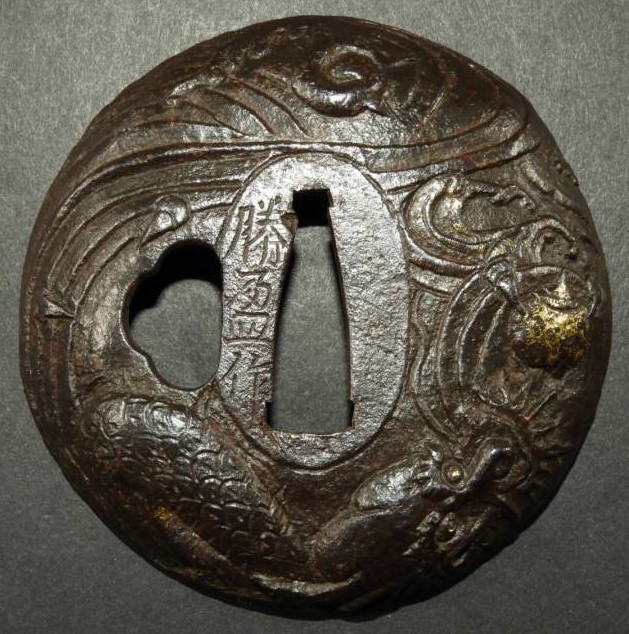  |
'KATSUMITSU SAKU' Not For Sale
"Iron tsuba that is well hammered and formed in a deep cup shape, the repousse from inside to get higher relief design of a dragon in waves. The high relief dragon is carved from the plate and is not iron on iron inlay. Only one hitsu-ana of kogai shape. There is some mystery about this type of tsuba. Does it come from the European cup handguard shape? It might also be of Chinese or even Persian origin. All that we can say is in all of this type produced, there does seem to be a Kyushu feeling. There is no appearance of lacquer." (Haynes) |
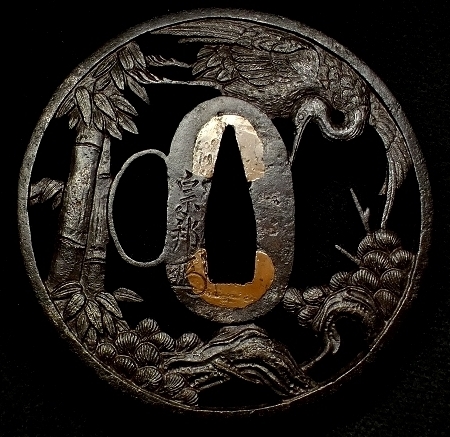 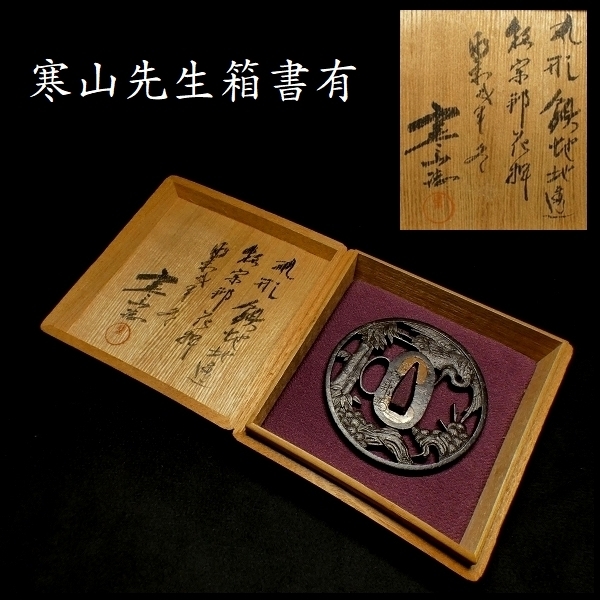 |
'MUNEKUNI' Price On Request "Under Study. Ref. Haynes Index H 06114.0." (Haynes) 7.61cm x 7.60cm x 0.61cm. |
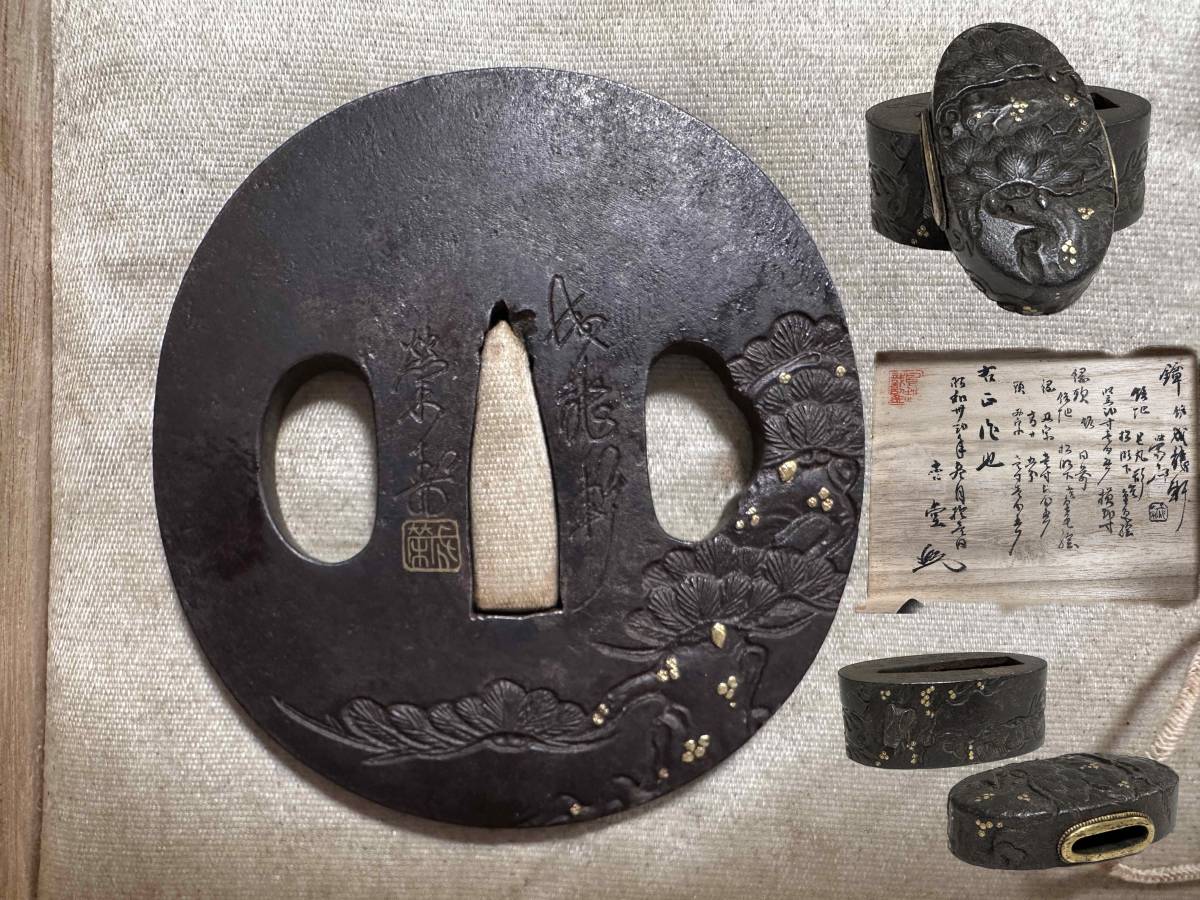 |
'SEIRYUKEN EIJU SAKU' and Seal. $2000.00 "Presented here is a set consisting of a tsuba and fuchi/kashira of iron. All pieces have a chiseled decor of plants. The style and quality of this set displays the high artistic ability of NAOFUSA. The signature on both the tsuba and fuchi read 'SEIRYUKEN EIJU SAKU'. He often signed his masterly pieces in beautiful cursive sosho (grass script) followed with a gold inlaid seal. This was the art name of NAOFUSA (H 06602.0). He was a student of Okamoto Harukuni (H 00810) and the adopted son of Okamoto Naoshige (H 06772)." Attributed here with a Hakogake by Dr. Torigoye." (Long) |
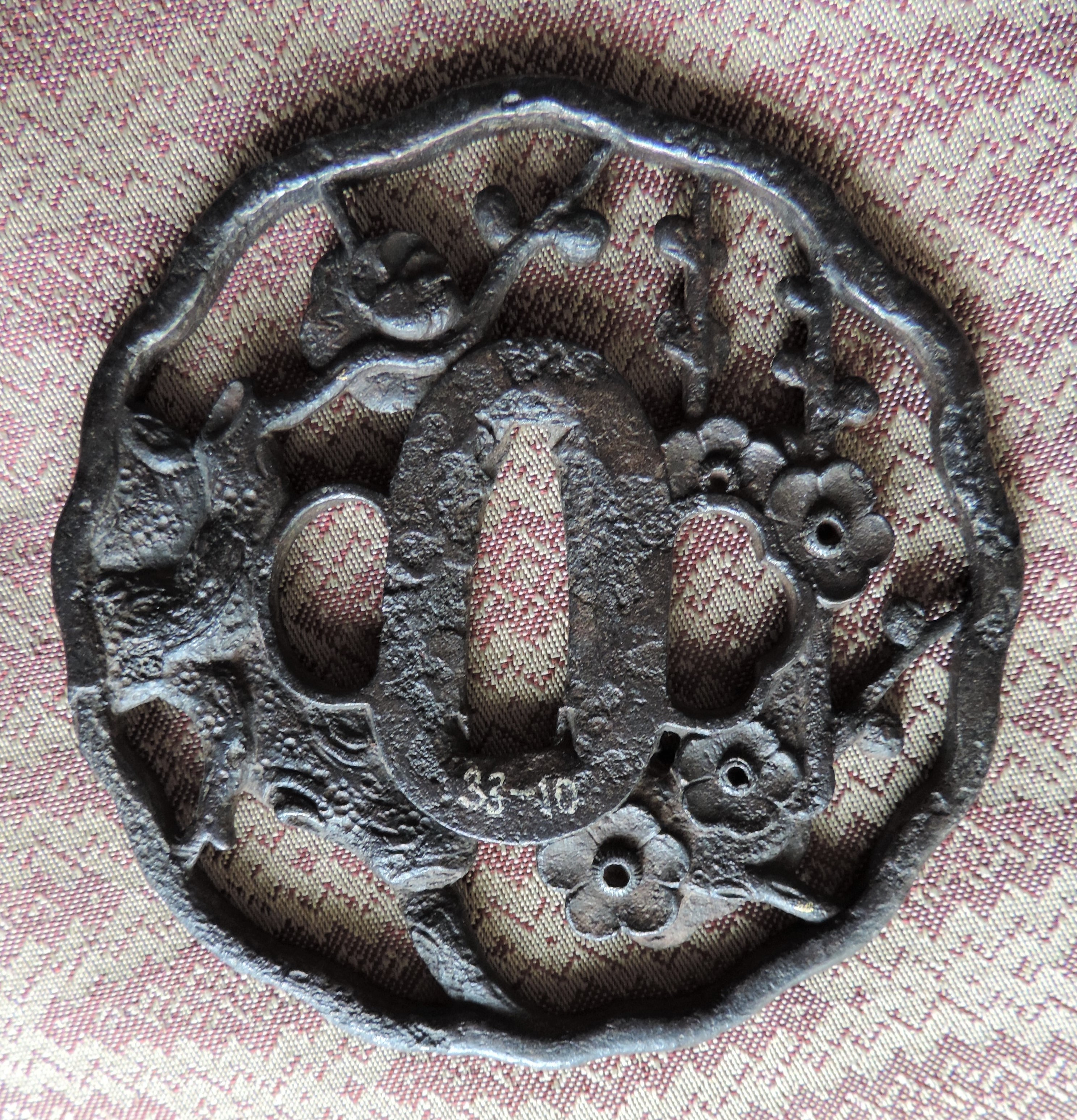 |
KASUGA SCHOOL $850.00 "Jiyu-gata (free-shaped) iron plate tsuba with the web carved with a design of a plum blossom branch. This example is remarkable in the very fine kebori carving and attention to detail. The center of each plum blossom is iron-on-iron inlay, four on the omote and five on the ura. It is possible that the thickest part of the branch on both sides has iron-on-iron inlay. In all respects, this is one of the finest examples of this school. Dates to ca. 1700-1750." (Long) 8.40cm x 8.60cm x 0.38cm (seppa). |
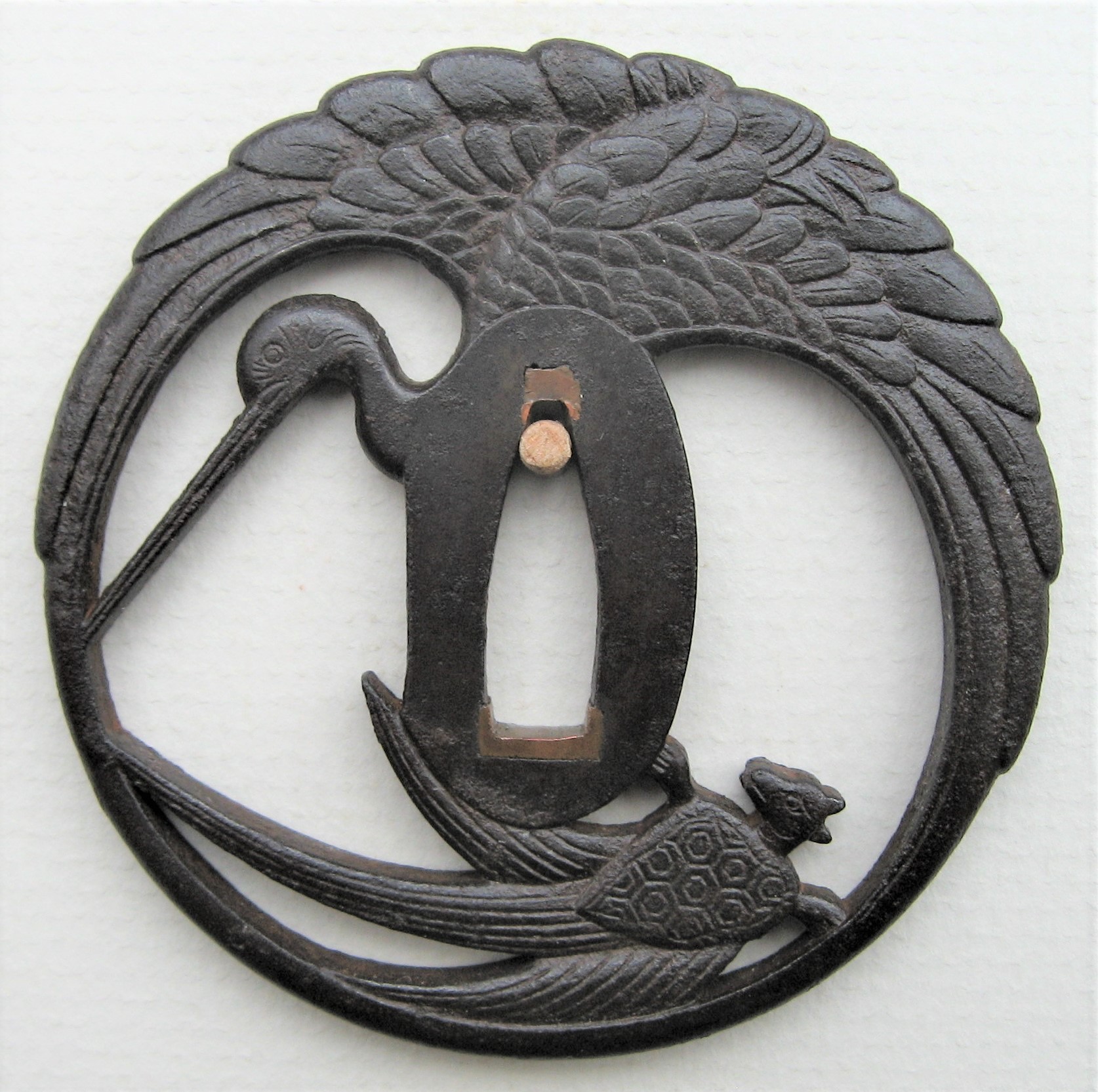 |
HORAI Design $2500.00 "Round (maru gata) iron plate tsuba with kebori carving of 'Horai Tsurukame', the symbolic design of the Horai family. The rim shape from a crane with spread wings and a minokame (mythical turtle) with bearded tail. Dates to 1800. All in all a very fine work by a very adept artist." (Haynes & Long) 8.05cm x 8.07cm x 0.50cm (seppa) |
  |
'MINAMOTO MASAKUNI' $2000.00 "The theme of this tsuba is Dragon with Waves and Rocks. The work is signed with a long signature (see translation below). This craftsman's work can be found around 1779, Mid Edo Period. It is valuable as a historic item. There is not a lot written on this craftsman yet, but on this tsuba there is a lot of good information about him." (Haynes & Long) 6.40cm x 5.90cm x 0.40cm |
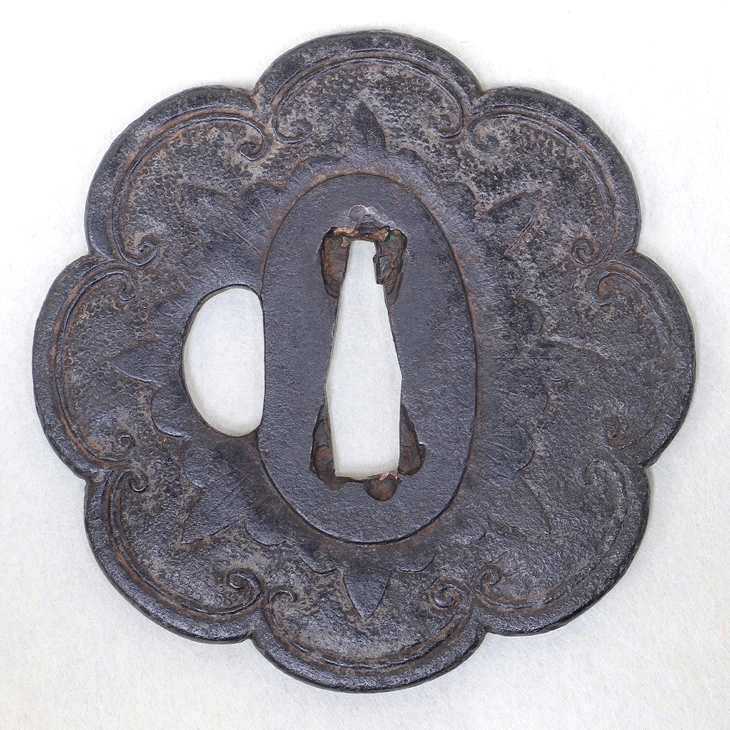 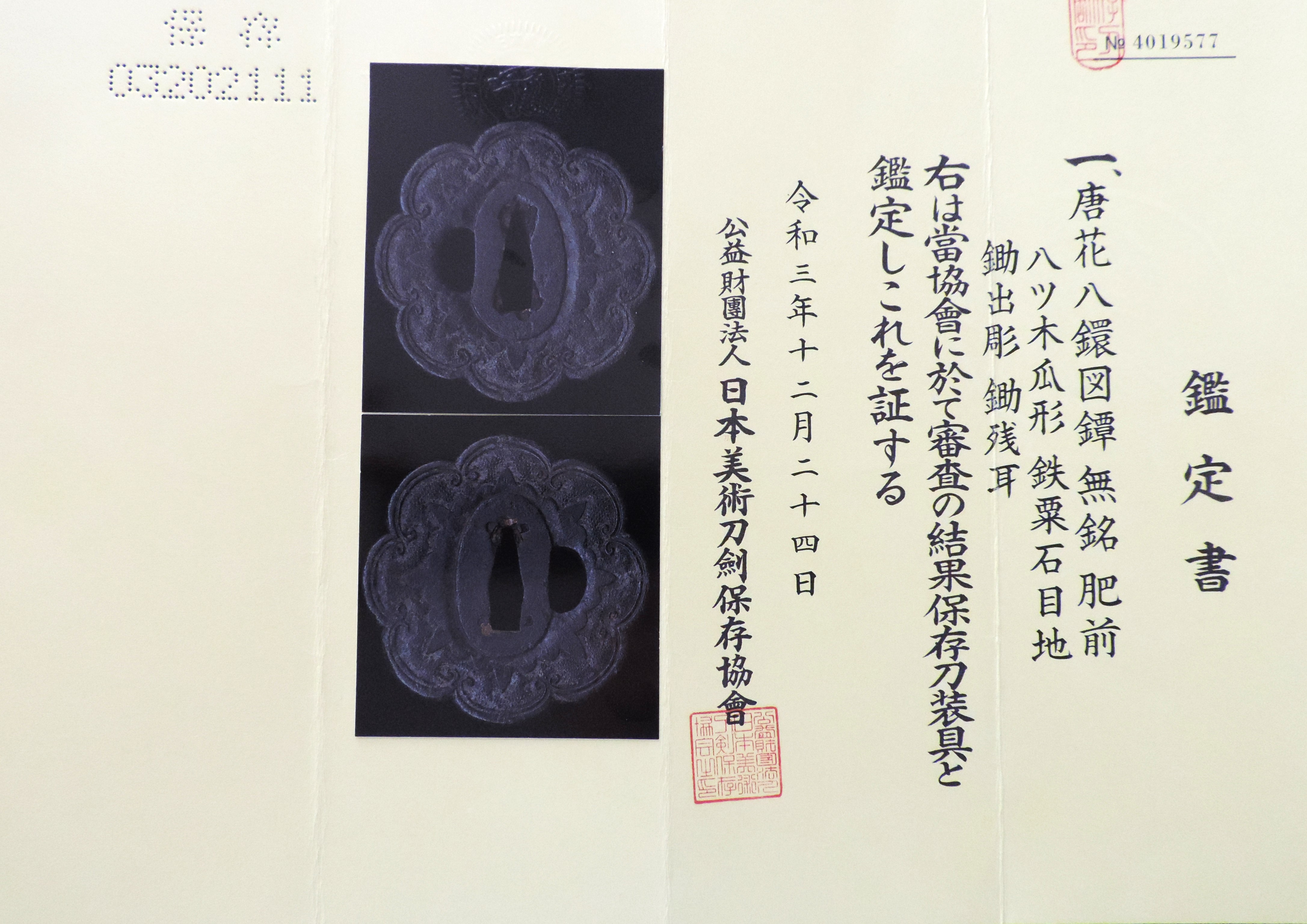 |
KARAHANA |
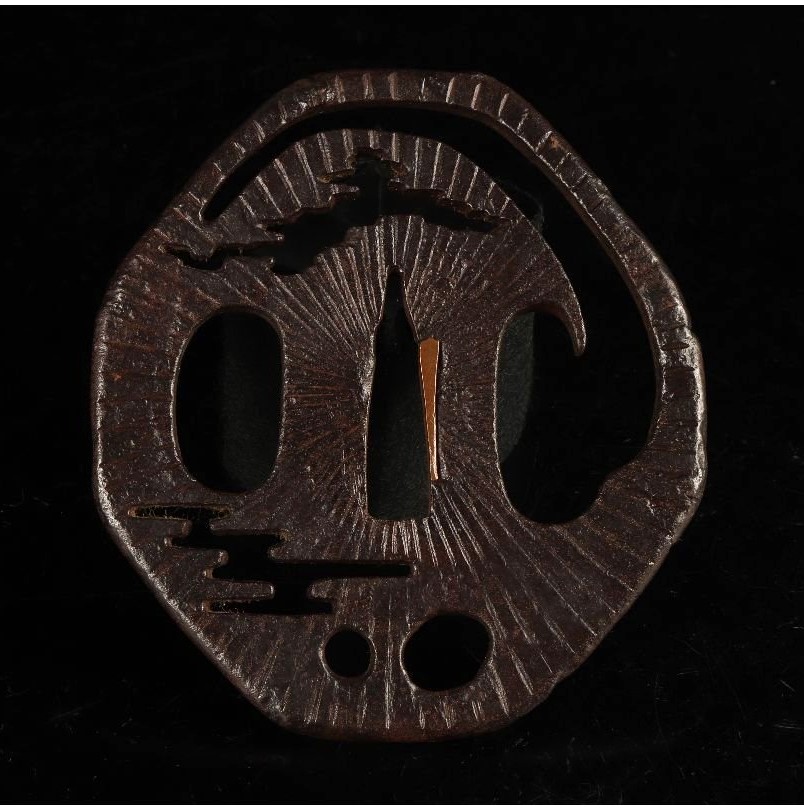 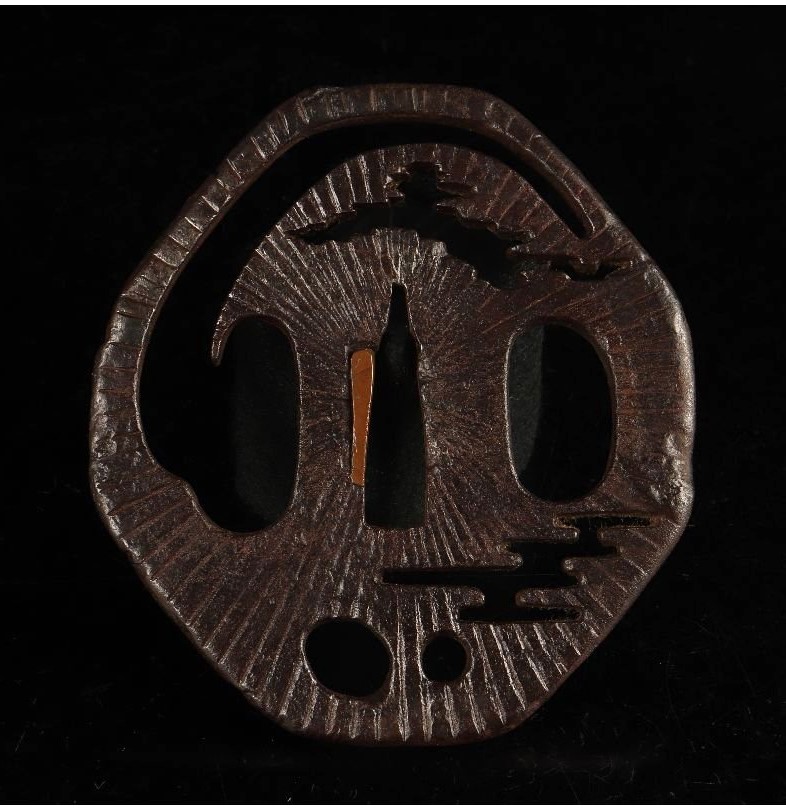 |
IWATA NORISUKE |
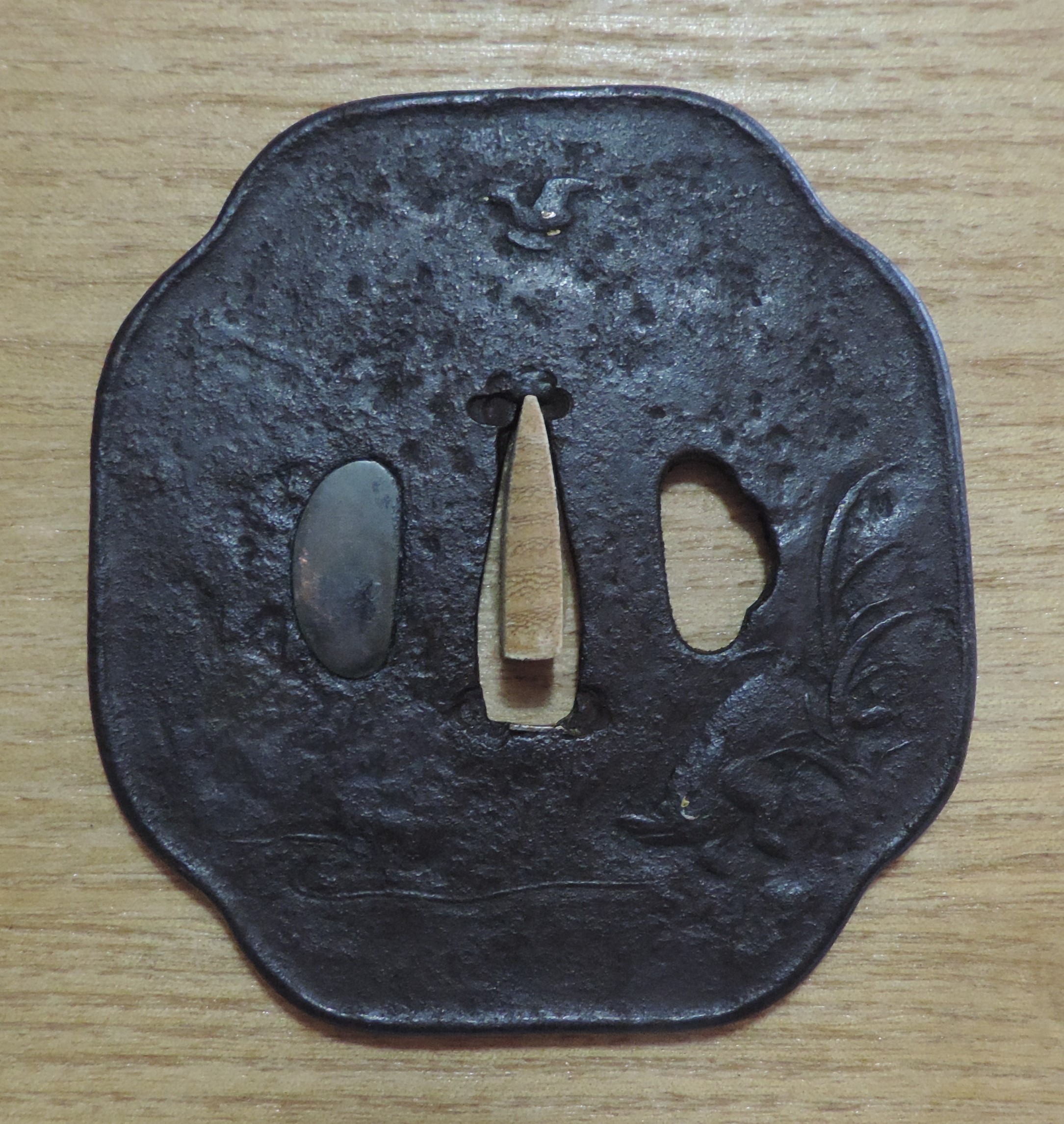 |
SANSUI-GA |
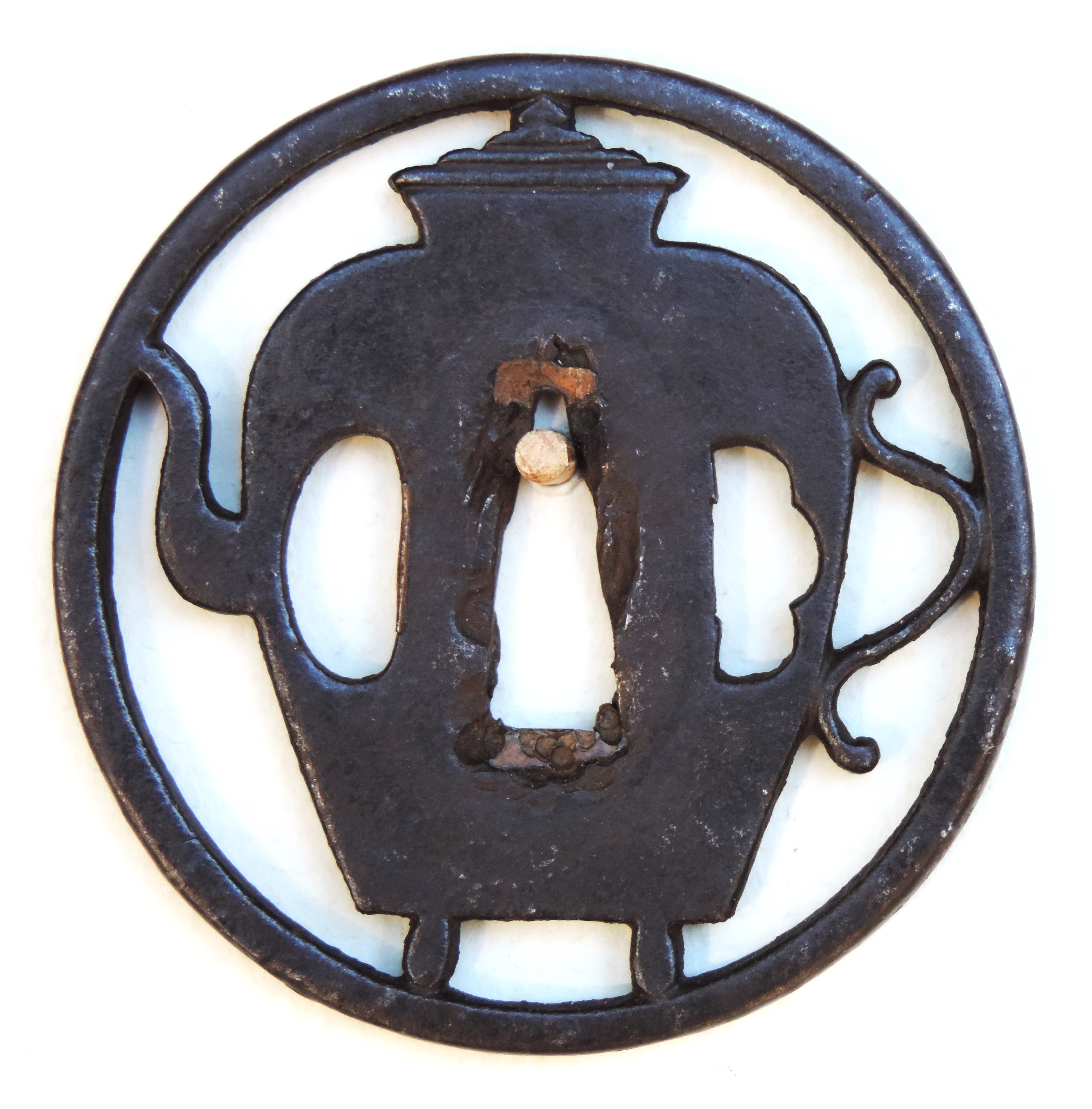 |
European Tea Kettle Design |
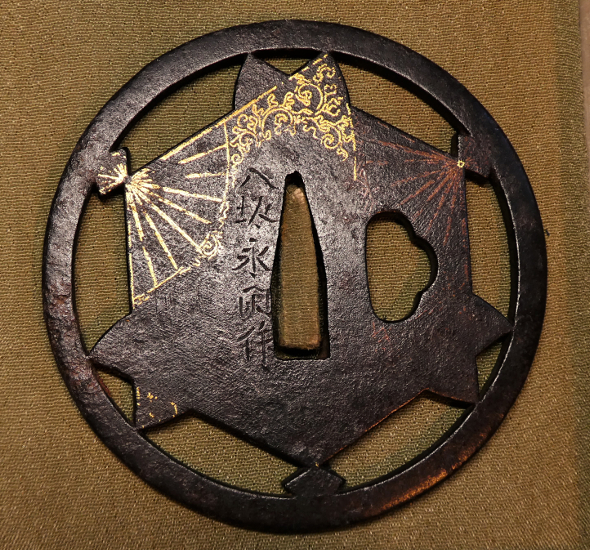 |
'YASAKA EIKAN SAKU' |
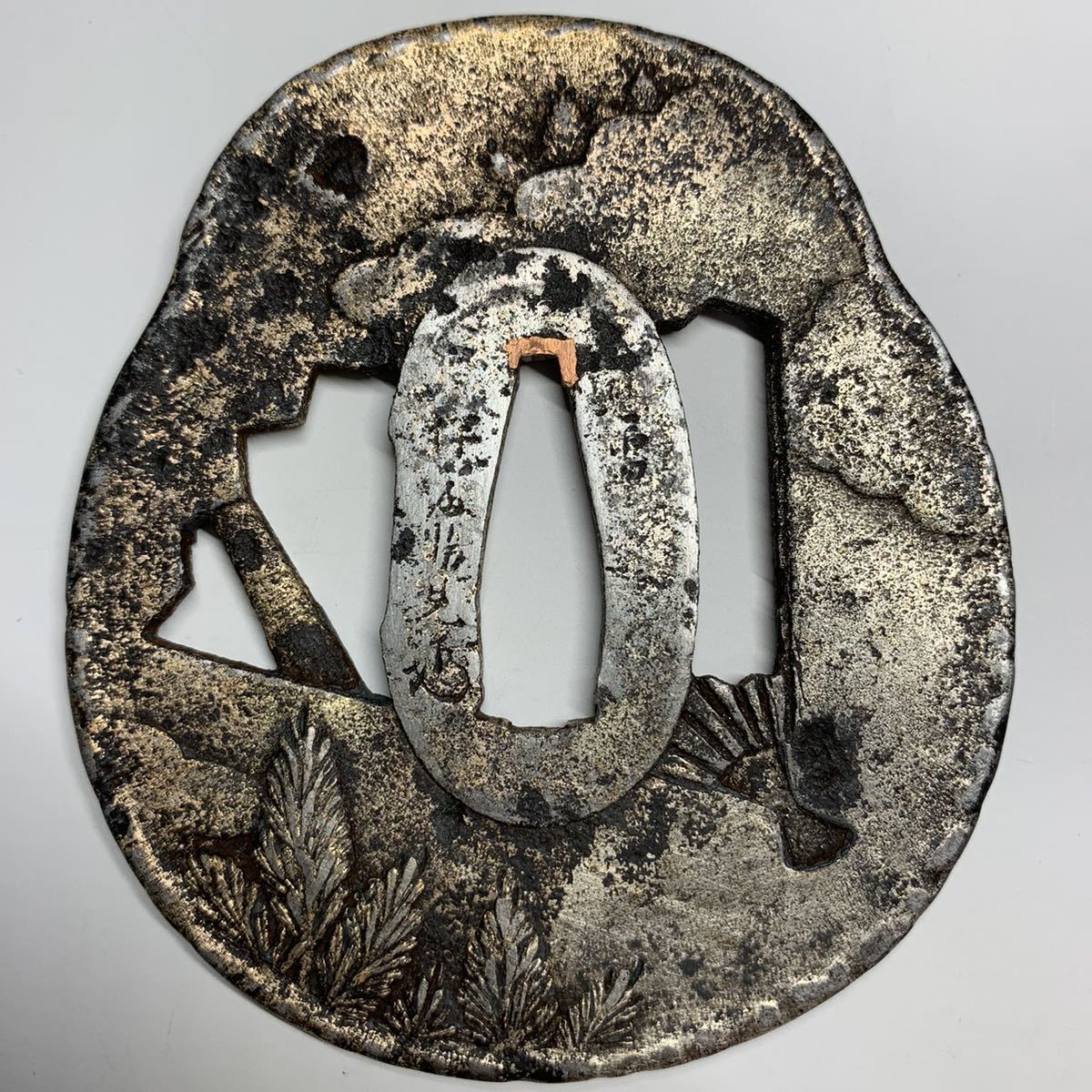 |
'YASUTSUGU' $600.00 |
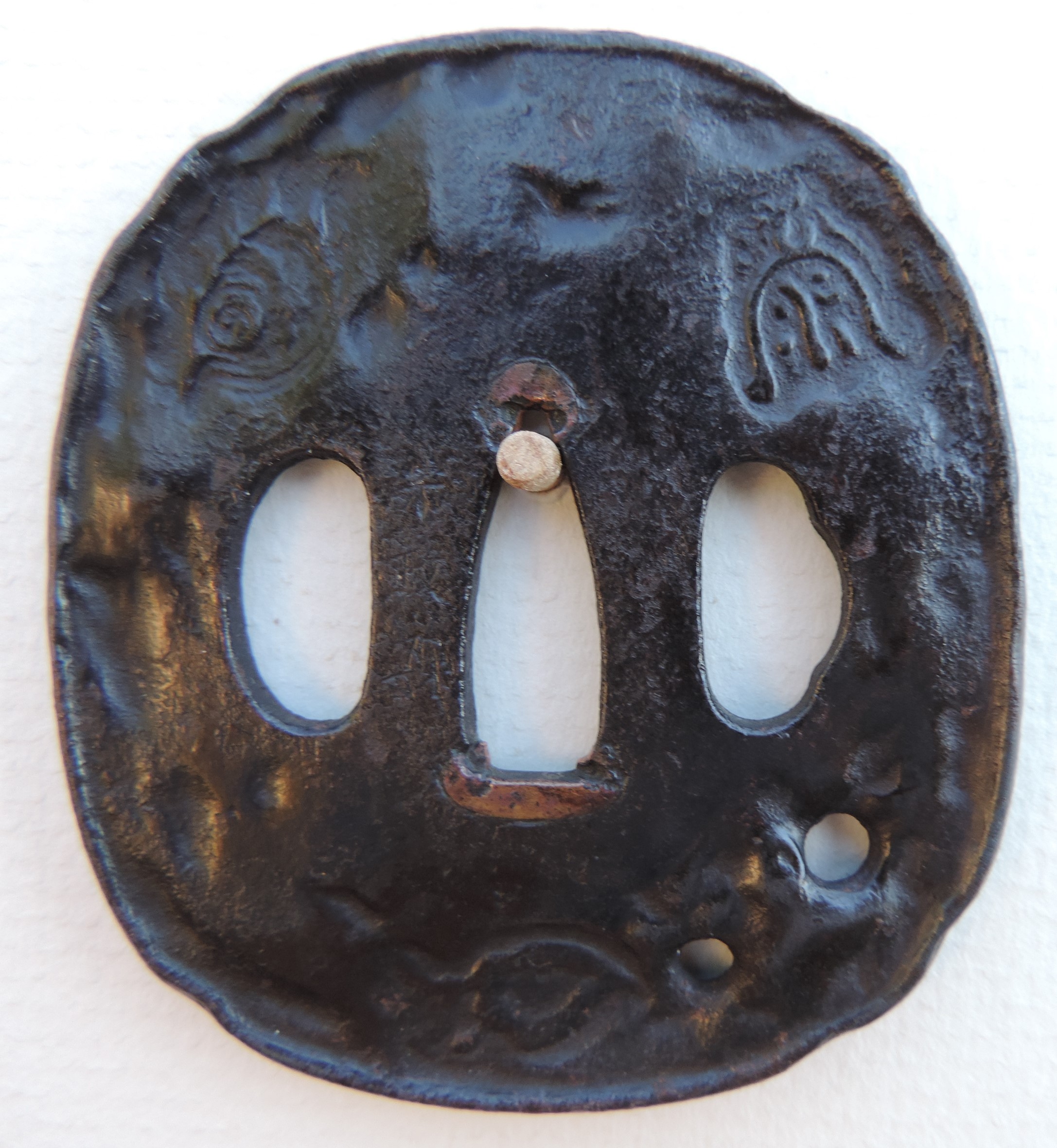 |
'MUNEMASA' with Kao
$700.00 "Irregular oval iron plate with smooth surface, and slightly raised rim. Hot stamped with the design of the symbols for the five mountain ranges of China. With original copper plugs at top and bottom of the nakago-ana, both with small chrysanthemum stamps on both sides. Udenuki appear in lower right quadrant. Signed: 'Munemasa' with kao, H 06130.0.This is the artist who lived in Hisai in Ise Province. Born 1817, died June 25, 1863." (Haynes & Long) |
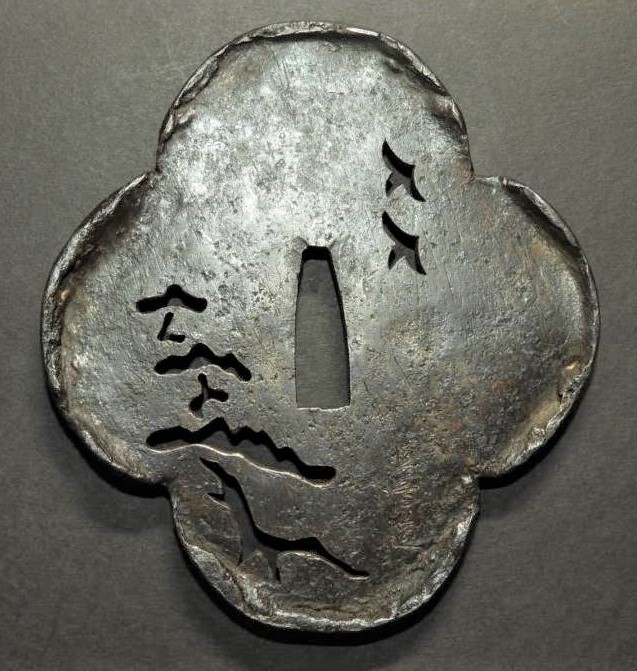 |
'TSUNETOSHI'
$900.00 A large and heavy iron mokko-gata shape tsuba for a very large Katana. The forging is extremely well done showing multiple folds in the steel. The hammer work is advanced, especially in the shaping of the rim. The sukashi in the lower quadrant is of landscape terrain and water. And two cranes above deciding where to land. This is very reminiscence of Kaneiye work. The signature that appears in the lower, right area, is of 'TSUNETOSHI' of the Miyaguchi family (H 10920.0). He was a swordsmith that made his own tsuba. (Haynes & Long) |
|
'DENSHASUI HARUSADA' |
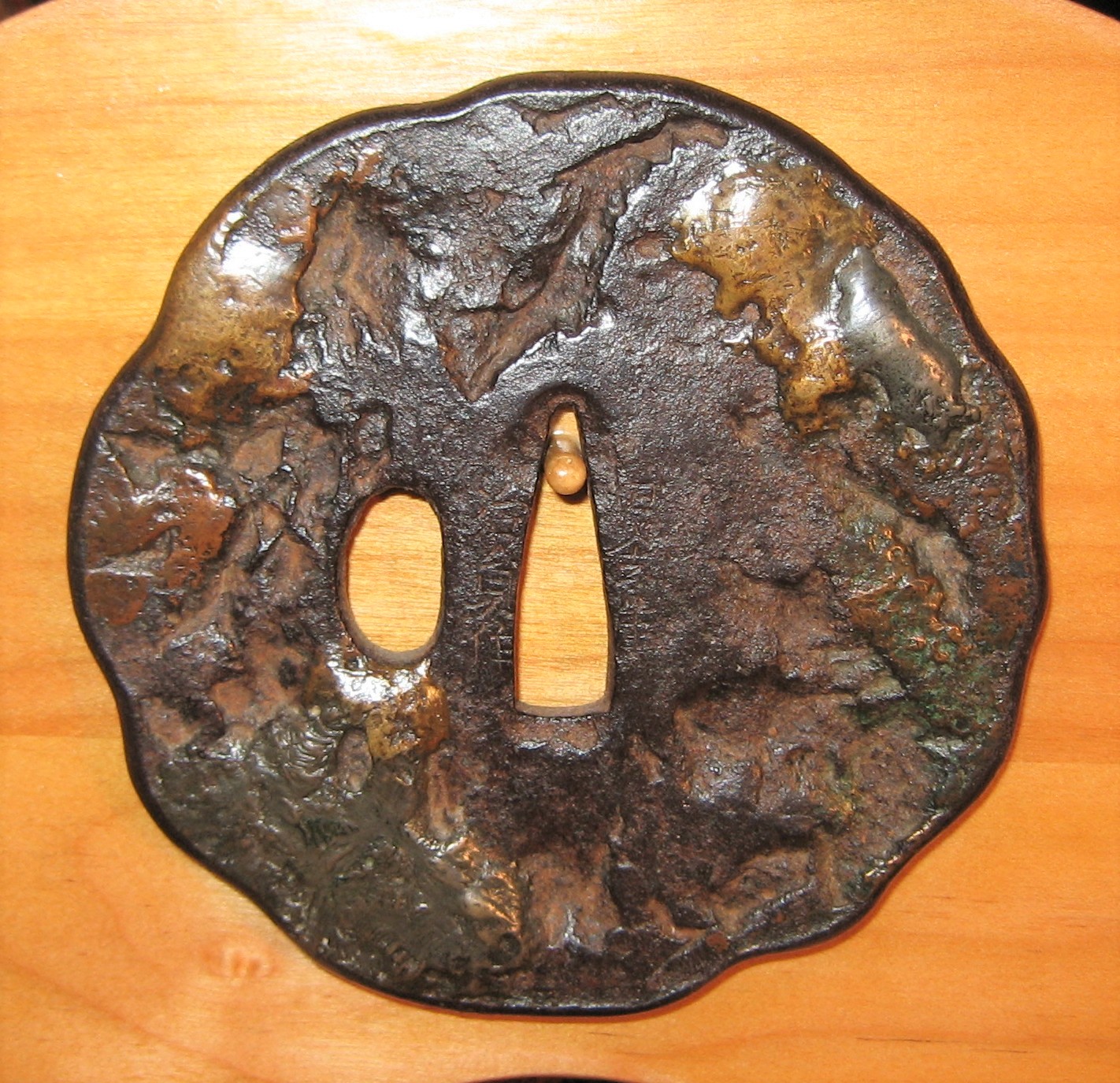 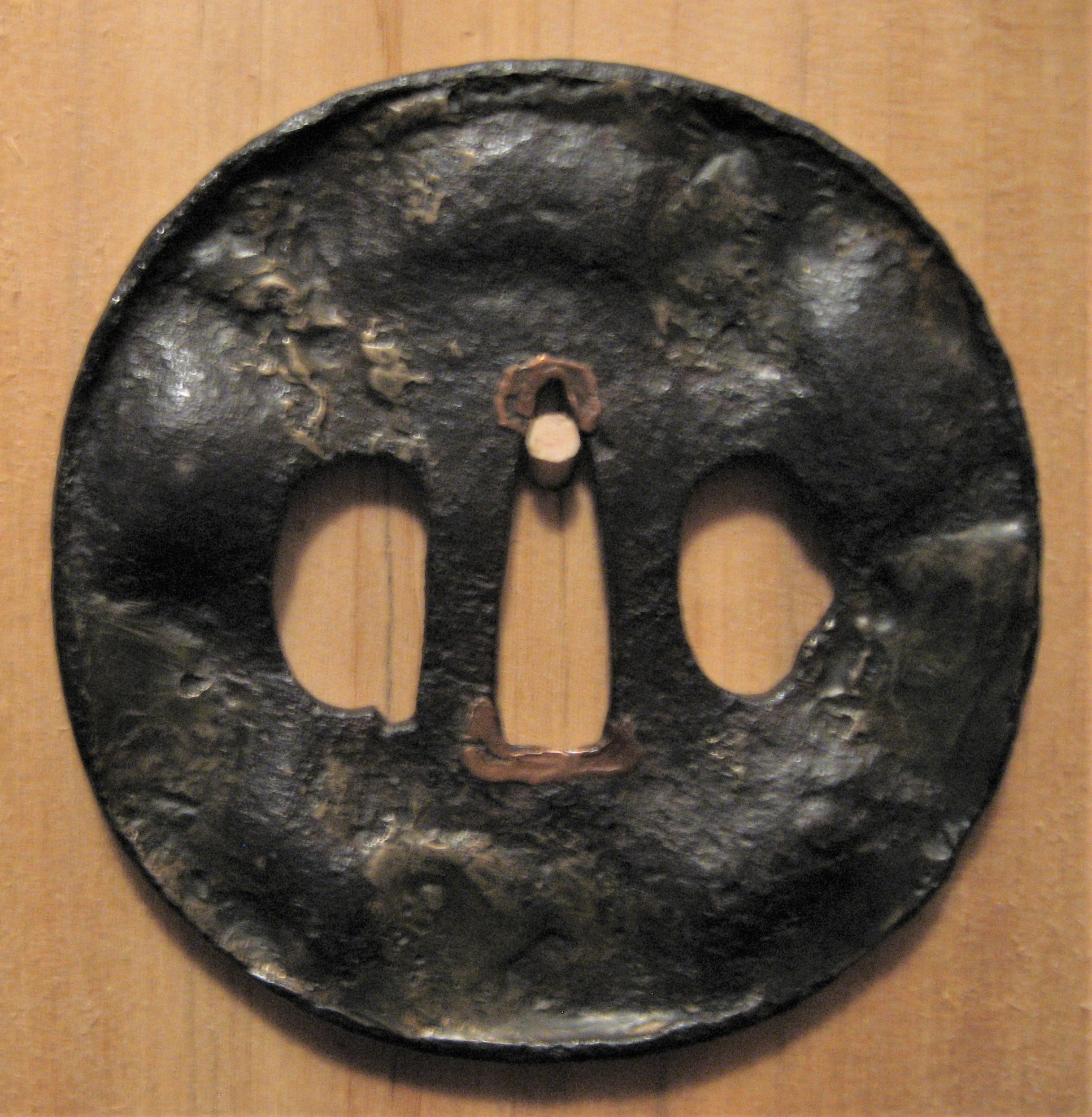 | 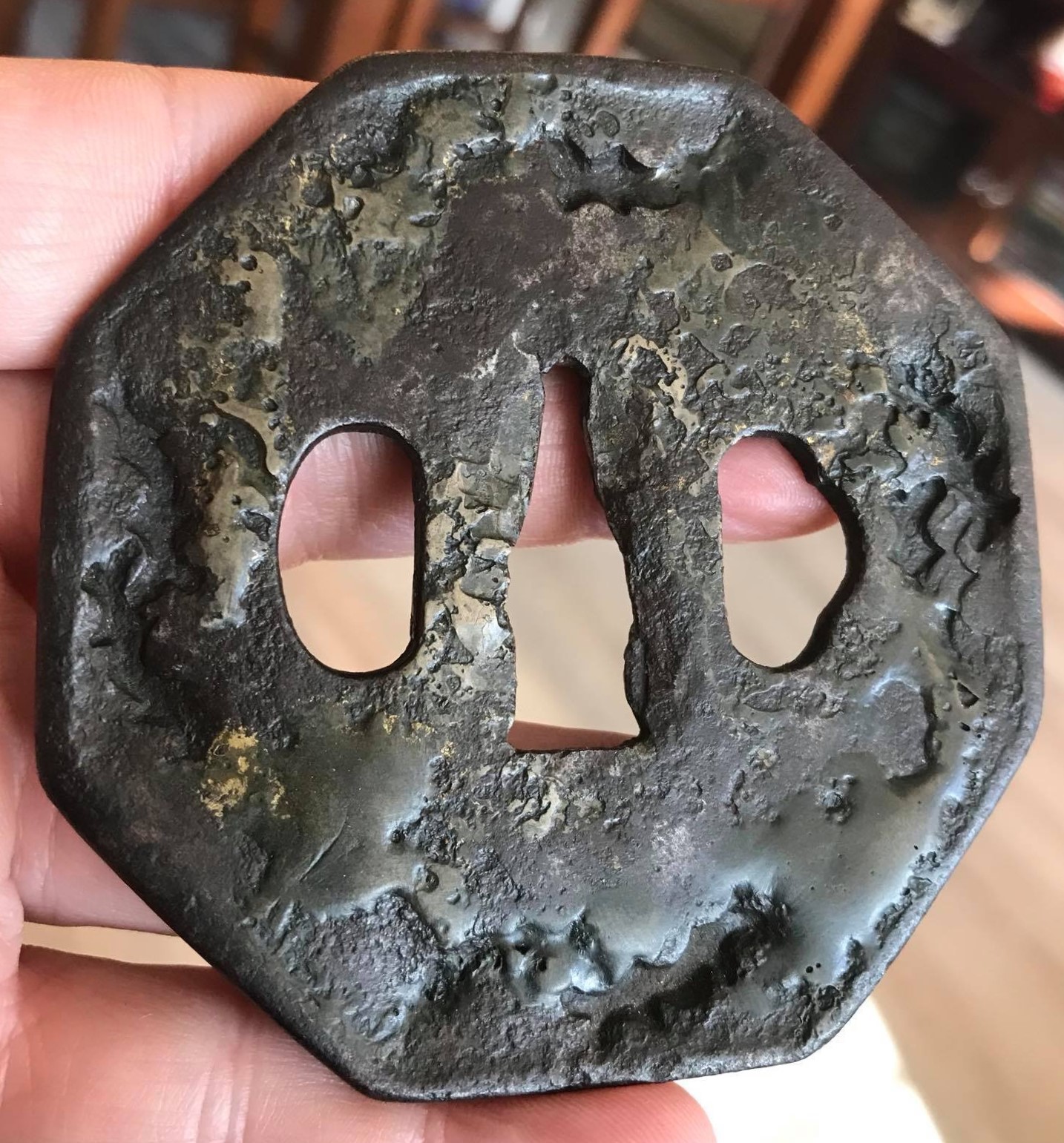 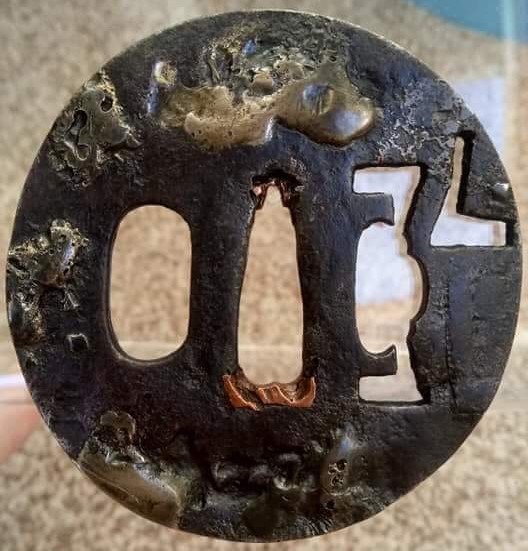 |
Here are my thoughts on the Harusada tsuba: During the entire time that Harusada was creating, he has a final goal in mind. This goal is his vision of what he ultimately wanted to achieve, and it provides both energy and the direction for the creative process. There is nothing accidental about this creation. My contemplation of the Harusada tsuba serves to clarify what is meant by the cognitive functioning of the emotions in tsuba art. It is these feelings that bring me back to this tsuba again and again. These emotions caused me to try to understand the work, to try to unravel its mystery. The more I come to understand this tsuba, the greater the pleasure I feel. |
SOFT METAL (KINKO) TSUBA
KO-KINKO, (Ko-Mino, Ko-Goto), and KINKO Tsuba
KO-KINKO TSUBA:
Ko-Kinko means old gold worker, and is usually applied to relatively ornate, early non-Goto, non-Mino shakudo and yamagane
fittings. These guards are considered the work of specialist kodogu makers,
although their names are not recorded. Some believe these tsuba are a type of
tachi-kanaguchi tsuba (tsuba done by makers of tachi fittings). The prefix Ko
denotes fittings made before the Edo period, Edo period is denoted by Kyo or Edo
Kinko. While there is doubtless a wide variety in the quality of sanmai tsuba,
these have received origami from the NBTHK attributing them to ko-kinko and
dating Momoyama to early Edo period. The Ko-kinko workers should be subdivided into three groups: the Mino-Goto, the Ko-Goto (sometimes referred to as the Jidai-Goto), and the independant Ko-Kinko. The Ko-kinko worked in kawarigane (soft metal) of shakudo or yamagane in most cases. NOTE: The authorities of the past have given little heed to the irogane ko-tsuba (multi-colored metal tsuba made in Muromachi and Momoyama ages) workers. Their importance as artists within the historical context of the development of the soft metal tsuba makers cannot be neglected. The work of the ko-kinko was to last until the end of the Momoyama age. At that time they were eclipsed through the rise of the kinko age. Tradition says that the Ko-Goto were the descendants of the Mino-Goto workers. There is little proof for this theory but it would seem to be true. There is some evidence that the inter-relationship of the ko-kinko workers was so strong that a clear distinction between the various subdivisions is almost impossible. By the end of the Edo age some of the ko-kinko seemed to have become tachi-kanagushi. More research is needed to clearly understand the ko-kinko.
Interesting paper about Ko-kinko tsuba and casting method by Yamabushiantiques.
|
|
NOT FOR SALE. "A most interesting and highly important tsuba with ongoing study. This tsuba was in the collection of Kenichi Kokubo. It is illustrated in his books: ZABO TANSEN (1974), page 318 and SHINSEN KINKO MEIKAN (1993) page 13 (right entry). The signature reads: KAWATSU (family name), CHOSA (short for Chosaemon), TAIRA (clan name), IESADA (no saku?). Date of Kanei Juninen Kit I Go Gatsu. The 12th year of Kanei is 1635, year of the hog. 5th month, May. Thus the date is: May 1635. In the year 1635 was the first of the SANKIN-KOTAI, a policy of the Tokugawa shogunate during most of the Edo period of Japanese history. The purpose was to strengthen central control over the daimyos (major feudal lords). It required feudal lords, daimyo, to alternate living for a year in their domain and in Edo, the capital. It was made compulsory for the tozama daimyos in 1635. It would seem that this tsuba was made for this trip. Opposite the date is inscribed: Shogun Den. The Sho kanji is also read Katsu and is not the proper kanji for the title of Shogun which is: hata, masa ni, with the same kanji gun. This seems to refer to the First Trip to Edo." (Haynes) |
The NARA SANSAKU
Toshiteru, founder of the Nara School, was affiliated with the Goto School but parted company, and continued for nine consecutive generations. The three best known masters of the Nara School in early Edo period were Toshinaga, Yasuchika and Joi, known as the Nara Sansaku. The style of Toshiteru and the second and third generations is called Old Nara and with a transition of style commencing with Toshinaga and thereafter New Nara, which differ greatly. In the work of the Old Nara one can see the Goto influence with simple and classic designs, while the style of the New Nara is more graceful, but not as strong and realistic as work by Somin and others. It is well known that among the works made by the Nara Sansaku there are 31 pieces which are titled with Juyo Bunkazai or Juyo Bijutsuhin; six for Toshinaga, twenty for Yasuchika, and five for Joi. This would seem to indicate that there is not much to be questioned or discussed. Even so, there are still many difficult questions to be discussed and conclusions that are unanswered. Since all of the works of the Nara Sansaku are signed, there is the only truth, genuine or gimei. In order to get it, it is necessary to study with great care both the detailed characteristics of the signature and the characteristic style of workmanship.
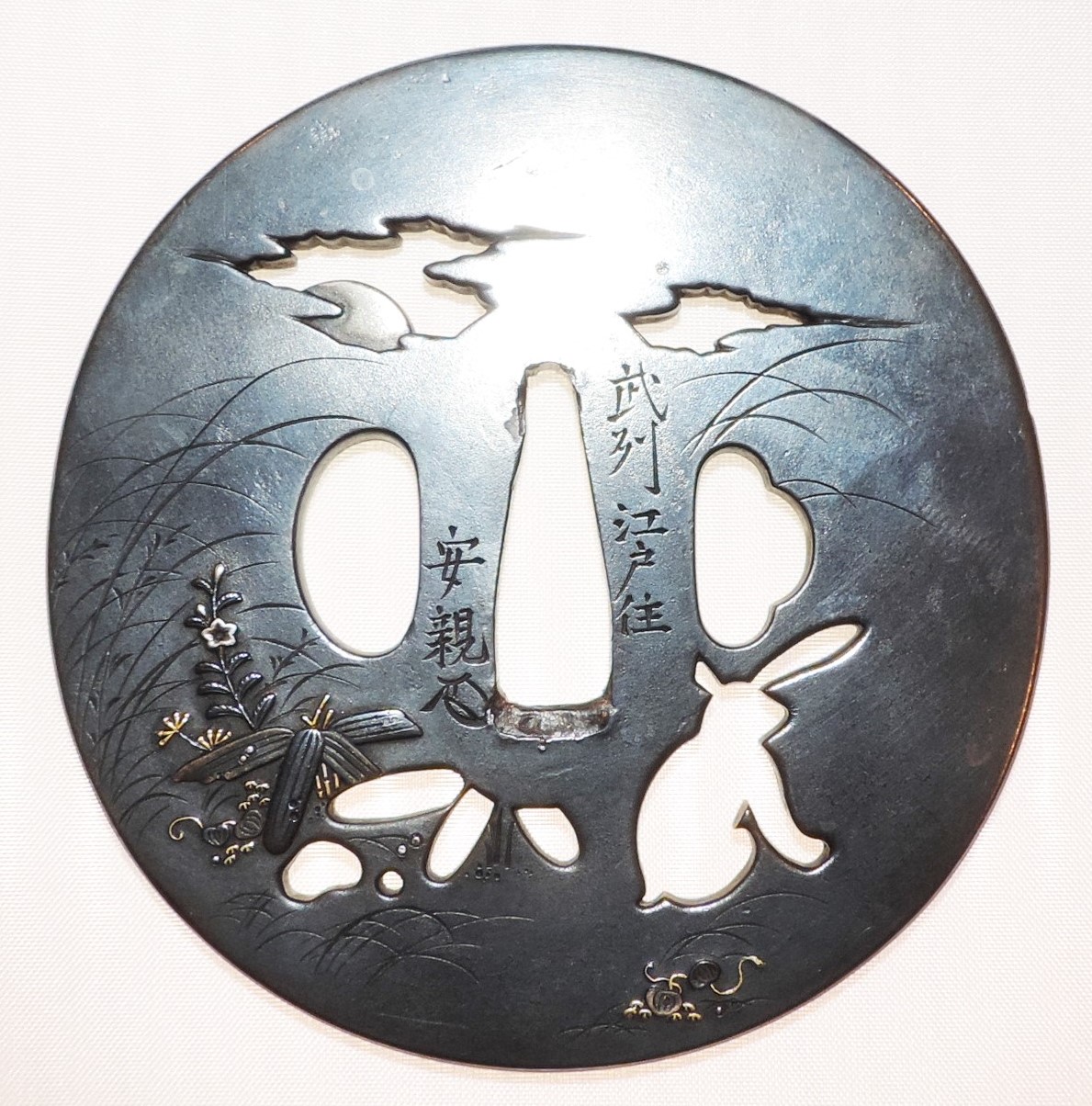 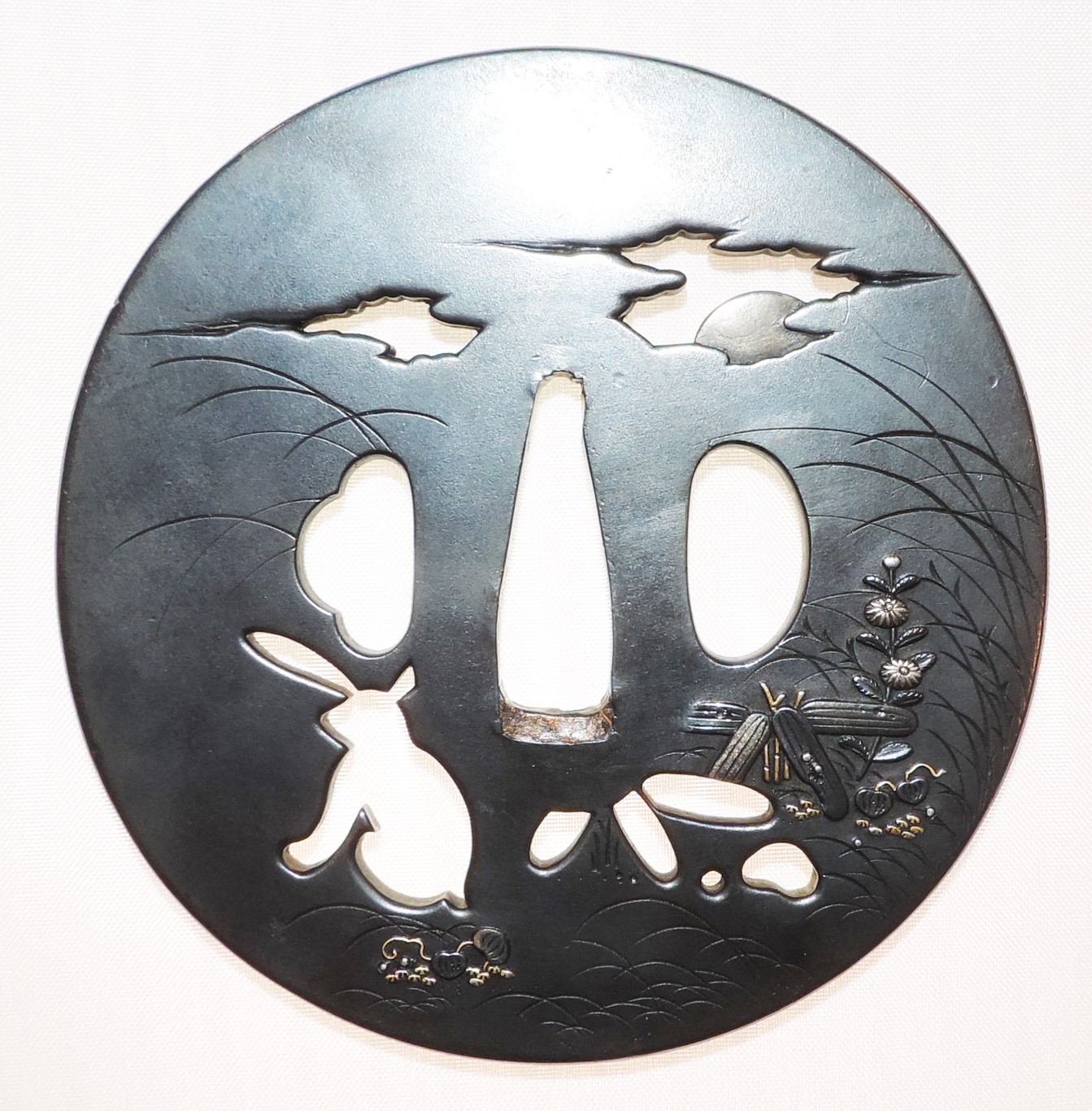 |
FOR STUDY PURPOSES ONLY. "This tsuba is of shakudo plate that is 8 cm. high and 7.9 cm. wide. It is signed:
'BUSHU EDO JU YASUCHIKA' and KAO. The round shape plate has an inlaid shakudo rim that does not go over the edges. This style of rim cover is to be seen in other shakudo plate tsuba of this time, and sometimes they are of gold. The design is of a hare in kage sukashi (silhouette sukashi), turned three quarters away so we see mostly the back of the animal. To its left are three sukashi sasa dwarf bamboo leaves, a dot of dew and a hart shape opening. Next to the bamboo leaves on the face are sasa bamboo leaves inlaid in two tones of shakudo, with gold flowers and other plants. A flower stock with nine shakudo leaves and a single silver bloom with a silver bud at the top, exits the bamboo leaves. This bloom is of the Rindo flower, or gentian (gentiana) often called the bell flower. The blooms of the Rindo are part of the family mon (crest) of the Matsudaira family." (Haynes) |
|
'JOI' 'Sensei' |
|
'BUJO AKASAKA INSHU RAKU JOI NAGAHARU TSUKURU' |
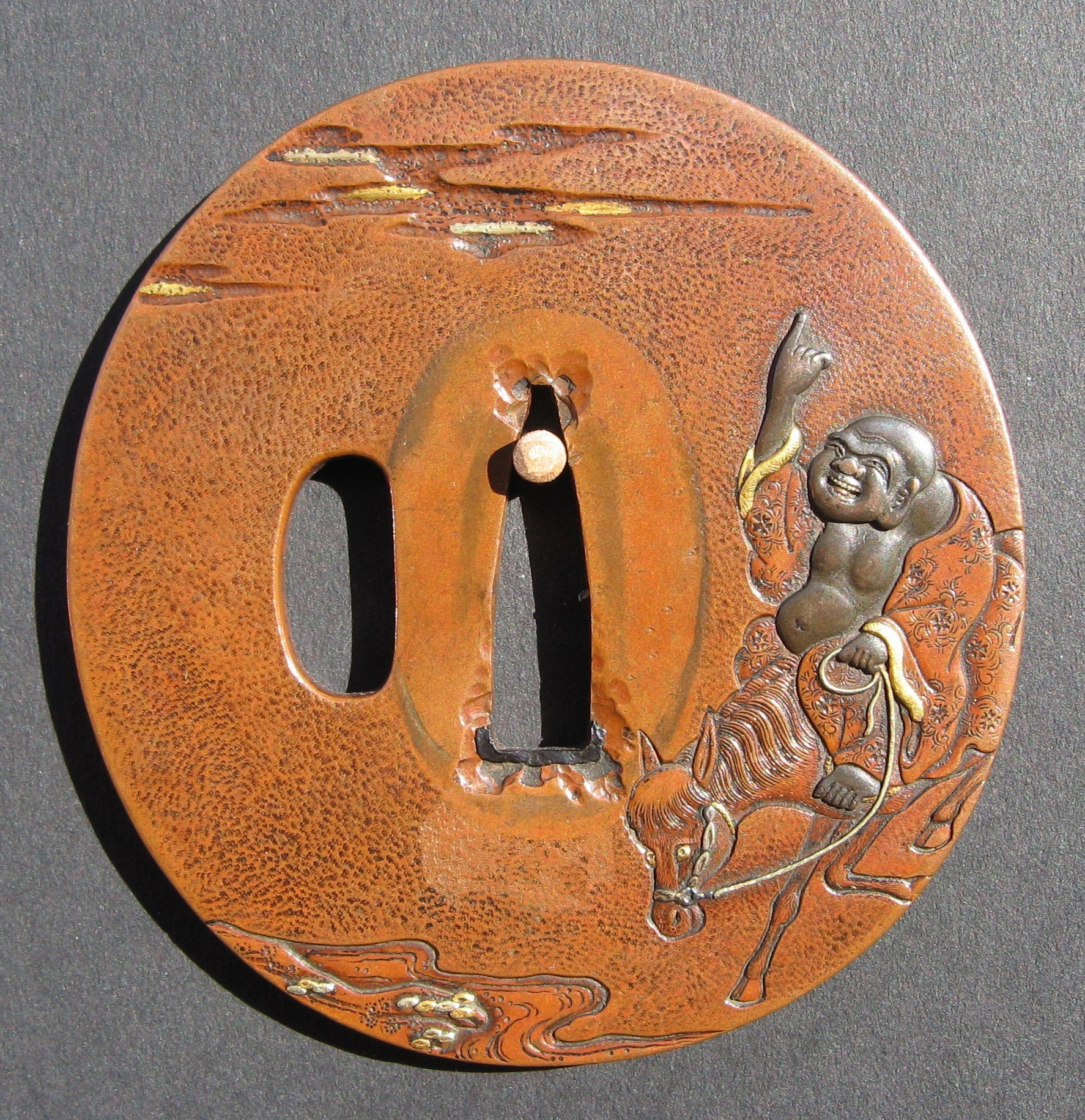 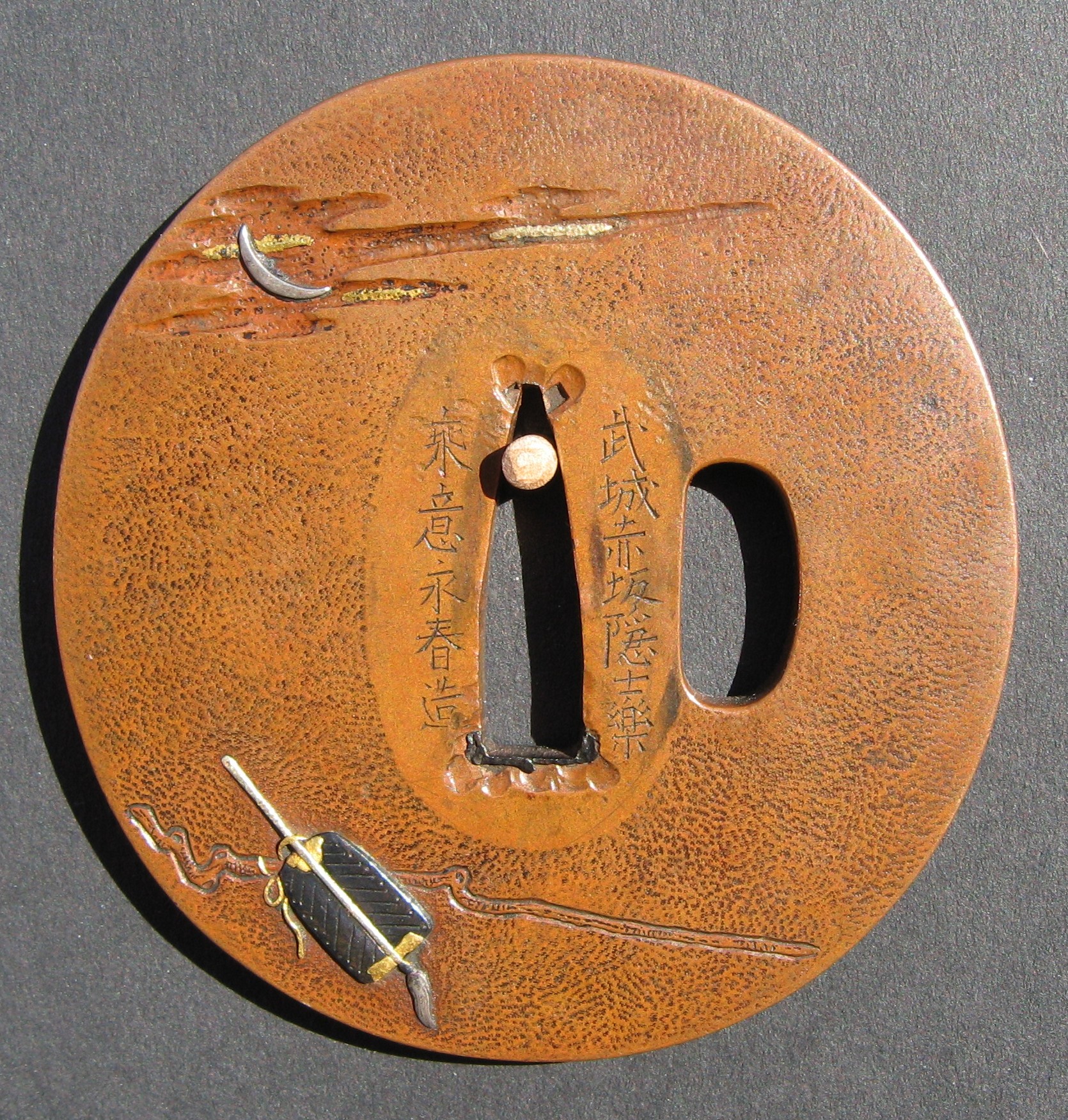 |
Serious Inquiries Only "A large round copper plate of katana size with the face showing Hotei riding on a horse, that looks much like a mule, or perhaps a Mongolian pony. His staff and fan are carved and inlaid on the reverse side. The plate surface is ishime of very fine grain. The horse, robe and staff are in pure shishiai style. The head, body and arm of Hotei are above surface inlay, as is the fan on the reverse side. The clouds are carved well below the plate surface and have gold inlay touches and a silver moon on the back side. The amount of detail carving is hard to see in some cases, as it is so fine. The quality of this tsuba is far superior to that of many others with this same subject, and shows the true ability of the work of Joi. Read complete descriptive article by Robert Haynes titled 'The M. Arthur Kay Sugiura Joi Tsuba HERE. |
|
'JOEI' 'Student' |
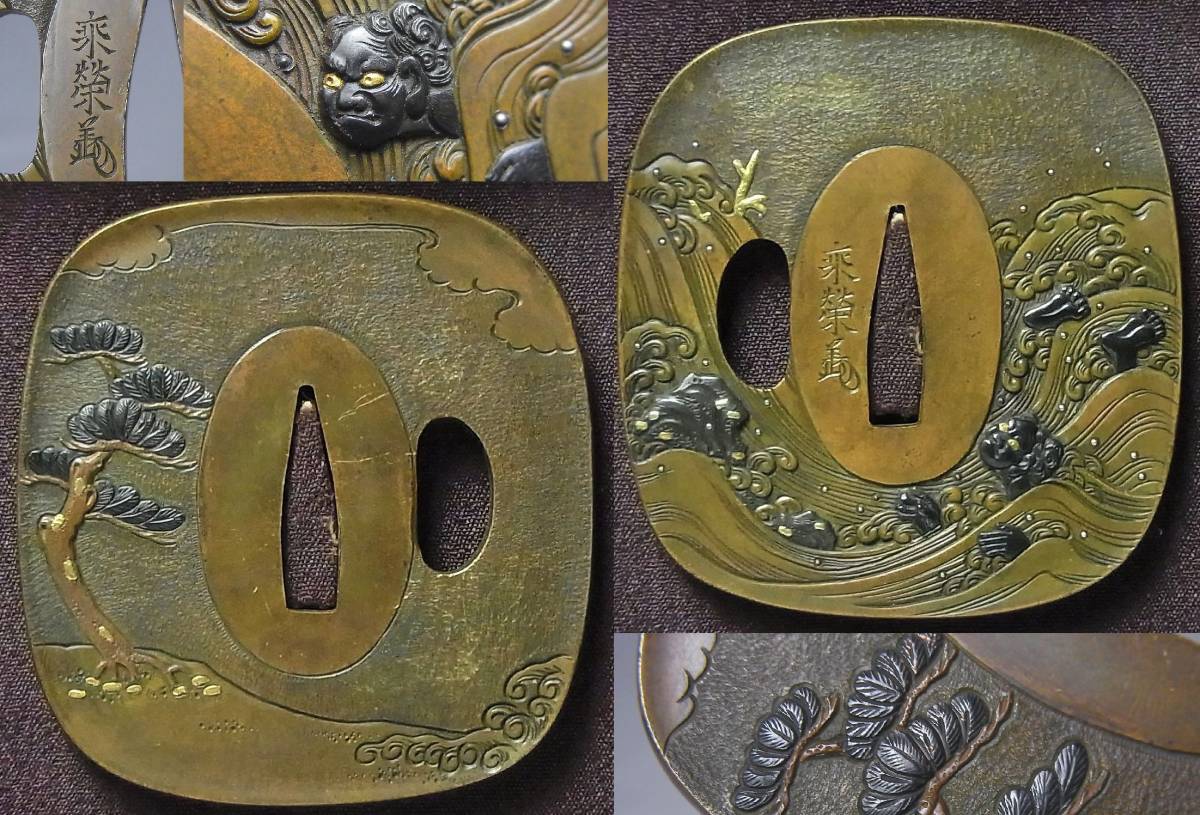 |
'JOEI' $4000.00 |
 |
'JOCHIKU' $10,000.00 |
 |
'ISSAI TOMEI' & Kao $7500.00 |
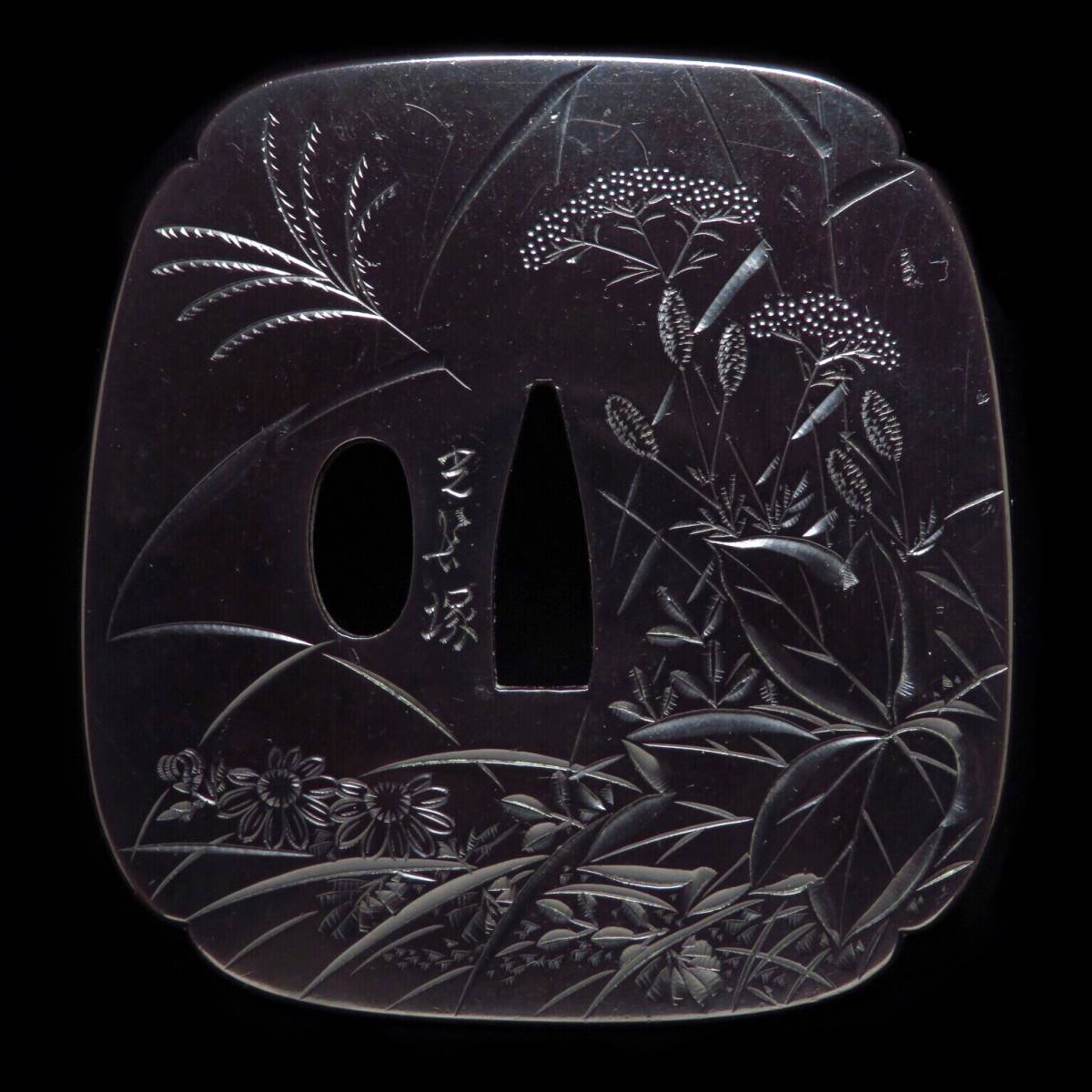 |
'MITSUNAGA' (Nidai) $5000.00 |
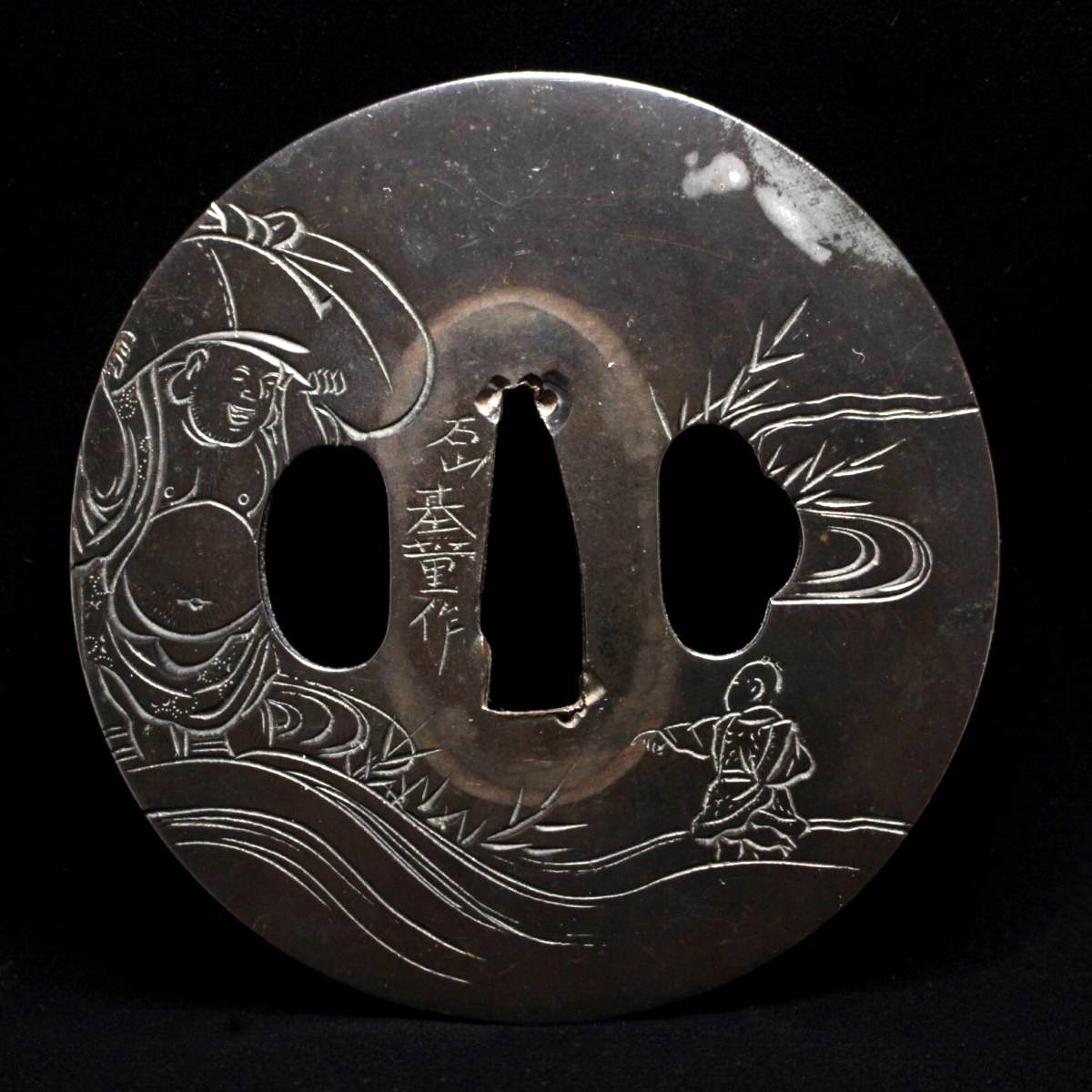 |
''ISHIYAMA MOTOTADA SAKU'' $1500.00 |
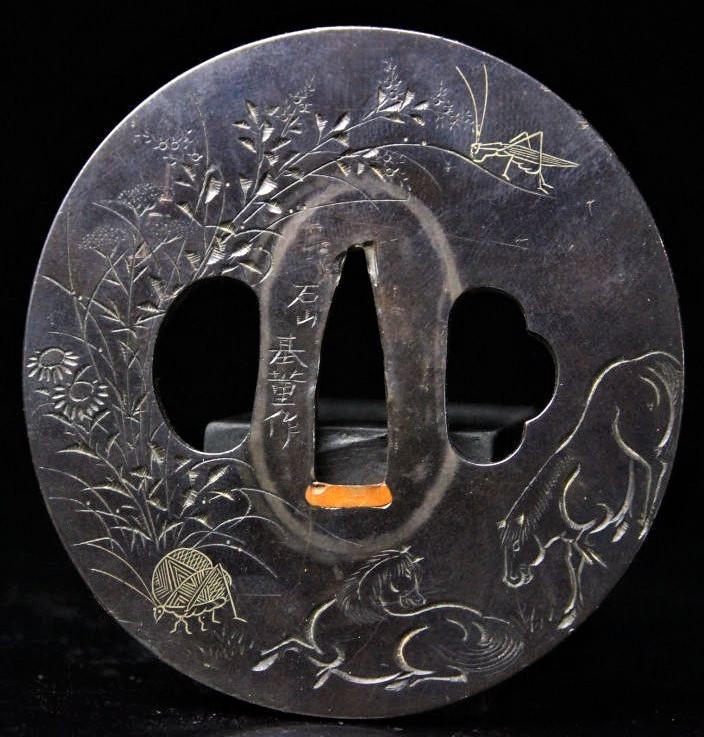 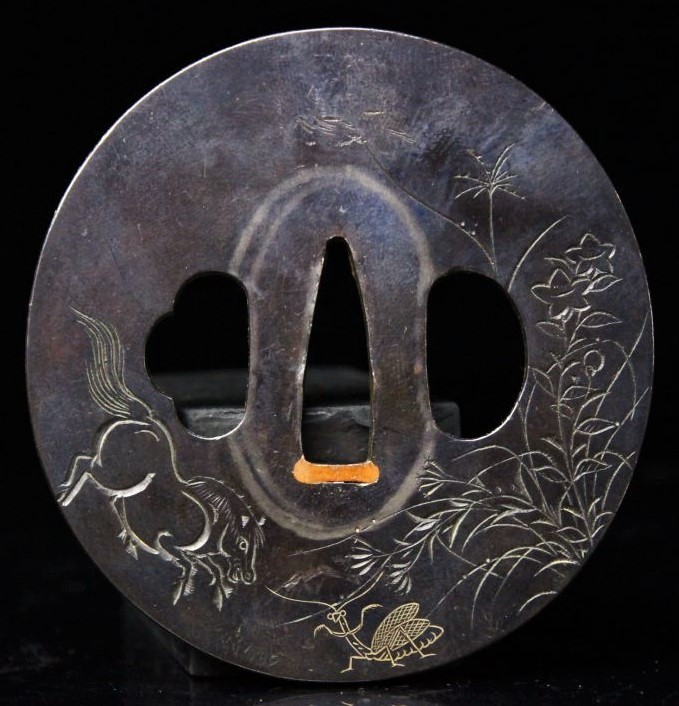 |
'ISHIYAMA MOTOTADA SAKU' (H 05940.0) $3000.00 Provenance: Robert E. Haynes "A very fine shakudo ground with gorgeous gold inlay work and a gold fukurin. The delicately carved horses, autumn grasses and mushi are realistic and show a high degree of ability and expressiveness." 6.90cm x 7.25cm x 0.35cm. |
  |
'SOYO' & Kao $1800.00 Provenance: Robert E. Haynes "Mei: 'SOYO' with Kao. This is Yokoya Soyo who is the 3rd master of the Yokoya family school. Worked in Edo. He specialized in katakiri carving on shibuichi plate (as shown here) and produced the finest of that style of work that any of the Yokoya school was to make." 6.90cm x 6.60cm x 0.40cm. |
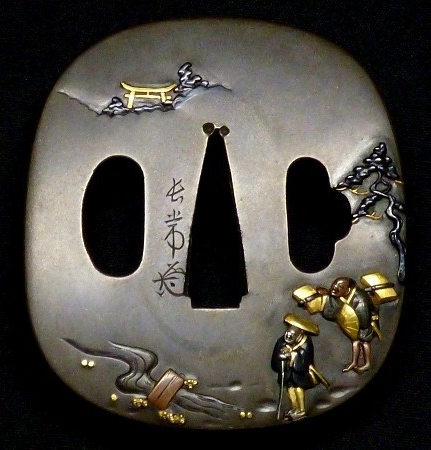 |
'NAGATSUNE' & Kao
$3000.00 |
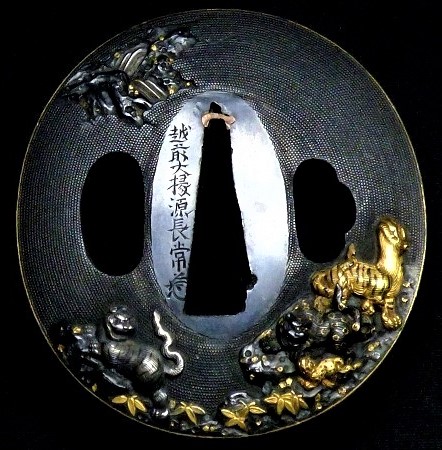 |
'ECHIZEN no DAIJO MINAMOTO NAGATSUNE' & Kao
$7000.00 "A slight oval shakudo plate with precise nanako. Both hitsu-ana are present and shows signs of being mounted more than once. A gold fukurin adorns the piece. The design is of Bamboo ("Take") and Tigers ("Tora"). Since its introduction to Japan, the Tiger in the Bamboo had been a preferred picture for paintings and for metal carving and inlays. The design was both carved and made separate then attached. MEI:'ECHIZEN no DAIJO MINAMOTO NAGATSUNE' & Kao. H 06539.0. Summarizing, he studied painting under Ishida Yutei, was a student of Yasui Takanaga, and received the title of Echizennodaijo in 1770." (Haynes & Long) |
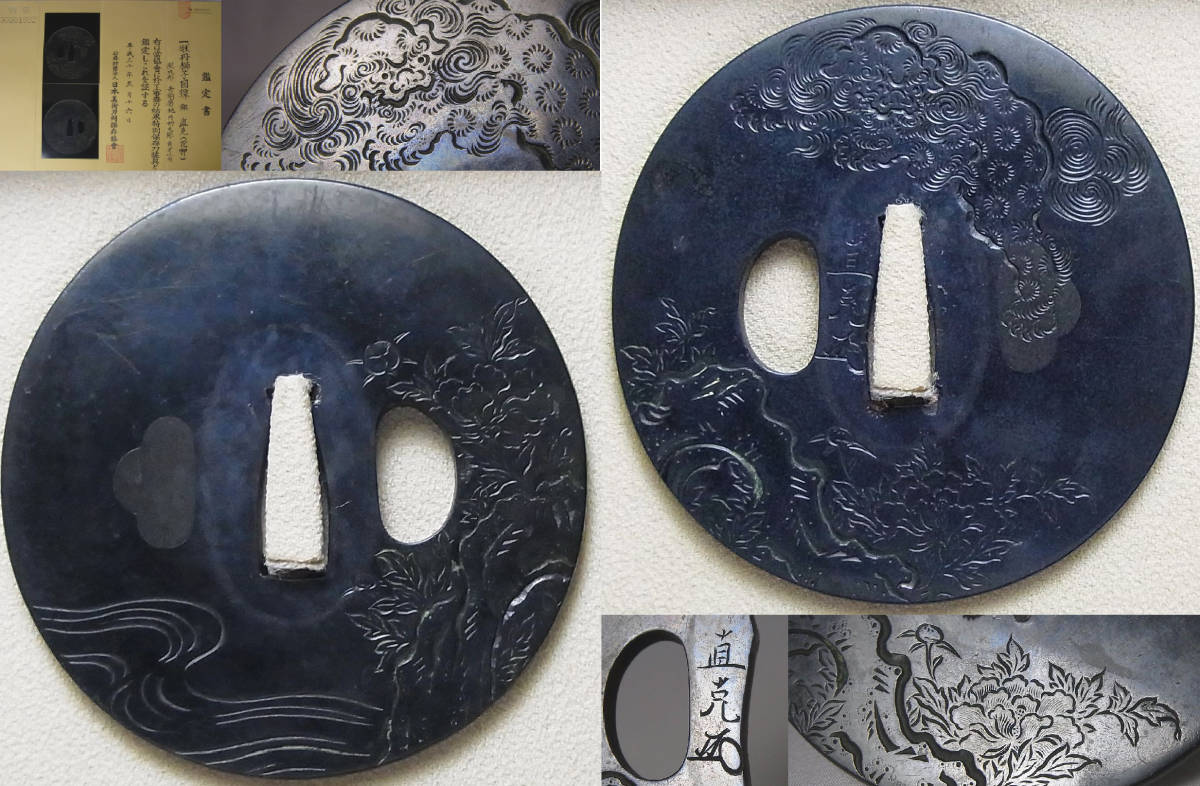 |
"NAOKATSU" $3000.00 "A very fine shakudo plate with a delicate carving of a leopard frolicing in nature. There are various types of foliage and landscape on both faces. It is a very advanced work showing the delicateness of the carving of the leaves, flower buds and the leopards spots along with the rest of the design. Signed: 'NAOKATSU'. This is the son of Naoshige (H 06773) and a student of Yanagawa Naomasa (H 06690). He signed with both the Inagawa and Yanagawa family names and would use the same Kao with each, in some cases." (Long) 7.45cm x 7.65cm x 0.45cm |
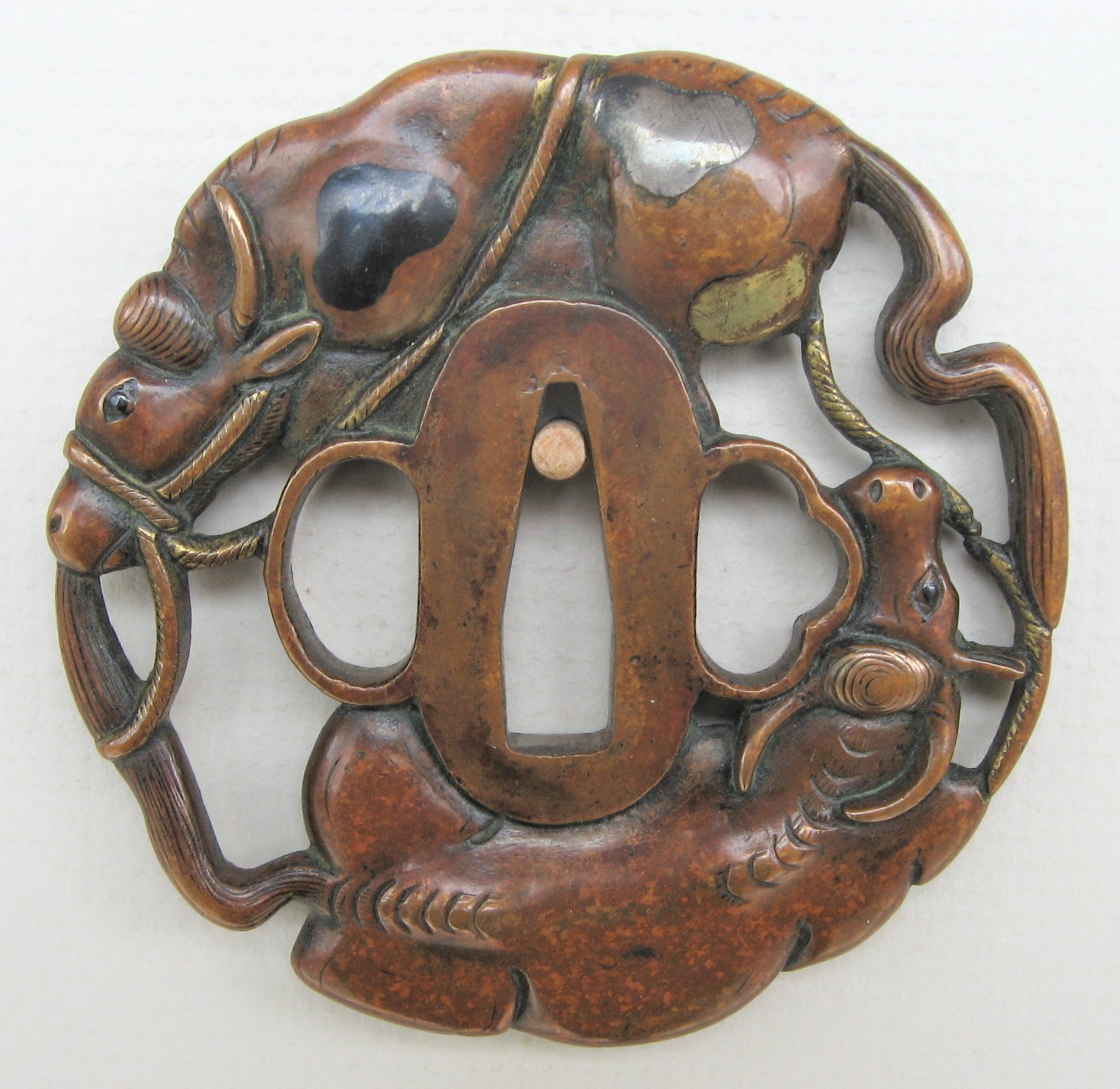 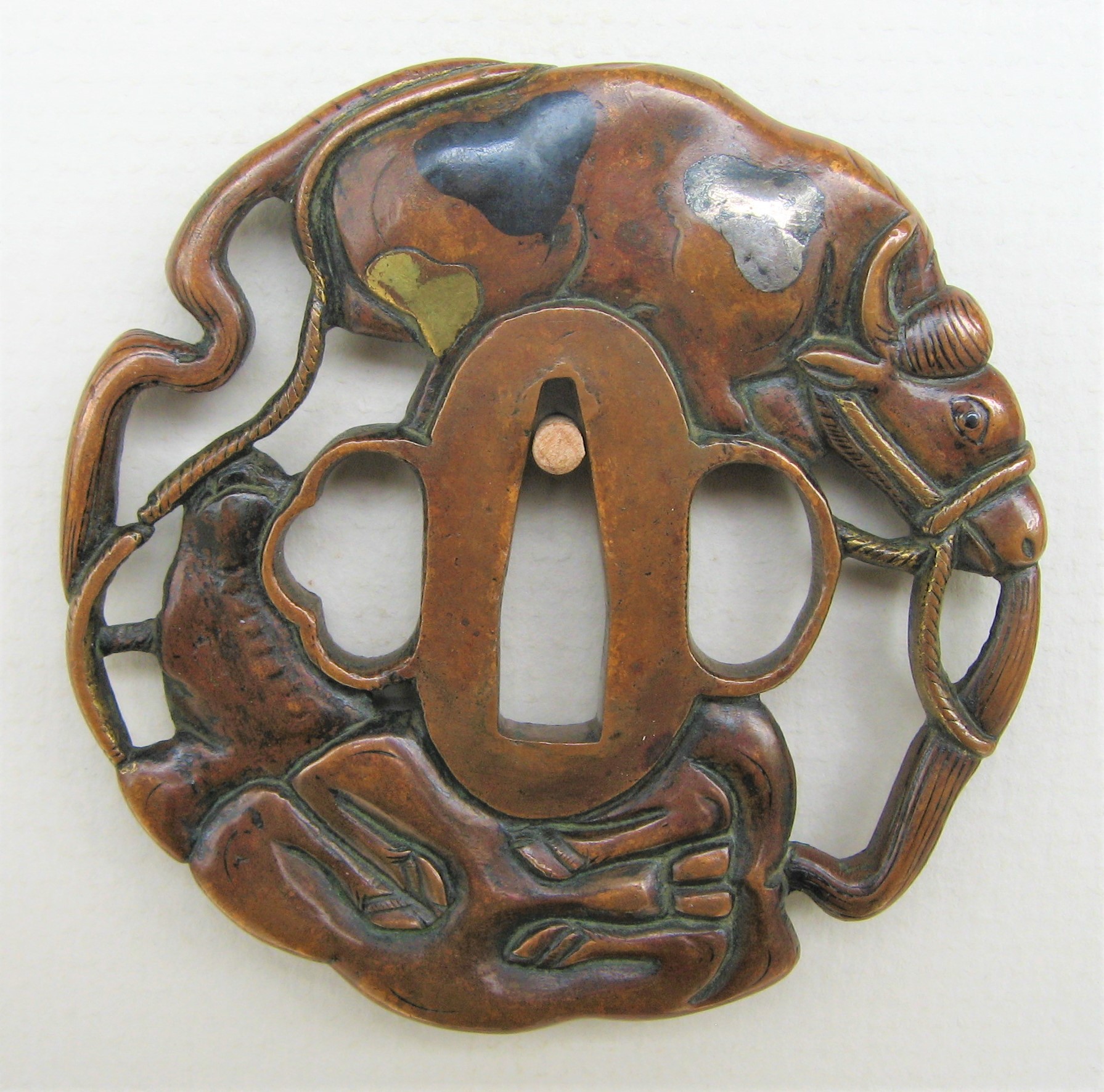 |
A STUDY of OX POA A study of OX themed tsuba done by three different schools and their interpretation. |
  |
'YASUCHIKA' (Seal) $3000.00 "This tsuba is of shakudo plate. The surface seems in various lights to have an almost serene quality about it. The plate is quiet and subtle in color and tone. The round shape plate has a smooth polished rim that goes over the edges. This style of rim is to be seen in other shakudo plate tsuba of this time, and sometimes they are of gold. The design on both faces are inlaid geese. The fowl on the front is highlighted in gold while the one on the reverse is inlaid in dark shakudo. Both have gold highlights. At the top on the front face is a silver moon. On the reverse is a gold inlaid branch and the 'Yasuchika' seal."(Long) 6.52cm x 6.18cm x 0.41cm |
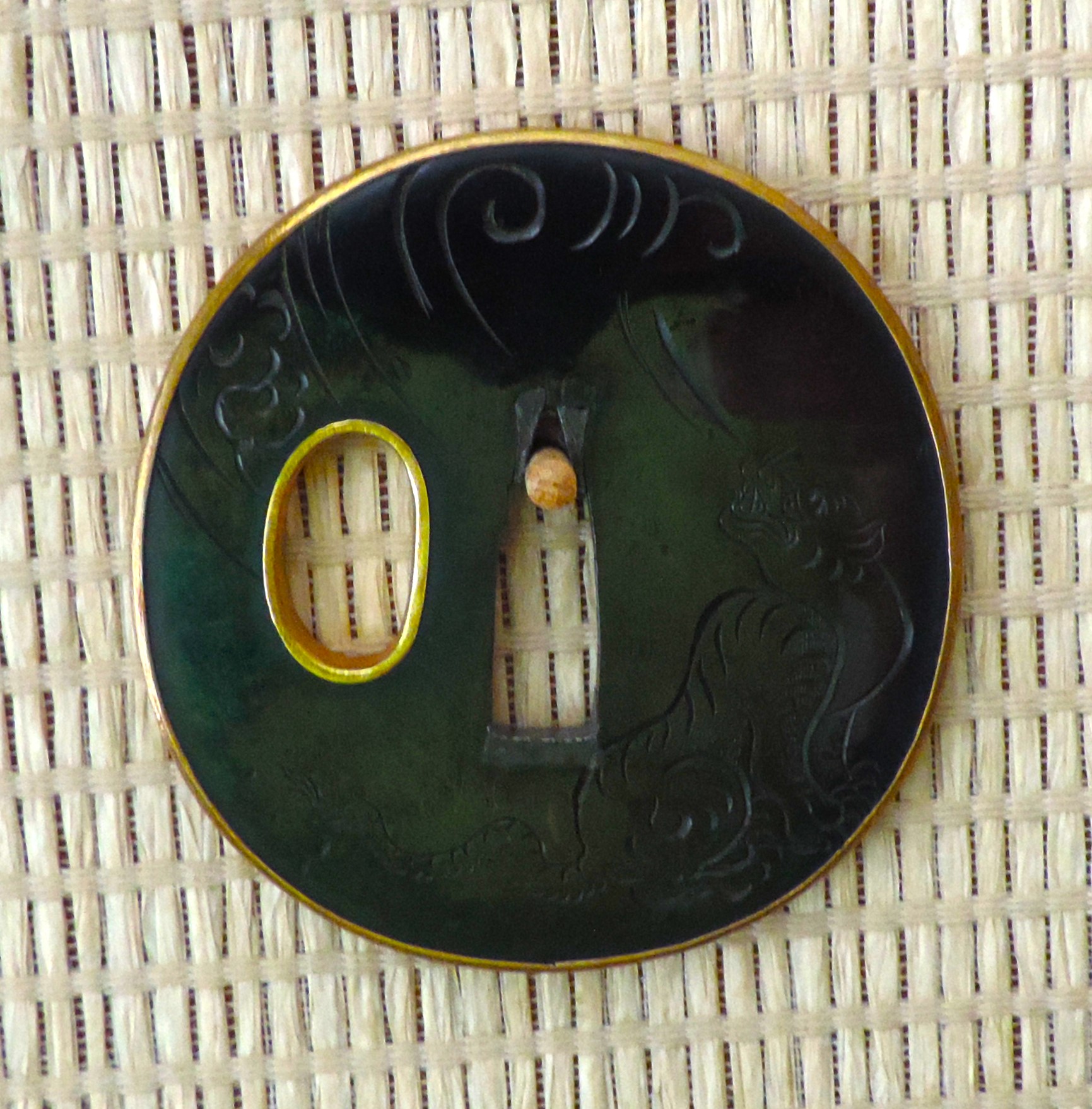 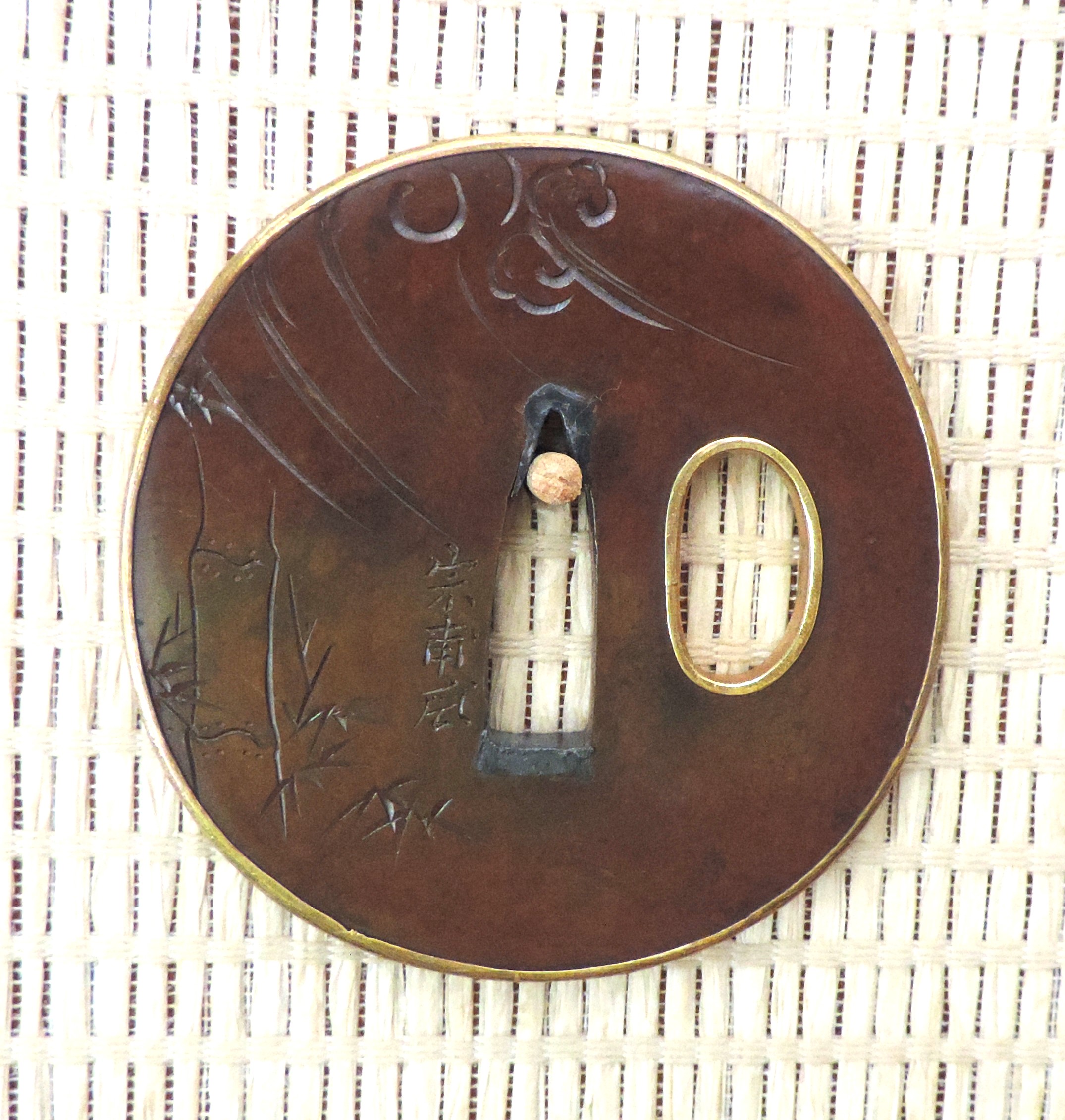 |
'SOHO' & Kao $2000.00 "Presented here is a rare gem of the YOKOTANI School. The tiger diagram on the omote and the bamboo forest on the ura are expressed in one-sided carving which is the family art of the Yokotani school. The base material is made day and night with shakudo and copper ground. The edges of the hitsu-ana and the rim are decorated with gorgeous gold rings. The mei reads: SOHO & Kao. This is H 08891.0."(Long) 6.50cm x 6.70cm x 0.40cm |
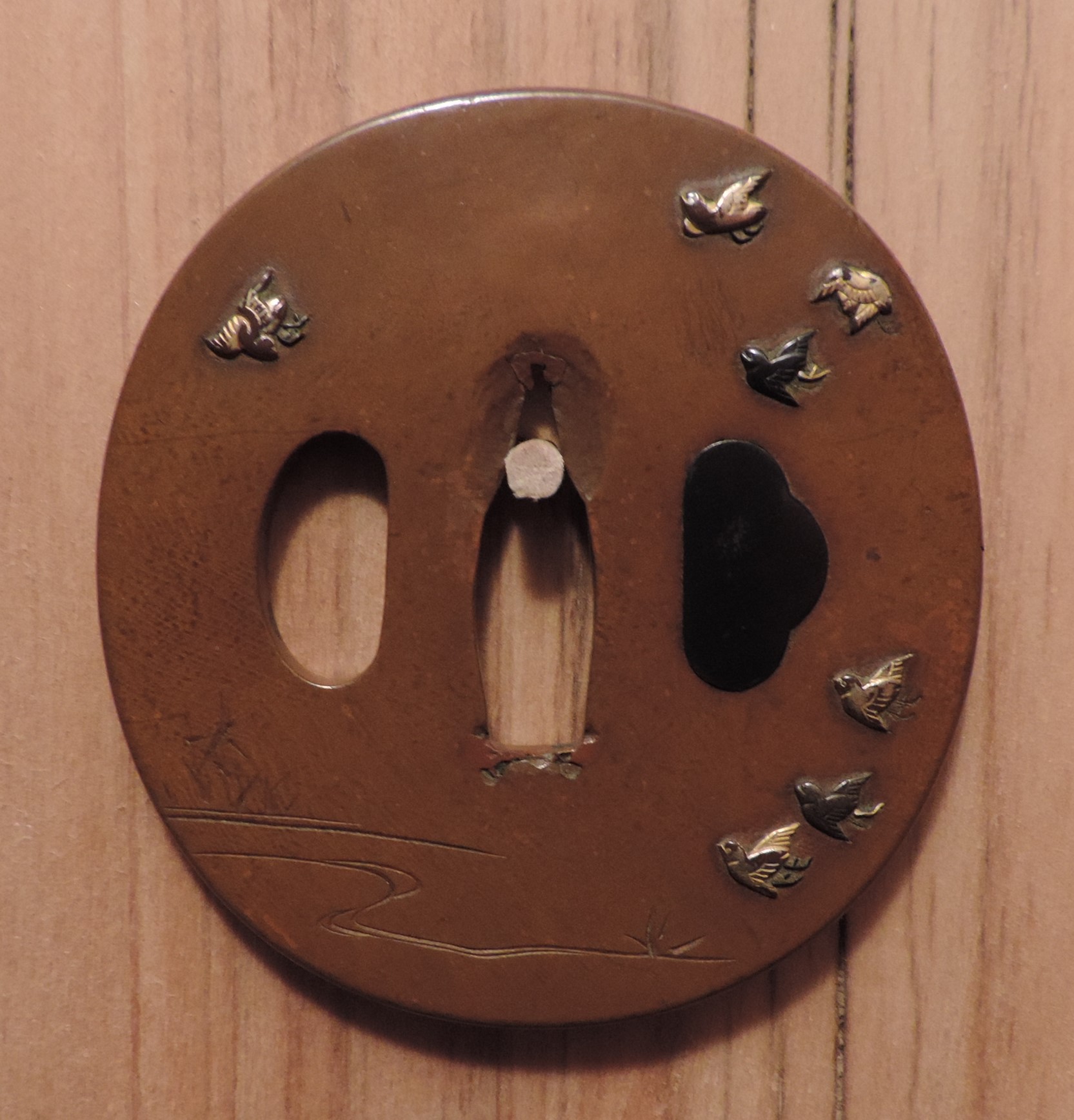 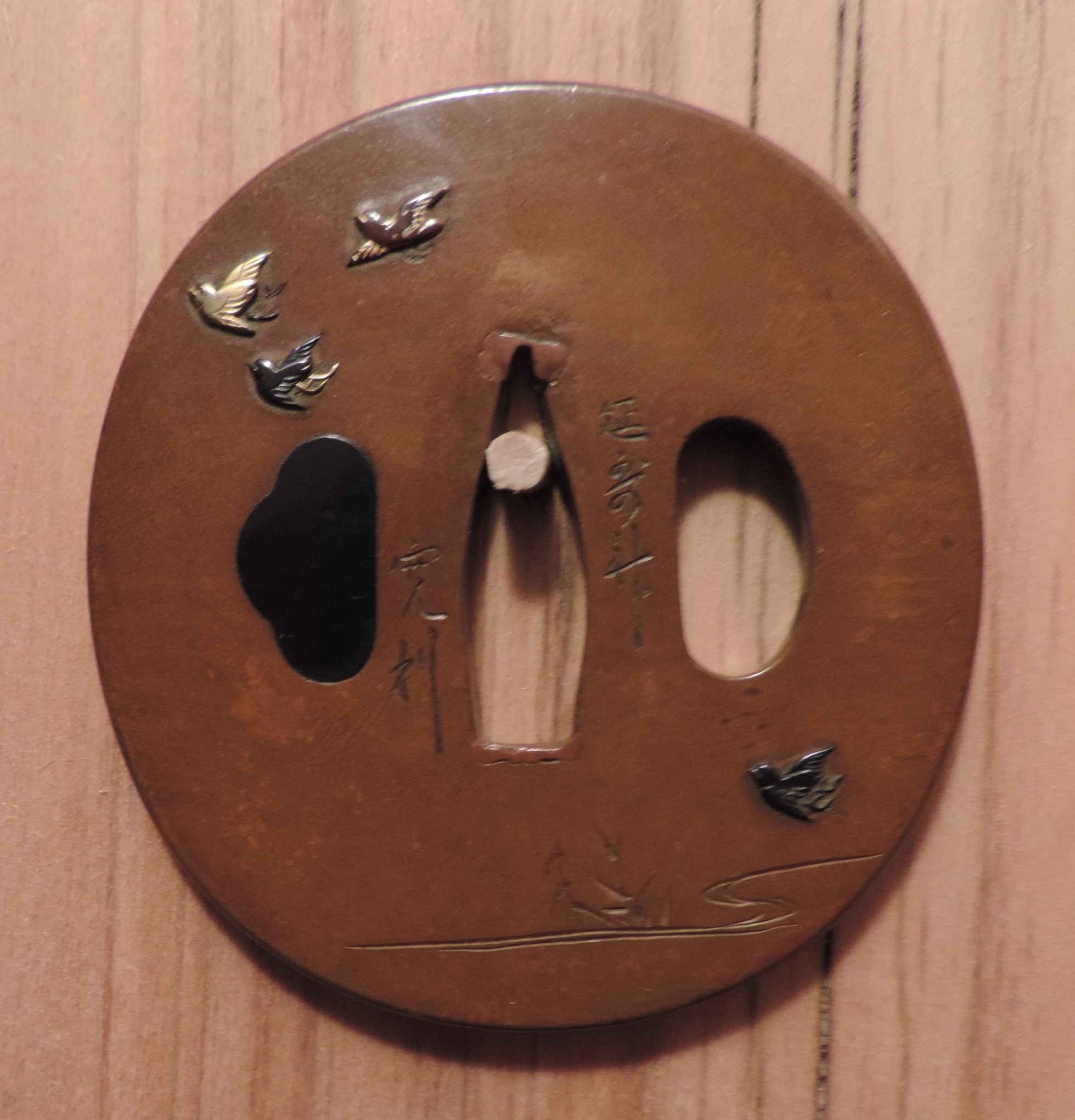 |
'ENJUSAI KANRI' $1500.00 Oval copper plate with original patina in perfect condition. The design is of 'Mura-chidori', a flock of plovers. There are seven on omote and four on the ura. The flock is flying over a stream. The plovers are in gold, shakudo, and copper. See Haynes Index H 02661.0. Accompanied with NBTHK Hozon #2002120.(Long) 6.20cm x 6.60cm x 0.35cm |
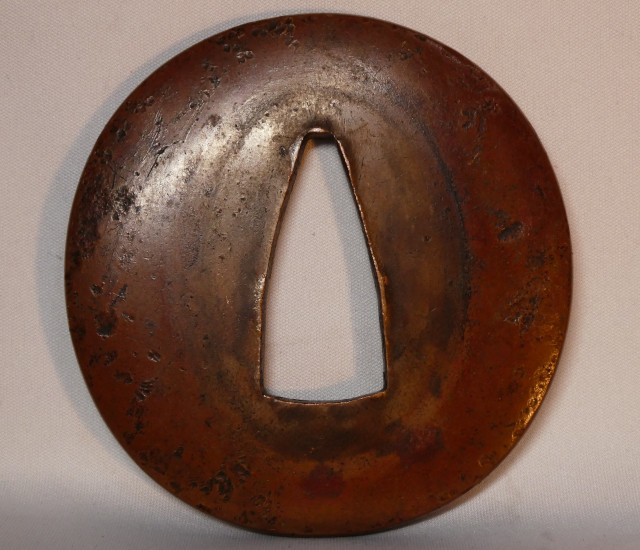 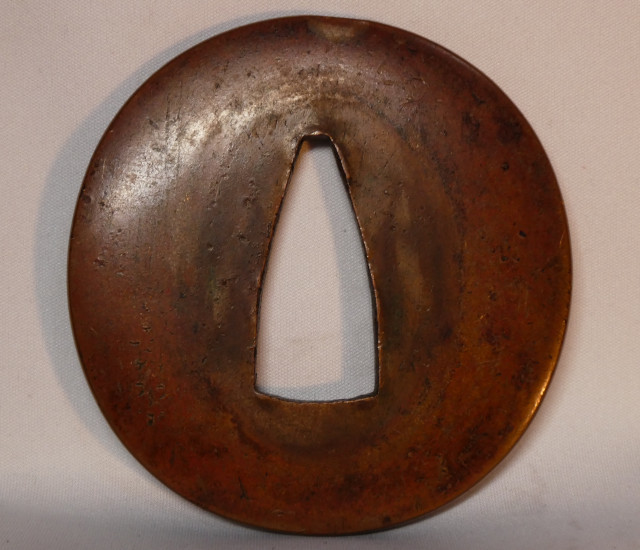 |
NAGINATA Guard Serious Inquiries Only "Large round copper plate nicely forged and hammered with excellent patina and color. Further study and description coming soon." (Haynes & Long) |
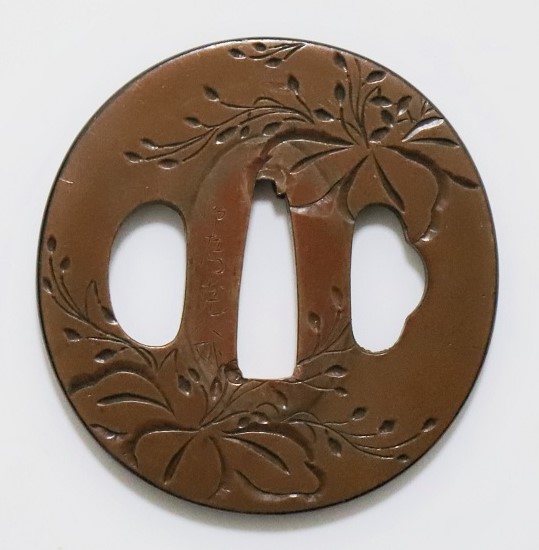 |
'GENZAEMON KATSUHISA' & Kao $1400.00 "A copper base plate with the design of paulownia using the Katakiri-Bori technique. The rim is of shakudo. Mei: 'GENZAEMON KATSUHISA'. This craftsman, Kuwamura Genzaemon Katsuhisa, was born in 1694 and had the reputation of 'Joko'. He was the son of Kuwamura Morikatsu, who was a disciple of Goto Kakujo. See Haynes Index H 02774.0." NBTHK Certification. Hozon Tosogu. March 16, 2017. (Long) 6.60cm x 6.40cm x 0.50cm |
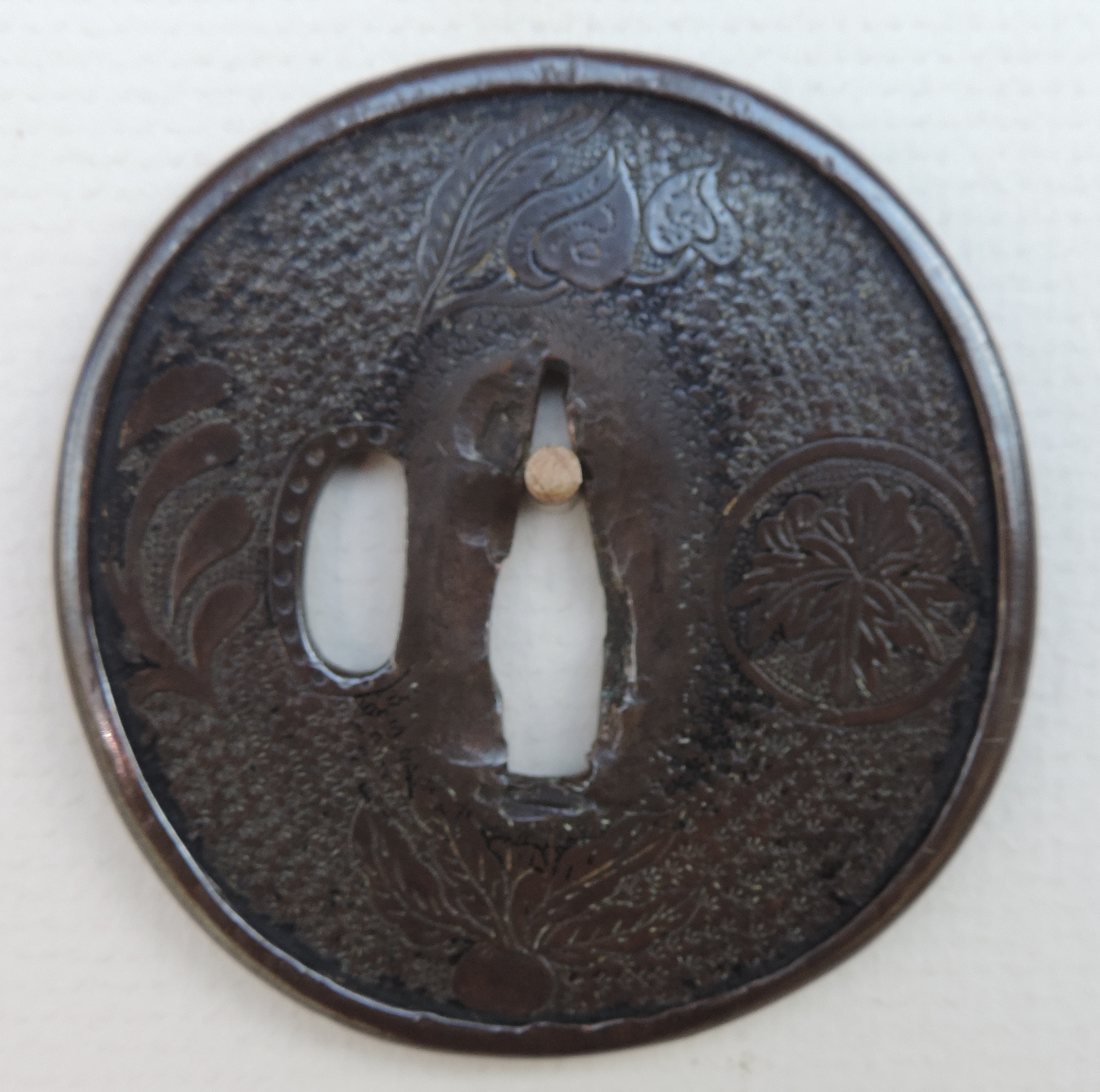 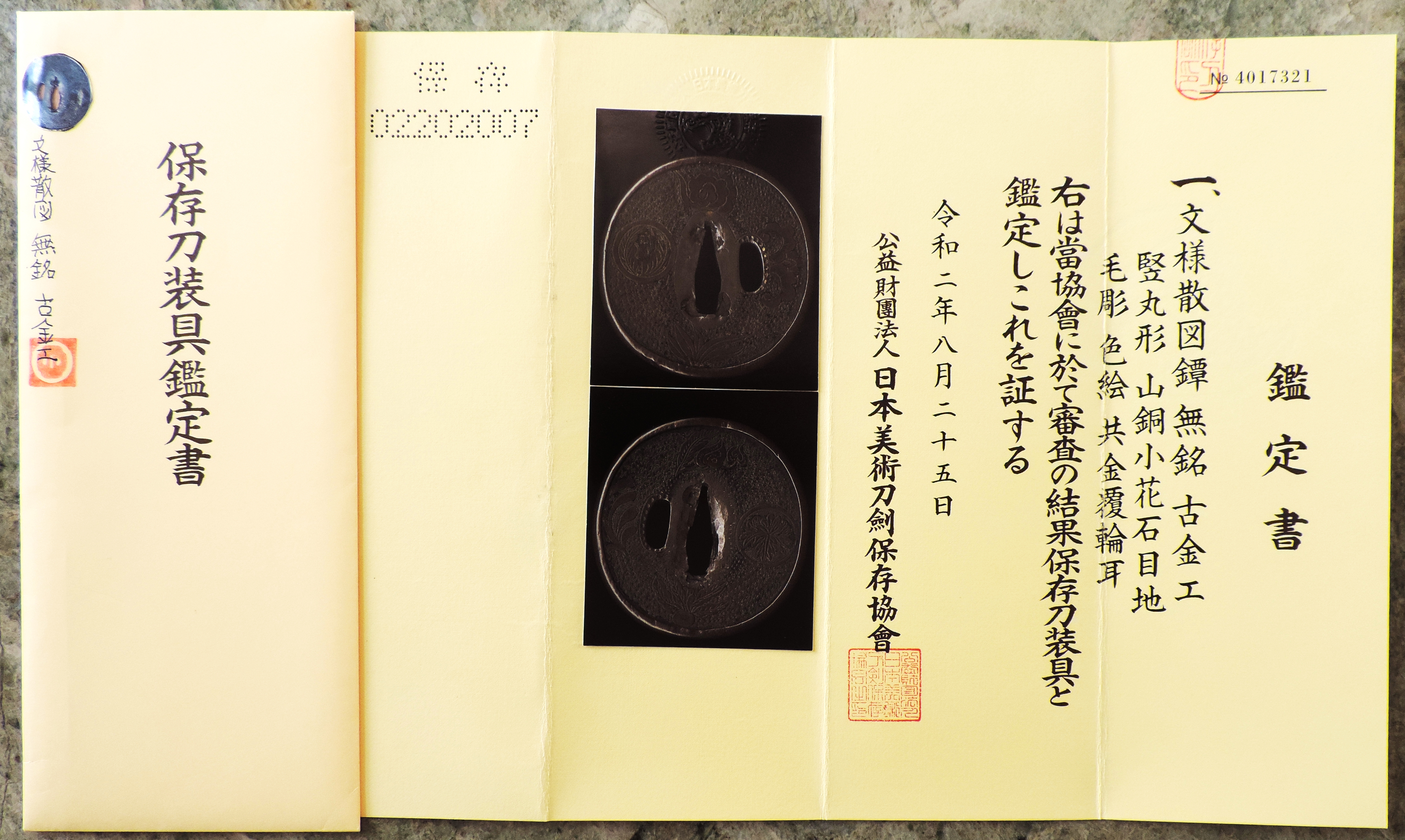 |
KO - KINKO NFS
"This type of tsuba is often referred to as Tachi Kanagu-shi work. There is no foundation for this name. It is a typical mid-Muromachi period work of yamagane plate with a 'star' punch surface and floral and family mon carved on the surface. The reverse is about the same. It has an applied rim cover of the same metal as the plate. The hitsu is original and has been slightly enlarged at the bottom end. It is wakisashi size and intended for a middle rank owner, lesser Daimyo, or ranking offical. It is typical for its period and has more careful work than most made of this period, ca.1450. It has a NBTHK Hozon paper, Reiwa 2nd year, that says 'Ko Kinko' and nothing more." (Long) 7.34cm x 7.16cm x 0.36cm |
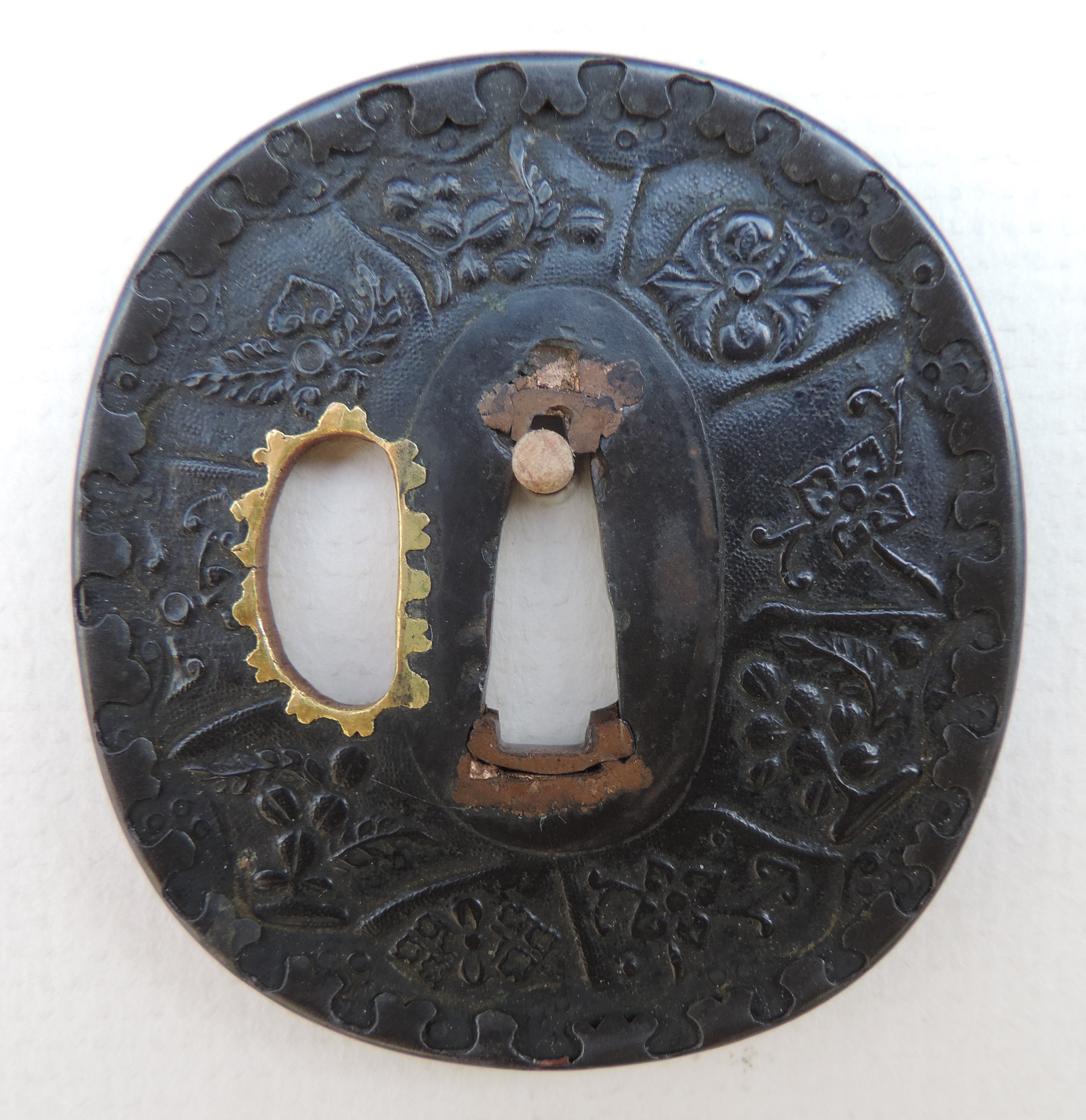 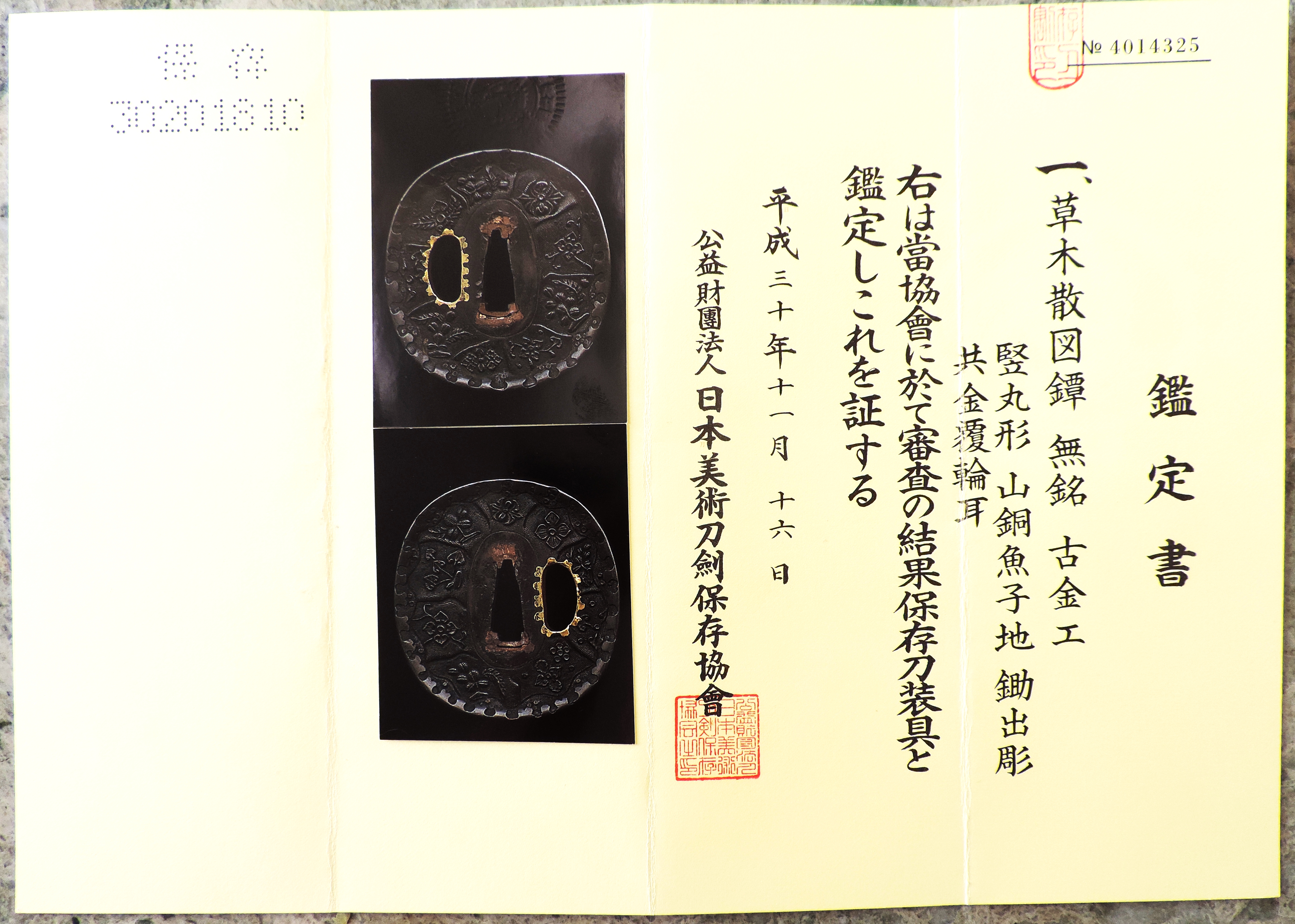 |
KO - KINKO NFS
"This remarkable work shows the best of its type from mid to late Muromachi period ca.1450-1500. It is a shakudo plate with raised rim folded over in panels on itself. The plate is divided into nine panels with floral designs in each. The gold decorative cover to the hitsu ana is a later addition. This must have been owned by a high ranking Daimyo, for it was very expensive when first made. It also shows the independant imagination of the artists of the Muromachi period, it is not the cookie-cutter work of the Edo period. Certified by NBTHK Hozon dated 1991. Mumei Ko-Kinko. Nothing else." (Long) 6.94cm x 6.51cm x 0.40cm |
|
KO - KINKO $1500.00
"Accompanied by a Hozon certificate number 433796, issued by the N.B.T.H.K. "Mumei and attributed to Ko-Kinko. Momoyama period, ca.1450-1500. A Mokko-gata tsuba with thin shakudo plates covering both surfaces. Autumn flowering plants are represented with ten-zogan and iroe. The rim is covered with Shakudo-yakitsuke fukurin." (Long) 6.46cm x 5.94cm |
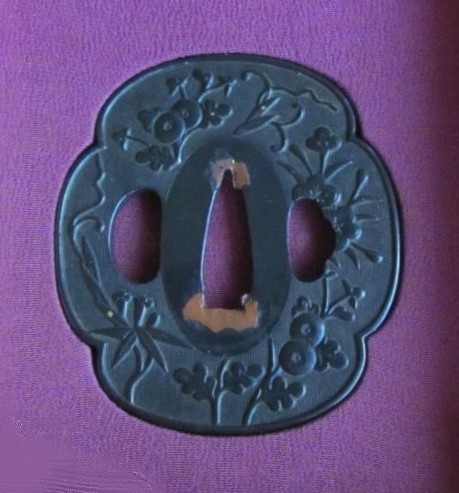 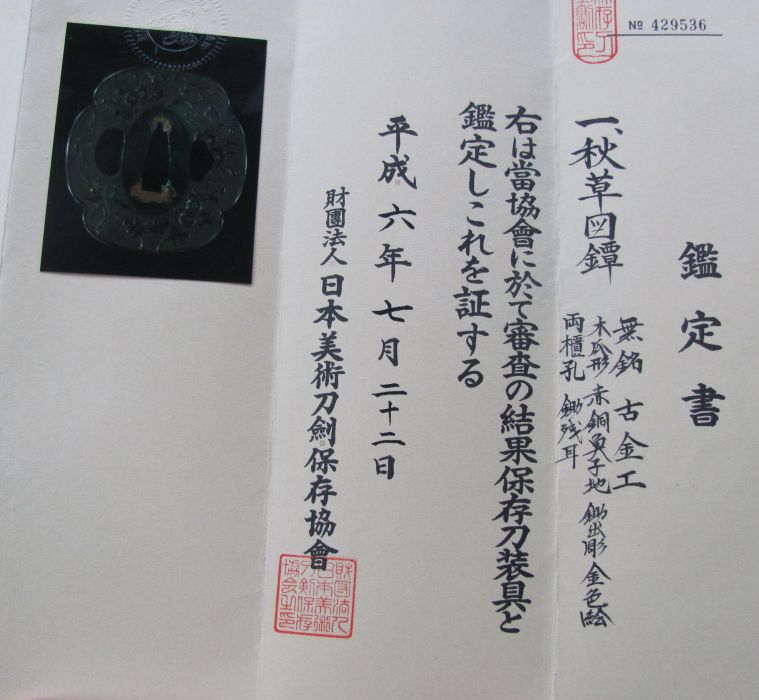 |
KO - KINKO $2000.00
"Accompanied by a Hozon certificate, issued by the N.B.T.H.K. 1994. "An excellent early (Ko-Kinko) tsuba of deep black shakudo with a nanako ground. On both faces are takabori relief of autumnal vegetation. Two hitsu-ana are present, one appearing to be a later addition." (Long) 6.60cm x 6.00cm x 0.35cm |
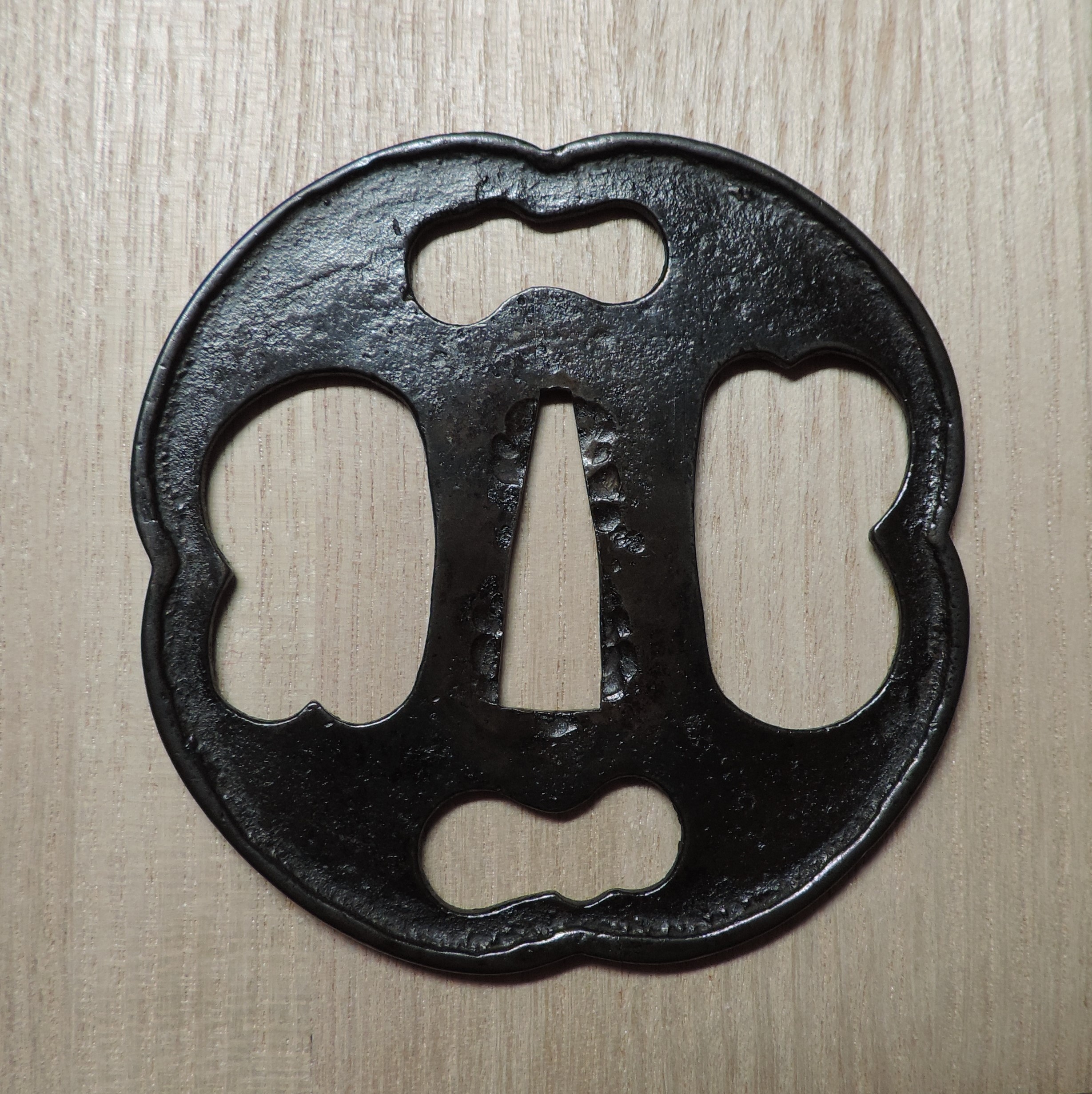 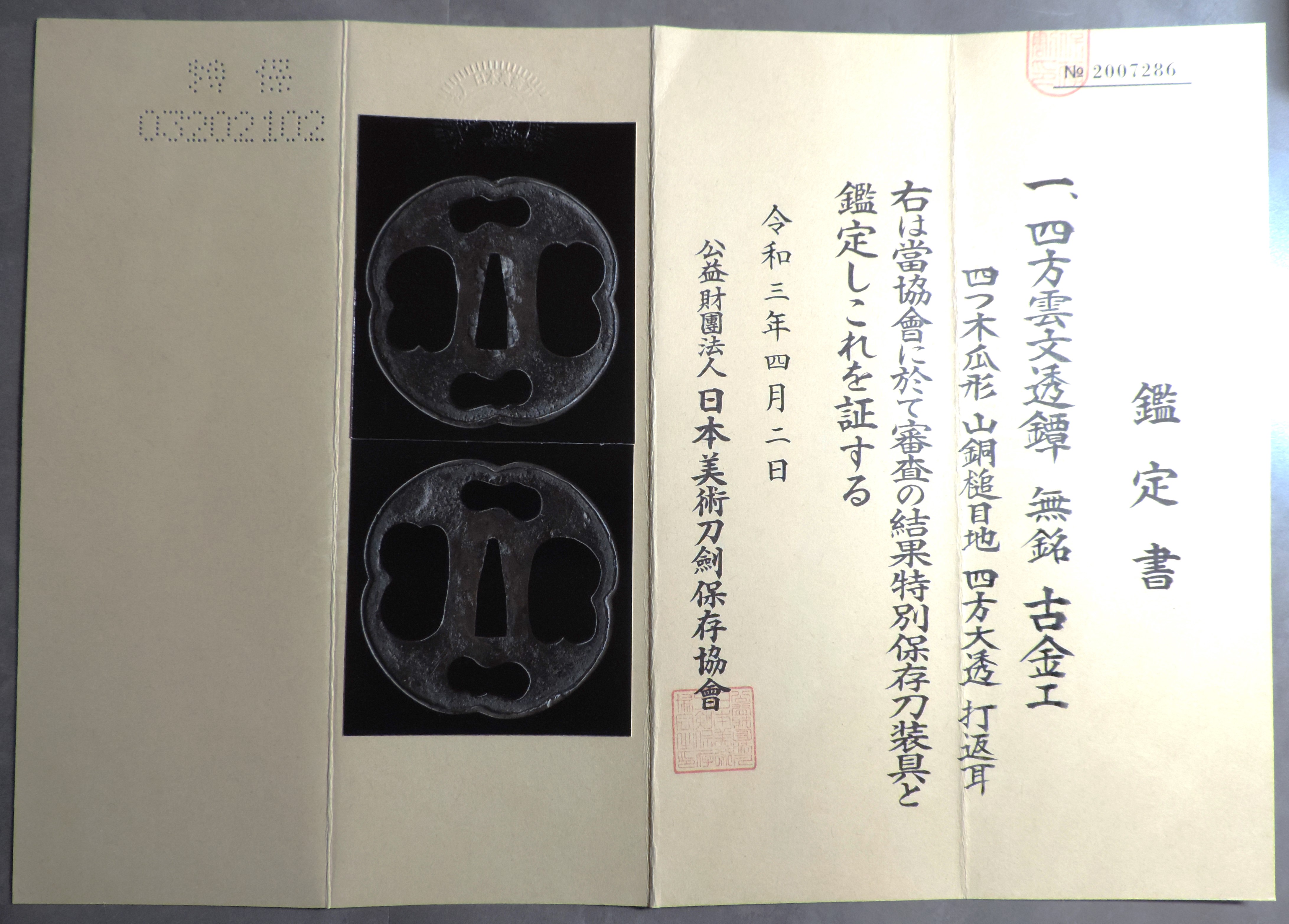 |
KO - KINKO NFS
"A tsuba from the era of actual warfare, boldly decorated with a shapeless large openwork. The thin layers of the tsuba, which would have been attached to a lightweight sword suitable for one-handed fighting, are also pursued for operability. The astringent copper ground (Yamagane) is beaten and the ears are made high, leaving traces of hammering on the ground. Traces of black lacquer remain. Dates to ca.1300. It is a work that shows the importance of deeply exploring the meaning of the design through Zen knowledge, which is common in tsuba that has evolved over time." (Long) 7.90cm x 7.80cm x 0.17cm (face) |
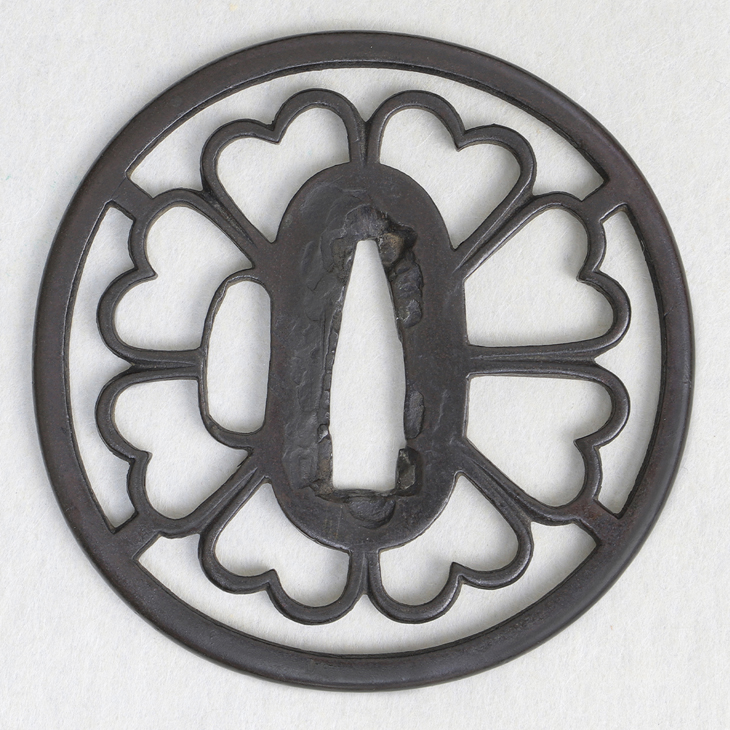 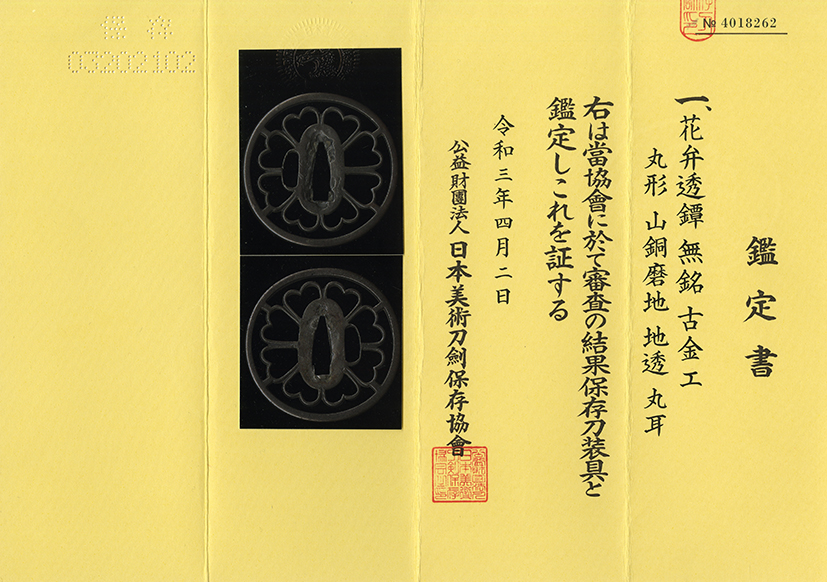 |
KO - KINKO NFS
"Made of a copper metal that has been mined with a refining technology that displays some impurities. This work is typical of the Muromachi period with flower petals as a design. For a work that is over 600 years old, it is very attractive." (Long) 7.04cm x 7.06cm x 0.30cm (face) |
  |
KO - KINKO Under Study "Iron stone mokko shape, engraved carving on a very large tsuba that is imagined to have been used for the Odachi sword of the late Muromachi period. After more than 600 years, the iron has developed a unique texture, and the scattered engravings such as cherry blossoms, chrysanthemums, bellflowers, and crests have been beautifully preserved." (Haynes) |
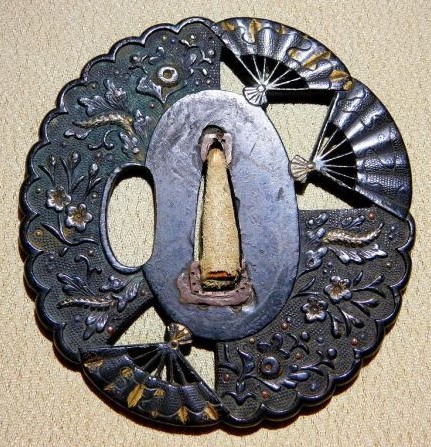 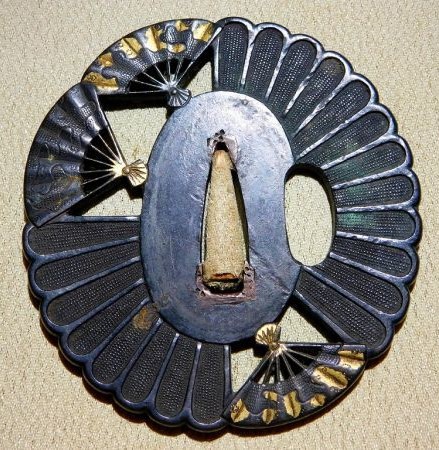 |
KO - KINKO POA "A slight oval shape shakudo kikka and fan motif, three fans depicted in positive silhouette sukashi set amid the petals of a partial 32-petal chrysanthemum on the ura. The petal surfaces are carved out sukidashi takabori and decorated with radiating lines of nanako. The omote is a surface design displaying more foilage including chrysanthemums, sakura, fern fronds and other plants on a background of nanako. The fans have iroe of 'worn' gold, kebori and nanako. The arrangement of fans and kiku is refined and very pleasing to enjoy." (Haynes) |
  |
GENJIKO KATSU HATO NFS "Yamagane plate of chrysanthemum shape with wave carved surface. Sukashi of Genji incense watermark and single hitsu-ana. Dates to early Muromachi period." (Haynes) |
  |
'ARITSUNE' & Kao NFS "A specially preserved sword fitting, signed by Kyoto master craftsman ARITSUNE, featuring a design of the Hundred Flower King and Peony, by a senior disciple of the Otsuki school, Kasunuki, in a custom-made paulownia wood box. The elegantly blooming peony flower is beautifully depicted in single-cut carving on a plain copper base that has acquired a subdued luster over the years. Aritsune was a famous craftsman representing Kyoto in the late Edo period. Specially preserved sword fittings appraisal certificate included. It comes in a custom-made antique paulownia wood box." (Haynes) |
 |
'SEKIJOKEN TAIZAN MOTOZANE' NFS "This is a large, exquisite tsuba featuring a beautifully crafted design of people showering in the evening, a highly engraved motif, and a colorful inlay on a polished brass base. 'MOTOZANE' (H 06004.0 ) the son of Oyama Genkyo. He was from Mito, Hitachi. He studied under the Nara School in Edo and returned home, where he led the Akagiken school to prosperity. He incorporated styles from the Nara, Hamano, and Yokotani schools. He changed his surname from Oyama to Taizan. He was commonly known as Shin'emon and Jihei. His pen names included Akagiken, Toyosai Genshun, and Togu. His given name was also pronounced "Mototaka." (Haynes) |
 |
'TSUNEMITSU KIKUCHI' NFS "He was a disciple of Naokatsu Inagawa and the founder of the Kikuchi school. In his later years, he became a priest and called himself 'SOJU'." He was good at takabori-iroe, hair carving, and katagiri carving. He formed a powerful family in the Yokoya school and produced many disciples. Mei: 'TSUNEMITSU'. See Haynes Index H 10845.0. Born 1704, signed at age 64 in 1768. Student of Kikuchi Tsunekatsu." (Haynes) |
  |
SHONAI NFS "Shonai is the current Tsuruoka City, Yamagata Prefecture, Sakai clan's 140,000 koku domain. Famous metalworkers include Chinkyu [??], who spread the Nara school to Shonai, his disciple Yasuchika [??] (the first generation) who later married his daughter, Washida Mitsunaka [????], and Katsurano Sekibun [????]. This plain copper tsuba is thick and mokko shape with two square hitsu-ana holes. It may not look very sophisticated, but the inlaid auspicious clouds give it a sophisticated look." (Haynes) |
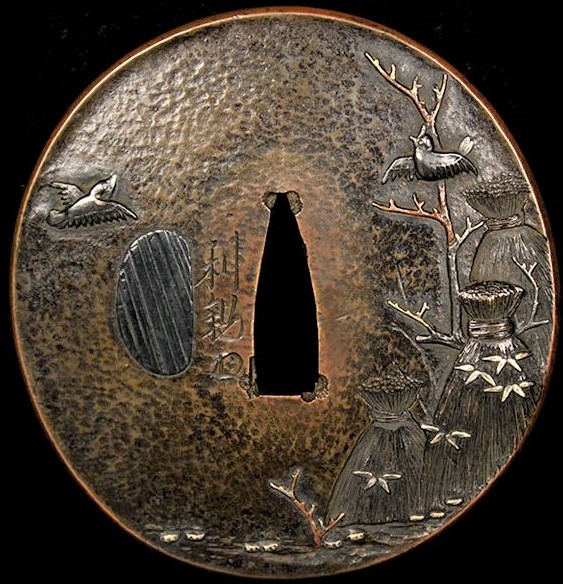  |
'TOSHICHIKA' & Kao NFS
"This is Nara Toshichika working in Edo ca. 1700. Copper plate with ishime surface and hitsu-ana filled with shakudo. The motif is of bales and birds in shakudo, gold, and silver. Refer to Haynes Index, H 10295.0." (Long) 7.30cm x 7.00cm x 0.51cm |
  |
AKITA KINKO NFS
"A work that expresses the autumn of fertility with a simple texture reminiscent of old metalwork. Among the metalworkers of the Shoami school, which flourished in Dewa Province, Denbei and others created works with a unique texture. This tsuba is also old-fashioned, reminiscent of Denbei, but it is highly carved with precision, and the composition stands out clearly on the surface finished in the style of rough ground. The plate is a mountain copper ground with an astringent color. The branches, vines and leaves are glossy with shakudo and bare copper. The branches that stretch out cheerfully are full of life, and the soft golden fruit is vivid. The fact that the arabesque is carved in the rim is also a highlight that is typical of Denbei." (Long) 7.80cm x 7.77cm x 0.43cm |
  |
TOKUGAWA MON NFS
"Copper plate of 16 petals (emperical) with gold wash or plated. There are five Tokugawa Mon on each side. The leaves of the Mon do not touch and fine nanako underneath. Dates to ca. 1550 - 1600." (Long) 8.00cm x 7.90cm x 0.40cm |
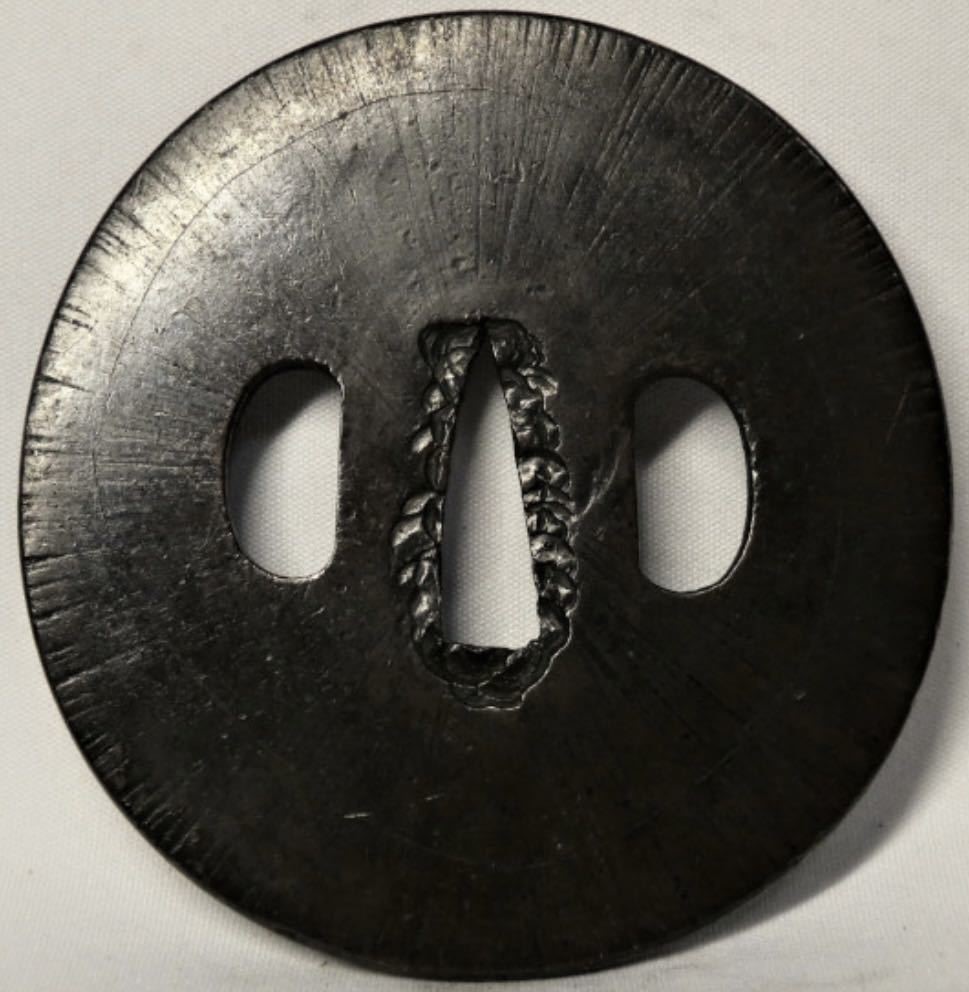 |
KO KINKO $600.00
"The tsuba presented here is a wonderful soft metal example with delicate Amida yasurime. This term - Amida - is the name of ancient Buddhism and it is interesting to speculate whether this finish was originally intended to have a particular religious meaning, such as to signify its owner's faith. There are two identical hitsu and extensive punch marks around the nakago-ana." (Long) 8.00cm x 7.70cm x 0.30cm |
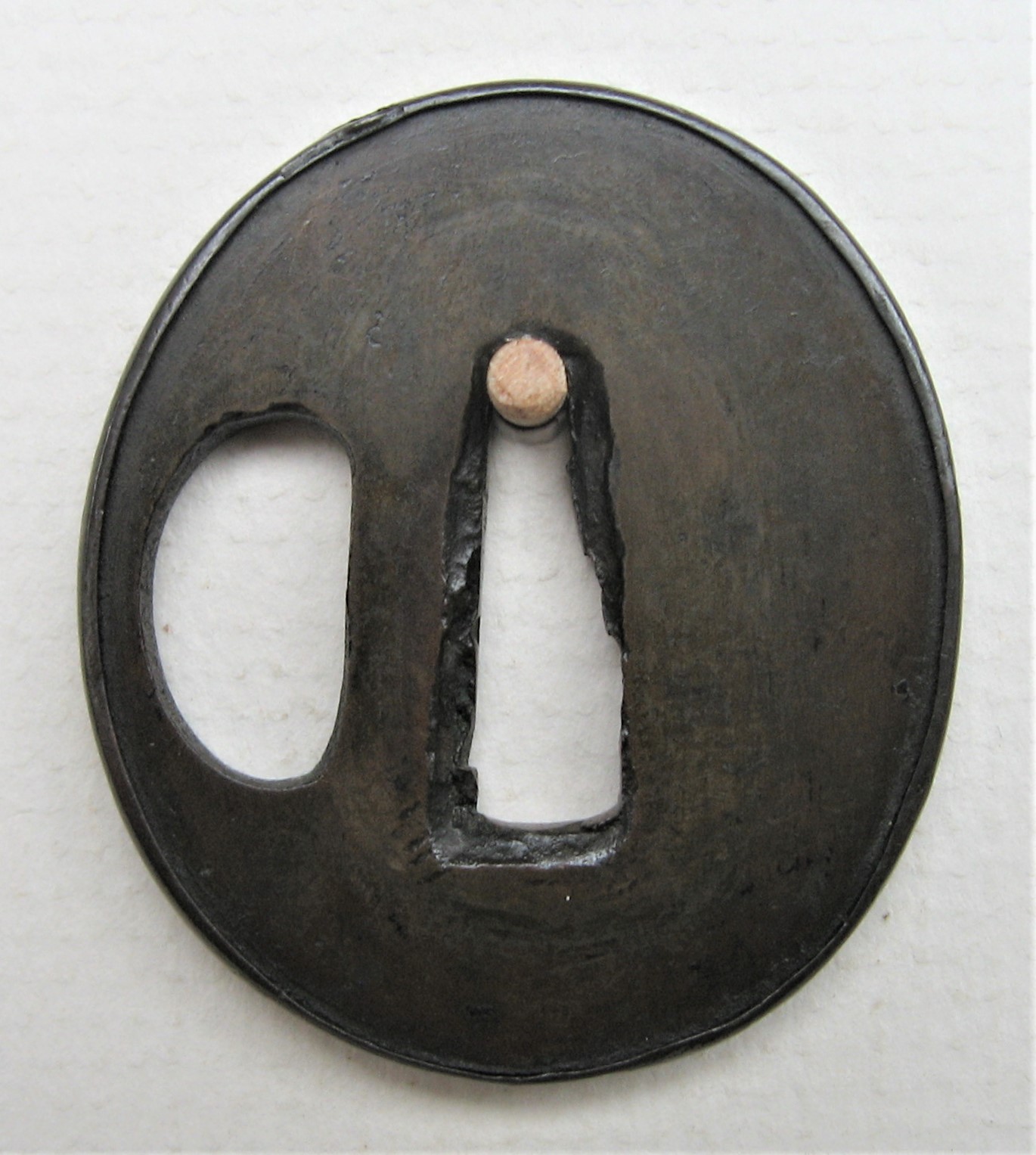 |
|
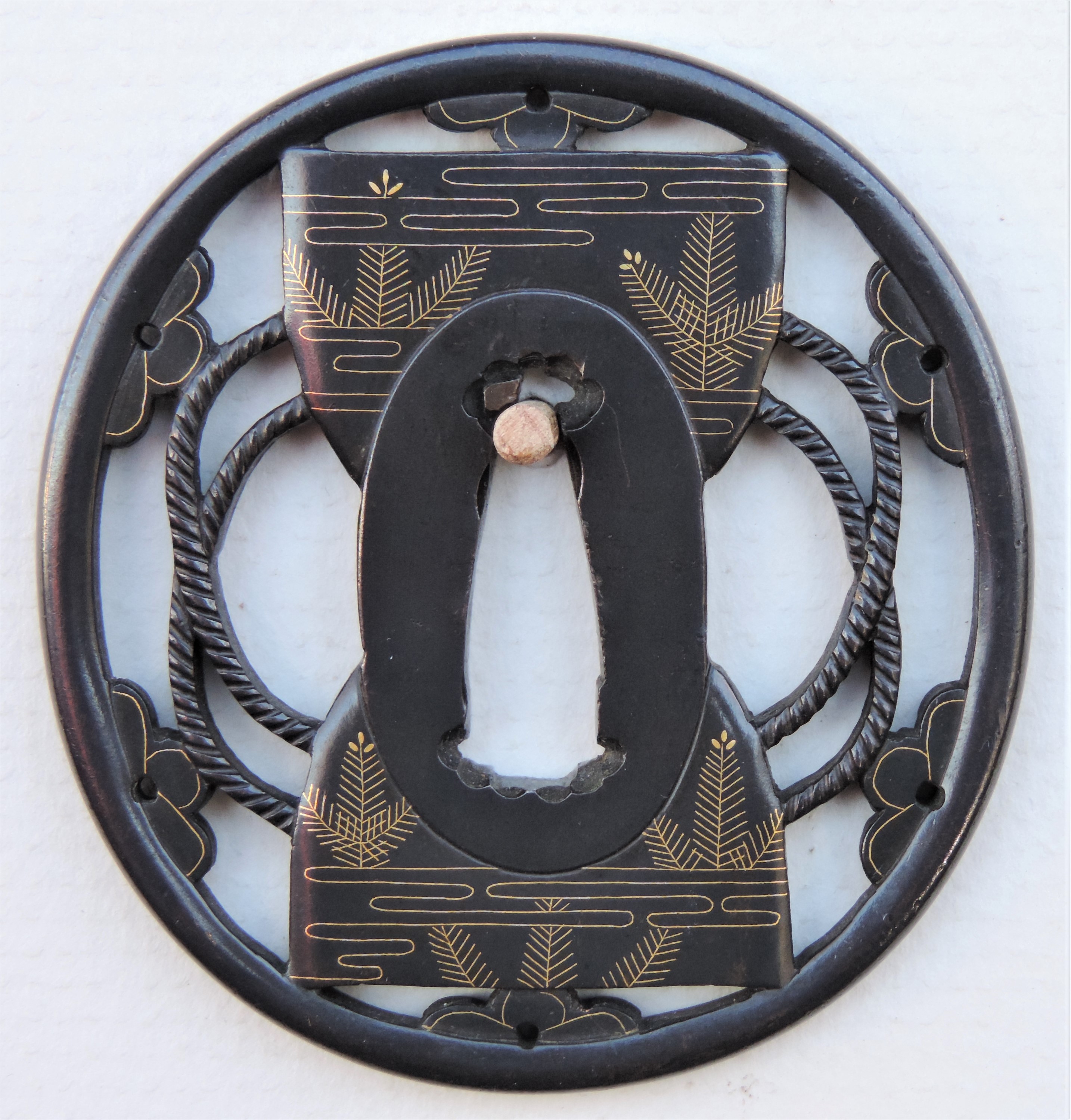 |
SENDAI KIYOSADA $3000.00 |
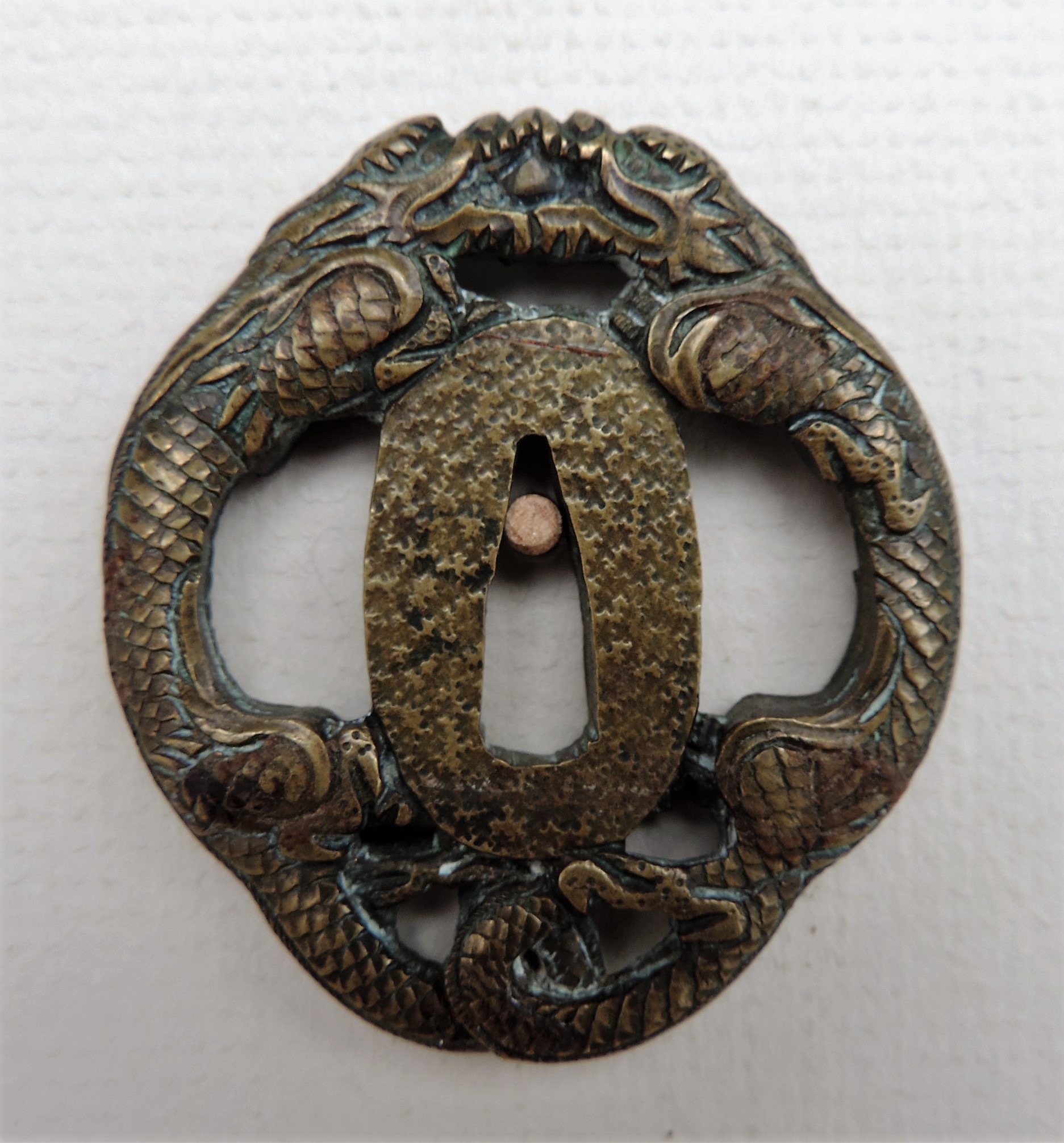 |
MACHIBORI $450.00
"A brass diamond shape (otafuka) tanto-sized tsuba with a well carved symetrical design of two dragons chasing a jewel. This suggests a theme of Qing Sino-Tibetan design. Dating to late Edo period. History tells us this design originated in ancient Mesopotamia, and repeated on 6th century Silk Road textiles from Central Asia. Now described as KANTON tsuba, which designates goods imported to Japan by Cantonese merchants in Nagasaki." (Long) 5.60cm x 6.15cm x 0.35cm (seppa) x 0.75cm (rim) |
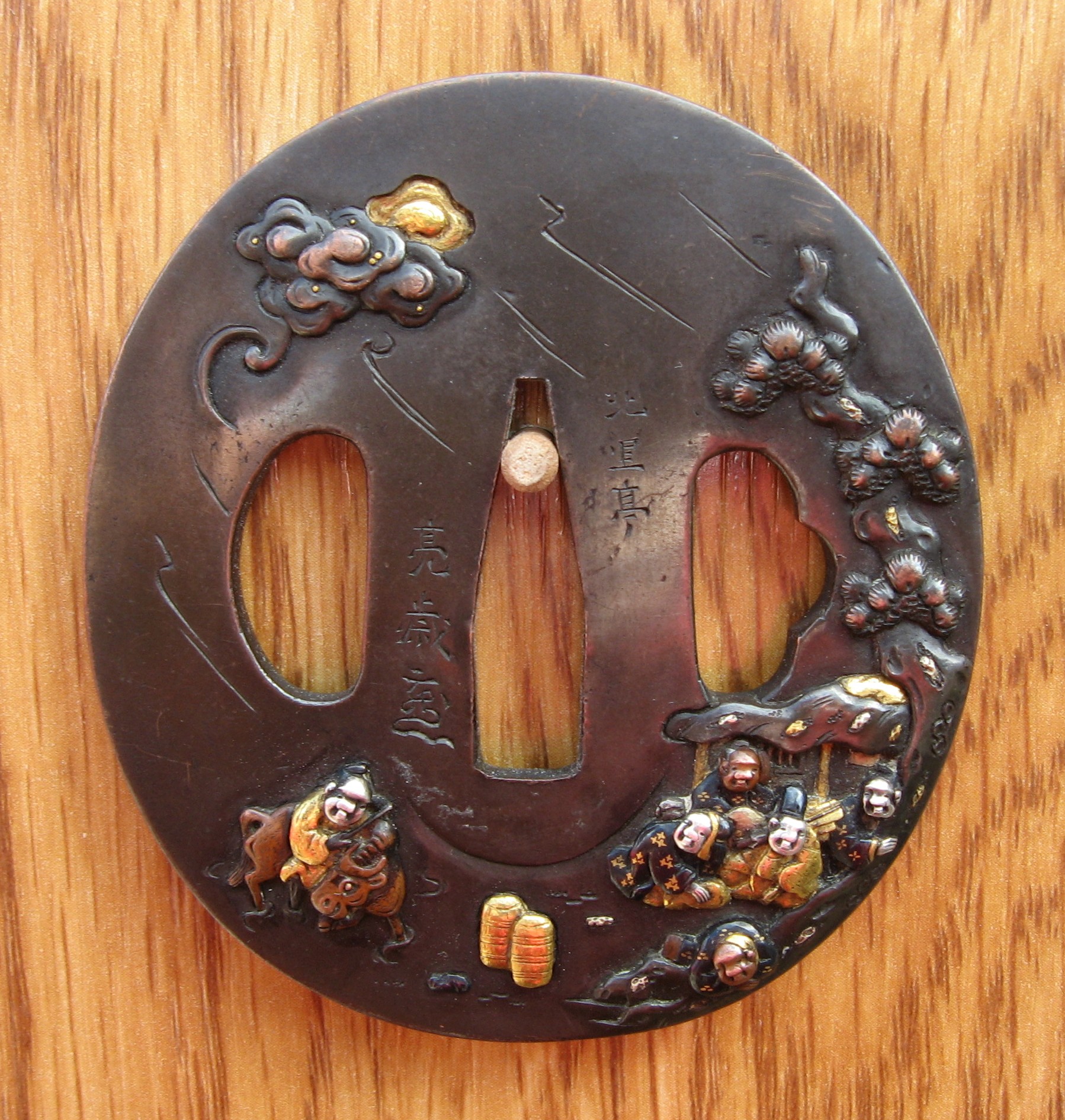 |
'HOKURITEI RYOSAI' $1200.00 "Oval shakudo plate with design of a court official greeting traveling merchants. The rather high relief inlay is in gold, silver, copper, shibuichi, and shakudo. One should note the style of the eccentric trees and clouds which are either by this artist or from a wood block print. The remainder of the subject is seen on the reverse and all is under a rain covered sky. The face is signed: (in tiny kanji) 'Hokuritei' and 'Ryosai' with kao, (H 07603.0)." (Haynes) 6.15cm x 6.70cm x 0.30cm |
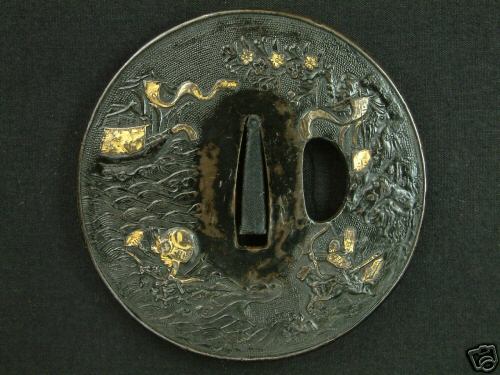 |
SANDO AWASE $800.00 |
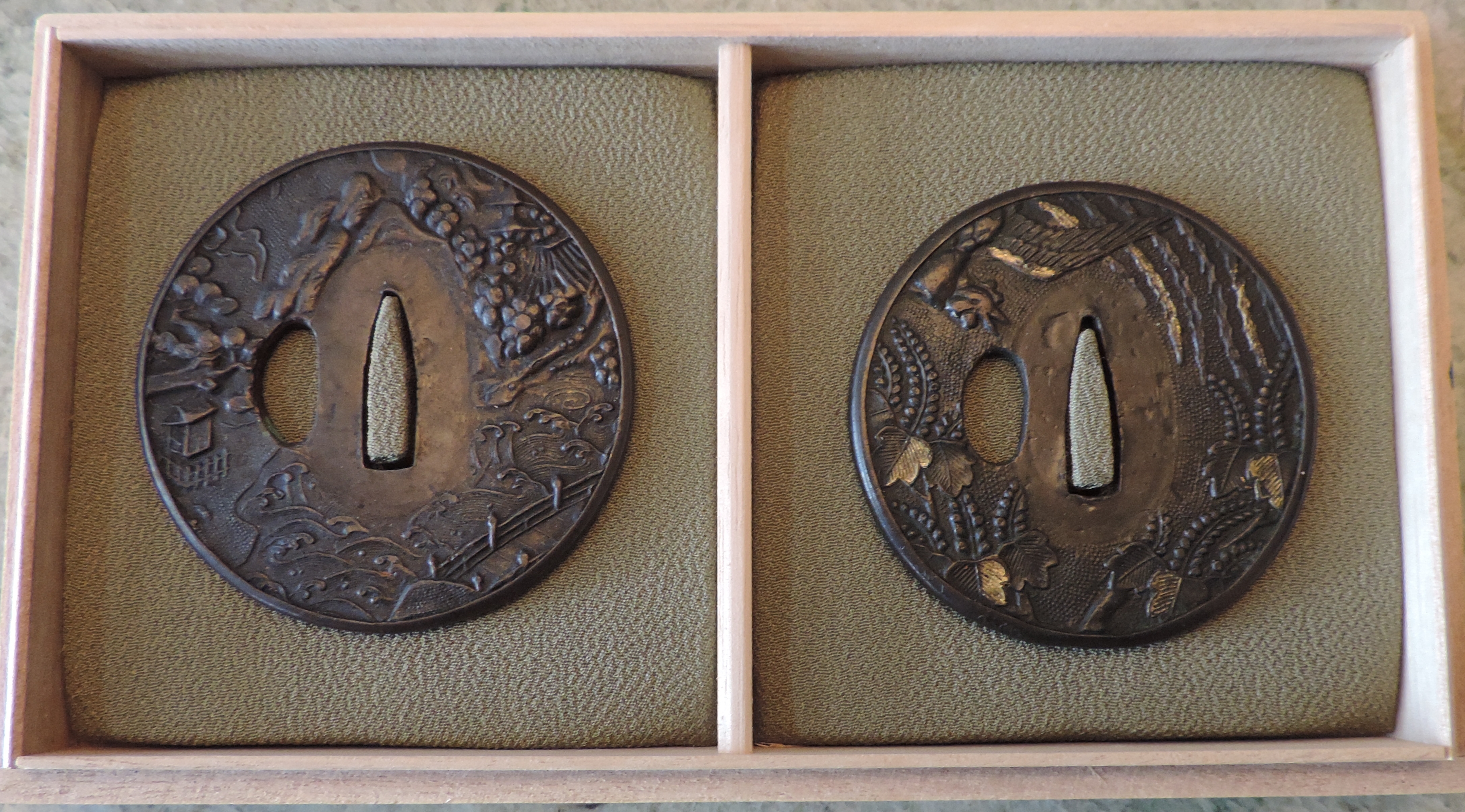 |
SANMAI DAISHO $800.00 |
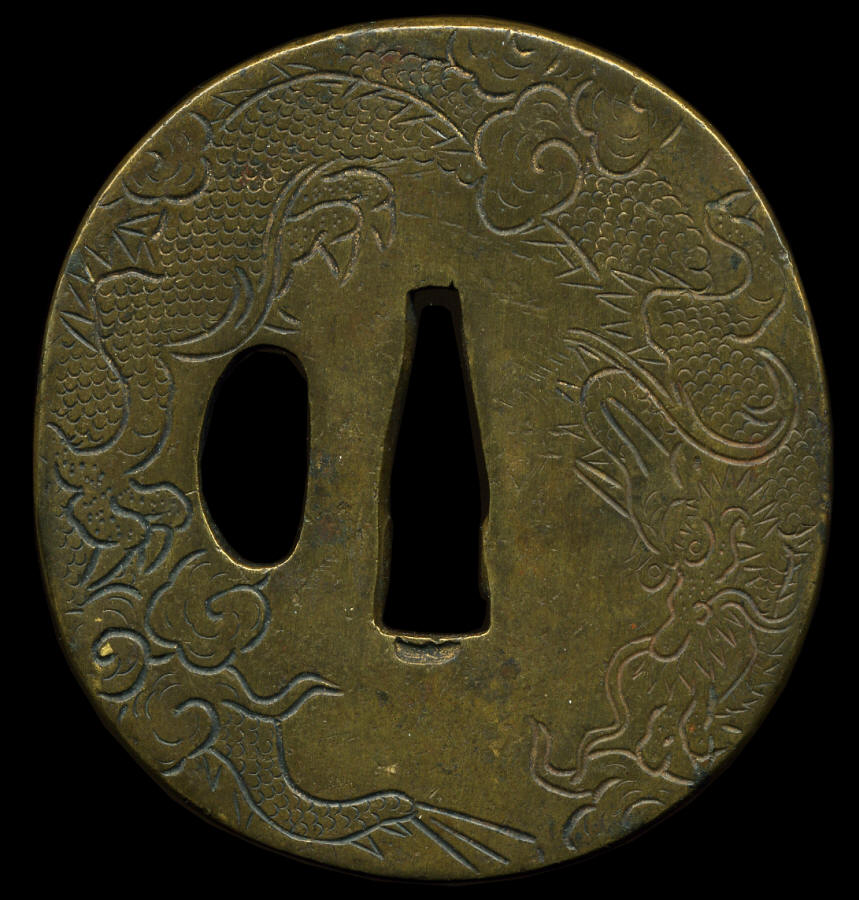 |
SAN DIEGO Style $600.00 |
|
'SEKIBUN' |
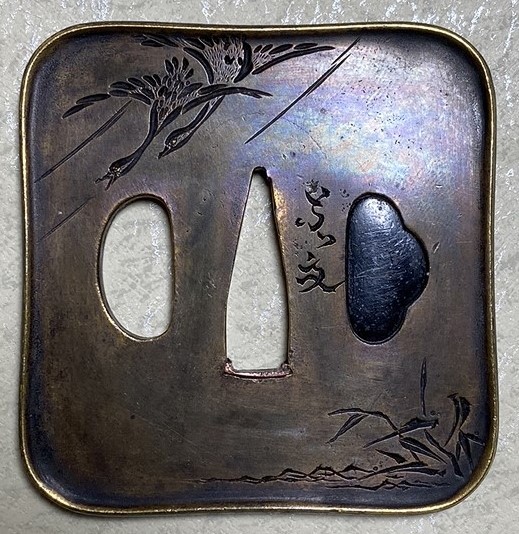 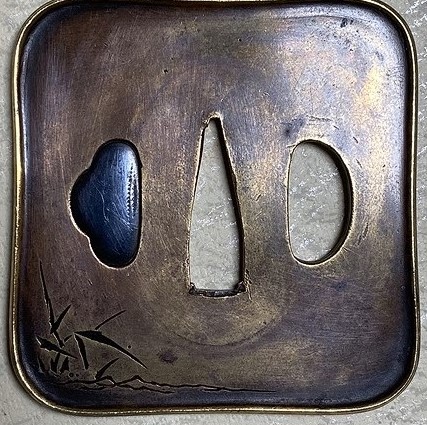 |
POA, Please Inquire. "A rounded square brass plate delicately carved named 'Maizuru Lakeside Ashizu'. The face is signed on the right side of the seppa-dai: 'Sekibun', H 08118.0. There were three generations of the name Sekibun and the last two worked in Shonai. Born in 1789 with the surname Katsura, he was the leading figure in Shonai Kinko. At the age of 36, he became a member of the Sakai clan of the Edo Shonai domain and moved to Tsuruoka 1845." (Long) |
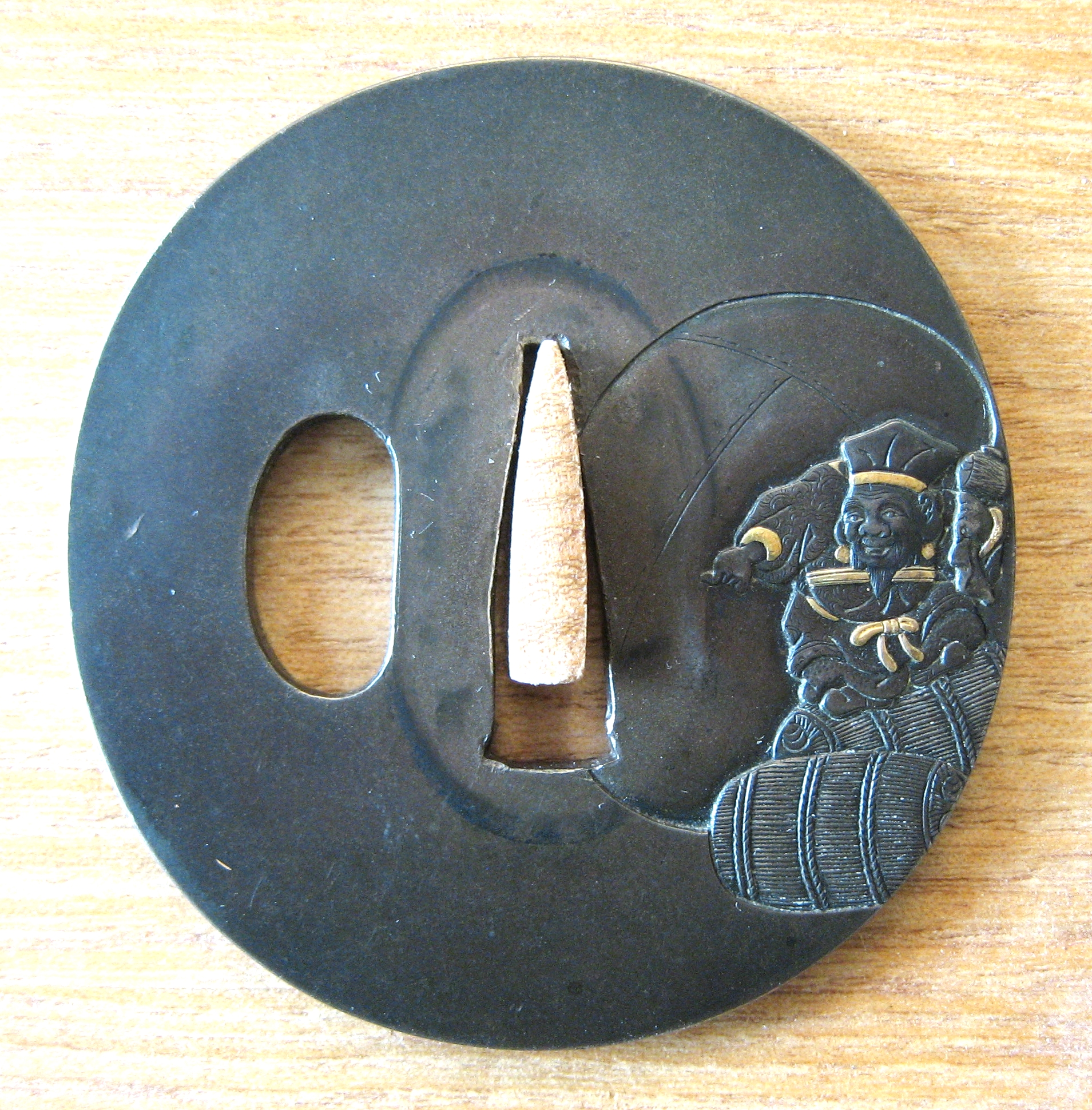 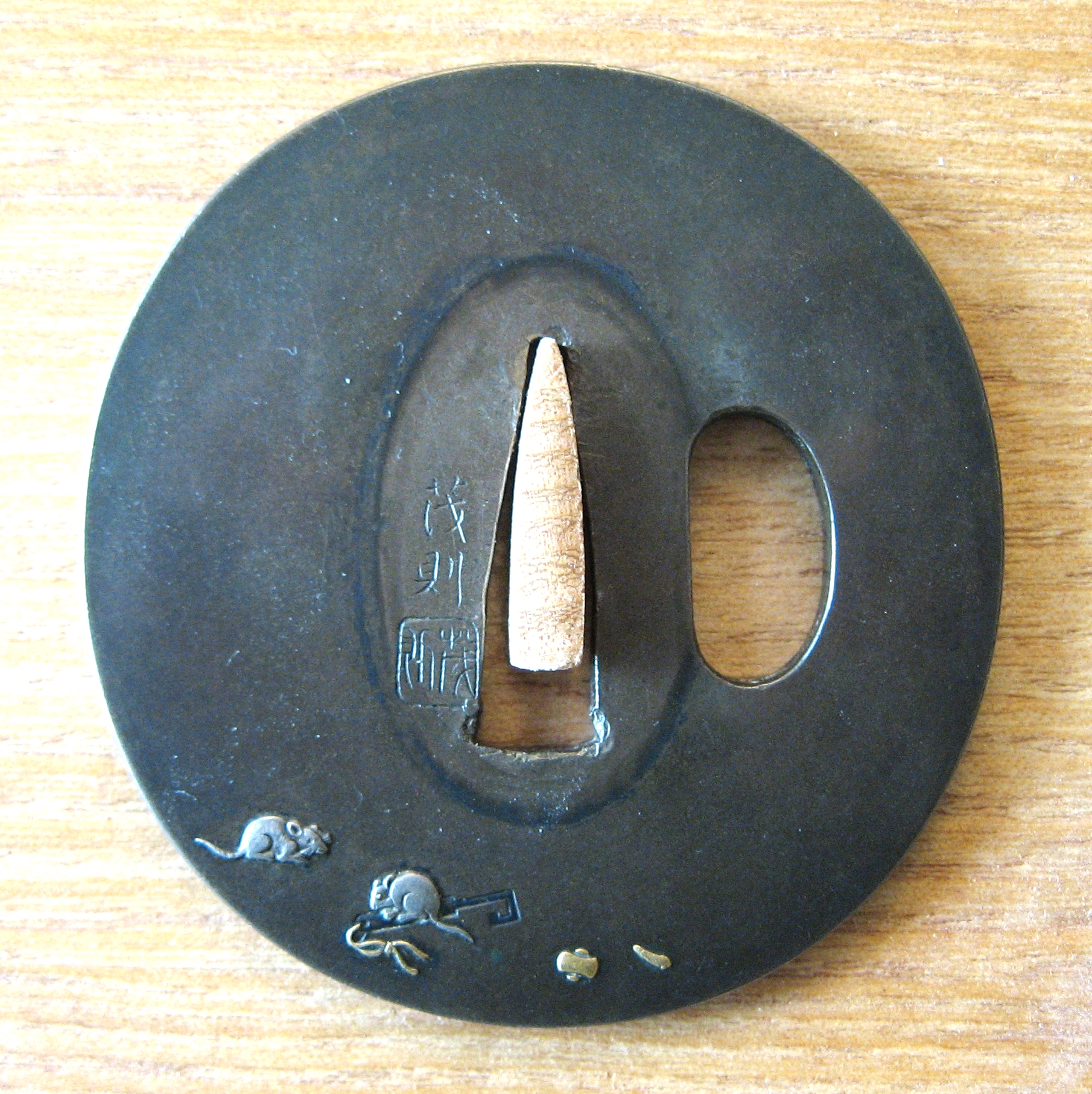 |
'SHIGENORI' $2000.00 "A shakudo plate in oval shape with inlays of gold, shakudo and silver. This is a classic representation of 'Dai-koku-ten'. Dai (Great) Koku (Darkness) Ten (Dharmapala) in Vajrayana Buddhism was the Defender Deity of the Law of Buddhism. In Japan, this deity is considered to be the Deity of Agriculture, Commerce and of Wealth. Mei: 'SHIGENORI' & Seal. This is H 08428.0. His teacher was Yanagawa Naomitsu." (Haynes & Long) 6.70cm x 7.00cm x 0.25cm |
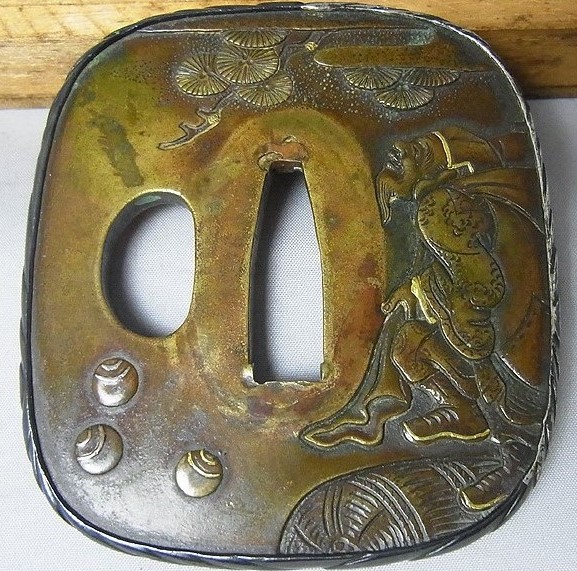 |
'SHIGETSUNE' |
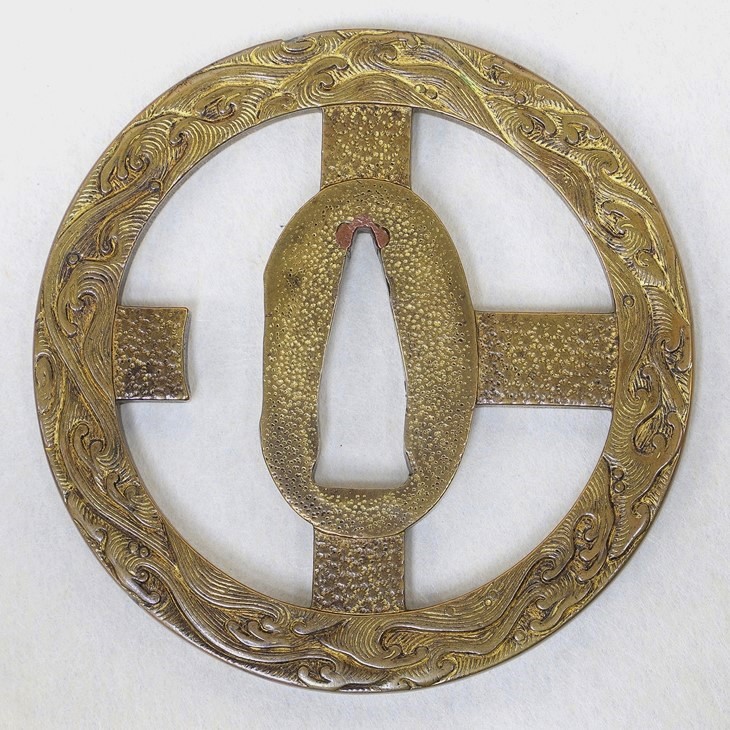 |
SATSUMA Mon |
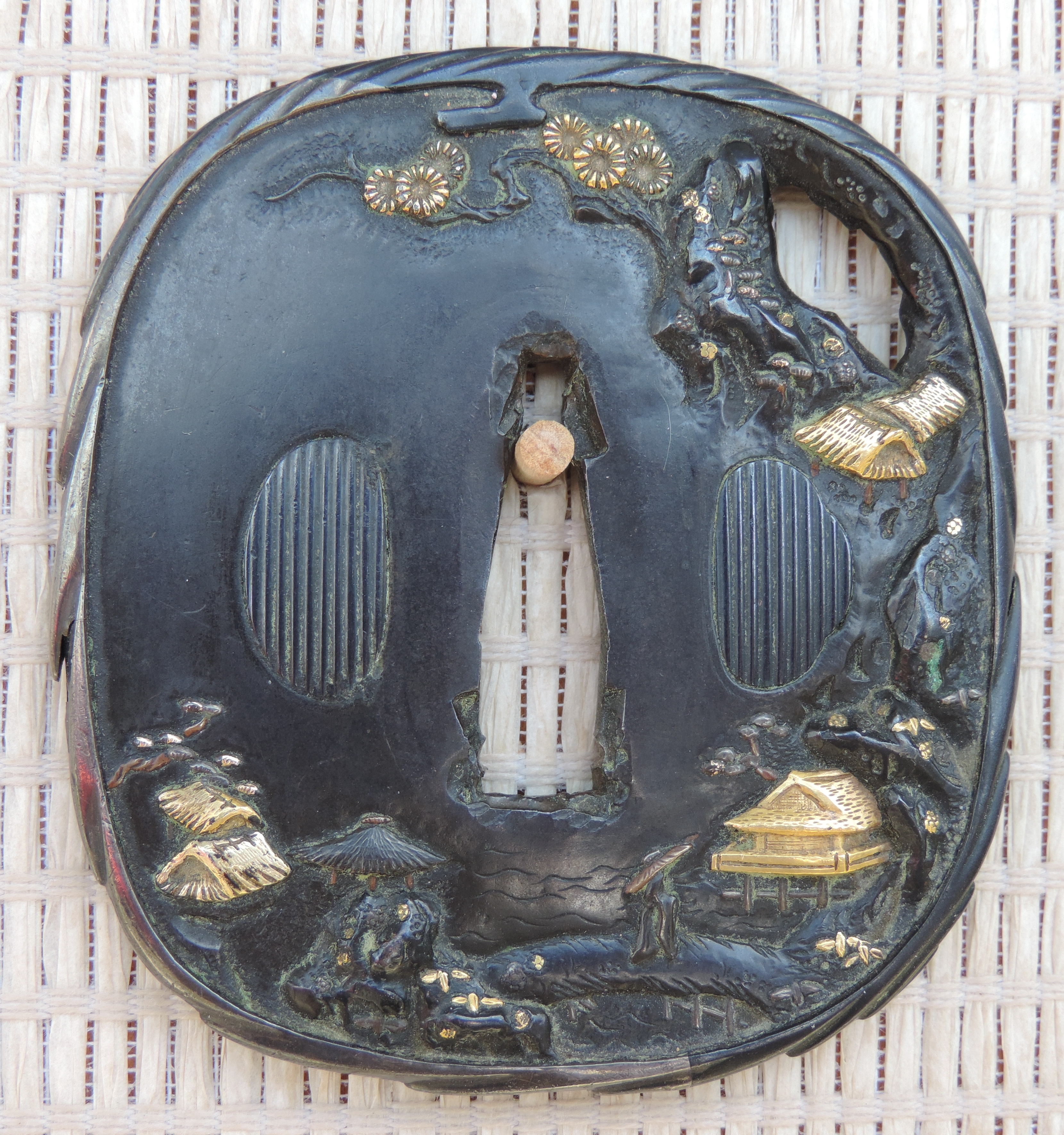 |
|
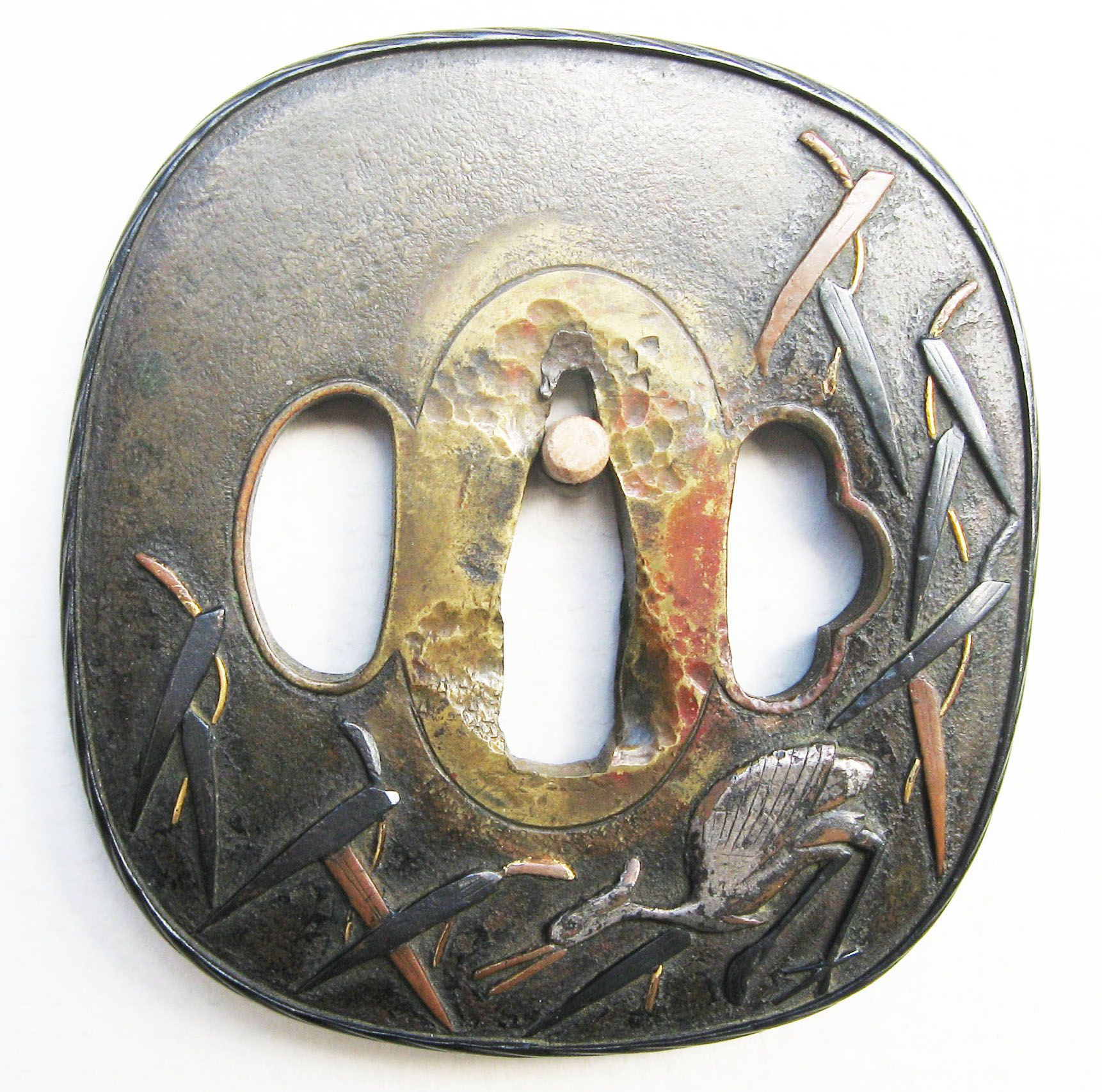 |
SHONAI SHOAMI $650.00
"Brass plate with ishime surface and inlaid in shakudo, copper, gold, and silver with a design of a heron in reeds by a stream. The reverse with just reeds in the same metals. This is a classic example of the work of the Shonai Shoami school circa 1700. This type of tsuba was very popular at the time with the local samurai. It is very rare in the West to find this type of brass plate with the original patina intact. The plate has been fitted with a very fine shakudo rope design rim cover, which is probably original to the origin of this tsuba. As of now we do not have any signed examples of this type of work." (Haynes) 6.05cm x 6.30cm x 0.46cm |
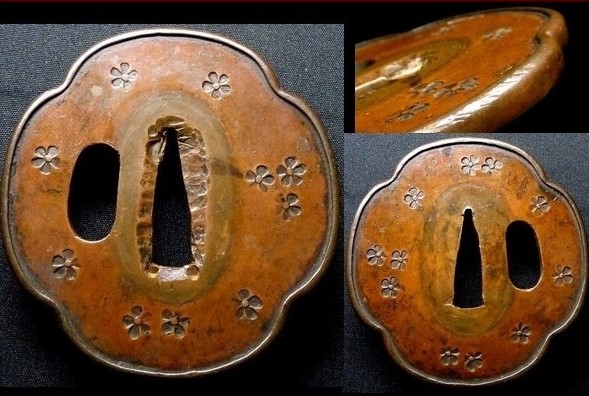 |
SHONAI $950.00 "Red copper plate with hot stamps of cherry flowers on both sides. Shakudo rim cover. A classic mid-Muromachi (ca. 1450) Tachikanagu-shi example. Appears to have been mounted several times." (Haynes) 6.35cm x 6.65cm x 0.45cm Rim |
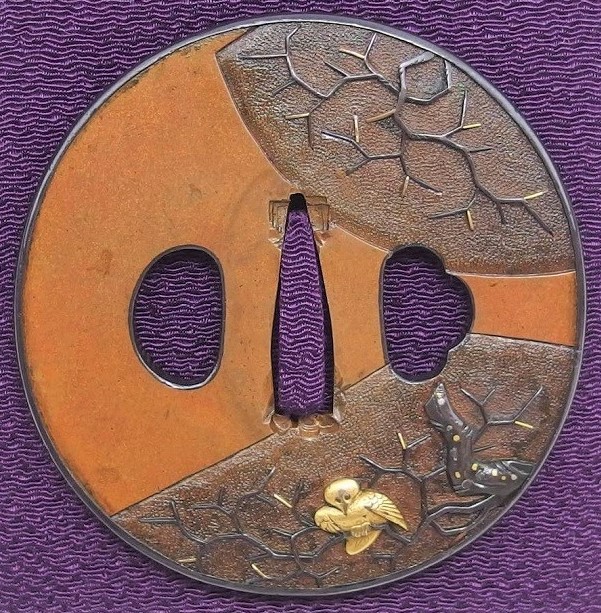 |
SHONAI-KINKO $2000.00 "A delicate soft metal plate of copper with shakudo fukurin and linings of both hitsu-ana. The areas of very fine nanako with branches of bamboo inlaid with dark shakudo, highlited with gold and with a few gold leaves. On the front face perched on a branch is a finely carved plover of gold whose eyes are inlaid with shakudo. The artist used a style of richness and splendor to create a masterpiece." (Haynes) 7.40cm x 7.65cm x 0.45cm |
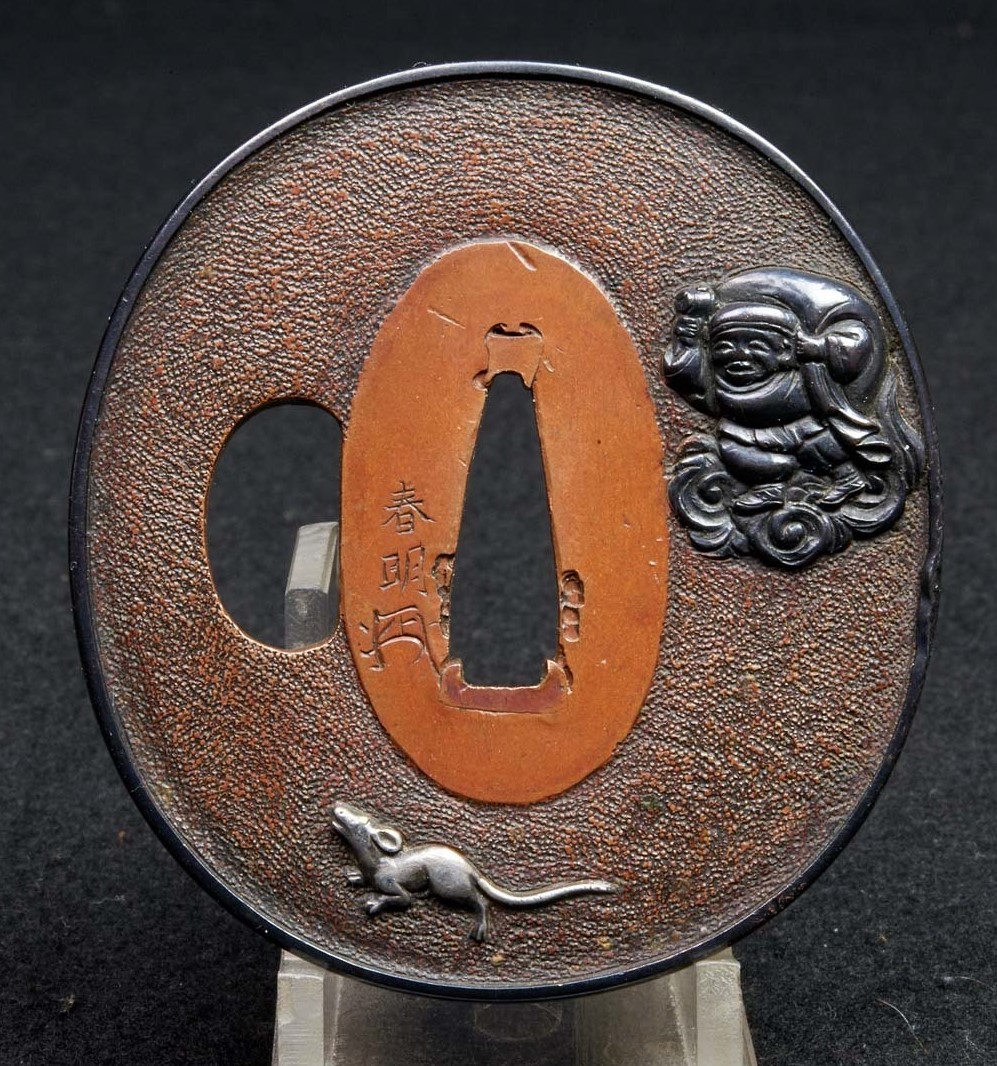 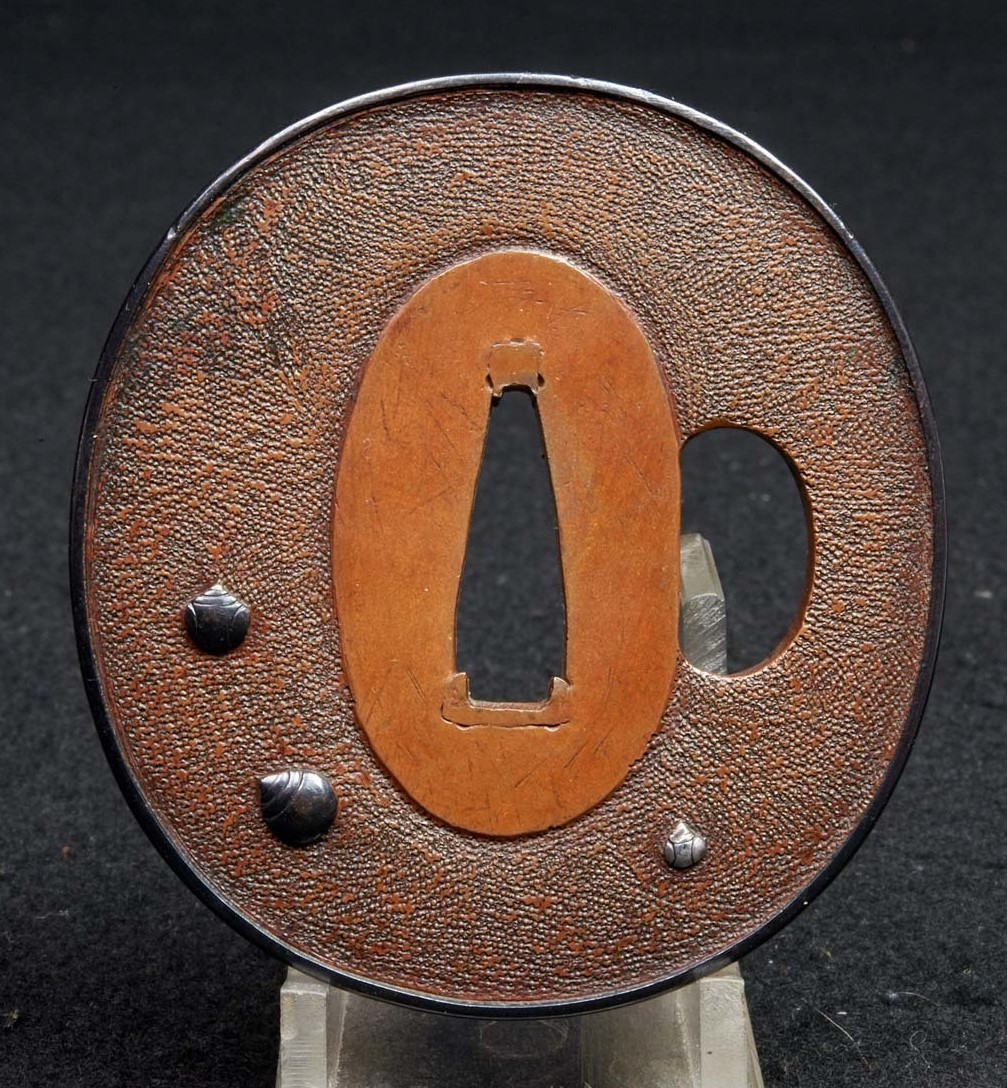 |
'SHUNMEI' $1000.00 "Slight oval, tatemaru gata, copper plate with shakudo fukurin. Finish of the plate, both sides are of chirimen ishime ji, or "silk crepe" finish. Appears as a very smart finish of exquisite taste, which was believed to have been originated by Murakami Jochiku and his school. Dates 1800 to 1850." (Long) 6.60cm x 6.10cm x 0.50cm |
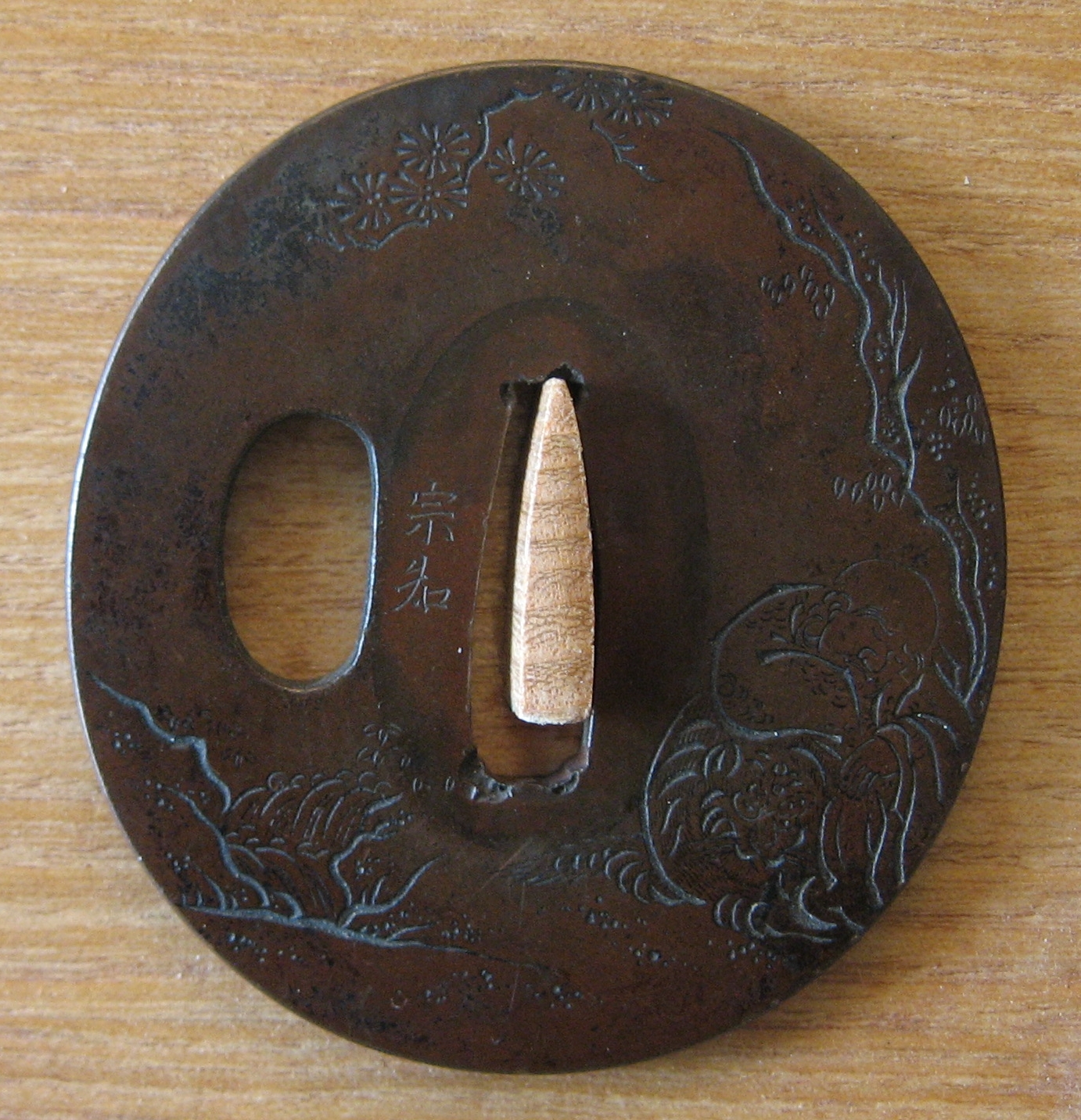 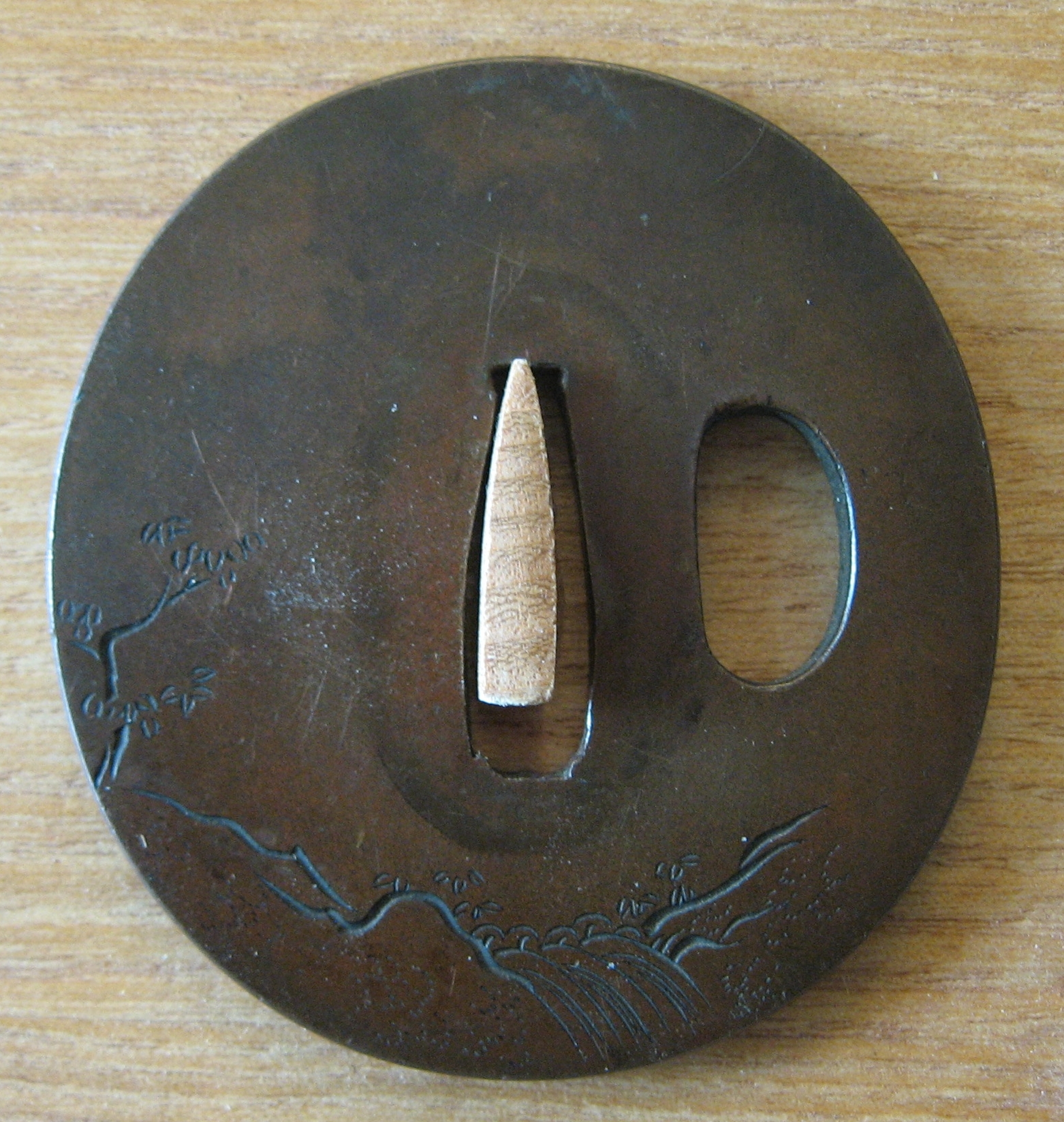 |
'SOCHI' $1500.00 "An oval shaped copper plate with very fine carving of 'Bukan' sleeping with his tiger next to a waterfall in the landscape. Bukan was a Zen monk and a poet who lived in the Tang Dynasty, and was known as a man of eccentricity who amazed people by riding around on his tiger. Mei: 'SOCHI'. This could be H 08860.0, of the Goto family ca. 1800. But further study is needed." (Haynes & Long) 6.50cm x 7.05cm x 0.40cm |
| If you would like to know more about any items on this website, or if you are considering a purchase, please send Elliott and Robert an E-MAIL ( elliott@shibuiswords.com ), asking us any questions you have or what pieces interest you. |
UPDATED Tsuba Glossary for your use while viewing the above tsuba. The source for this glossary comes from many different sources, the main source being 'TSUBA, An Aesthetic Study' by Dr. Kazutaro Torigoye & Robert E. Haynes.
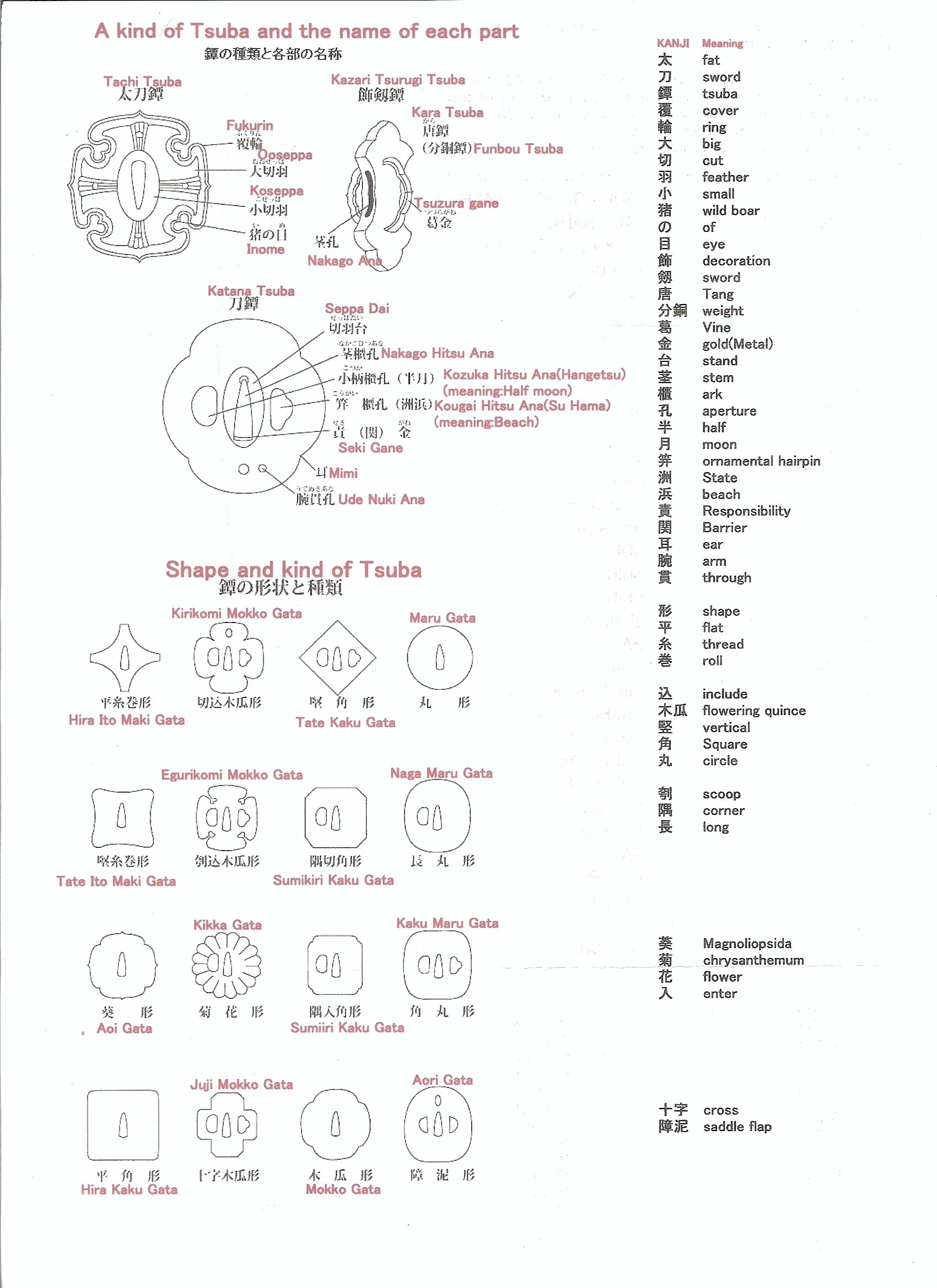
NIHONTO and TOSOUGU ORIGAMI
Schools of Tsuba Artists HERE
Tsuba Identification Guide HERE