SWORD GALLERY
Updated October 2022
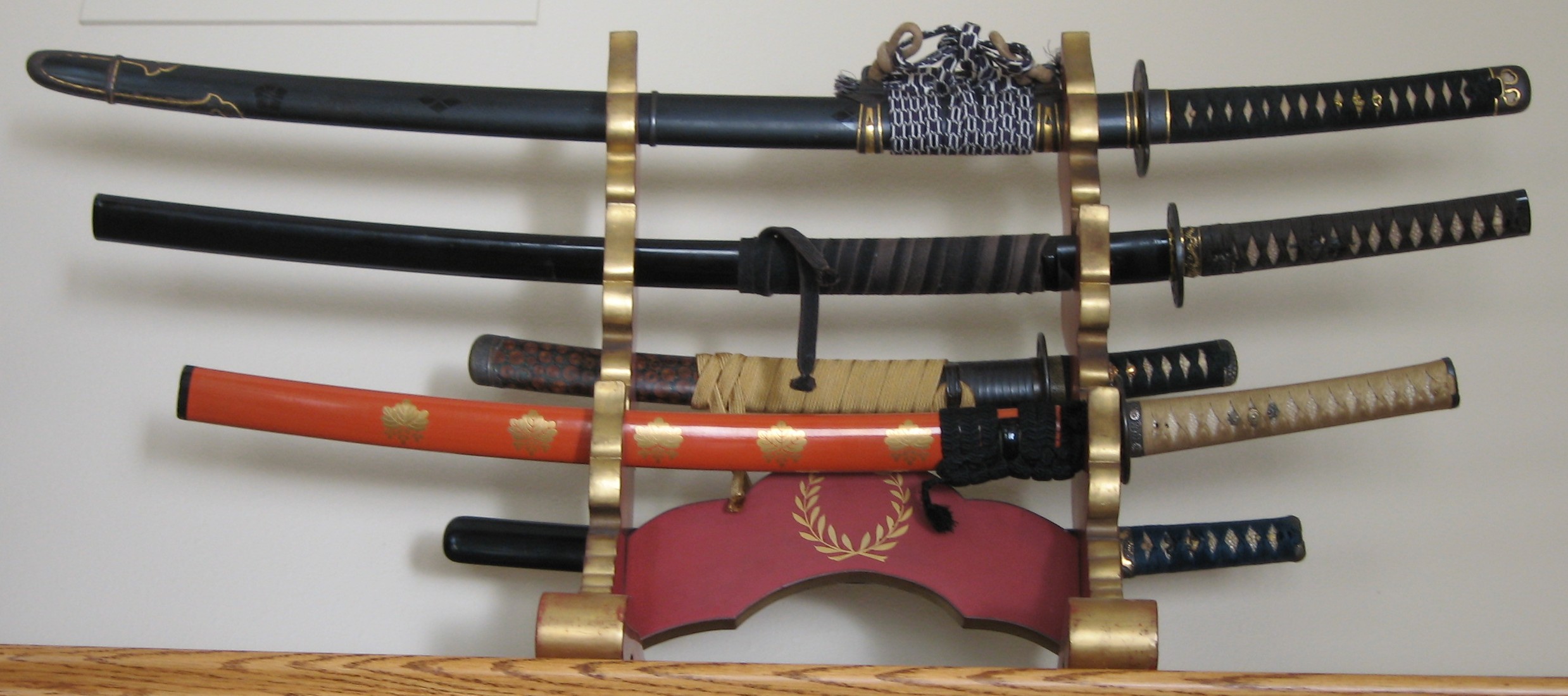
The sword smith is not a mere artisan but an inspired artist and his workshop a sanctuary. He commences his craft with prayer and purification, "he committed his soul and spirit into the forging and tempering of the steel." Every swing of the sledge, every plunge into water, every friction on the grindstone, was a religious act.
| If you would like to know more about any items on this website, or if you are considering a purchase, please send Elliott and Robert an E-MAIL ( elliott@shibuiswords.com ), asking us any questions you have or what pieces interest you. |
| Or, if you would rather, you may call me (Elliott): |
|
HOME PHONE: 503-666-2342 or CELL PHONE: 503-754-8082 |
Koto period
SADAYUKI Ubu Shoto
Origami by NTHK
SAKAKURA MASATOSHI Daito
Origami by Kotoken Kagihara
SUE-BIZEN OSAFUNE Uchigatana
Origami by Inami Hakusui
SHIMADA SOSHU Dambira
Origami by NBTHK
Shinshinto period
ENJU NOBUKATSU Tanto
Origami by NTHK
Shinken
Custom J.TAYLOR w/ PPK BLADE
$750.00
TWO CHENESS 1045 KATANA
$350.00 each
Iaito
CHENESS IAITO
$350.00
CARMEL SAMURAI COMPANY
Carmel Samurai Company creates original masterpieces; swords of art & elegance by legendary Japanese Masters for serious art collectors.
Nihonto For Sale by Marc Torppa
YAMATO SHIZU NAKAMAKI. Nambokucho period. List $13500, Sell $8500
Well known piece, includes very nice mounts.
KANEZANE TACHI, signed. Last Chance YAMATO Holy Grail. List $8900, Sell $5500.
Papered by NBTHK.
JUMONJI YARI by MASANAO. Sell $3300.
Perfect Blade, Perfect Tang.
SENJUIN KEN signed NAGAMITSU. Kamakura period, ca.1307. List $12000, Sell $7500.
YAMATO Holy Grail, 14"inch Nagasa, Well Known Piece.
ALL INQUIRIES: Contact Marc at sugarsnout@gmail.com .
NIHONTO and TOSOUGU ORIGAMI
KANTEI PICTURE GUIDE
MY THOUGHTS ON 'MEI'
The ideal situation would be a well preserved antique blade with a clear Mei, with the attributes preceivable for the collector to determine the blades authenticity. In reality, such blades are rare because the majority of them are 1) altered (suriage, in the case of Koto) and/or polished repeatedly, 2) lacking the Mei in the first place (mumei) or have
3) lost attributes due to rusts, pits, and/or discolorations due to natural aging or neglect.
If the Mei exists on a blade, then the evaluation can be based on photo's contained in various volumes; Nihonto Zuikan, Toko Taikan, Toko Jiten, Fujishiro's, Teiryo Toji and others. Mei related attributes can be found by paying attention to the contents of the mei, "Mei-buri" as well as coloration of patina on the Nakago.
It is important to understand that the Mei is not simply an identity of the smith; it is a 'signature', 'title', 'phrase' or even a 'sentence' that is actually written by the smith. To "read" Mei is to study the Mei-buri (how the Mei is written on the Nakago by the smith using a chisel) by comparing how it is written on the Nakago with other 'writings' by the (supposed) smith on his other blades.
The main benefit of Oshigata is that it helps you recognize the characters and "read" Mei more clearly. Oshigata enables the collector to pay attention to the overall 'Mei-buri' by simplifying the three dimensional carvings on the nakago into a two dimensional picture. The limitations of an oshigata as a two dimensional picture is that it does not allow you to see the color of
patina on the nakago (critical determinants of the age of the blade) or other characteristics of the carving. Oshigata is only beneficial as an initial step of the more complex screening process involving examination of attributes, the combination of which collectively helps an experienced collector determine the authenticity of the blade with some confidence.
A collector must conclude from visual examination the actual coloration of the nakago and other characteristics of the Mei with his own trained eyes in addition to other characteristics of the blade to determine with confidence whether the blade is "sho-shin" or "gi-mei".
My collection of Japanese Swords
(Nihon-To) includes mostly pieces from the KOTO era. All of these pieces have paper (Origami) from current / past NTHK, NBTHK, Kotoken Kagihara and Inami Hakusui. Being as new to Nihon-To as I am, one must rely on the expertise of
others to include the above listed organizations.
The descriptions written for each piece in my collection are my opinion based on my studies and the knowledge given me by my mentors. Should you see something I over looked or disagree with something I have stated, please contact me with your opinions. It would be an addition to my growing education.
Learning to Kantei both swords and tsuba are very important to me. I have combined excellant material
from three different web sites and with my editing, have developed information that I use often in determining style, school, and smith. Please read my 'Learning to Kantei' PAGE.
WHY ARE JAPANESE SWORDS SPECIAL?
The following contains excerpts from the book, THE JAPANESE SWORD, by Kanzan Sato. The uniqueness of the Japanese sword lies in the technical innovations devised by the Japanese in an effort to resolve the three conflicting practical requirements of a sword: unbreakability, rigidity, and cutting power. Unbreakability implies a soft but tough metal, such as iron, which will not snap with a sudden
blow, while rigidity and cutting power are best achieved by the use of hard steel. The Japanese have combined these features in a number of ways which have given their swords a very distinctive character. First of all, most Japanese blades are made up of two different metals: a soft and durable iron core is enveloped in a hard outer skin of steel which has been forged and reforged many times in order to produce a complex and close-knit crystalline
structure. Second, the cross-section, widening from the back to a ridge on both sides, then narrowing to a very acute angle at the edge, combines the virtues of thickness for strength and thinness for cutting power. Third and most important of all, a highly tempered edge is formed by covering the rest of the blade with a special heat-resistant clay and heating and quenching only the part left exposed. The result is a steel which is even harder than
the rest of the outer skin and can take a razor-sharp edge. A fourth feature, the distinctive curve away from the edge, owes its origin to another practical demand: the need to draw the sword and strike as quickly as possible and in a continuous motion. Where the sword itself forms part of the approximate circumference of a circle with its center at the wearer's right shoulder and its radius the length of his arm, drawing from a narrow scabbard will
naturally be easier and faster than with a straight weapon.
But to the Japanese specialist the beauty of a sword lies in more than just its fulfillment of practical requirements or its almost mechanical perfection of finish and cleanness of profile. The Japanese swordsmith has given his product a number of features which, although they may have a strictly practical origin, have been elaborated far beyond the simple requirement of hard-wearing
efficiency in battle. One example of this is the forging of the outer skin, a process necessary to produce steel of adequate purity and hardness: this has been done in a multitude of different ways so as to obtain a wide variety of distinct grains in the surface of the blade. But it is the tempering process which has received the most careful attention. The heat-resistant clay is wholly or practically scraped away from the area of the edge in a
seemingly inexhaustible range of outlines resulting in an enormous number of patterns of hard crystalline steel which guarantee that no two swords will ever be the same: and yet these outlines have no practical function beyond the simple requirement that the edge must be tempered in one way or another.
Return To Home Page OR Go To Tsuba Collective